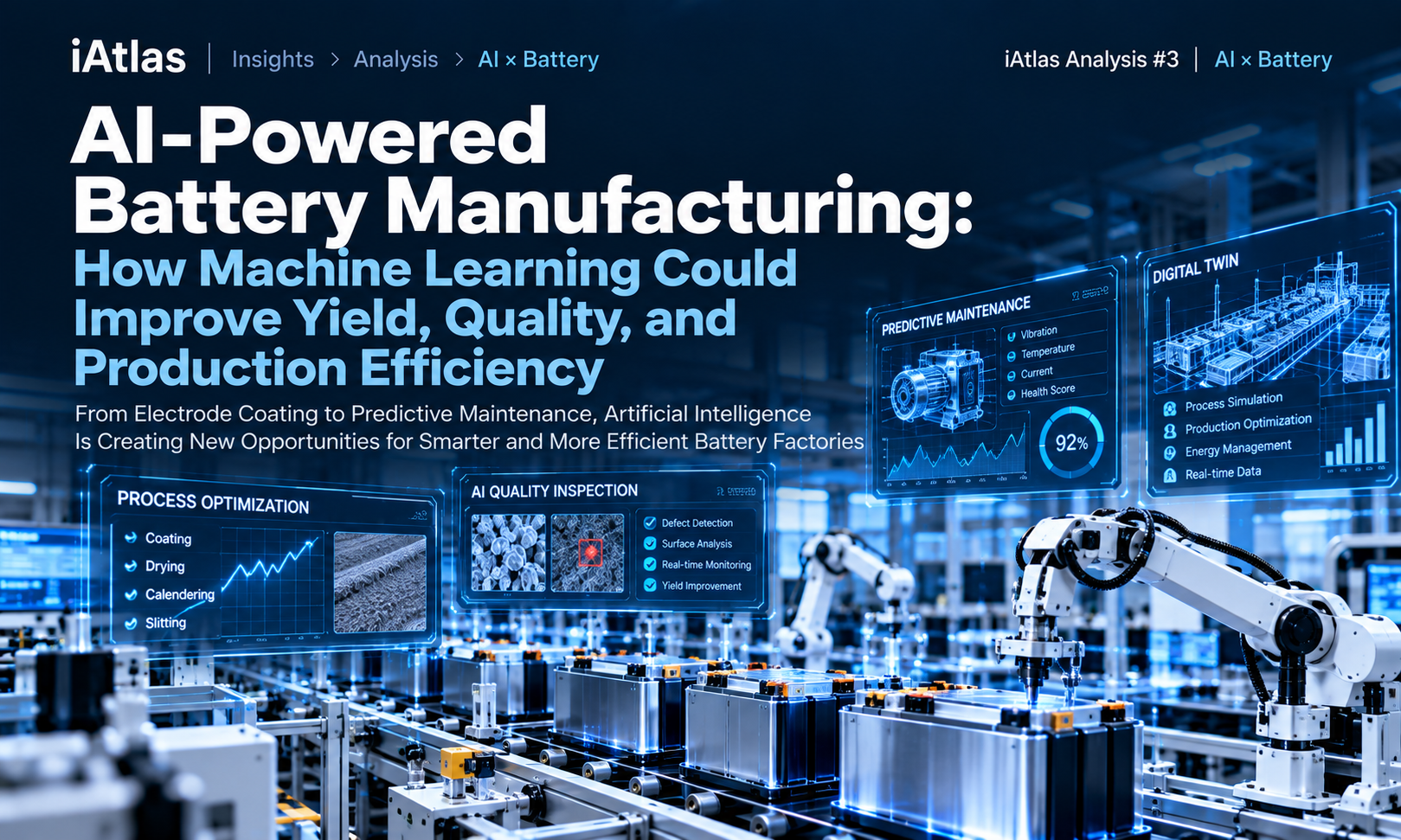
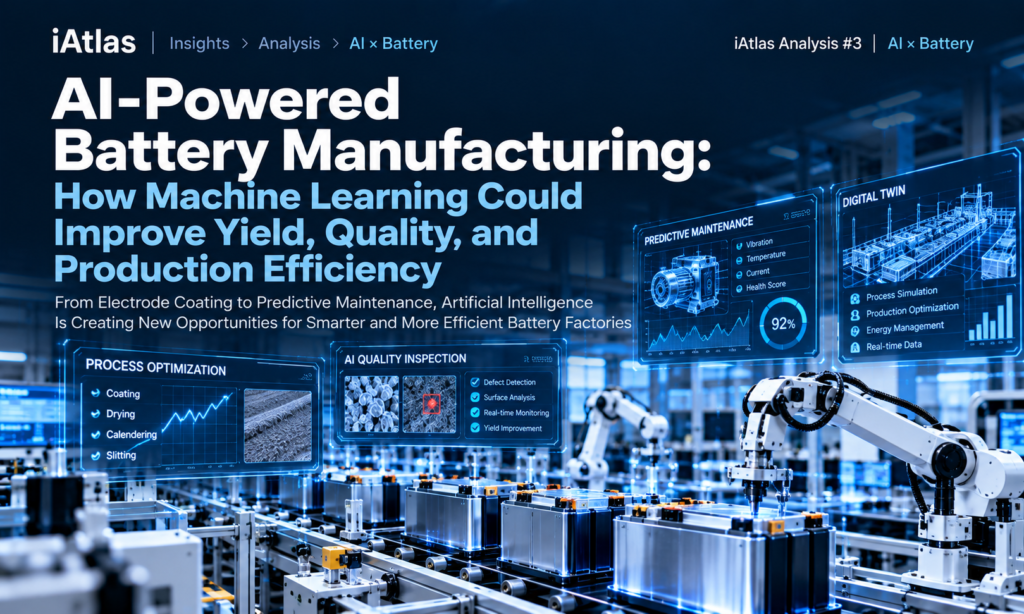
AI-Powered Battery Manufacturing: How Machine Learning Could Improve Yield, Quality, and Production Efficiency
From Electrode Coating to Predictive Maintenance, Artificial Intelligence Is Creating New Opportunities for Smarter and More Efficient Battery Factories
iAtlas Analysis #3 | AI × Battery
The next major improvement in battery manufacturing may not come from a new cathode material or a revolutionary battery chemistry.
It may come from understanding why two seemingly identical battery cells perform differently.
Modern battery factories operate thousands of interconnected machines, sensors, inspection systems, and process controls.
Every manufacturing stage generates information about materials, equipment conditions, production parameters, and product quality.
Yet having this information does not automatically mean manufacturers understand it.
A small variation during electrode coating can influence downstream electrode properties. A minor alignment problem during assembly can lead to rejected cells. An equipment malfunction may disrupt an entire production line.
These problems are expensive because battery manufacturing is both capital-intensive and highly sensitive to process consistency.
Artificial intelligence offers a new way to connect manufacturing data, identify hidden relationships, and improve decisions before small problems become costly defects.
From electrode production and automated inspection to predictive maintenance and digital twins, AI-powered battery manufacturing could reshape how future gigafactories operate.
But an important question remains:
Can AI deliver measurable improvements in battery production, or will its impact remain limited to selected manufacturing applications?
The answer depends on how effectively manufacturers combine data, process engineering, and industrial implementation.
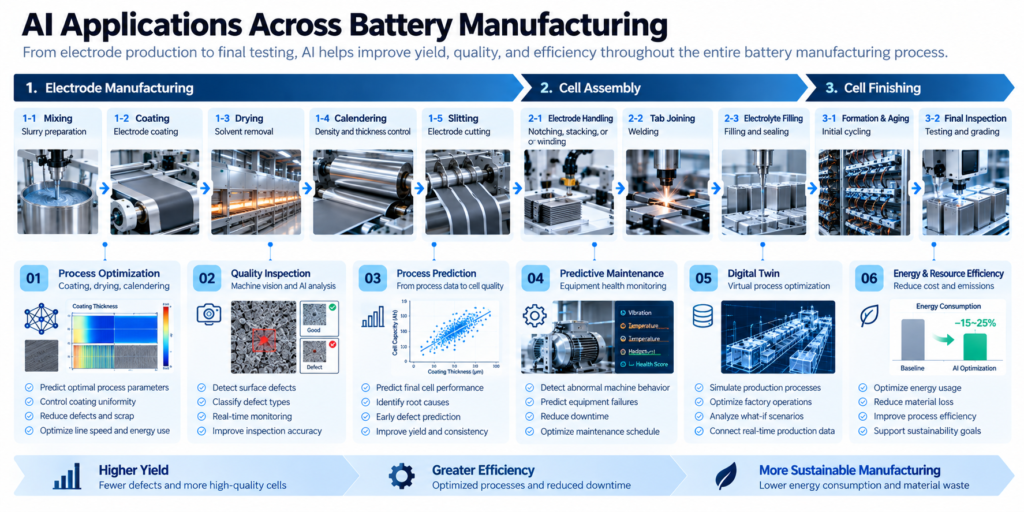
1. Why Battery Manufacturing Is an Ideal Target for AI
Producing a lithium-ion battery requires far more than assembling a cathode, anode, separator, and electrolyte.
The manufacturing process involves multiple stages that must operate under carefully controlled conditions.
A simplified process consists of three major phases.
Electrode Manufacturing
- Material mixing and slurry preparation
- Electrode coating
- Electrode drying
- Calendering
- Slitting and electrode preparation
Cell Assembly
- Electrode notching
- Winding or stacking
- Tab joining and welding
- Electrolyte filling and wetting
- Cell sealing
Cell Finishing
- Formation
- Aging
- Degassing, where applicable
- Final inspection and grading
Each step influences downstream product characteristics.
For example, changes in slurry viscosity can influence coating uniformity.
Coating variations may affect electrode loading and thickness.
These variations can subsequently influence cell capacity, internal resistance, or performance consistency.
Manufacturers therefore face a complicated challenge:
How can thousands of interacting production variables be controlled while maintaining high throughput, low cost, and consistent battery quality?
Traditional manufacturing relies on process recipes, automation, statistical process control, equipment monitoring, and quality inspection.
These methods remain essential.
AI introduces additional capabilities by analyzing complex datasets and identifying relationships that may not be immediately apparent using conventional approaches.
This is particularly relevant when production variables interact in nonlinear ways.
However, AI does not automatically provide better control.
Its effectiveness depends on the quality of the data, the stability of the manufacturing process, and the reliability of the models used.
2. AI in Electrode Coating: Controlling One of the Most Critical Processes
Electrode coating is an important starting point for understanding AI applications in battery manufacturing.
In conventional lithium-ion battery production, cathode and anode slurries are deposited onto metallic current collectors.
The coating process must produce electrodes with consistent thickness, loading, width, and surface quality.
Even small variations can influence downstream cell characteristics.
Why Electrode Coating Is Difficult to Optimize
Coating behavior depends on several interacting parameters:
- Slurry viscosity and rheology
- Slurry flow rate
- Coating-head settings
- Current collector speed
- Coating gap
- Temperature
- Drying conditions
- Equipment stability
Changing one parameter may influence several others.
Increasing line speed, for example, may improve throughput but require corresponding changes in slurry delivery, coating stability, and drying capacity.
This creates an optimization problem involving both production efficiency and electrode quality.
How AI Can Help
Machine learning models can analyze historical process data to identify combinations of operating conditions associated with favorable coating results.
Possible applications include:
Coating thickness prediction
Models may estimate coating behavior using measurements from process sensors and equipment.
Defect detection
Computer vision systems can identify coating defects such as streaks, irregularities, or abnormal surface features.
Process optimization
Data-driven models can help engineers identify process settings associated with more consistent coating quality.
Early abnormality detection
Changes in machine signals or inspection results may indicate unstable production conditions.
Research Example: Fraunhofer
Fraunhofer IPA describes digital solutions designed to reduce rejects and improve battery cell quality.
Its work includes event-based feedback loops for electrode coating and automatic control of slot-die coating conditions based on machine data.
The objective is to improve coating uniformity and respond more effectively to process deviations.
Fraunhofer IKTS also investigates advanced process-monitoring systems, including sensor-based measurements and AI-supported defect detection.
These developments demonstrate how data-driven analysis can be integrated with real electrode manufacturing processes.
However, reliable closed-loop control requires careful validation.
A model should not automatically change production parameters unless its outputs have been tested against equipment constraints and product-quality requirements.
The goal is not simply to detect coating problems. It is to identify and correct process deviations before they generate large quantities of defective electrode material.
For a detailed explanation of the manufacturing process itself, see our iAtlas guide:
Electrode Coating Explained: How Battery Slurry Becomes an Electrode
3. AI in Electrode Drying and Energy Optimization
After coating, wet electrodes must undergo controlled drying.
This process removes the liquid medium and helps establish the final electrode structure.
Drying is particularly important because changes in temperature, airflow, residence time, and solvent-removal behavior can influence electrode properties.
It is also a major energy-consuming operation in conventional wet electrode production.
The Manufacturing Challenge
Manufacturers need to balance several objectives.
Faster drying can improve production throughput.
Controlled drying is necessary to maintain suitable electrode properties.
Lower energy consumption can reduce operating costs.
But optimizing one objective may affect the others.
For example, aggressive drying conditions may increase throughput but create undesirable gradients or changes in electrode microstructure.
Potential AI Applications
Data-driven models may support:
- Prediction of drying behavior
- Optimization of temperature profiles
- Analysis of airflow and operating conditions
- Identification of abnormal drying trends
- Energy-consumption forecasting
- Coordination between coating speed and drying capacity
One potential approach combines physical process models with machine learning.
Physics-based simulations describe drying mechanisms, while data-driven models use operational measurements to refine predictions.
This can support more informed process optimization.
However, reliable energy savings must be demonstrated using actual production data.
A model that predicts lower energy consumption is not sufficient if the resulting electrode fails quality requirements.
Why This Matters Economically
Battery factories consume substantial energy through manufacturing equipment and environmental control systems.
Improving the efficiency of energy-intensive operations can affect operating costs and manufacturing emissions.
The commercial opportunity becomes especially significant when improvements are replicated across multiple production lines.
For manufacturers, the relevant question is therefore not:
Can AI optimize drying?
It is:
Can AI reduce energy consumption or processing time while maintaining validated electrode quality?
4. AI in Cell Assembly: Improving Precision and Consistency
After electrode production, prepared electrodes and separators are assembled into battery cells.
Depending on the cell format, the process can involve winding, stacking, welding, insertion into cell housings, electrolyte filling, and sealing.
These operations require mechanical precision and reliable material handling.
Important Assembly Quality Parameters
Manufacturers monitor factors such as:
- Electrode alignment
- Separator position
- Winding or stacking accuracy
- Tab welding quality
- Particle contamination
- Cell dimensions
- Seal integrity
Errors introduced during assembly may become difficult or expensive to correct after subsequent processing.
Machine Vision and Automated Inspection
AI-based computer vision can support inspection systems by analyzing images captured during assembly.
For example, an inspection system may classify electrode misalignment, surface damage, or particular welding abnormalities.
The underlying camera or measurement system remains critical.
AI cannot reliably detect defects that the sensing system cannot observe.
Models also require appropriate training data and validation across different production conditions.
Predictive Process Quality
Beyond visual inspection, manufacturers can combine equipment measurements with downstream quality results.
For example, information about welding parameters may be analyzed alongside electrical or mechanical test results.
This can help engineers identify process conditions associated with higher defect rates.
The broader objective is to connect manufacturing parameters with product quality.
Fraunhofer ISE’s battery production research includes process optimization, automated stacking, welding, sensor validation, and digital traceability.
These activities illustrate the type of manufacturing infrastructure needed for advanced data-driven optimization.
For readers unfamiliar with these assembly operations, our related article provides a process-level explanation:
Battery Cell Assembly Explained: How Electrodes Become a Battery Cell
5. AI-Powered Quality Control: Detecting Problems Earlier
Quality control may be one of the most commercially important applications of AI in battery manufacturing.
A battery defect is not simply a technical problem.
It can lead to rejected material, production delays, additional testing costs, and potential reliability concerns.
The cost of a defect can also increase as the product moves through successive production stages.
Consider two scenarios.
Scenario A:
A coating defect is identified immediately after electrode coating.
The affected material can be isolated before further processing.
Scenario B:
The defect is discovered only after assembly, electrolyte filling, formation, and final testing.
By then, additional materials, equipment time, energy, and labor have been invested in the cell.
This illustrates why early quality detection is economically valuable.
From Inspection to Prediction
Conventional inspection primarily asks:
Does this product meet the required specifications?
Predictive quality analysis adds another question:
Can available production data indicate that a product is likely to fail a later quality requirement?
AI models can analyze multiple variables simultaneously.
These may include:
- Material batch information
- Coating measurements
- Assembly equipment parameters
- Environmental conditions
- Formation-test data
- Inspection results
By connecting these data sources, manufacturers may identify relationships between early production conditions and final product quality.
The Importance of Traceability
Predictive quality models require reliable connections between manufacturing records and individual products or material lots.
This is commonly addressed through digital traceability.
Without accurate traceability, identifying which upstream parameters influenced a particular cell becomes much more difficult.
Fraunhofer ISE has described digital systems for recording machine, process, and dry-room infrastructure data, alongside efforts to improve tracking across battery cell production.
This highlights an important requirement:
Before AI can predict battery quality effectively, manufacturers need a trustworthy digital record of how each cell was produced.
A Critical Limitation
Predictive models may generate false positives or fail to identify certain defects.
For this reason, AI-based quality analysis should complement, rather than automatically replace, validated industrial inspection and testing procedures.
Safety-critical applications require particular caution.
6. AI in Formation and Aging: Turning Test Data into Manufacturing Intelligence
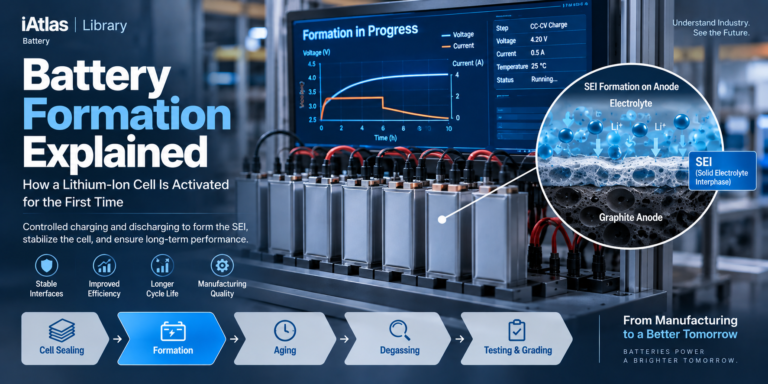
Battery formation is the controlled initial electrochemical cycling performed after cell assembly and electrolyte filling.
During formation, important electrochemical interfaces develop inside the battery.
The process generates large amounts of electrical and thermal data.
Typical measurements include:
- Cell voltage
- Charging and discharging current
- Capacity
- Temperature
- Resistance-related characteristics
- Time-dependent response
These measurements provide information about the cell’s initial electrochemical behavior.
Why Formation Is a Valuable AI Application
Formation is both a manufacturing process and an early source of battery-performance data.
AI models may help identify unusual cell behavior, classify quality-related patterns, or investigate relationships between formation characteristics and later performance.
Potential applications include:
Early quality classification
Identify cells exhibiting abnormal electrochemical responses.
Formation process optimization
Investigate whether alternative protocols can reduce processing time while preserving cell performance.
Degradation-related analysis
Study correlations between initial formation measurements and subsequent cell behavior.
Manufacturing feedback
Connect formation-test results with earlier production parameters.
The Economic Opportunity
Formation and aging can occupy substantial equipment capacity and factory space.
Reducing unnecessary processing time could therefore improve production economics.
However, shorter formation does not automatically mean better manufacturing performance.
Any proposed optimization must be validated against cell lifetime, safety, and quality requirements.
This is an area where electrochemical expertise and machine learning must work together.
For a detailed explanation of this process, see:
Battery Formation Explained: How a Lithium-Ion Cell Is Activated for the First Time
7. Predictive Maintenance: Can AI Reduce Production Downtime?
Battery gigafactories rely on complex and expensive manufacturing equipment.
Examples include coating machines, calendering systems, slitting equipment, robotic assembly systems, welding stations, and production-control infrastructure.
Unexpected equipment failures can interrupt production and create substantial costs.
Traditional maintenance strategies generally include preventive maintenance and corrective maintenance.
AI-enabled predictive maintenance adds another approach.
How Predictive Maintenance Works
Equipment sensors collect information such as:
- Motor current
- Temperature
- Vibration
- Equipment operating cycles
- Mechanical performance
- Process stability
Machine learning models analyze the signals and identify patterns associated with developing abnormalities.
For example, changes in vibration or temperature may indicate increased mechanical wear.
The model may provide an early warning that maintenance should be considered.
This allows maintenance teams to investigate potential problems before a major failure occurs.
What Are the Potential Benefits?
- Reduced unexpected downtime
- Improved maintenance planning
- Better spare-parts management
- Longer useful life for certain components
- Higher equipment availability
- More stable manufacturing operations
Fraunhofer FFB identifies predictive maintenance as an application of artificial intelligence in battery production.
Its research also includes quality prediction and resource-saving production optimization.
However, prediction accuracy depends on the quality of operational data.
A system trained on one machine or operating environment may not necessarily perform reliably on another.
Maintenance recommendations must also be evaluated against equipment manufacturer requirements and actual failure histories.
8. Digital Twins: Connecting Virtual Models with Real Production Lines
A digital twin is a digital representation of a physical system that can incorporate operational data.
In battery manufacturing, digital twins may represent:
- Individual manufacturing equipment
- Electrode coating processes
- Assembly stations
- Production lines
- Factory infrastructure
Their purpose is to support analysis of system behavior.
Digital Twins and AI Are Not the Same
A digital twin may use physical models, simulation software, operational data, or combinations of these methods.
AI can be integrated into a digital twin to improve prediction, estimate difficult-to-measure variables, or support optimization.
However, not every digital twin requires AI.
Likewise, machine learning can operate without a digital twin.
A Practical Manufacturing Example
Consider a virtual model of an electrode coating and drying line.
The model might incorporate:
- Slurry properties
- Coating speed
- Drying temperature
- Equipment operating conditions
- Measured coating quality
Engineers could investigate how changing certain parameters might influence production performance.
AI models may help estimate the outcomes of complex parameter combinations.
The model could then support process engineering decisions before changes are introduced to the actual equipment.
The Importance of Validation
Simulation results are only useful if the digital model adequately represents the real manufacturing process.
Manufacturers must therefore validate model predictions against production measurements.
Fraunhofer’s battery manufacturing research includes digital twins, process modeling, and production data integration.
These approaches show how digital engineering can support increasingly sophisticated manufacturing analysis.
The long-term opportunity is to move from reacting to production problems toward predicting and preventing them.
9. The Economics of AI: Why Small Improvements Can Matter
The commercial case for AI depends on measurable improvements in manufacturing performance.
Battery production economics are influenced by several important variables.
These include:
- Production yield
- Equipment utilization
- Material consumption
- Energy consumption
- Labor productivity
- Maintenance costs
- Production throughput
AI can potentially influence several of these factors.
But the impact should be evaluated using actual factory data.
Illustrative Example: Improving Production Yield
Consider a hypothetical battery production line.
Assume:
- Production input: 1,000,000 cells
- Initial accepted-cell yield: 90%
- Improved accepted-cell yield: 93%
Under the original condition:
1,000,000 × 90% = 900,000 accepted cells
Under the improved condition:
1,000,000 × 93% = 930,000 accepted cells
The improvement produces:
30,000 additional accepted cells from the same input volume.
<small>Illustrative calculation only. These figures are not reported results from a specific battery manufacturer or AI implementation.</small>
This illustrates the potential economic significance of production yield.
However, the financial benefit depends on whether improved yield is achieved without additional operating costs, unacceptable quality risks, or other production constraints.
Why Percentage Improvements Matter
High-volume manufacturing operates at scale.
A relatively small improvement in yield or process stability can affect large volumes of material and production capacity.
Similarly, reduced downtime may improve the utilization of expensive equipment.
Lower energy consumption can affect operating costs across multiple production lines.
The commercial value of AI therefore comes from operational improvements, not simply from installing advanced software.
10. Why Data Integration Is the Biggest Challenge
One of the most difficult aspects of industrial AI adoption is connecting information from different manufacturing systems.
Battery factories frequently use equipment from multiple suppliers.
Each machine may generate data in different formats.
Information may be stored separately in:
- Manufacturing Execution Systems (MES)
- Supervisory Control and Data Acquisition (SCADA) systems
- Programmable Logic Controllers (PLC)
- Quality Management Systems (QMS)
- Laboratory Information Management Systems (LIMS)
- Equipment-specific databases
This creates fragmented data environments.
Why Fragmentation Matters
Imagine that a manufacturer wants to investigate why some cells show abnormal capacity during final testing.
The relevant causes may originate several production stages earlier.
The manufacturer may need to connect:
Material Batch → Slurry Properties → Coating Parameters → Assembly Conditions → Formation Data → Final Quality
If the data cannot be linked reliably, identifying root causes becomes significantly more difficult.
The Role of Traceability
Digital traceability provides a foundation for cross-process analysis.
It enables manufacturers to connect material history, process conditions, and test results.
AI can then analyze these relationships to support quality prediction and process improvement.
Fraunhofer IPA’s 2026 white paper, Digitalization and AI in Battery Cell Manufacturing, emphasizes structured data integration, traceability, digital twins, and AI-driven analytics.
This highlights a fundamental principle:
A battery factory does not become intelligent simply by collecting more data. It becomes more intelligent when those data can be connected, interpreted, and used to improve decisions.
11. AI Cannot Replace Manufacturing Fundamentals
AI offers powerful analytical capabilities, but it cannot compensate for every manufacturing problem.
Several important limitations must be considered.
Poor Sensor Data
Models cannot reliably identify process conditions if measurements are inaccurate, incomplete, or inconsistent.
Insufficient Training Data
Some production defects are rare.
This can make it difficult to collect enough examples for reliable model development.
Changing Manufacturing Conditions
Models developed using one battery chemistry, equipment configuration, or process recipe may not perform equally well after production conditions change.
Limited Explainability
Engineers must understand whether predictions reflect meaningful process relationships.
A statistical correlation does not necessarily establish a physical cause.
Industrial Safety
Manufacturing control systems must maintain safe and validated operating conditions.
AI-generated recommendations should be reviewed and constrained accordingly.
Economic Uncertainty
Implementation costs can include sensors, data infrastructure, software, system integration, validation, and maintenance.
Companies must demonstrate that these investments produce measurable benefits.
For this reason, successful AI implementation often begins with a clearly defined manufacturing problem rather than a broad objective to introduce AI everywhere.
12. What Will Define the Next Generation of Battery Factories?
The next stage of industrial AI adoption is likely to involve deeper integration between manufacturing systems and data-driven analytics.
Several developments deserve attention.
1. Cross-Process Quality Prediction
Manufacturers may increasingly connect information from electrode manufacturing, assembly, formation, and final testing.
This could help identify quality risks earlier and support better root-cause analysis.
2. More Adaptive Process Optimization
AI-supported models may help engineers investigate process adjustments based on measured production conditions.
Implementation will depend on validated operating boundaries and equipment capabilities.
3. Expanded Digital Traceability
More comprehensive tracking of materials, equipment settings, and product histories may create stronger foundations for AI applications.
4. Integration of Digital Twins and AI
Virtual models may increasingly support process development, troubleshooting, and optimization.
5. Stronger Focus on Energy and Resource Efficiency
Data-driven analysis may help manufacturers reduce avoidable scrap, process energy consumption, and unnecessary equipment downtime.
However, these trends should not be interpreted as evidence that fully autonomous battery factories are already widespread.
Many applications remain dependent on engineering validation, careful system integration, and demonstrated commercial performance.
The most successful manufacturers may be those that prioritize practical improvements rather than technological complexity for its own sake.
Conclusion: The Next Battery Factory Will Compete on Intelligence
Battery manufacturing has always required precision, consistency, and process expertise.
Artificial intelligence introduces additional tools for understanding the relationships between manufacturing conditions and product performance.
AI can help engineers identify electrode coating defects, analyze assembly quality, predict equipment failures, and investigate opportunities to improve production efficiency.
When integrated with digital traceability and validated process models, these capabilities may create a more connected approach to battery manufacturing.
However, the greatest value will not come from AI alone.
It will come from combining machine learning with reliable data, manufacturing knowledge, quality engineering, and practical industrial implementation.
The battery industry’s competitive advantage may therefore depend increasingly on three interconnected capabilities:
Advanced Battery Technology + Manufacturing Excellence + Data Intelligence
The factories that integrate these capabilities effectively may be better positioned to improve quality, reduce costs, and scale production.
The future of battery manufacturing will not simply be about producing more cells. It will be about producing more high-quality cells with greater consistency, efficiency, and intelligence.
Related Articles
Electrode Coating Explained: How Battery Slurry Becomes an Electrode
Understand how coating parameters, slurry behavior, and electrode uniformity influence battery manufacturing quality.
Battery Cell Assembly Explained: How Electrodes Become a Battery Cell
Explore the precision manufacturing processes where automated inspection and process monitoring can support defect prevention.
Battery Formation Explained: How a Lithium-Ion Cell Is Activated for the First Time
Learn how initial electrochemical activation generates valuable data for cell quality analysis and manufacturing optimization.
Explore the AI × Battery Series
Previous Article — iAtlas Analysis #2
AI in Battery Materials Discovery: Can Artificial Intelligence Accelerate the Next Battery Breakthrough?
Explore how machine learning and automated laboratories are changing battery materials research.
Series Overview — iAtlas Analysis #1
How AI Is Transforming the Battery Industry: From Materials Discovery to Smart Manufacturing
Understand the broader impact of AI across battery research, manufacturing, quality management, and battery operation.
Next Article — iAtlas Analysis #4
Digital Twins in Battery Gigafactories: How Virtual Models Could Transform Production
A deeper examination of how digital models, production data, and AI can support manufacturing optimization.
References & Further Reading
1. Fraunhofer IPA — Digitalization and AI in Battery Cell Manufacturing (2026)
A white paper examining production data integration, traceability, digital twins, AI-supported quality assurance, predictive maintenance, and energy optimization.
2. Fraunhofer FFB — Artificial Intelligence in Battery Production
Research covering quality prediction, predictive maintenance, process optimization, and data-driven manufacturing.
3. Fraunhofer IPA — Reduction of Rejects and Optimization of Battery Cell Quality
Industrial applications involving production data analysis, electrode coating control, and quality improvement.
4. Fraunhofer IKTS — Process Monitoring
Research on electrode coating monitoring, high-precision sensors, machine learning, and automated defect classification.
5. Fraunhofer ISE — Battery Cell Production
An overview of industrially relevant battery cell assembly, process optimization, digitalization, traceability, and sensor validation.
6. Fraunhofer Battery Alliance — Cell Production
Research on advanced electrode manufacturing, cell assembly, automation, and digital twins in battery production.
ℹ️ About iAtlas
iAtlas is an independent publication covering batteries, semiconductors, OLED, advanced materials, AI, and global industrial trends.
We transform complex industrial developments into clear, reliable, and easy-to-understand insights.
Whether you’re following today’s industry news or building long-term expertise, iAtlas helps you understand not only what happened, but why it matters.
Technology creates change.
Insight creates opportunity.
— iAtlas