LCD vs OLED Explained: What Is the Difference?
🖥️ OLED & Display #2 | 💡 Fundamentals → LCD vs OLED
At a Glance
- LCD requires a backlight, while OLED pixels generate their own light.
- OLED can turn individual pixels off, enabling deeper blacks and higher contrast.
- LCD remains highly competitive in cost, brightness, scale, and mature manufacturing.
- OLED enables thinner, flexible, curved, and foldable display designs.
- Power consumption depends on image content, brightness, and display architecture.
- Neither technology is universally “better” — their advantages depend on the application.
Introduction
LCD and OLED are two of the most important display technologies used in modern electronic devices.
Both can produce high-resolution, full-color images, but the way they generate and control light is fundamentally different.
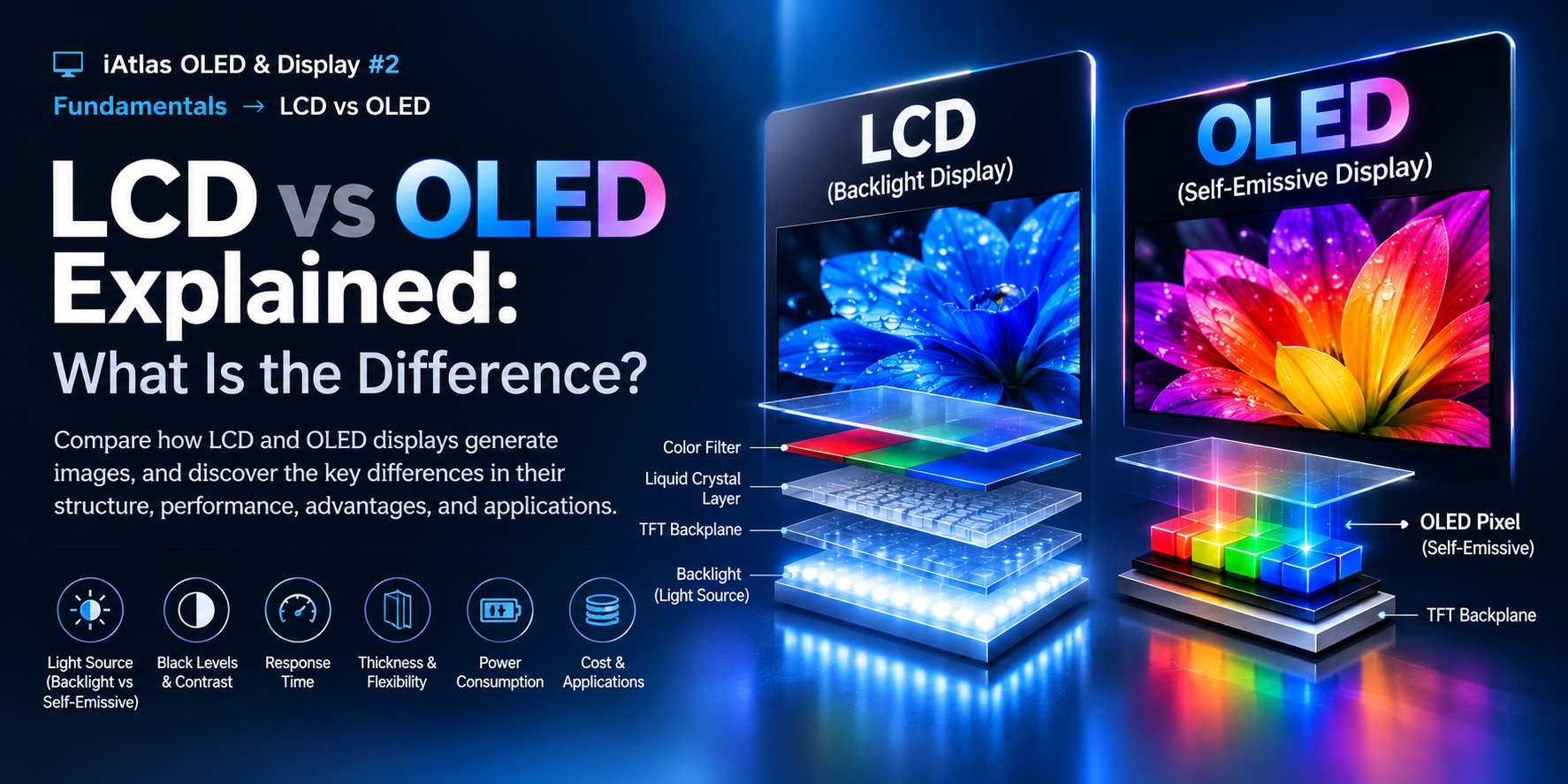
LCD uses a separate backlight behind the panel and controls how much of that light passes through each pixel.
OLED, by contrast, is a self-emissive display technology in which individual pixels generate their own light.
That structural difference affects almost every major display characteristic, including:
- Black levels
- Contrast
- Thickness
- Response time
- Viewing angle
- Power consumption
- Flexibility
- Manufacturing cost
Understanding LCD and OLED is therefore one of the best starting points for understanding the modern display industry.
What Is LCD?
LCD stands for Liquid Crystal Display.
Liquid crystals do not generate light by themselves.
Instead, an LCD requires a light source positioned behind the display.
A simplified structure looks like this:
Backlight
   ↓
Polarizer
   ↓
TFT / Liquid Crystal Layer
   ↓
Color Filter
   ↓
Polarizer
   ↓
Viewer
The backlight produces light continuously.
The liquid crystal layer then controls how much of that light passes through each pixel.
Color filters divide the transmitted light into red, green, and blue components to create a full-color image.
In simple terms:
Backlight → Light Control → Color → Image
What Is OLED?
OLED stands for Organic Light-Emitting Diode.
Unlike LCD, OLED does not require a separate backlight.
Organic semiconductor layers inside the OLED device emit light when electrical energy is applied.
A simplified concept is:
Electrical Signal
      ↓
OLED Pixel
      ↓
Light
Each OLED pixel can control its own light output.
This is why OLED is described as a self-emissive display.
The difference between backlit LCD and self-emissive OLED is the foundation for many of their performance differences.
LCD vs OLED: The Fundamental Difference
The simplest comparison is this:
LCD
The panel controls light coming from behind it.
OLED
The pixel itself creates light.
This sounds like a small distinction, but it changes the entire display architecture.
LCD
Backlight
   ↓
Liquid Crystal
   ↓
Color Filter
   ↓
Image
OLED
OLED Pixel
   ↓
Light
   ↓
Image
Because OLED removes the separate backlight system, the display can become thinner and individual pixels can be controlled more directly.
Black Levels and Contrast
One of the most visible differences between LCD and OLED is black performance.
LCD
In an LCD, the backlight remains active even when a pixel is supposed to display black.
The liquid crystal attempts to block the light.
However, some light can still pass through the panel.
This is commonly referred to as light leakage.
As a result, black may appear slightly gray, particularly in dark environments.
OLED
OLED behaves differently.
When a pixel needs to display black:
The pixel can simply stop emitting light.
This produces extremely deep black levels.
The difference between bright and dark areas can therefore become much greater.
This is one of the main reasons OLED is known for strong contrast performance.
Brightness
Brightness comparisons between LCD and OLED require more nuance.
High-performance LCDs can use powerful backlight systems and sophisticated local dimming to achieve very high brightness.
OLED displays can also achieve high brightness, but their output is influenced by factors such as:
- OLED material performance
- Pixel area
- Thermal management
- Display size
- Image content
- Lifetime requirements
OLED therefore should not simply be described as “dimmer than LCD.”
Actual brightness performance depends on the specific panel design and application.
Response Time
Response time describes how quickly a pixel can change from one state to another.
LCD
LCD pixels depend on the physical reorientation of liquid crystal molecules.
This process takes time.
OLED
OLED pixels control light emission electrically through the OLED device.
They can generally respond much faster.
This makes OLED particularly attractive for:
- Gaming
- High-refresh-rate displays
- Fast-moving video
- AR/VR applications
Fast pixel response can reduce visible motion blur and improve motion clarity.
Viewing Angle
Display performance can also change depending on the viewing position.
LCD
Light must travel through multiple optical layers before reaching the viewer.
Depending on the LCD architecture, brightness, contrast, or color can change when viewed from an angle.
Modern LCD technologies have improved this significantly.
OLED
Because light is emitted directly from the pixels, OLED generally maintains strong image performance across wide viewing angles.
This is useful for:
- Large televisions
- Smartphones
- Automotive displays
- Multi-user viewing environments
Display Thickness
LCD requires several major optical components, including a backlight system.
OLED does not.
This allows OLED modules to be made thinner.
A simplified comparison is:
LCD
Cover
↓
LCD Panel
↓
Optical Films
↓
Backlight
OLED
Cover
↓
OLED Panel
The actual commercial module is more complex, but removing the backlight creates significant opportunities for thinner device designs.
Flexible and Foldable Displays
This is one of OLED’s most important structural advantages.
LCD depends on a backlight system and multiple optical layers, making extreme bending more difficult.
OLED can be manufactured using thin flexible substrates.
This enables:
- Curved displays
- Flexible displays
- Foldable smartphones
- Rollable concepts
- New automotive display shapes
Flexible OLED does not mean that every OLED display is flexible.
The entire display stack — including substrate, encapsulation, electrodes, touch layer, cover material, and module structure — must also support repeated bending.
Color Performance
Both LCD and OLED can achieve excellent color performance.
The mechanisms, however, are different.
LCD
LCD typically uses:
Backlight → Color Filter → RGB Image
Modern LCDs may also use technologies such as quantum dots to improve color performance.
OLED
OLED generates light through emissive materials and display-specific color architectures.
Different approaches include:
- RGB OLED
- WOLED
- QD-OLED
As a result, color performance cannot be judged only by whether a display is LCD or OLED.
Material design, panel architecture, calibration, and driving technology all matter.
Power Consumption
A common statement is that OLED always uses less power than LCD.
That is too simple.
LCD
The backlight operates across a significant portion of the display regardless of the exact image being shown.
Power consumption therefore tends to depend strongly on:
- Backlight brightness
- Panel efficiency
- Local dimming architecture
OLED
Each pixel generates its own light.
Power consumption therefore changes significantly depending on the image.
A mostly black interface may require relatively little pixel emission.
A bright full-screen white image can require much more power.
OLED power efficiency is therefore content-dependent.
Lifetime and Burn-In
OLED uses organic light-emitting materials that gradually degrade during operation.
Different subpixels may also degrade at different rates.
If particular screen areas repeatedly display the same content, uneven aging can occur.
This may lead to permanent image retention commonly known as burn-in.
Modern OLED displays use multiple technologies to reduce this risk, including:
- Pixel compensation
- Brightness control
- Image shifting
- Improved OLED materials
- Advanced driving algorithms
LCD does not suffer from OLED-style emissive material burn-in, although LCD panels can have their own aging and image-quality issues.
Moisture and Oxygen Sensitivity
OLED devices are particularly sensitive to moisture and oxygen.
These environmental contaminants can damage OLED materials and electrodes.
OLED therefore requires effective encapsulation.
For flexible OLED displays, Thin Film Encapsulation is particularly important because the barrier must protect the OLED while maintaining flexibility.
LCD also requires controlled manufacturing environments, but OLED’s sensitive emissive stack makes barrier technology especially important.
Manufacturing Differences
The difference between LCD and OLED extends far beyond the final display.
Their manufacturing processes and supply chains are also different.
Simplified LCD Manufacturing
TFT Backplane
      ↓
Liquid Crystal Cell
      ↓
Color Filter
      ↓
Cell Assembly
      ↓
Backlight Unit
      ↓
Module
Simplified OLED Manufacturing
TFT Backplane
      ↓
OLED Material Deposition
      ↓
Pixel Formation
      ↓
Encapsulation
      ↓
Inspection
      ↓
Module
OLED manufacturing places particularly high demands on:
- Organic materials
- Vacuum deposition
- Patterning accuracy
- Encapsulation
- Particle control
- Yield management
These differences influence equipment suppliers, materials companies, manufacturing cost, and competitive barriers.
Cost and Manufacturing Maturity
LCD has been manufactured at enormous scale for decades.
Its supply chain, equipment ecosystem, manufacturing processes, and production infrastructure are highly mature.
This gives LCD important advantages in applications where:
- Large panel size is important
- Cost is critical
- Extreme flexibility is unnecessary
OLED manufacturing is more complex in several areas and can require expensive deposition, encapsulation, and precision process equipment.
However, as OLED capacity expands and manufacturing yields improve, OLED continues to enter more applications.
Where Is LCD Still Important?
The growth of OLED does not mean LCD is disappearing.
LCD remains highly important in many applications, including:
- Televisions
- Monitors
- Industrial displays
- Automotive displays
- Entry and mid-range devices
- Large-format displays
Its combination of mature manufacturing, scale, brightness, and cost competitiveness remains difficult to replace in many markets.
Where Is OLED Expanding?
OLED adoption has become particularly strong in applications where premium display performance and thin form factors matter.
Major areas include:
- Smartphones
- Smartwatches
- Premium televisions
- Tablets
- Notebooks
- Automotive displays
- Foldable devices
- AR/VR displays
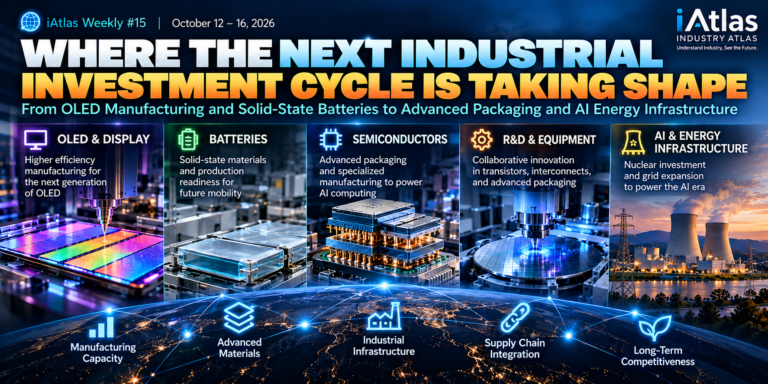
One of the most important areas to watch is IT OLED, where OLED adoption is expanding beyond smartphones into tablets, notebooks, and other computing devices.
LCD vs OLED at a Glance
| Characteristic | LCD | OLED |
|---|---|---|
| Light source | Separate backlight | Self-emissive pixels |
| Black level | Backlight must be blocked | Pixel can turn off |
| Contrast | High | Very high |
| Response time | Good | Very fast |
| Thickness | Requires backlight | Can be thinner |
| Flexible design | Limited | Strong advantage |
| Viewing angle | Depends on LCD type | Generally wide |
| Burn-in risk | No OLED-type burn-in | Possible |
| Power behavior | Backlight-dependent | Content-dependent |
| Manufacturing | Highly mature | Advanced and process-intensive |
| Cost competitiveness | Strong | Improving |
| Foldable applications | Difficult | Major advantage |
Which Is Better: LCD or OLED?
There is no universal answer.
The better technology depends on what the product requires.
If the priority is:
Deep black, high contrast, thinness, fast response, or flexibility
OLED may offer a major advantage.
If the priority is:
Cost, manufacturing maturity, large-area scalability, or certain high-brightness applications
LCD may remain highly competitive.
This is why LCD and OLED continue to coexist across the display market.
iAtlas Insight
The LCD-to-OLED transition is not simply a change in screen quality.
It represents a shift in where technological and economic value is created across the display supply chain.
LCD relies heavily on technologies such as:
- Backlights
- Liquid crystals
- Optical films
- Color filters
OLED shifts more value toward:
- Organic emissive materials
- Advanced TFT backplanes
- Vacuum deposition
- Fine patterning
- Encapsulation
- High-precision inspection
That means a change in display architecture also changes which materials, equipment, and manufacturing capabilities become strategically important.
OLED Expansion Does Not Automatically Mean LCD Disappears
Display technologies tend to segment by application rather than disappear overnight.
OLED can dominate where its structural advantages matter most, while LCD can remain competitive where scale and cost are more important.
This makes application mix one of the most important factors when analyzing the display industry.
IT OLED Is Particularly Important
OLED’s expansion from smartphones into tablets and notebooks can increase demand for:
- Larger OLED substrates
- Improved material efficiency
- Higher manufacturing yield
- Tandem structures
- New deposition equipment
- Longer device lifetime
The significance of IT OLED therefore goes beyond another application category.
It can influence the entire OLED manufacturing ecosystem.
Follow the Manufacturing Technology
For industry analysis, it is not enough to ask:
“Will OLED replace LCD?”
A more useful question is:
“In which applications does OLED create enough additional value to justify a different manufacturing structure and cost?”
That question helps explain where future investments in materials, equipment, panel capacity, and supply chains are likely to concentrate.
FAQ
What is the main difference between LCD and OLED?
LCD uses a separate backlight and controls how much light passes through each pixel.
OLED pixels generate their own light.
Why does OLED have better black levels?
An OLED pixel can completely stop emitting light when displaying black.
LCD must block light coming from an active backlight, so some light leakage may remain.
Does OLED always use less power than LCD?
No.
OLED power consumption depends heavily on image content and brightness.
Dark images can be very efficient, while bright full-screen images require more emission.
Is OLED always better than LCD?
No.
OLED has major advantages in contrast, response time, thickness, and flexibility.
LCD remains highly competitive in cost, manufacturing scale, brightness, and many large-area applications.
Why can OLED displays fold?
OLED does not require a rigid backlight unit and can be fabricated on flexible substrates.
However, the entire display structure must be designed to withstand repeated bending.
Key Takeaways
- LCD requires a backlight, while OLED is self-emissive.
- OLED can turn individual pixels off, enabling deep blacks and high contrast.
- OLED generally offers faster response, thinner structures, and greater flexibility.
- LCD remains highly competitive because of mature manufacturing, scale, and cost.
- OLED power consumption depends strongly on image content.
- OLED introduces challenges involving material degradation, burn-in, and environmental sensitivity.
- LCD and OLED require different materials, equipment, and manufacturing ecosystems.
- The future display market is more likely to involve application-based coexistence than one technology completely replacing the other.
OLED & Display Learning Path
Previous Article
OLED & Display #1 — What Is OLED? How Organic Light-Emitting Diode Displays Work
Current Article
OLED & Display #2 — LCD vs OLED Explained: What Is the Difference?
Next Article
OLED & Display #3 — How OLED Displays Work: From Electricity to Light
The next article will take a closer look inside an OLED device and explain how electrons, holes, organic layers, and electroluminescence work together to generate light.
References & Further Reading
- LG Display — LCD Technology
- Samsung Display — OLED
- Universal Display Corporation — Organic Light Emitting Diodes (OLEDs)
- Samsung Display — Flexible OLED
- Samsung Display — Encapsulation
- Samsung Display — Thin Film Encapsulation (TFE)
- ITU — Display Energy Reduction Through Image Signal Processing
- Samsung Display — Evaporation
ℹ️ About iAtlas
iAtlas is an independent publication covering batteries, semiconductors, OLED, advanced materials, AI, and global industrial trends.
We transform complex industrial developments into clear, reliable, and easy-to-understand insights.
Whether you’re following today’s industry news or building long-term expertise, iAtlas helps you understand not only what happened, but why it matters.
Technology creates change.
Insight creates opportunity.
— iAtlas