What Is Engineering? Engineering Explained Simply
⚙️ Engineering Fundamentals | Introduction → What Is Engineering?
What is engineering?
Engineering is the practical application of science, mathematics, and technical knowledge to solve real-world problems.
Engineering is everywhere.
The smartphone in your hand, the battery inside an electric vehicle, the semiconductor chips powering AI systems, and the equipment used in modern factories all exist because engineers turn knowledge into useful systems.
But what exactly is engineering?
In simple terms:
Engineering is the process of using science, mathematics, and practical knowledge to design solutions to real-world problems.
Science helps us understand how the world works.
Engineering uses that understanding to build something useful.
Science vs Engineering: What Is the Difference?
Science and engineering are closely connected, but they have different goals.
Science often asks:
Why does this happen?
Engineering asks:
How can we use this knowledge to solve a problem?
For example, physics explains how electricity behaves.
Electrical engineering applies those principles to design motors, circuits, sensors, power systems, and industrial control equipment.
Chemistry explains how substances interact and react.
Chemical engineering applies those principles to industrial processes involving chemicals, pharmaceuticals, battery materials, gases, and other products.
The relationship can be summarized simply:
Science → Understanding
Engineering → Application
Engineering Is About Solving Problems
Imagine that a factory needs to maintain a process chamber at a specific temperature.
The requirement sounds simple:
Keep the chamber at 25°C.
But an engineer needs to consider many questions.
- How much heat is generated inside the chamber?
- How much heat enters from the surrounding environment?
- What cooling capacity is required?
- Which temperature sensor should be used?
- How accurately should the temperature be controlled?
- What happens if the cooling system fails?
A practical engineering solution may therefore require several technologies working together.
Temperature Sensor
↓
Controller
↓
Cooling System
↓
Process Chamber
↓
Feedback
Engineering is rarely about a single component.
It is about creating a system in which multiple components work together safely, efficiently, and reliably.
The Major Fields of Engineering
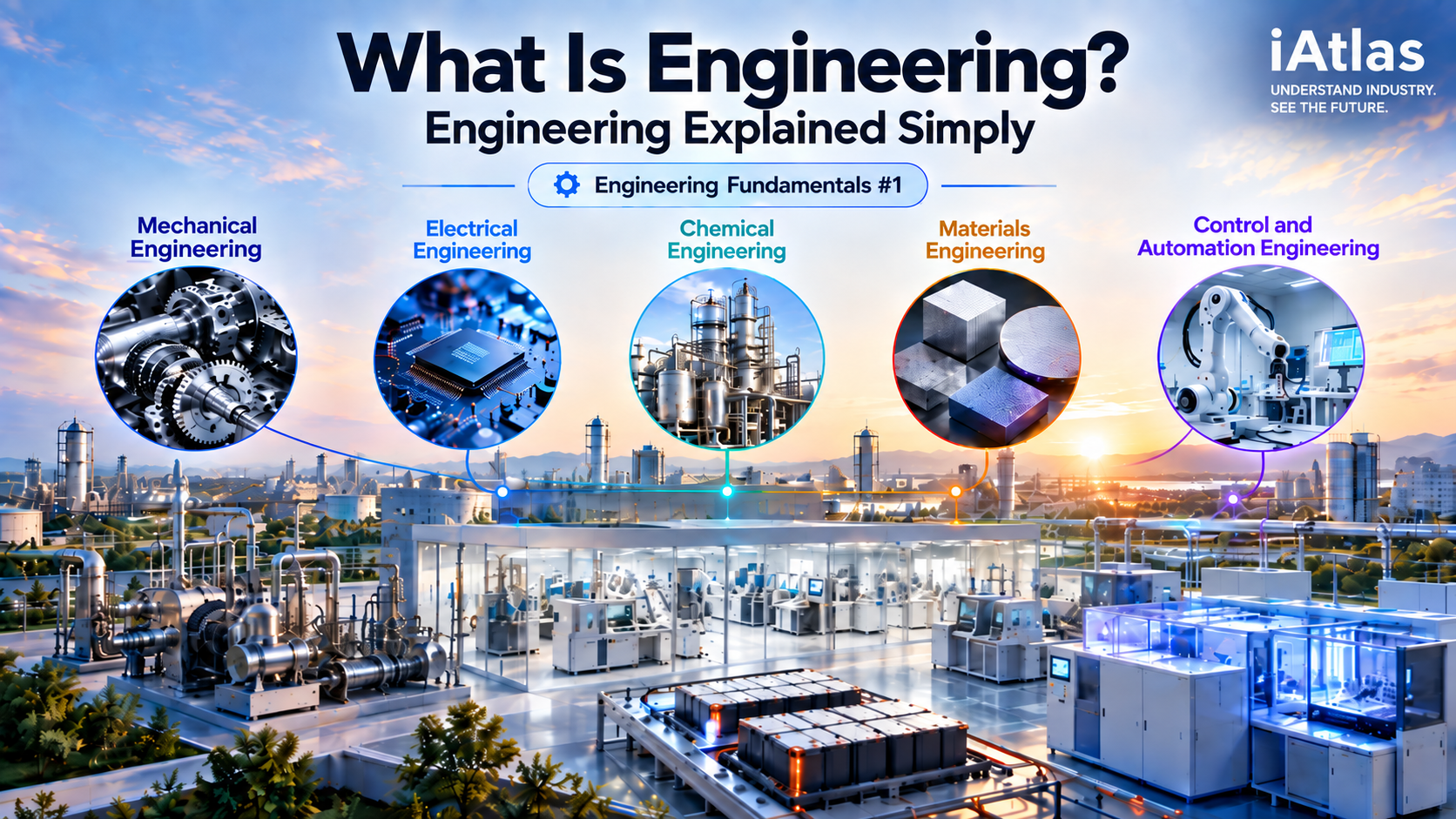
Engineering includes many specialized disciplines.
Mechanical Engineering
Mechanical engineering deals with machines, motion, forces, energy, heat, and physical systems.
Typical topics include:
- Force
- Torque
- Friction
- Vibration
- Motors
- Pumps
- Bearings
- Cooling systems
Mechanical engineers may work on manufacturing equipment, robots, vehicles, pumps, compressors, and production machinery.
Electrical Engineering
Electrical engineering focuses on electricity, electronics, power, and electrical systems.
Important concepts include:
- Voltage
- Current
- Resistance
- Power
- AC and DC
- Motors
- Sensors
- Electrical control systems
Almost every modern industrial machine depends on electrical engineering.
Chemical Engineering
Chemical engineering applies chemistry, physics, mathematics, and engineering principles to processes involving materials and chemical transformations.
Examples include:
- Battery materials
- Semiconductor chemicals
- Pharmaceuticals
- Petrochemicals
- Gas processing
- Solvent handling
Chemical engineers focus not only on chemical reactions themselves, but also on how materials can be produced safely, consistently, and efficiently at industrial scale.
Materials Engineering
Materials engineering studies how the structure and properties of materials affect their performance.
Engineers work with materials such as:
- Stainless steel
- Aluminum
- Ceramics
- Polymers
- Glass
- Semiconductor materials
- Battery materials
Selecting the correct material can determine whether equipment can withstand heat, pressure, corrosion, mechanical stress, or chemical exposure.
Control and Automation Engineering
Modern factories depend heavily on automation.
Control engineers work with systems such as:
- Sensors
- PLCs
- HMIs
- Controllers
- Valves
- Motors
- Interlocks
A simplified control loop may look like this:
Sensor → Controller → Actuator → Process → Sensor
The sensor measures what is happening.
The controller compares the measurement with the desired condition.
The actuator then changes the process when necessary.
This allows industrial equipment to automatically maintain variables such as pressure, temperature, flow, speed, or gas concentration.
Engineering Is Built on Fundamental Concepts
Although engineering covers many different industries, the same fundamental concepts appear repeatedly.
Force
Force describes an interaction that can change the motion or deformation of an object.
Pressure
Pressure is essential for understanding gas systems, pumps, vacuum systems, piping, and process chambers.
Flow
Flow describes how liquids or gases move through a system.
Heat
Heat transfer determines how equipment gains, loses, or controls thermal energy.
Electricity
Voltage, current, resistance, and power are fundamental to almost every modern industrial machine.
Measurement
Sensors allow engineers to observe what is happening inside a process.
Control
Control systems use measurement data to adjust equipment and maintain the desired operating condition.
These concepts may initially seem separate.
In real industrial systems, however, they are closely connected.
An Industrial Example: A Glovebox System
Consider an inert-atmosphere glovebox used in battery, semiconductor, or advanced-material research.
At first glance, it may appear to be simply a sealed enclosure filled with inert gas.
But many engineering principles are working simultaneously.
Pressure Engineering
The enclosure must maintain a controlled internal pressure.
Gas Flow
Inert gas must move through the enclosure and purification system.
Chemical Engineering
Reactive contaminants such as oxygen and moisture must be removed from the internal atmosphere.
Mechanical Engineering
Fans, pumps, valves, seals, chambers, and structural components must operate reliably.
Electrical Engineering
Motors, heaters, sensors, controllers, and other components require electrical power.
Measurement
Parameters such as oxygen concentration, moisture concentration, pressure, and temperature may need to be measured.
Automation
A control system can coordinate circulation, purification, valves, alarms, and safety functions.
A single industrial machine can therefore combine several different engineering disciplines.
Why Engineering Fundamentals Matter
You do not need to become an engineer to understand industrial technology.
However, understanding a few fundamental concepts makes industrial systems much easier to follow.
Once you understand pressure, you can better understand:
- Gas systems
- Vacuum systems
- Pumps
- Process chambers
- Gloveboxes
Once you understand heat transfer, you can better understand:
- Chillers
- Cooling systems
- Heat exchangers
- Thermal management
Once you understand voltage, current, and power, electrical equipment specifications become much easier to read.
And once you understand measurement and control, sensors, PLCs, alarms, and automated equipment begin to make much more sense.
This is why engineering fundamentals matter.
They provide the foundation for understanding how modern industrial technology works.
Engineering Fundamentals Learning Path
The iAtlas Engineering Fundamentals series will gradually explore the core principles used across modern industry.
The learning path begins with fundamental concepts such as:
Force
↓
Energy
↓
Power
↓
Pressure
↓
Flow
↓
Heat
↓
Electricity
↓
Measurement
↓
Control
From there, these concepts will connect to real industrial technologies including pumps, sensors, vacuum systems, automation equipment, battery manufacturing, semiconductor production, and chemical processing.
The goal is not to turn every reader into an engineer.
The goal is to make engineering easier to understand.
Key Takeaway
Engineering is not simply about machines, equations, or complicated technology.
At its core, engineering is about one thing:
Using knowledge to solve practical problems.
Understanding basic engineering concepts makes it much easier to understand how industrial technologies, manufacturing equipment, and modern production systems actually work.
And that is where the Engineering Fundamentals journey begins.
Engineering Fundamentals Learning Path
Next Lesson
⚙️ Mechanics & Motion #1 | Force & Motion → What Is Force in Engineering?
Force Explained: What Is Force in Engineering?
Learn what force is, how it is measured in newtons, and why force is one of the most fundamental concepts for understanding motion, machines, structures, and industrial equipment.
References
- ABET — Criteria for Accrediting Engineering Programs
General engineering education criteria covering mathematics, science, engineering principles, analysis, design, and engineering disciplines. - MIT OpenCourseWare — Engineering Courses
Open educational resources covering fundamental engineering concepts and engineering systems. - IEEE — Institute of Electrical and Electronics Engineers
Technical and educational resources related to electrical engineering, electronics, automation, computing, and industrial technologies. - ASME — American Society of Mechanical Engineers
Professional resources related to mechanical engineering, energy, manufacturing, thermal systems, and engineering practice. - National Academy of Engineering — NAE
Resources covering engineering, technology, education, and the role of engineering in society.
ℹ️ About iAtlas
iAtlas is an independent publication covering batteries, semiconductors, OLED, advanced materials, AI, and global industrial trends.
We transform complex industrial developments into clear, reliable, and easy-to-understand insights.
Whether you’re following today’s industry news or building long-term expertise, iAtlas helps you understand not only what happened, but why it matters.
Technology creates change.
Insight creates opportunity.
— iAtlas