What Is OLED? How Organic Light-Emitting Diode Displays Work
🖥️ iAtlas OLED & Display #1 | 💡 Fundamentals → What Is OLED?
At a Glance
- OLED stands for Organic Light-Emitting Diode.
- OLED is a self-emissive display technology, meaning individual pixels generate their own light.
- Unlike LCD, OLED does not require a separate backlight.
- OLED enables deep blacks, high contrast, thin designs, and flexible or foldable displays.
- OLED performance depends on advanced organic materials, thin-film structures, deposition, encapsulation, and precise manufacturing.
- Moisture, oxygen, material degradation, and blue-emitter lifetime remain important technical challenges.
Introduction
OLED has become one of the most important display technologies used in smartphones, televisions, wearables, automotive displays, and emerging AR/VR devices.
Unlike LCDs, which require a separate backlight, OLED displays can generate light directly from individual pixels.
This fundamental difference allows OLED displays to deliver deep blacks, high contrast, fast response times, thin designs, and flexible form factors.
But what exactly is OLED, and how does it create light?
This article introduces the fundamental principles behind OLED technology, explains how an OLED device generates light, and explores why OLED has become such an important part of the modern display industry.
What Does OLED Mean?
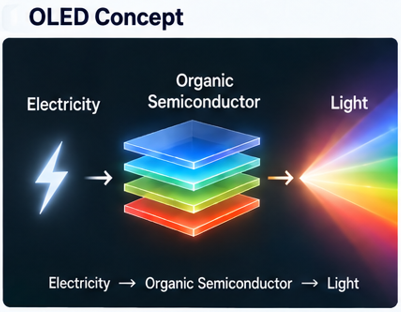
OLED stands for Organic Light-Emitting Diode.
An OLED is a light-emitting device that uses thin layers of organic semiconductor materials.
When electrical energy is supplied to these materials, they can emit light.
In simple terms:
Electricity → Organic Semiconductor → Light
The most important characteristic of OLED is that the display does not require a separate light source behind the panel.
Instead, individual pixels generate their own light.
This is why OLED is classified as a self-emissive display technology.
How Is OLED Different from LCD?
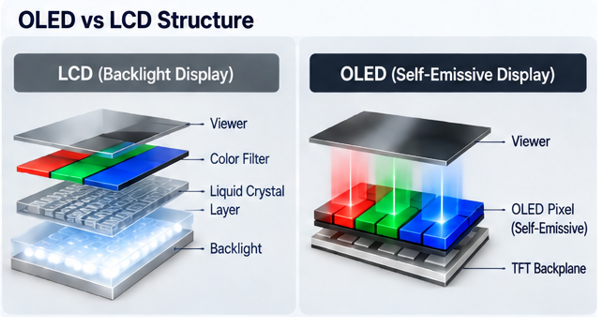
The easiest way to understand OLED is to compare it with LCD.
LCD
An LCD cannot generate light by itself.
It requires a backlight located behind the display panel.
A simplified LCD structure can be understood as:
Backlight
↓
Liquid Crystal Layer
↓
Color Filter
↓
Viewer
The liquid crystal controls how much light from the backlight is transmitted through each pixel.
OLED
OLED works differently.
Each OLED pixel can generate its own light.
The simplified concept is:
Electrical Signal
↓
OLED Pixel
↓
Light
Because a separate backlight is not required, OLED displays can be thinner and can control light at the individual pixel level.
This is one of the main reasons OLED can achieve very high contrast and extremely deep black levels.
How Does OLED Produce Light?
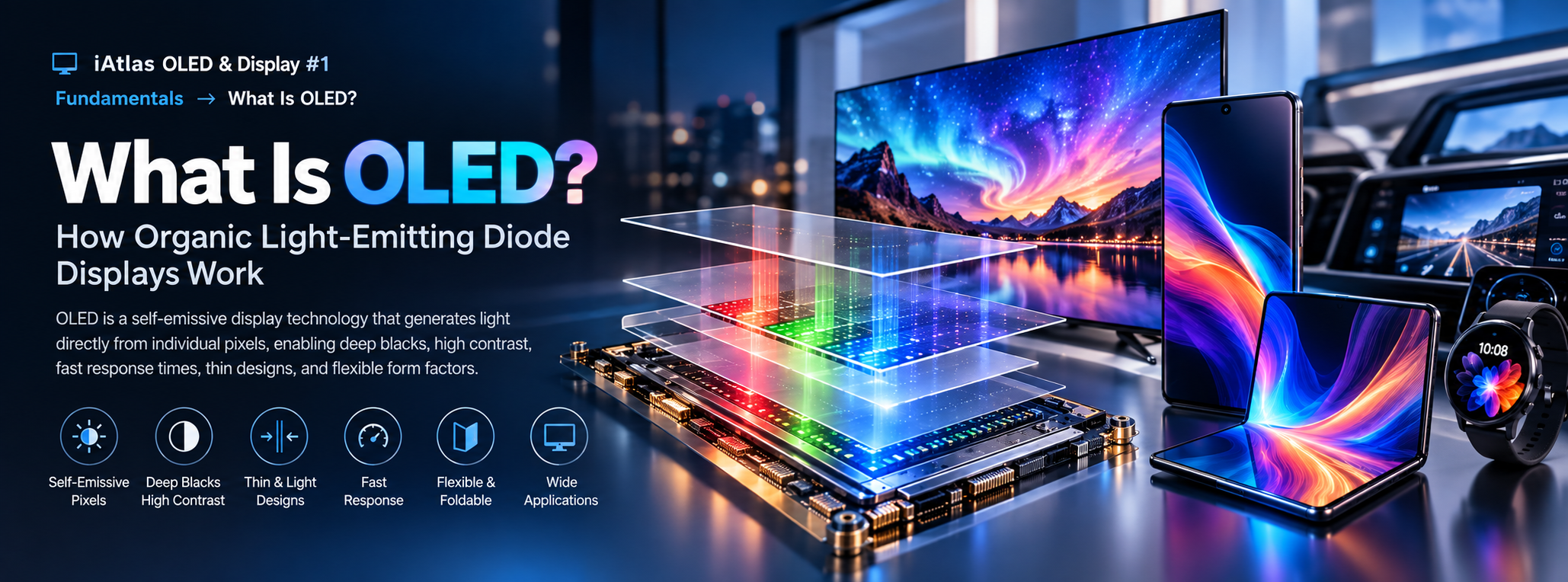
An OLED device contains several extremely thin functional layers positioned between two electrodes.
A simplified OLED structure can be represented as:
Cathode
   ↓
Electron Transport Layer
   ↓
Emission Layer
   ↓
Hole Transport Layer
   ↓
Anode
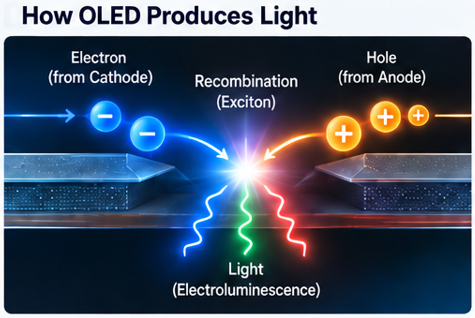
When voltage is applied:
- Electrons are injected from the cathode.
- Holes are injected from the anode.
- Electrons and holes move through the organic layers.
- They meet inside the emission region.
- Their interaction releases energy.
- That energy is emitted as light.
This phenomenon is known as electroluminescence.
Commercial OLED devices are more complex than this simplified structure and may contain additional functional layers designed to improve charge transport, efficiency, color performance, and operational lifetime.
What Does “Organic” Mean in OLED?
The word organic can sometimes be confusing.
It does not mean that OLED displays use naturally grown or biological materials.
In electronics and chemistry, organic materials generally refer to compounds based primarily on carbon-containing molecular structures.
OLED manufacturers use specially engineered organic semiconductor materials that can:
- Transport electrical charge
- Control electrons and holes
- Emit specific colors of light
- Improve device efficiency
- Improve operational lifetime
These materials form the functional layers inside an OLED device.
What Are the Main OLED Layers?
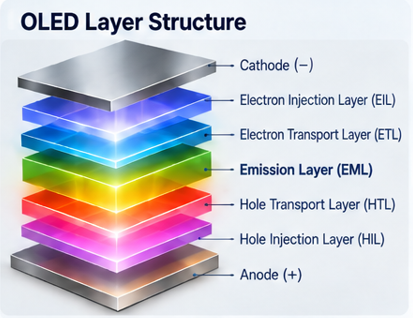
OLED devices contain multiple layers, with each layer performing a different function.
HIL — Hole Injection Layer
Helps inject holes from the anode into the organic layers.
HTL — Hole Transport Layer
Transports holes toward the emission layer.
EML — Emission Layer
The region where light is primarily generated.
ETL — Electron Transport Layer
Transports electrons toward the emission layer.
EIL — Electron Injection Layer
Helps inject electrons from the cathode.
These ultra-thin functional layers work together to control charge movement and light generation.
Later articles in the OLED Materials series will examine each layer in greater detail.
How Does OLED Produce Color?
Modern displays reproduce images using combinations of three primary colors:
Red + Green + Blue
These are commonly referred to as RGB.
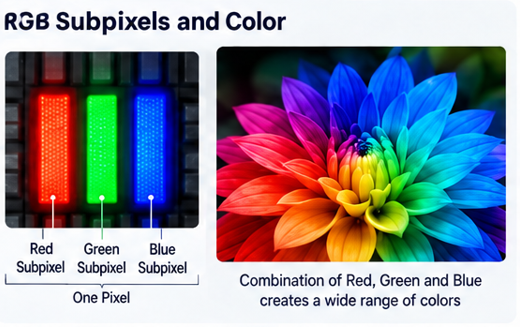
An OLED pixel can contain several smaller light-emitting elements known as subpixels.
A simplified RGB pixel structure is:
Pixel
├─ Red Subpixel
├─ Green Subpixel
└─ Blue Subpixel
By controlling the brightness of these subpixels independently, the display can reproduce a wide range of colors.
Different OLED architectures use different approaches to generate color.
Examples include:
- RGB OLED
- WOLED
- QD-OLED
These technologies will be explored separately later in the OLED & Display series.
Why Can OLED Produce Deep Black?
One of OLED’s most recognizable characteristics is its ability to produce extremely deep black.
The reason comes directly from its self-emissive structure.
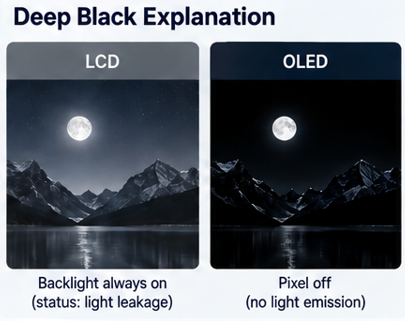
When an OLED pixel needs to display black:
The pixel can simply turn off.
No light is emitted.
In an LCD, however, the backlight remains active behind the panel.
The liquid crystal attempts to block that light, but some light leakage may still occur.
This gives OLED an important advantage in contrast performance.
Major Advantages of OLED
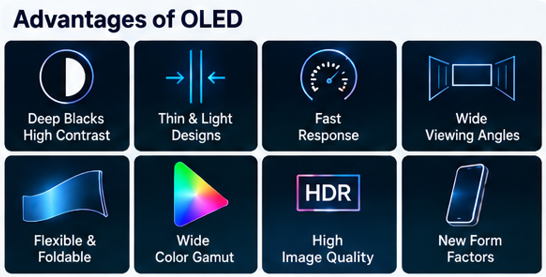
Self-Emissive Pixels
OLED pixels generate their own light.
No separate backlight is required.
Deep Blacks and High Contrast
Individual pixels can be completely turned off when displaying black.
This enables extremely high contrast between bright and dark areas.
Thin Display Structure
Removing the backlight allows OLED display modules to become thinner and lighter.
Fast Response Time
OLED pixels can respond quickly to electrical signals, making OLED well suited for video, gaming, and high-refresh-rate displays.
Wide Viewing Angles
OLED displays generally maintain strong contrast and color performance even when viewed from an angle.
Flexible Form Factors
OLED devices can be fabricated on flexible substrates.
This makes new display designs possible, including:
- Flexible displays
- Curved displays
- Foldable displays
- Rollable displays
This design flexibility is one of the major reasons OLED has become important in premium mobile devices.
What Are the Challenges of OLED?
OLED also has several important technical challenges.
Material Degradation
Organic materials gradually degrade during operation.
This affects OLED lifetime and long-term performance.
Burn-In
Different pixels may age at different rates.
If certain static images remain displayed for long periods, some pixels may degrade faster than others.
This can create permanent image retention commonly known as burn-in.
Blue OLED Performance
Blue OLED materials have historically been more difficult to optimize for both:
- High efficiency
- Long lifetime
Improving blue-emitting materials remains an important area of OLED research and development.
Moisture and Oxygen Sensitivity
OLED materials can be highly sensitive to environmental exposure.
In particular, moisture and oxygen can negatively affect OLED device performance and lifetime.
For this reason, environmental control and encapsulation are extremely important during OLED manufacturing.
Why Is Encapsulation Important?
After OLED layers are formed, the device must be protected from the external atmosphere.
OLED devices therefore require encapsulation.
The basic concept is:
OLED Device
     ↓
Barrier Layer
     ↓
Protection from
Moisture + Oxygen
For flexible OLED displays, Thin Film Encapsulation (TFE) is particularly important.
Instead of relying only on rigid glass, multiple thin barrier layers can be used to protect the OLED while maintaining flexibility.
Encapsulation is therefore one of the key manufacturing technologies behind modern flexible and foldable displays.
Where Is OLED Used?
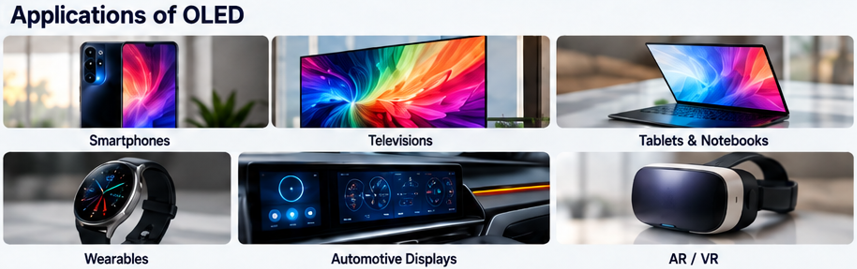
OLED technology is now used across a wide range of electronic products.
Smartphones
OLED is widely used in premium smartphones because of its thin structure, high contrast, image quality, and compatibility with flexible displays.
Televisions
Large-area OLED panels are used in premium televisions where black level and contrast are especially important.
Tablets and Notebooks
OLED adoption is expanding into IT devices as manufacturers seek higher image quality and thinner display designs.
Wearables
Smartwatches and other wearable devices benefit from OLED’s compact structure and self-emissive pixels.
Automotive Displays
OLED is increasingly being used or developed for:
- Instrument clusters
- Infotainment systems
- Center information displays
- Premium interior displays
AR and VR
Advanced technologies such as Micro-OLED and OLED-on-Silicon are being developed for high-resolution near-eye displays.
OLED Is More Than Just a Screen
An OLED panel may look simple from the outside, but manufacturing one requires a highly complex industrial ecosystem.
A simplified OLED manufacturing flow can be understood as:
Materials
   ↓
TFT Backplane
   ↓
OLED Deposition
   ↓
Patterning
   ↓
Encapsulation
   ↓
Inspection
   ↓
Module Assembly
   ↓
Finished Display
This connects OLED manufacturing to many advanced technologies and industries, including:
- Specialty chemicals
- Organic semiconductor materials
- Vacuum technology
- Thin-film deposition
- Precision equipment
- Encapsulation
- Laser processing
- Inspection and metrology
Understanding OLED therefore requires looking beyond the finished display itself.
OLED in the Display Industry
OLED is one part of a much broader display technology landscape.
Modern display technologies include:
- LCD
- OLED
- QD-OLED
- Mini LED
- Micro-OLED
- MicroLED
Each technology has different advantages, manufacturing requirements, cost structures, and target applications.
The OLED & Display series will explore these technologies step by step — from basic device structures to materials, manufacturing, equipment, companies, and markets.
iAtlas Insight
OLED should not be viewed simply as a higher-performance replacement for LCD.
The shift toward self-emissive displays changes the technologies and industrial capabilities required across the display value chain.
OLED performance depends not only on panel design but also on advances in:
- Organic materials
- TFT backplanes
- Vacuum deposition
- Encapsulation
- Inspection and yield control
- Precision manufacturing equipment
Several areas are particularly important to watch.
Material Efficiency and Lifetime
Better organic materials can improve efficiency, brightness, color performance, and operational lifetime.
Blue-emitting materials are particularly important because improvements in blue efficiency and lifetime can influence the performance of the entire OLED device.
Manufacturing Yield
As display size and resolution increase, controlling particles, defects, and process variation becomes increasingly important.
Yield therefore has a direct impact on OLED manufacturing economics.
Deposition Technology
OLED manufacturing requires extremely precise control of very thin functional layers.
Deposition uniformity, material utilization, patterning accuracy, and equipment productivity are therefore major areas of competition.
Moisture and Oxygen Protection
OLED’s sensitivity to moisture and oxygen makes encapsulation a critical technology.
Improved barrier performance is especially important for flexible and foldable devices.
New Form Factors
OLED’s thin and flexible structure enables products that are difficult to achieve with traditional display architectures.
Foldable smartphones are one example, but OLED technology is also expanding toward IT displays, automotive applications, and near-eye displays.
The OLED industry should therefore be understood as a technology ecosystem rather than simply a competition between finished display panels.
Materials, equipment, manufacturing capability, yield, and supply-chain competitiveness all influence where value is created.
FAQ
What does OLED stand for?
OLED stands for Organic Light-Emitting Diode.
It uses organic semiconductor materials that can emit light when electrical energy is applied.
Does OLED need a backlight?
No.
OLED is a self-emissive technology, so individual pixels generate their own light.
This is one of the major differences between OLED and LCD.
Why does OLED produce better black levels?
OLED pixels can be completely turned off when black is required.
Because no light is emitted from those pixels, OLED can achieve extremely deep blacks and high contrast.
Why is OLED sensitive to moisture?
OLED contains thin organic and electrode layers that can be damaged or degraded by environmental exposure.
For this reason, OLED devices require effective encapsulation.
What causes OLED burn-in?
OLED pixels gradually degrade during operation.
If some pixels display the same high-brightness content for significantly longer periods than others, uneven aging can create persistent image retention.
Key Takeaways
- OLED stands for Organic Light-Emitting Diode.
- OLED pixels generate their own light and therefore do not require a backlight.
- OLED’s self-emissive structure enables deep blacks, high contrast, fast response, and thin displays.
- Organic functional layers control charge transport and light generation.
- OLED can support flexible, curved, foldable, and rollable display designs.
- Material degradation, burn-in, blue-emitter performance, moisture, and oxygen remain important technical challenges.
- OLED manufacturing depends on advanced materials, deposition, encapsulation, inspection, and precision equipment.
- Understanding OLED requires understanding both the device itself and the industrial ecosystem behind it.
OLED & Display Learning Path
Current Article
#1 — What Is OLED? How Organic Light-Emitting Diode Displays Work
Next Article
#2 — LCD vs OLED Explained: What Is the Difference?
The next article will compare how LCD and OLED generate images and examine the differences in their structures, performance characteristics, and applications.
References & Further Reading
- Samsung Display — OLED
- Universal Display Corporation — Organic Light Emitting Diodes (OLEDs)
- Samsung Display — Organic Layers
- Samsung Display — Encapsulation
ℹ️ About iAtlas
iAtlas is an independent publication covering batteries, semiconductors, OLED, advanced materials, AI, and global industrial trends.
We transform complex industrial developments into clear, reliable, and easy-to-understand insights.
Whether you’re following today’s industry news or building long-term expertise, iAtlas helps you understand not only what happened, but why it matters.
Technology creates change.
Insight creates opportunity.
— iAtlas