TSMC and GlobalFoundries Are Building a New U.S. AI Packaging Supply Chain
A $2 Billion Silicon Interposer Agreement Highlights the Growing Importance of Advanced Packaging in AI Semiconductor Manufacturing
iAtlas Daily #76 | Semiconductor & Advanced Packaging | October 13, 2026
The Big Story
The TSMC GlobalFoundries partnership is establishing a new U.S.-based manufacturing supply chain for silicon interposers, a critical component in advanced AI semiconductor packaging.
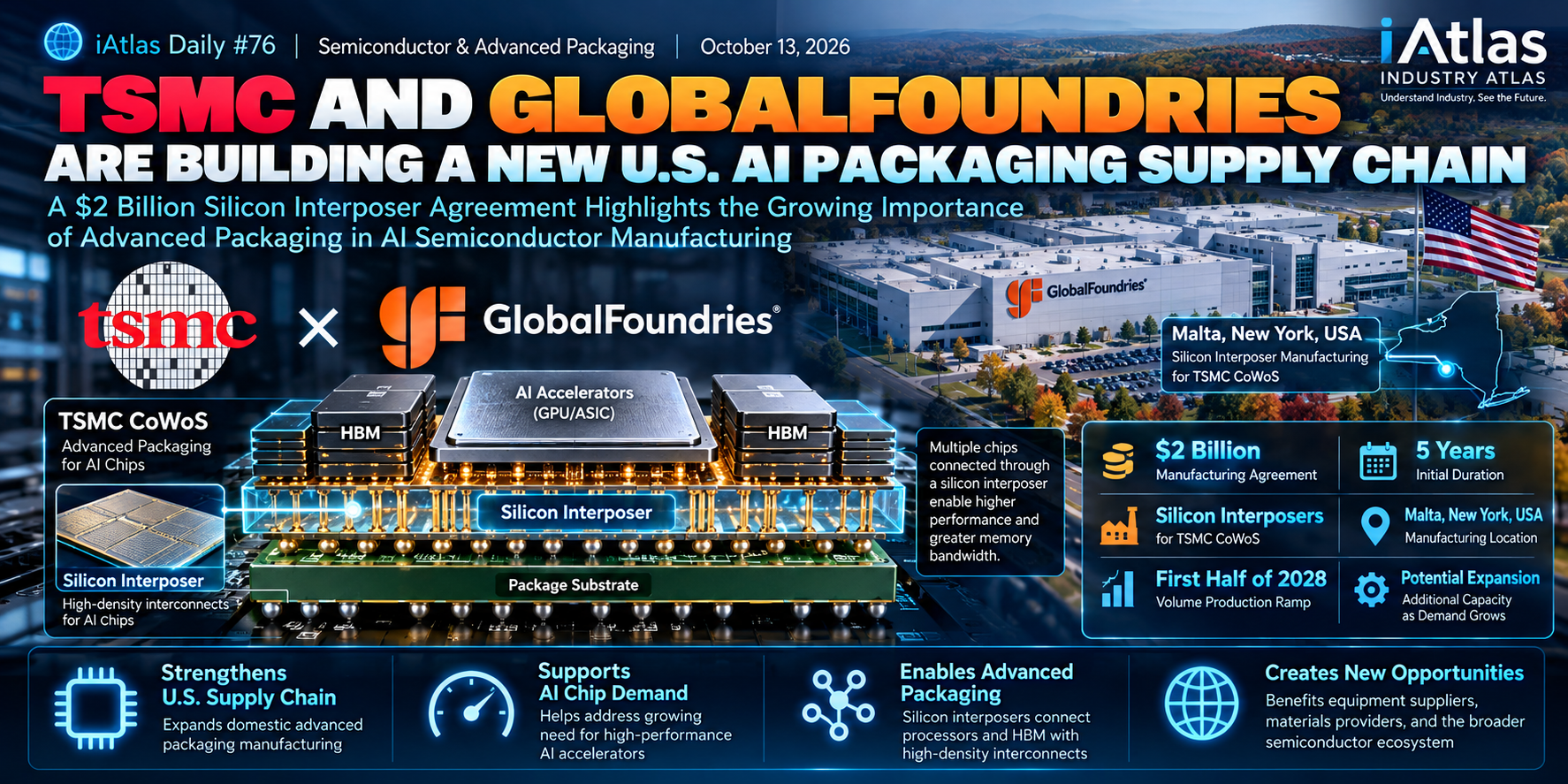
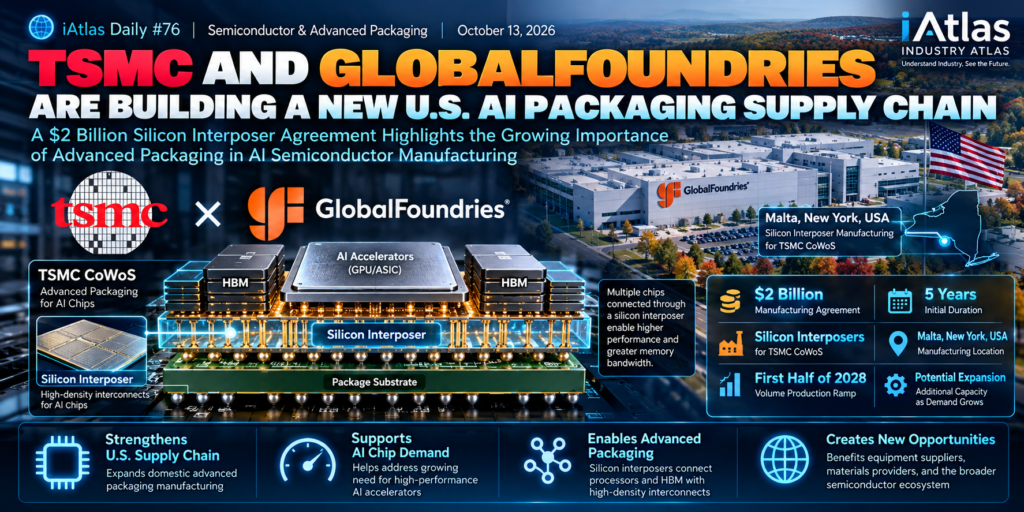
On October 8, 2026, GlobalFoundries announced a $2 billion, five-year manufacturing agreement with TSMC to produce silicon interposers for TSMC’s CoWoS advanced packaging ecosystem.
Under the agreement, GlobalFoundries will expand manufacturing capacity at its Malta, New York facility, with volume production expected to begin ramping up in the first half of 2028.
The arrangement is significant because silicon interposers help connect advanced processors and high-bandwidth memory within the same semiconductor package.
As AI accelerators become more complex, the ability to manufacture and integrate these components is becoming increasingly important.
The agreement also reflects a broader industry shift.
Advanced packaging is no longer simply the final step in semiconductor manufacturing. It is becoming a strategic part of the AI chip supply chain.
1. What Exactly Did TSMC and GlobalFoundries Agree To?
The agreement establishes a manufacturing relationship in which GlobalFoundries will supply silicon interposers for TSMC’s advanced packaging ecosystem.
The key details are:
| Item | Agreement Details |
|---|---|
| Companies | TSMC and GlobalFoundries |
| Agreement value | $2 billion |
| Initial duration | Five years |
| Manufacturing location | Malta, New York, United States |
| Product | Silicon interposers |
| Application | TSMC CoWoS advanced packaging |
| Production ramp | First half of 2028 |
| Expansion | Additional capacity possible as demand grows |
The agreement includes support for advanced interposer technologies, including embedded deep trench capacitor components.
GlobalFoundries expects the investment to establish a U.S.-based source of silicon interposers supporting this advanced packaging ecosystem.
Importantly, the agreement does not mean GlobalFoundries will manufacture TSMC’s leading-edge AI processors.
Its role is focused on a specialized component within the broader advanced packaging process.
That distinction helps explain why the partnership matters.
TSMC remains a leader in advanced logic manufacturing, while GlobalFoundries is expanding its role in supplying the supporting technologies required to build complete AI semiconductor systems.
2. Why Silicon Interposers Matter for AI Chips
Modern AI accelerators are no longer defined by a single processor die.
Many high-performance AI systems integrate multiple components, including:
- GPU or AI accelerator dies
- High-bandwidth memory (HBM)
- High-density interconnect structures
- Package substrates
- Power delivery and supporting components
These components must communicate at extremely high speeds while minimizing power consumption and signal delays.
A silicon interposer provides a high-density interconnection platform between chips.
In advanced packaging architectures, processor dies and HBM stacks can be positioned on an interposer, which enables electrical connections at much finer densities than conventional package substrates alone.
This is particularly important for AI systems.
As computing performance increases, processors require access to larger amounts of memory bandwidth.
HBM helps address this requirement, but the memory must also be connected efficiently to the processor.
The interposer is one of the technologies that makes this integration possible.
Without sufficient advanced packaging capacity, manufacturing more processor wafers alone may not translate into more completed AI accelerators.
3. CoWoS Is Becoming a Strategic Manufacturing Technology
TSMC’s CoWoS, short for Chip-on-Wafer-on-Substrate, is an advanced packaging technology used to integrate multiple semiconductor components.
It enables high-performance processors and memory to operate within a closely connected package.
A simplified CoWoS manufacturing structure can be understood as follows:
Advanced Logic Dies + HBM → Silicon Interposer → Package Substrate → Completed Semiconductor Package
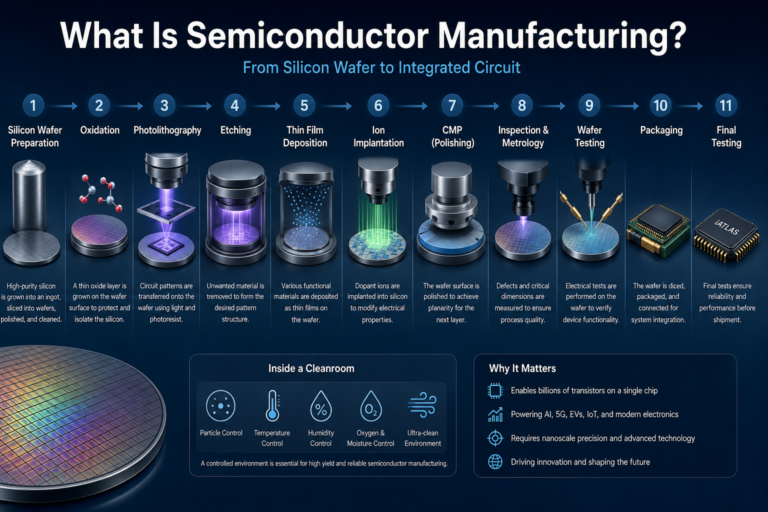
The actual manufacturing flow is more complex and involves numerous fabrication, bonding, assembly, inspection, and testing processes.
But the central principle is straightforward.
Instead of relying on one increasingly large monolithic chip, advanced packaging enables multiple components to function together as a high-performance system.
This approach is particularly important as semiconductor scaling becomes more technically and economically challenging.
Advanced packaging can help manufacturers improve system performance without depending exclusively on smaller transistor dimensions.
The TSMC GlobalFoundries partnership reinforces the growing strategic importance of this manufacturing layer.
4. Why TSMC Is Expanding Its U.S. Packaging Supply Chain
The semiconductor industry has traditionally operated through a globally distributed supply chain.
Advanced logic fabrication, memory production, packaging, and testing frequently take place in different locations.
This specialization has supported efficiency and technological progress.
However, rapid growth in AI computing has increased the importance of securing reliable capacity across the entire manufacturing chain.
For TSMC, expanding silicon interposer supply provides several potential advantages.
Additional manufacturing capacity
A new supplier can help expand the availability of a component used in advanced AI packages.
Supply-chain diversification
Establishing a U.S.-based source can reduce dependence on a narrower geographic manufacturing footprint.
Long-term production planning
A multiyear manufacturing agreement creates a framework for investment and future capacity expansion.
Support for AI customers
Additional interposer capacity could help support demand for increasingly complex AI and high-performance computing products.
However, silicon interposer production is only one part of the packaging supply chain.
Additional fabrication, assembly, testing, and qualification capabilities are still required to produce complete semiconductor packages.
Therefore, the agreement should be understood as an expansion of U.S. advanced packaging capabilities, rather than the completion of an entirely domestic AI chip manufacturing ecosystem.
5. Why GlobalFoundries Is an Interesting Partner
GlobalFoundries is not primarily competing with TSMC in the most advanced transistor manufacturing nodes.
Instead, it has developed a business around differentiated semiconductor technologies and manufacturing platforms.
These include technologies used in communications, automotive electronics, power management, radio-frequency applications, and other specialized semiconductor markets.
The new agreement demonstrates how established semiconductor manufacturing infrastructure can support additional parts of the AI value chain.
GlobalFoundries’ Malta facility will expand its role by producing specialized interposer components for advanced packaging.
This is strategically significant because not every semiconductor component requires the most advanced transistor node.
Some of the industry’s most important manufacturing opportunities are found in supporting technologies.
Interposers, substrates, power delivery, photonics, and packaging-related components can all influence the performance and availability of advanced computing systems.
The AI semiconductor supply chain creates opportunities beyond leading-edge logic fabrication.
6. What This Means for Semiconductor Equipment and Materials
The agreement also has implications for equipment and materials suppliers.
Silicon interposer manufacturing involves precision semiconductor fabrication processes.
Depending on the interposer architecture, these may include lithography, etching, deposition, metallization, wafer thinning, inspection, and through-silicon-via processing.
Advanced interposers can also incorporate passive components such as deep trench capacitors.
As manufacturing capacity expands, demand may increase for equipment and materials associated with these processes.
| Supply Chain Segment | Potential Relevance |
|---|---|
| Lithography equipment | Fine interconnect patterning |
| Etching equipment | Via and structural feature formation |
| Deposition equipment | Insulating and conductive layers |
| Metallization | High-density electrical connections |
| Wafer processing | Thinning, handling, and surface preparation |
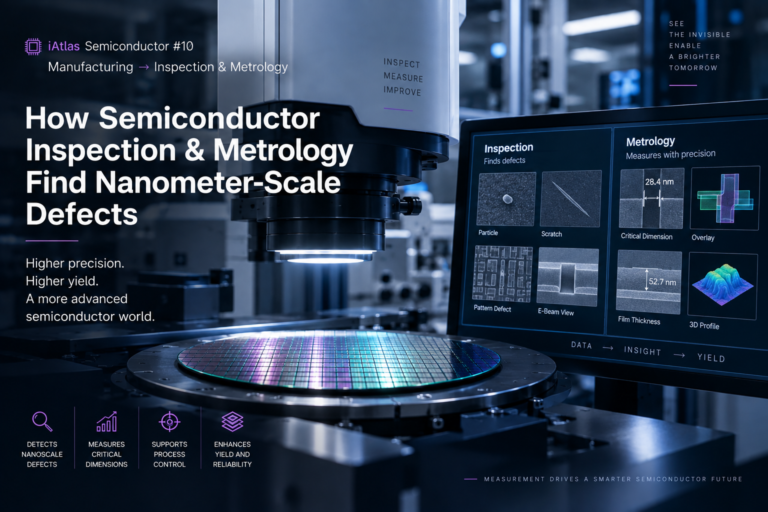
| Inspection and metrology | Defect detection and dimensional control |
| Advanced materials | Dielectrics, conductors, and packaging materials |
These are potential industry implications rather than confirmed equipment orders under the agreement.
The actual investment opportunities will depend on the manufacturing process selected, the scale of capacity expansion, and the qualification requirements established by TSMC.
7. Advanced Packaging Is Becoming a Supply-Chain Bottleneck
The semiconductor industry often measures manufacturing capacity in wafer starts per month.
But for AI accelerators, wafer fabrication is only part of the equation.
A completed AI chip package may require advanced logic dies, HBM stacks, interposers, substrates, and sophisticated assembly processes.
If any critical component is unavailable, the final package cannot be completed on schedule.
This creates a different kind of manufacturing constraint.
Increasing advanced logic capacity may have limited immediate value if advanced packaging capacity cannot expand at a similar pace.
The TSMC GlobalFoundries agreement addresses one part of this challenge by developing additional silicon interposer manufacturing capacity.
It does not eliminate all packaging bottlenecks.
But it illustrates how manufacturers are expanding their focus beyond the wafer fabrication stage.
For further context, see iAtlas’s analysis of TSMC’s advanced packaging capacity expansion.
Industry Impact
The agreement could influence several areas of the semiconductor industry.
Foundries: Specialized manufacturing capabilities may create new partnership opportunities across different parts of the semiconductor value chain.
Advanced packaging providers: Greater interposer availability could support future expansion of high-performance packaging capacity.
AI chip developers: A more diversified supply chain may improve long-term production planning, subject to qualification and capacity execution.
Equipment manufacturers: Expansion of interposer fabrication could create demand for specialized semiconductor process equipment.
Materials suppliers: Advanced packaging growth may increase the strategic importance of interconnect and dielectric materials.
U.S. semiconductor infrastructure: Domestic interposer production could strengthen one important part of the country’s advanced semiconductor manufacturing ecosystem.
What to Watch
2028 production ramp: GlobalFoundries’ ability to begin volume production on schedule will be a major milestone.
TSMC qualification: Manufacturing yield, reliability, and process compatibility will determine whether the new supply source meets TSMC’s requirements.
Additional capacity: The agreement provides a framework for expansion, but the timing and scale of future investment remain dependent on demand.
Advanced packaging technology: Larger packages, higher interconnect density, and evolving memory architectures could change interposer requirements.
U.S. supply-chain integration: Additional packaging and testing investments will determine how much of the complete AI semiconductor manufacturing process can be supported domestically.
iAtlas Insight
The TSMC GlobalFoundries partnership illustrates an important change in semiconductor competition.
For decades, the industry’s technological leadership was closely associated with the ability to manufacture smaller transistors.
That capability remains essential.
But the performance of advanced AI systems increasingly depends on how multiple semiconductor components are connected, packaged, powered, and cooled.
A leading-edge processor is only one part of the finished system.
High-bandwidth memory, interposers, package substrates, and advanced assembly technologies are also critical.
The $2 billion agreement demonstrates that semiconductor manufacturing partnerships are expanding into these supporting technologies.
It also highlights an opportunity for companies that do not compete directly in the most advanced logic nodes.
By specializing in strategically important manufacturing processes, they can participate in the growth of AI computing.
The next phase of semiconductor competition will not be defined by transistor scaling alone.
It will also depend on the ability to manufacture and integrate complete computing systems at scale.
And increasingly, that competition will extend across the entire advanced packaging supply chain.
Related Articles
iAtlas Daily #10: TSMC Expands Advanced Packaging Capacity as AI Demand Grows
Explore how rising AI chip demand is driving investment in advanced semiconductor packaging capacity.
References
1. GlobalFoundries — Official Announcement (October 8, 2026)
GlobalFoundries Reaches Agreement to Establish U.S.-Based Supply of Silicon Interposers for Advanced AI Packaging
2. GlobalFoundries — Investor Relations Press Release
GlobalFoundries Reaches Agreement to Establish U.S.-Based Supply
3. Reuters — October 8, 2026
GlobalFoundries to Make Key AI Chip Component for TSMC in $2 Billion Deal
4. Data Center Dynamics — October 8, 2026
GlobalFoundries Signs $2bn, Five-Year Deal with TSMC for Production of Advanced Packaging Components
5. Electronics360 — October 9, 2026
GF, TSMC Agree to Advanced Packaging Deal
ℹ️ About iAtlas
iAtlas is an independent publication covering batteries, semiconductors, OLED, advanced materials, AI, and global industrial trends.
We transform complex industrial developments into clear, reliable, and easy-to-understand insights.
Whether you’re following today’s industry news or building long-term expertise, iAtlas helps you understand not only what happened, but why it matters.
Technology creates change.
Insight creates opportunity.
— iAtlas