
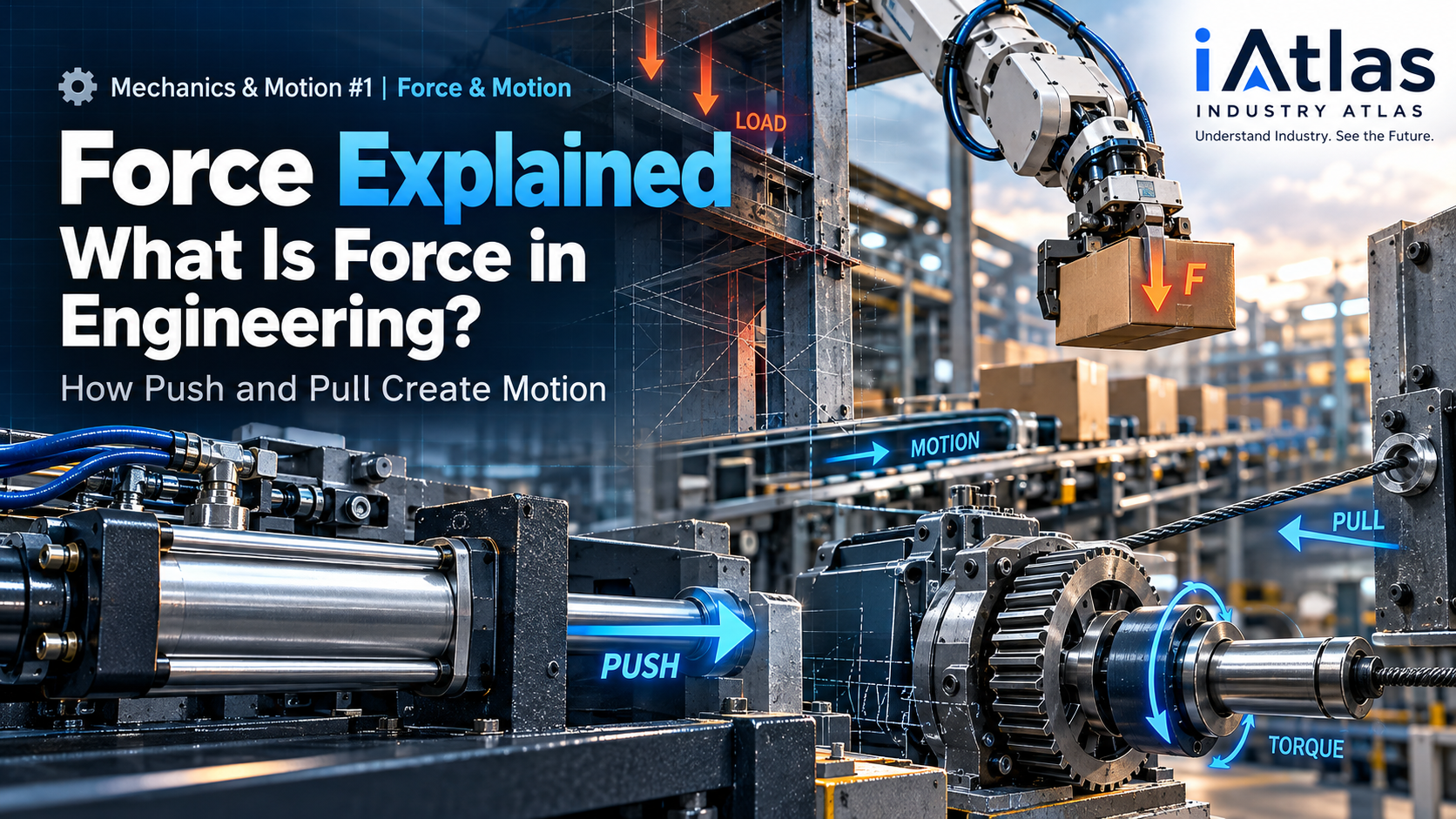
Force Explained: What Is Force in Engineering?
⚙️ Mechanics & Motion #1 | Force & Motion → What Is Force in Engineering?
What is force in engineering?
Force is one of the most fundamental concepts used to understand how machines, structures, vehicles, robots, and industrial equipment move and behave.
Whenever something starts moving, stops, changes direction, bends, stretches, compresses, or rotates, force is involved.
In simple terms:
Force is a push or pull acting on an object.
This definition sounds simple, but understanding force opens the door to many other engineering concepts—from motion and torque to stress, vibration, and structural design.
What Is Force in Engineering?
In engineering, force describes an interaction that can change the motion or shape of an object.
A force can:
- Start an object moving
- Stop a moving object
- Increase or decrease its speed
- Change its direction
- Stretch or compress a material
- Bend a structure
- Create rotation
For example, pushing a cart creates force.
A motor creates forces that move mechanical components.
A hydraulic cylinder generates force to lift or press a load.
Gravity continuously applies force to objects around us.
Force is therefore one of the foundations of engineering mechanics.
Force, Mass, and Acceleration
One of the most important relationships in mechanics is Newton’s second law:
F = m × a
where:
- F = Force
- m = Mass
- a = Acceleration
More precisely, Newton’s second law states that the net external force acting on a system equals its mass multiplied by its acceleration. OpenStax
This relationship tells us something intuitive:
More force → more acceleration
and
More mass → more force required for the same acceleration
A Simple Example
Imagine a 10 kg object accelerating at 2 m/s².
Using:
F = m × a
we get:
F = 10 kg × 2 m/s²
F = 20 N
So a net force of 20 newtons is required to produce that acceleration.
Now imagine the mass increases to 20 kg while the desired acceleration remains the same.
F = 20 kg × 2 m/s²
F = 40 N
Doubling the mass doubles the required force.
This simple relationship appears throughout mechanical engineering.
What Is a Newton?
The SI unit of force is the newton, abbreviated:
N
One newton is defined as:
1 N = 1 kg·m/s²
In other words, one newton is the force required to accelerate a mass of 1 kilogram at 1 meter per second squared. OpenStax
Industrial forces may also be expressed in:
- N
- kN
- MN
where:
1 kN = 1,000 N
1 MN = 1,000,000 N
Large machines, structural systems, presses, and heavy equipment often deal with forces measured in kilonewtons or even meganewtons.
Force Has Both Magnitude and Direction
Force is not described only by how large it is.
It also has a direction.
For example:
100 N
describes only the magnitude.
But:
100 N →
describes both magnitude and direction.
Because force has magnitude and direction, force is a vector quantity.
This becomes particularly important when multiple forces act on the same object.
What Is Net Force?
In real engineering systems, an object usually experiences several forces simultaneously.
Consider a box being pushed along a surface.
A person pushes the box to the right with:
100 N →
while friction acts in the opposite direction:
← 30 N
The net force is:
100 N − 30 N = 70 N
So:
Net Force = 70 N →
It is the net external force, rather than any single force, that determines the resulting acceleration. OpenStax
Balanced vs Unbalanced Forces
This leads to another important distinction.
Balanced Forces
Consider:
100 N → [Object] ← 100 N
The forces are equal and opposite.
Therefore:
Net Force = 0 N
When the net force is zero, there is no acceleration. An object at rest can remain at rest, while an object already moving can continue with constant velocity if the forces remain balanced.
Unbalanced Forces
Now consider:
150 N → [Object] ← 50 N
The net force is:
100 N →
Because the net force is not zero, the object accelerates in the direction of the net force.
Understanding balanced and unbalanced forces is essential when analyzing machinery and structures.
Common Types of Force in Engineering
Force can appear in many different forms.
Gravitational Force
Gravity pulls objects toward Earth.
The gravitational force acting on an object is called its weight.
Near Earth’s surface:
W = m × g
where:
- W = Weight
- m = Mass
- g = Gravitational acceleration
Near Earth’s surface, gravitational acceleration is approximately:
9.8 m/s²
Therefore, a 10 kg object has a weight of approximately:
10 × 9.8 = 98 N
OpenStax distinguishes mass from weight: mass describes the amount/inertia of the object, while weight is the gravitational force acting on that mass. OpenStax
Friction Force
Friction acts between surfaces and tends to resist relative motion.
You encounter friction in:
- Bearings
- Conveyor systems
- Tires
- Sliding mechanisms
- Mechanical seals
- Linear guides
Friction is not always undesirable.
Without friction, tires could not grip roads and many clamping systems could not hold objects securely.
But excessive friction can cause:
Heat → Wear → Energy loss
We will examine friction in more detail later in the Mechanics & Motion series.
Normal Force
When an object rests on a surface, the surface can exert a force perpendicular to itself.
This is called the normal force.
For example, industrial equipment sitting on a floor applies a downward load, while the supporting surface provides an upward reaction.
Tension
Tension is associated with pulling forces in components such as:
- Cables
- Ropes
- Chains
- Tie rods
- Structural members
Crane cables are a simple example.
The cable experiences tension while supporting the suspended load.
Compression
Compression occurs when forces push a material or component together.
Examples include:
- Structural columns
- Machine supports
- Press systems
- Compression fittings
Materials behave differently under tension and compression, which is why both are important in structural and mechanical design.
Shear Force
Shear acts parallel to a surface or cross-section and tends to make adjacent portions of a material slide relative to one another.
Bolts, pins, joints, and sheet materials often experience shear forces.
Later in this series, we will look more closely at how different loads produce stress inside materials.
Spring Force
A spring can produce force when it is:
- Compressed
- Stretched
Springs are widely used in:
- Valves
- Mechanical switches
- Suspension systems
- Actuators
- Safety mechanisms
The generated force typically changes as the spring is displaced.
Force vs Mass vs Weight
These three terms are often confused.
| Concept | Meaning | Typical SI Unit |
|---|---|---|
| Mass | Amount of matter / inertia | kg |
| Force | Push or pull | N |
| Weight | Gravitational force on mass | N |
For example, an object may have:
Mass = 10 kg
but its weight on Earth is approximately:
98 N
So:
Kilograms measure mass, not force.
This distinction becomes important when reading equipment specifications.
Force in Industrial Equipment
Understanding force in engineering becomes much easier when we look at real industrial equipment.
Pneumatic Cylinders
A pneumatic cylinder uses compressed gas to move a piston.
A simplified relationship is:
Force = Pressure × Area
or:
F = P × A
This means that available force generally increases when:
- Pressure increases
- Piston area increases
That is why cylinder diameter and operating pressure are important specifications when selecting pneumatic equipment.
Hydraulic Systems
Hydraulic systems use pressurized liquids rather than compressed gas.
Because hydraulic systems can operate at relatively high pressures, they can generate large forces with comparatively compact actuators.
This makes hydraulics common in:
- Press machines
- Construction equipment
- Lifting equipment
- Heavy industrial machinery
Robots
Industrial robots require forces to:
- Lift components
- Move arms
- Grip objects
- Accelerate loads
- Stop safely
The required force changes depending on payload, acceleration, geometry, and operating conditions.
Conveyors
Conveyor motors must generate enough mechanical output to overcome:
- Load
- Friction
- Inertia
and accelerate the conveyor and transported materials.
Force therefore contributes directly to motor and drive-system selection.
Clamping Systems
Manufacturing processes often require a workpiece to remain fixed.
Clamps apply force to prevent unwanted movement during:
- Machining
- Assembly
- Welding
- Inspection
Too little clamping force may allow movement.
Too much may deform or damage the workpiece.
Engineering is often about finding the appropriate amount—not simply maximizing force.
Force Can Create Rotation
Force does not always produce straight-line motion.
When a force is applied at a distance from a rotational axis, it can create a turning effect.
This is called torque.
For example:
- Turning a wrench
- Rotating a valve handle
- Driving a shaft
- Operating a gearbox
This relationship will become important later when we study rotational motion and torque.
Force and Structural Design
Machines and structures must withstand the forces acting on them.
Consider an equipment frame supporting a heavy machine.
Engineers may need to consider:
- Weight
- Dynamic forces
- Vibration
- Tension
- Compression
- Bending
- Shear
If the resulting loads exceed what a component can safely withstand, the component may deform or fail.
This eventually leads us to concepts such as:
Load → Stress → Strain → Deformation → Failure
These will be covered later in the Mechanics & Motion learning path.
Force and Motion Are Connected
Force is important because it connects directly to motion.
A net force can cause:
Force
↓
Acceleration
↓
Change in velocity
↓
Change in motion
This relationship forms the foundation for much of classical mechanics. OpenStax
Once force is understood, concepts such as motion, work, energy, power, torque, vibration, and mechanical loading become much easier to follow.
A Simple Way to Analyze Force
Whenever you encounter a mechanical system, ask five questions:
- What is creating the force?
- What object does the force act on?
- How large is the force?
- Which direction does it act?
- What effect does the force produce?
For example:
Pneumatic cylinder
→ compressed air creates force
→ force acts on the piston
→ piston moves
→ mechanical equipment moves
This simple approach is useful for understanding many industrial mechanisms.
Key Takeaway
Force in engineering is one of the fundamental concepts used to explain how physical systems move, deform, and interact.
Force is a push or pull that can change the motion or shape of an object.
Its SI unit is the newton (N).
One of the most important relationships is:
F = m × a
But real engineering systems often involve several forces acting simultaneously, so understanding net force, direction, load, friction, tension, and compression is equally important.
Learning force provides the foundation for understanding the rest of mechanics.
Engineering Fundamentals Learning Path
Previous Lesson
⚙️ Engineering Fundamentals | Introduction → What Is Engineering?
What Is Engineering? Engineering Explained Simply
Discover how science, mathematics, materials, electricity, mechanics, and control systems come together to solve practical industrial problems.
Next Lesson
⚙️ Mechanics & Motion #2 | Motion → How Objects Move in Engineering
Motion Explained: How Objects Move in Engineering
Learn how position, distance, displacement, speed, velocity, and acceleration describe the movement of machines and physical systems.
References
- OpenStax — Newton’s Second Law of Motion
Covers the relationship among net force, mass and acceleration, as well as the SI definition of the newton and the distinction between mass and weight. - OpenStax — University Physics: Newton’s Second Law
Detailed treatment of net external force, mass, acceleration, and vector forces. - NIST — Guide to the SI: Force Units and Conversion Factors
Reference information for newtons and other force-related units.
ℹ️ About iAtlas
iAtlas is an independent publication covering batteries, semiconductors, OLED, advanced materials, AI, and global industrial trends.
We transform complex industrial developments into clear, reliable, and easy-to-understand insights.
Whether you’re following today’s industry news or building long-term expertise, iAtlas helps you understand not only what happened, but why it matters.
Technology creates change.
Insight creates opportunity.
— iAtlas