What If Solar Panels Could Generate More Power from the Same Sunlight?
How Perovskite-Silicon Tandem Solar Cells Could Transform Solar Efficiency, Manufacturing, and the Future of Renewable Energy
iAtlas Daily #83 | Perovskite Solar & Energy Technology | October 22, 2026
The Next Solar Breakthrough May Come from Better Materials, Not More Panels
Perovskite solar cells could transform the future of solar energy by generating more electricity from the same amount of sunlight.
Imagine generating more electricity from a rooftop without installing additional solar panels.
For homeowners, that could mean producing more electricity from limited roof space. For large solar farms, it could mean increasing energy output without expanding the installation area.
This is the promise of perovskite-silicon tandem solar cells, one of the most closely watched technologies in next-generation solar energy.
Conventional silicon solar panels have improved dramatically over several decades. However, silicon has a fundamental limitation: it cannot efficiently convert every part of sunlight into electricity.
Researchers are now exploring a different approach.
Instead of replacing silicon entirely, they are combining it with another light-absorbing material called perovskite.
The result could be a new generation of solar panels capable of generating more electricity from the same sunlight.
But the path from laboratory efficiency records to commercial solar farms is far from straightforward.
1. Why Conventional Silicon Solar Cells Have an Efficiency Limit
Solar cells generate electricity by converting sunlight into electrical energy.
The efficiency of a solar cell describes how much incoming solar energy it converts into usable electricity.
Modern commercial silicon solar modules commonly operate at efficiencies of approximately 20–24%, depending on their technology and design.
But even an ideal single-junction silicon solar cell has a theoretical efficiency ceiling.
According to Fraunhofer ISE, the physical maximum efficiency of silicon solar cells is approximately 29.4%.
Why does this limitation exist?
Sunlight contains photons with different energies.
Some photons do not have enough energy to be absorbed by silicon, while some of the excess energy from higher-energy photons is lost as heat.
This means that simply improving the manufacturing quality of silicon cells cannot eliminate all energy losses.
To achieve substantially higher efficiencies, researchers need a different solar-cell architecture.
That is where tandem technology comes in.
2. How Perovskite-Silicon Tandem Solar Cells Work
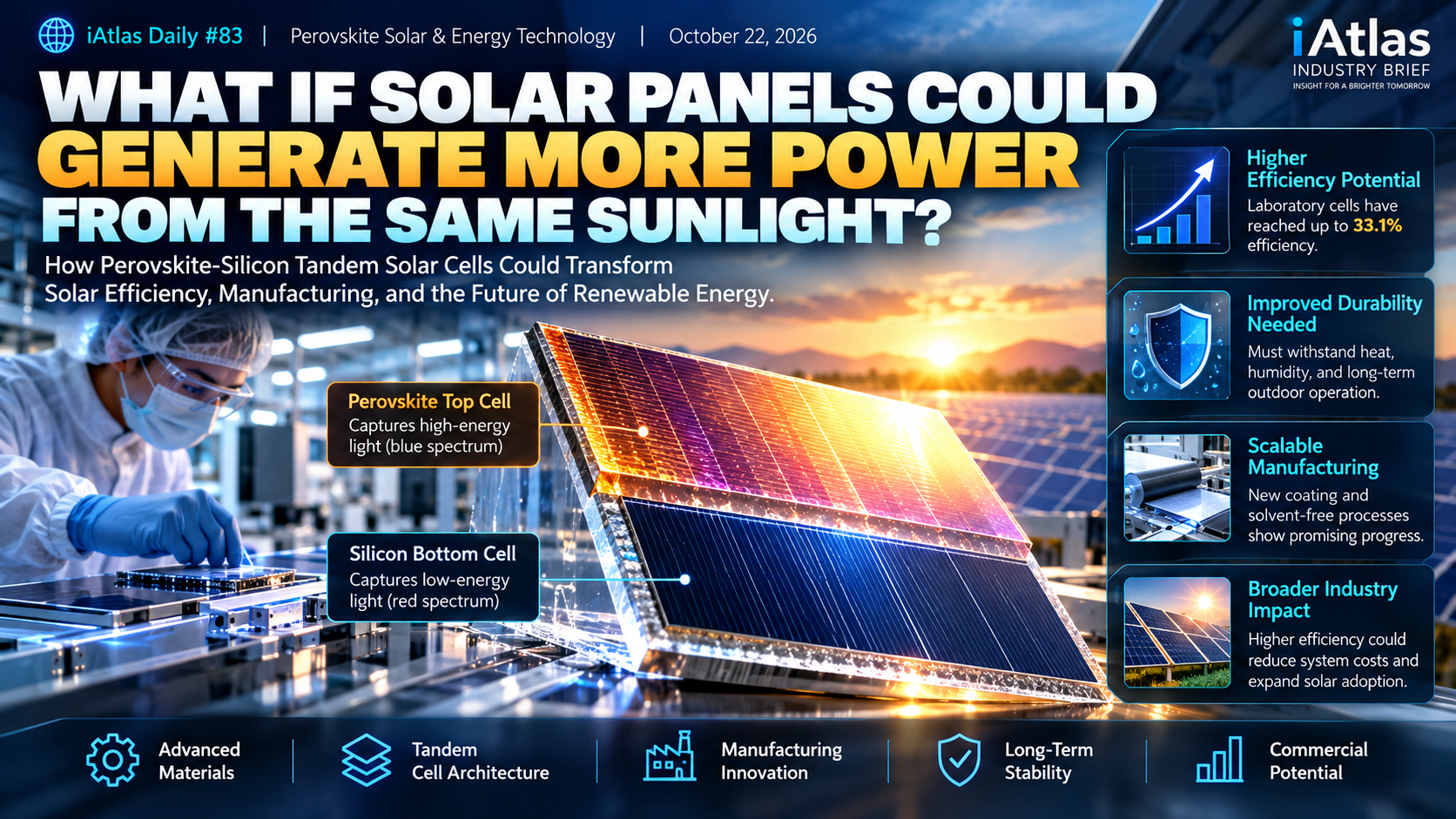
A tandem solar cell combines two light-absorbing layers that are optimized for different parts of the solar spectrum.
In a common perovskite-silicon tandem design:
- The upper perovskite cell captures higher-energy photons, including much of the blue portion of sunlight.
- The lower silicon cell captures lower-energy photons that pass through the upper layer.
By dividing the work between two materials, the tandem structure reduces some of the energy losses found in conventional single-junction solar cells.
The principle is relatively simple.
Instead of asking one material to capture sunlight across a broad energy range, two complementary materials work together.
A Laboratory Efficiency of 33.1%
In September 2025, an international research team involving KAUST, the University of Freiburg, and Fraunhofer ISE reported a perovskite-silicon tandem solar cell with a power conversion efficiency of up to 33.1%.
The researchers improved surface passivation, reducing energy losses associated with charge-carrier recombination and transport.
Importantly, the approach was demonstrated using textured silicon cells, which are relevant to established industrial solar-cell manufacturing.
However, this was a laboratory cell result, not proof that commercial modules can consistently achieve the same efficiency.
That distinction is essential when evaluating the technology’s commercial potential.
3. Why Higher Efficiency Matters Economically
Higher solar-cell efficiency is more than a technical achievement.
It can influence the economics of an entire solar power project.
Consider two hypothetical solar installations with the same panel area.
If one system operates at 22% module efficiency and another achieves 27%, the higher-efficiency system has approximately 23% greater rated power output under the same standard test conditions.
This does not mean its annual electricity generation will automatically increase by exactly 23%.
Real-world performance also depends on temperature, sunlight conditions, shading, system design, and degradation over time.
Nevertheless, higher efficiency can provide important advantages.
More Power from Limited Space
Rooftops, industrial buildings, and urban installations often have limited available surface area.
Higher-efficiency modules can increase installed capacity without requiring additional space.
Potential Reductions in System-Level Costs
More power from each module may reduce certain costs relative to electricity output, including mounting structures, installation labor, and land requirements.
Improved Opportunities for High-Value Applications
Space-constrained applications may be especially attractive for early adoption, where additional energy output can justify a higher module price.
However, higher efficiency alone does not guarantee lower electricity costs.
The additional manufacturing expense and operating lifetime of tandem modules must also be considered.
4. The Biggest Challenge: Making Perovskite Solar Cells Last
If perovskite-silicon tandem cells can achieve such high efficiency, why are they not already replacing conventional silicon panels everywhere?
One major reason is durability.
Commercial solar modules are expected to operate outdoors for decades.
They must withstand repeated temperature changes, humidity, ultraviolet exposure, mechanical stress, and other environmental conditions.
Perovskite materials can be particularly sensitive to moisture, elevated temperatures, and structural changes.
These vulnerabilities can cause performance degradation over time.
Researchers are therefore developing improved materials, protective interfaces, and encapsulation technologies to extend device lifetimes.
For tandem solar cells, achieving high initial efficiency is only the beginning.
The technology must also demonstrate that it can preserve its performance throughout years of real-world operation.
A module that begins with exceptional efficiency but degrades rapidly may ultimately produce less lifetime electricity than a conventional silicon module.
The true commercial benchmark is not simply peak efficiency. It is reliable energy generation over the module’s lifetime.
5. Manufacturing at Scale Is Another Major Obstacle
Laboratory solar cells are often fabricated using processes optimized for small samples.
Industrial manufacturing requires something very different.
A commercially viable production process must deliver consistent quality across large surfaces, operate at high throughput, and maintain competitive costs.
This is particularly challenging for perovskite layers.
Producing uniform thin films over large areas requires precise control of material composition, deposition conditions, and crystallization.
Small defects can reduce efficiency or accelerate degradation.
Moving Beyond Laboratory Coating
In June 2025, Fraunhofer ISE and KAUST reported progress toward scalable manufacturing by replacing laboratory-oriented spin-coating with blade-coating in a hybrid deposition process.
The researchers demonstrated tandem solar cells with efficiencies of 27.8% using this approach.
The significance was not a new overall efficiency record.
It was evidence that a more scalable coating technique could be integrated into tandem-cell fabrication.
Further progress followed in August 2026, when researchers from the University of Freiburg and Fraunhofer ISE reported a solvent-free process chain for perovskite-silicon tandem solar cells.
The process used physical vapor deposition and other solvent-free techniques to investigate a potentially more scalable manufacturing route.
These developments illustrate an important shift in the field.
Research is increasingly focused not only on how efficiently a cell converts sunlight, but also on how reliably and economically it can be manufactured.
6. What Needs to Happen Before Mass Commercialization?
For perovskite-silicon tandem technology to compete broadly with established silicon photovoltaics, several conditions must come together.
Long-Term Reliability
Manufacturers must demonstrate stable performance under standardized accelerated testing and extended outdoor operation.
High Manufacturing Yields
Production lines must consistently produce large-area cells and modules with minimal defects.
Competitive Production Costs
Higher efficiency must justify any additional materials, equipment, and processing costs.
Reliable Encapsulation
Protective structures must prevent moisture ingress and withstand mechanical and thermal stresses without damaging sensitive layers.
Bankability and Certification
Project developers, insurers, investors, and lenders need confidence in module performance, warranty commitments, and lifetime electricity generation.
These requirements explain why record-breaking laboratory results do not immediately translate into widespread commercial adoption.
The challenge is no longer confined to materials science.
It also involves equipment engineering, industrial process control, quality assurance, and project economics.
7. Industry Implications: A New Opportunity Across the Solar Supply Chain
Perovskite-silicon tandem technology could reshape parts of the photovoltaic value chain.
For established silicon manufacturers, tandem cells offer a possible route to higher efficiency while retaining portions of existing silicon manufacturing infrastructure.
For materials suppliers, the technology creates demand for specialized absorbers, transport layers, interface materials, and encapsulation solutions.
For equipment manufacturers, large-area thin-film deposition, precision coating, environmental control, and advanced inspection could become increasingly important.
And for solar project developers, higher-efficiency modules could improve the economics of installations where available space is limited.
Why Process Control Matters
Perovskite manufacturing requires careful management of deposition conditions, material interfaces, and crystallization behavior.
Depending on the material formulation and process, moisture and oxygen exposure can influence film formation and stability.
This creates opportunities for controlled-atmosphere processing, precision coating equipment, vacuum deposition, and advanced inspection technologies.
However, not every perovskite process requires the same environmental conditions.
The appropriate manufacturing environment depends on the chemistry, deposition method, and desired device structure.
The commercial challenge is therefore to identify process conditions that consistently deliver high-quality films without creating unnecessary manufacturing costs.
iAtlas Insight | Why Manufacturing Matters More Than Efficiency Records
Perovskite-silicon tandem solar cells represent more than another improvement in solar-cell efficiency.
They illustrate a broader shift in advanced energy technologies: the transition from laboratory performance to industrial manufacturability.
Achieving record efficiency under controlled laboratory conditions is an important scientific milestone. However, commercial success requires consistent performance across large-area modules, reliable manufacturing yields, and long-term environmental stability.
Three factors will be particularly important.
1. Manufacturing Scalability
The ability to deposit uniform perovskite layers across large surfaces will influence production costs, defect rates, and manufacturing yields.
2. Environmental Stability
Moisture, oxygen, temperature, and ultraviolet exposure can affect perovskite materials and interfaces. Controlling degradation during manufacturing and throughout product operation is essential.
3. Commercial Competitiveness
Higher efficiency must translate into lower lifetime electricity costs or other meaningful economic advantages. Additional manufacturing complexity cannot be ignored.
For materials and equipment suppliers, this transition could create opportunities in precision coating, thin-film deposition, environmental control, encapsulation, and advanced inspection technologies.
For solar manufacturers, the competitive advantage may increasingly depend on integrating materials innovation with scalable, reliable production processes.
The next breakthrough in solar energy may not be the highest laboratory efficiency record, but the first manufacturing platform capable of delivering high-efficiency tandem modules reliably and economically at scale.
Related Articles
Semiconductor Manufacturing
How Thin Film Deposition Builds Semiconductor Devices Layer by Layer
Explore how precision deposition technologies such as PVD, CVD, and ALD create advanced material layers—and why film uniformity and interface control matter for next-generation devices.
Industrial Strategy & Manufacturing
The Next Industrial Advantage Is Flexibility
Discover why manufacturing flexibility, process innovation, and production economics are becoming increasingly important across advanced technology industries.
Energy & Industrial Supply Chains
Industrial Competition Is Moving Deeper into the Supply Chain
Understand how advanced materials, manufacturing equipment, and energy infrastructure are reshaping industrial competitiveness and creating new opportunities across technology supply chains.
References
Research reporting 33.1% conversion efficiency through improved passivation and interface engineering.
2. Fraunhofer ISE — Scalable Manufacturing of Perovskite-Silicon Tandem Solar Cells (2025)
Research demonstrating blade-coating as a potentially scalable alternative to laboratory spin-coating processes.
3. Fraunhofer ISE — Solvent-Free Tandem Solar Cell Manufacturing (2026)
Research exploring solvent-free manufacturing processes for perovskite-silicon tandem solar cells.
4. Fraunhofer ISE — Silicon-Based Tandem Solar Cells and Modules
Technical overview of tandem photovoltaic architectures, efficiency potential, and industrial implementation.
Scientific publication in Science examining passivation, charge transport, and high-efficiency tandem solar cells.
ℹ️ About iAtlas
iAtlas is an independent publication covering batteries, semiconductors, OLED, advanced materials, AI, and global industrial trends.
We transform complex industrial developments into clear, reliable, and easy-to-understand insights.
Whether you’re following today’s industry news or building long-term expertise, iAtlas helps you understand not only what happened, but why it matters.
Technology creates change.
Insight creates opportunity.
— iAtlas