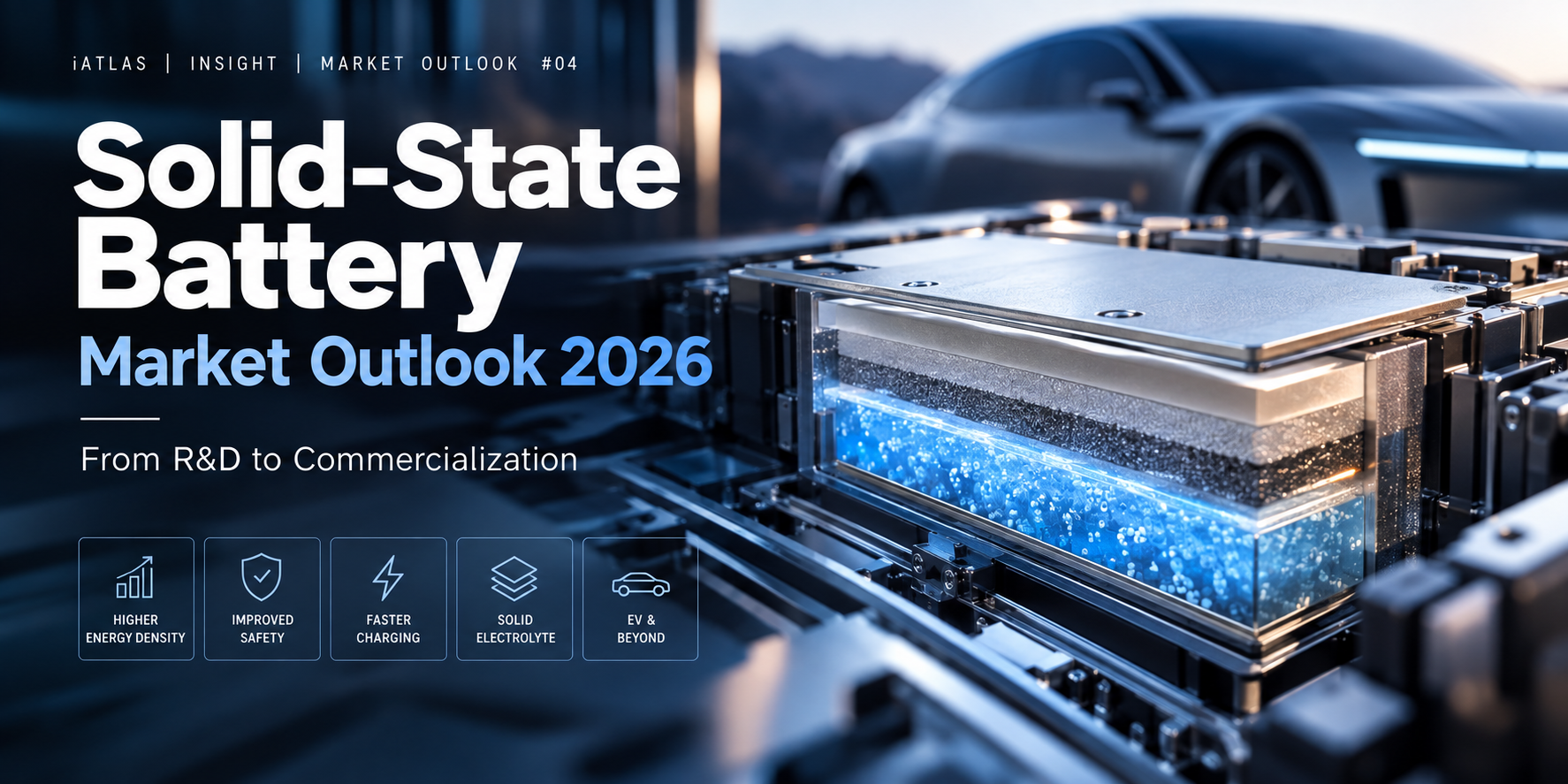
Solid-State Battery Market Outlook 2026
From R&D to Commercialization
iAtlas | Insight | Market Outlook #04
The solid-state battery market outlook for 2026 is entering a critical transition.
For years, solid-state batteries have been described as one of the most promising next-generation battery technologies. Their potential advantages — higher energy density, improved safety and compatibility with lithium-metal anodes — could significantly improve the performance of electric vehicles and other advanced applications.
But the industry is now approaching a much more difficult stage.
The question is no longer simply whether solid-state batteries can work in the laboratory.
It is whether they can be manufactured reliably, economically and at automotive scale.
Toyota is targeting the market launch of all-solid-state battery EVs around 2027–2028. Samsung SDI plans to begin mass production in the second half of 2027. Nissan is targeting EV introduction by fiscal 2028, while companies such as QuantumScape are moving pilot production toward customer testing and product integration. Idemitsu and Toyota
The next few years could therefore mark the beginning of commercialization.
But they are unlikely to mark the immediate replacement of conventional lithium-ion batteries.
Key Takeaways
- Solid-state batteries are moving from laboratory research toward pilot production and early commercialization.
- Toyota and Samsung SDI are targeting initial commercialization or production around 2027–2028. Idemitsu and Toyota
- Nissan aims to launch EVs using internally developed all-solid-state batteries by fiscal 2028. Global Nissan Newsroom
- The IEA expects early solid-state battery costs to remain high because manufacturing processes and supply chains are still immature. IEA
- Premium EVs are likely to be among the first major applications, where customers may be willing to pay for additional range and performance.
- Manufacturing challenges — including interface contact, pressure requirements, yield and solid-electrolyte production — remain major barriers.
- The IEA expects all-solid-state batteries to remain concentrated primarily in premium applications through the first half of the 2030s, rather than immediately becoming a mass-market battery. IEA
- Robotics and other high-value applications could emerge alongside EVs as early markets for solid-state technology. IEA
1. Solid-State Batteries Are Moving Beyond the Laboratory
Solid-state batteries are not a single technology.
The term covers several battery designs that replace some or all of the liquid electrolyte used in conventional lithium-ion batteries with solid materials.
This distinction is important.
Semi-solid and quasi-solid batteries may still contain liquid components, while all-solid-state batteries aim to operate with a mechanically solid electrolyte throughout the cell.
Some semi-solid battery technologies are already commercial.
True all-solid-state batteries, however, remain primarily at the prototype and pilot-production stage.
The IEA notes that all-solid-state cells are already being produced in small quantities for testing, but manufacturing remains more complex and expensive than conventional lithium-ion battery production. IEA
That means the industry is crossing an important boundary:
Research
↓
Prototype Cells
↓
Pilot Production
↓
Customer Validation
↓
Initial Commercialization
↓
Mass Production
The first four stages are already happening.
The challenge now is moving successfully through the final two.
2. Why Is the Battery Industry Pursuing Solid-State Technology?
Today’s lithium-ion batteries have improved dramatically.
LFP has become cheaper and more capable.
High-nickel NCM batteries continue to improve energy density.
Cell-to-pack technology reduces unnecessary structural weight.
Battery-management systems are becoming more sophisticated.
So why invest billions of dollars in an entirely new battery architecture?
Because conventional lithium-ion batteries still face fundamental trade-offs between:
Energy Density
Safety
Fast Charging
Weight
Lifetime
Solid-state technology could potentially change some of those trade-offs.
Replacing flammable liquid electrolytes with solid materials may improve safety characteristics.
More importantly, some solid-state architectures can enable the use of lithium-metal or anode-less designs, potentially increasing the amount of energy stored within the same battery volume.
Samsung SDI, for example, says its all-solid-state battery design using proprietary solid electrolyte and anode-less technology targets an energy density of 900 Wh/L, roughly 40% higher than its referenced mass-produced prismatic battery. Samsung SDI Newsroom
For EV manufacturers, higher energy density could translate into:
More Range
or
Smaller Battery
or
Lower Vehicle Weight
depending on how the technology is used.
3. Toyota Is Targeting 2027–2028
Toyota is one of the most closely watched companies in solid-state battery development.
The company has been developing sulfide-based all-solid-state batteries and is working with Japanese energy and materials company Idemitsu Kosan to establish a supply chain for solid electrolytes.
Toyota and Idemitsu have described a phased commercialization strategy.
The companies are developing and validating sulfide solid electrolytes, preparing pilot-scale production and eventually planning larger-scale manufacturing.
Toyota’s stated target is to introduce BEVs using all-solid-state batteries around 2027–2028. Idemitsu and Toyota
Toyota has previously indicated that its solid-state technology could offer significantly improved range and very rapid charging, while emphasizing that cost remains an area requiring further development. Toyota
The important point is not simply the target year.
Toyota is simultaneously developing:
- Battery technology
- Solid electrolytes
- Cathode materials
- Manufacturing processes
- Vehicle integration
- Supply-chain relationships
In other words, commercialization requires an entire industrial ecosystem, not just a successful battery cell.
4. Samsung SDI Is Also Targeting 2027
Korea is another important center of all-solid-state battery development.
Samsung SDI completed its S-Line solid-state battery pilot facility in 2023 and has supplied prototype cells to customers for evaluation.
The company currently plans to begin mass production of its all-solid-state battery, branded SolidStack, in the second half of 2027. Samsung SDI Newsroom
Its development strategy is particularly interesting because Samsung SDI is looking beyond EVs.
The company has indicated that solid-state batteries could also be applied to:
- Humanoid robots
- Mobile robots
- Industrial robots
- Other physical-AI systems
where high energy density and safety can justify higher battery costs. Samsung SDI Newsroom
This highlights an important possibility for the market.
The first meaningful solid-state battery market may not depend entirely on automobiles.
Applications where battery performance has very high economic value per kilogram or liter could adopt the technology earlier.
5. Nissan Is Building Toward Fiscal 2028
Nissan is following another vertically integrated path.
The company began operating an all-solid-state battery pilot line in January 2025 and aims to launch EVs using its internally developed technology by fiscal year 2028. Global Nissan Newsroom
Manufacturing cost is a major focus.
Nissan has partnered with LiCAP Technologies to develop a dry-electrode production process for all-solid-state battery cathodes.
Dry processing could reduce the need for conventional solvent-based coating, drying and solvent-recovery equipment.
That could potentially reduce both manufacturing cost and environmental burden.
But Nissan also acknowledges that achieving high production efficiency at mass-production scale remains a major challenge. Global Nissan Newsroom
This is representative of the broader solid-state battery problem:
A technology can perform extremely well in a cell and still fail commercially if the manufacturing process is too slow, expensive or inconsistent.
6. Pilot Lines Are Becoming the New Battleground
Solid-state battery competition is increasingly shifting from the laboratory to the factory.
Samsung SDI has its S-Line.
Nissan operates its pilot line.
Honda has built a demonstration production line in Tochigi, Japan, designed to reproduce major production processes including material mixing, coating, roll pressing, cell formation and module assembly. Honda Global
QuantumScape inaugurated its Eagle Line in California in February 2026.
The line incorporates the company’s Cobra separator-manufacturing process and is intended to produce cells for customer sampling, product integration and technology demonstrations. QuantumScape
This shift matters.
Battery development is entering what could be described as the manufacturing validation phase.
A successful laboratory cell answers:
Can the chemistry work?
A pilot line must answer:
Can thousands of cells be manufactured consistently?
And mass production must answer:
Can millions of cells be manufactured economically?
Those are very different questions.
7. Manufacturing Remains the Biggest Challenge
Solid-state batteries could theoretically simplify certain parts of battery architecture.
But they introduce entirely new manufacturing challenges.
One major issue is interface contact.
In a conventional lithium-ion cell, liquid electrolyte naturally fills microscopic gaps between battery materials.
Solid materials cannot flow in the same way.
Electrodes and solid electrolytes must therefore maintain extremely close physical contact for ions to move efficiently.
Toyota has highlighted the importance of accurately stacking battery layers without damaging materials. Honda is developing roll-press processes designed to achieve sufficient electrode density and interface adhesion. Toyota
Another issue is operating pressure.
The IEA notes that some all-solid-state battery designs require greater mechanical pressure inside the battery pack, complicating vehicle integration and pack design. IEA
Other manufacturing challenges can include:
- Solid-electrolyte handling
- Moisture sensitivity
- Layer uniformity
- Electrode/electrolyte interface stability
- Lithium dendrite control
- Production speed
- Cell yield
- Quality inspection
- Pack integration
These are precisely the kinds of problems that often separate promising battery technologies from commercially scalable ones.
8. Cost Will Determine How Quickly the Market Expands
Even if solid-state batteries achieve superior technical performance, mass-market adoption ultimately depends on economics.
Conventional lithium-ion batteries have a huge advantage:
scale.
Global lithium-ion manufacturing infrastructure already spans:
- Cathode materials
- Anode materials
- Electrolytes
- Separators
- Cell manufacturing
- Battery packs
- Production equipment
- Recycling
Billions of dollars have been invested in optimizing those processes.
Solid-state batteries must compete against a technology whose cost continues to decline.
This creates a moving target.
The IEA expects early solid-state batteries to carry high costs because their manufacturing processes and supply chains remain immature. IEA
That makes immediate mass-market adoption unlikely.
Instead, early commercialization is more likely to focus on applications where better battery performance commands a premium.
9. Premium EVs Are the Most Likely Starting Point
This leads to one of the most important conclusions for the solid-state battery market outlook.
Early commercialization is likely to be top-down rather than bottom-up.
Instead of entering low-cost EVs first, solid-state batteries are more likely to appear initially in vehicles where additional range, performance or technological differentiation can justify higher costs.
The IEA expects premium markets to play an important role in early adoption and suggests that solid-state batteries are likely to remain limited largely to premium segments until the first half of the 2030s. IEA
The commercialization pathway could therefore resemble:
Prototype Vehicles
↓
Premium / Low-Volume EVs
↓
Manufacturing Learning
↓
Lower Cost
↓
Higher Production Volume
↓
Broader Vehicle Segments
This pattern is common in emerging technologies.
High-value markets absorb early costs.
Scale and manufacturing learning then determine whether the technology can move downstream.
10. Real-World Vehicle Testing Is Becoming More Important
Another major transition is already underway:
solid-state batteries are moving onto actual roads.
Mercedes-Benz and Factorial Energy began road testing a lithium-metal solid-state battery in a modified EQS after integrating a prototype battery system into the vehicle in late 2024. Mercedes has described the system as targeting higher energy efficiency and approximately 25% more driving range at comparable battery weight and size. Mercedes-Benz Group
BMW and Solid Power have also moved all-solid-state battery cells into an i7 test vehicle. BMW Group PressClub
These programs matter because automotive batteries must operate under conditions that laboratory testing cannot fully reproduce.
They experience:
- Temperature changes
- Vibration
- High-power acceleration
- Fast charging
- Repeated cycling
- Mechanical loads
- Long-term aging
Real-world testing is therefore an essential bridge between prototype performance and commercial confidence.
11. Solid-State Could Expand Beyond EVs
EVs remain the largest potential market.
But solid-state technology may find other applications sooner.
The IEA has pointed to robotic devices, including humanoid robots, as a potential early source of solid-state battery demand. IEA
This makes technical sense.
Robots face strong constraints on:
Weight
Available Space
Operating Time
Safety
A battery that provides more energy within a smaller space could create considerable value.
Other potential high-value applications could eventually include:
- Industrial robots
- Drones
- Aerospace systems
- High-performance mobility
- Specialized electronics
This suggests the commercialization pathway may not be:
EV → Everything Else
It could instead develop across several premium markets simultaneously.
12. Solid-State Will Compete Against a Moving Target
Perhaps the biggest challenge for solid-state batteries is that conventional lithium-ion technology is not standing still.
LFP continues to become cheaper.
NCM continues to improve energy density.
Silicon-rich anodes could improve capacity.
Cell-to-pack and cell-to-chassis architectures are reducing pack-level inefficiencies.
Fast charging is improving.
Sodium-ion batteries are emerging for cost-sensitive applications.
Solid-state batteries therefore do not need merely to outperform today’s lithium-ion battery.
They need to outperform the lithium-ion batteries available when solid-state production finally reaches scale.
This makes the competitive benchmark increasingly demanding.
For mass adoption, solid-state batteries may ultimately need to offer some combination of:
Higher Energy Density
Better Safety
Faster Charging
Long Life
Competitive Cost
Technical performance alone will not be enough.
13. What Could the Market Look Like in the 2030s?
The first commercial introductions expected around 2027–2028 should not be confused with immediate mass-market penetration.
A more realistic development path could look like this.
2026–2028
Pilot & Validation Phase
- Customer sampling
- Pilot production
- Vehicle testing
- Initial commercial launches
2028–2030
Early Commercialization
- Premium EV applications
- Limited volumes
- Manufacturing optimization
- Supply-chain development
Early 2030s
Scale-Up Phase
- Greater production volume
- Lower manufacturing cost
- More automotive platforms
- Wider applications
Beyond
Potential Mass-Market Expansion
If performance, yield and economics become competitive.
This timeline is not guaranteed.
Commercialization could accelerate if manufacturing breakthroughs occur.
It could also be delayed if cost, durability or production-yield challenges remain unresolved.
That uncertainty is one of the defining characteristics of the solid-state battery market today.
iAtlas Outlook
The solid-state battery market outlook has reached an important turning point.
For years, the discussion centered on possibility.
Could solid-state batteries achieve higher energy density?
Could they improve safety?
Could lithium-metal anodes work reliably?
Those questions are increasingly being joined by a more difficult set of questions.
Can the technology be manufactured at high yield?
Can solid electrolyte be produced at scale?
Can cells survive real automotive conditions?
Can costs compete with rapidly improving lithium-ion batteries?
Solid-State Battery 1.0
Laboratory Research
↓
Prototype Cells
↓
Performance Records
↓
Technology Promise
Solid-State Battery 2.0
Pilot Production
↓
Customer Validation
↓
Vehicle Integration
↓
Early Commercialization
↓
Manufacturing Scale
↓
Cost Reduction
This transition will determine whether solid-state batteries become a major battery platform or remain limited to specialized applications.
The signs of progress are real.
Toyota, Samsung SDI, Nissan, Honda, QuantumScape and other developers are moving increasingly serious resources into manufacturing validation.
But commercialization should not be confused with mass adoption.
The first solid-state batteries are likely to be expensive.
Production volumes will initially be limited.
Premium EVs and high-value applications could lead adoption.
And conventional lithium-ion batteries will remain extremely competitive.
The key battle in the next few years will therefore not be fought primarily in the laboratory.
It will be fought on pilot lines, production equipment and manufacturing floors.
The solid-state battery race is moving from science to industrialization.
That is what makes the next stage so important.
Continue Reading
Previous Market Outlook
LFP vs NCM Market Outlook 2026
How the Battery Chemistry Market Is Shifting
Next Market Outlook
Global Semiconductor Market Outlook 2026
What Will Drive the Next Industry Cycle?
References
International Energy Agency (IEA) — Global EV Outlook 2026: Electric Vehicle Batteries
Solid-state battery technology, commercialization status and expected adoption pathway.
Toyota Motor Corporation — Idemitsu and Toyota Cooperation for All-Solid-State Batteries
Toyota’s 2027–2028 commercialization target and sulfide-electrolyte supply-chain strategy.
Samsung SDI — All Solid Battery / SolidStack
Pilot production, energy-density strategy and 2027 mass-production roadmap.
Nissan — All-Solid-State Battery Production Development
Pilot production and fiscal 2028 EV commercialization target.
QuantumScape — Eagle Line Pilot Production
Solid-state lithium-metal battery pilot production and customer-validation activities.
Honda — All-Solid-State Battery Demonstration Production Line
Development of mass-production processes for all-solid-state batteries.
Mercedes-Benz — Solid-State Battery Road Testing
Real-world testing of lithium-metal solid-state battery technology.
ℹ️ About iAtlas
iAtlas is an independent publication covering batteries, semiconductors, OLED, advanced materials, AI, and global industrial trends.
We transform complex industrial developments into clear, reliable, and easy-to-understand insights.
Whether you’re following today’s industry news or building long-term expertise, iAtlas helps you understand not only what happened, but why it matters.
Technology creates change.
Insight creates opportunity.
— iAtlas