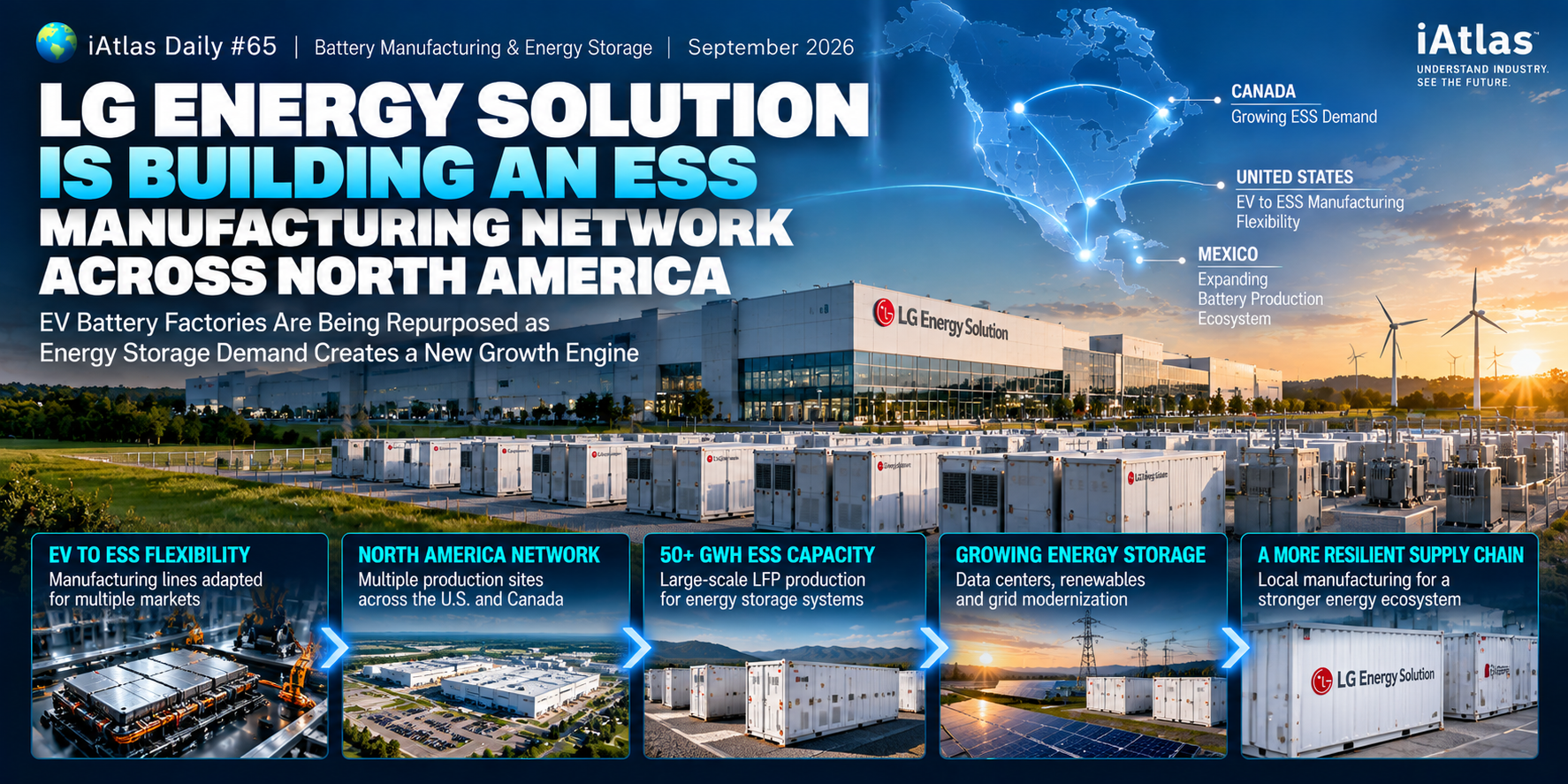
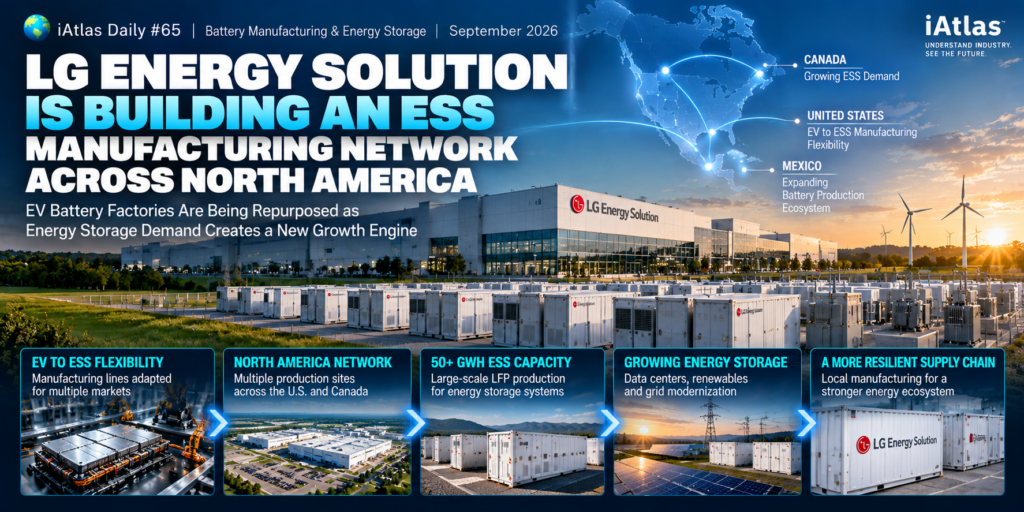
LG Energy Solution Is Building an ESS Manufacturing Network Across North America
Five Production Hubs Show How Battery Factories Are Evolving from EV-Only Assets into Flexible Energy Infrastructure
🔋 iAtlas Daily #65 | ESS & Battery Manufacturing | September 2026
For much of the past decade, the battery industry’s biggest manufacturing race centered on one market:
Electric Vehicles
Battery companies invested billions of dollars in factories designed to support rapidly growing EV demand.
But the energy market is changing.
Electricity demand is rising.
Renewable generation is expanding.
Power grids need more flexibility.
And large data centers require increasingly reliable power infrastructure.
That is creating another enormous battery market:
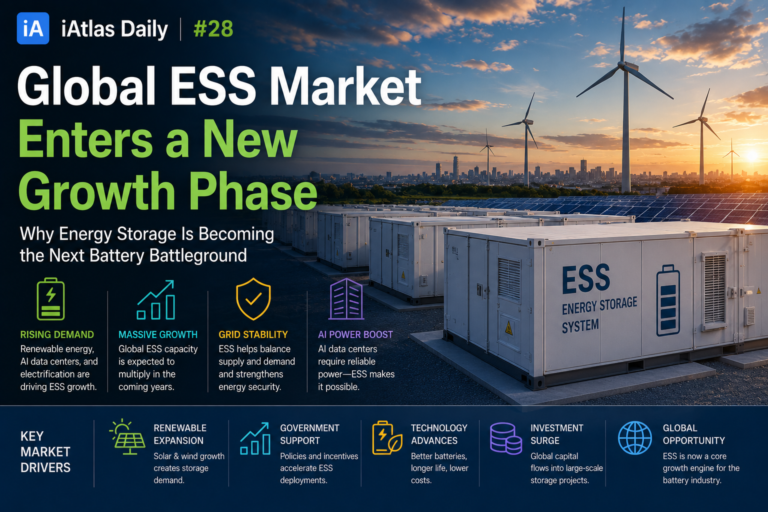
Energy Storage Systems
LG Energy Solution’s North American manufacturing strategy shows how quickly this shift is affecting the battery industry.
With the start of production at its Lansing plant in Michigan, the company has completed a network of:
Five ESS Battery Production Hubs
across North America.
By the end of 2026, LG Energy Solution plans to have more than:
50 GWh
of LFP cell manufacturing capacity for ESS applications in the region. LG Energy Solution
But the more important story is not simply the number of factories.
It is how battery manufacturing itself is becoming more flexible.
EV Manufacturing Capacity
↓
Factory Rebalancing
↓
ESS Production
↓
Flexible Battery Manufacturing Network
The next phase of the battery industry may be defined not only by how much capacity companies build, but by how effectively they can redirect that capacity toward changing demand.
🌎 The Big Story
LG Energy Solution’s North American ESS network now consists of five locations:
Michigan — Holland
Michigan — Lansing
Ohio — L-H Battery Company
Tennessee — Ultium Cells
Ontario — NextStar Energy
Three are wholly owned or operated through LG Energy Solution-led entities, while the Ohio and Tennessee facilities are joint ventures. LG Energy Solution
Together they create a geographically distributed ESS manufacturing network across the Great Lakes and central North America.
The Lansing facility is particularly important.
The 226-acre plant started production in August and is designed to manufacture batteries for both:
Energy Storage Systems
and:
Electric Vehicles
At full scale, the facility is expected to exceed 35 GWh of annual cell-production capacity. LG Energy Solution
That dual-purpose structure tells us something important.
This is not simply an ESS expansion.
It is a change in how battery factories are being designed and operated.
🔋 1. Why Is ESS Demand Growing?
Electricity systems have a fundamental problem.
Electricity production and electricity consumption must remain closely balanced.
But renewable energy sources such as:
Solar
and:
Wind
are variable.
Solar output changes with sunlight.
Wind output changes with weather.
Electricity demand changes throughout the day.
Battery storage provides one way to bridge those differences.
The basic model is:
Electricity Generation
↓
Battery Storage
↓
Electricity When Needed
This allows batteries to become part of the electricity infrastructure itself.
⚡ 2. ESS Is Much More Than Renewable-Energy Storage
ESS is often associated with solar and wind.
But its role is broader.
Large battery systems can support:
Peak Shaving
Load Shifting
Frequency Regulation
Grid Stabilization
Backup Power
and:
Renewable Integration
The battery therefore becomes more than an energy container.
Combined with power electronics and control software, it becomes a controllable grid asset.
This distinction matters.
EV batteries primarily move energy with a vehicle.
ESS batteries help manage energy across an electrical system.
🏭 3. Battery Factories Were Built Around the EV Boom
The battery industry’s previous investment cycle was dominated by expectations of rapid EV adoption.
Manufacturers built enormous production capacity across:
United States
Canada
Europe
China
and:
South Korea
The manufacturing logic was straightforward:
More EVs
↓
More Battery Packs
↓
More Cells
↓
More Gigafactories
But EV demand has not grown uniformly across every market or manufacturer.
That creates a challenge.
A battery factory represents billions of dollars of fixed assets.
If vehicle demand changes, that capacity cannot simply remain idle indefinitely.
🔄 4. ESS Creates Another Destination for Battery Capacity
This is where ESS becomes strategically important.
Instead of viewing manufacturing capacity as:
EV Only
battery companies can increasingly think in terms of:
EV
ESS
The result is a broader demand base.
LG Energy Solution describes its strategy as strategic rebalancing, expanding beyond an EV-centered business structure while improving the utilization of existing production assets. LG Energy Solution
This is one of the most important manufacturing themes in the battery industry today.
The factory itself becomes more adaptable.
🏗️ 5. Tennessee Shows What Factory Conversion Looks Like
LG Energy Solution’s Ultium Cells joint venture with GM provides a particularly clear example.
The Spring Hill, Tennessee facility was originally built around EV battery production.
In March, Ultium Cells announced approximately:
$70 Million
of conversion investment to introduce ESS-oriented LFP cell production at the facility. LG Energy Solution
The shift can be simplified as:
Existing EV Battery Factory
↓
Production-Line Conversion
↓
LFP ESS Cells
This is very different from building an entirely new factory.
Existing:
Buildings
Utilities
Automation
Workforce
and:
Manufacturing Infrastructure
can potentially be reused.
That can reduce both time and capital requirements.
🧪 6. But You Cannot Simply Change the Label from EV to ESS
EV and ESS batteries share fundamental lithium-ion technology.
But the products do not have identical requirements.
An EV battery may prioritize:
Energy Density
Weight
Fast Charging
Driving Range
An ESS battery may place greater emphasis on:
Cost
Cycle Life
Safety
Long-Term Reliability
Stationary Operating Economics
That means manufacturing conversion can require changes across:
Cell Chemistry
Electrode Design
Process Conditions
Formation
Quality Control
and:
Pack Architecture
Factory flexibility therefore requires engineering flexibility.
🧱 7. Why LFP Matters
LG Energy Solution’s North American ESS expansion is closely connected to:
LFP
Lithium iron phosphate.
LFP has several characteristics that make it attractive for stationary storage.
It generally offers:
Strong Cycle Life
Good Thermal Stability
Lower Material Cost Potential
and:
No Nickel or Cobalt in the Cathode
Its lower energy density compared with some nickel-rich chemistries is less problematic in stationary applications.
An ESS does not need to move its own battery weight down a highway.
That changes the engineering trade-off.
⚖️ 8. The Best Battery Depends on the Application
This is a useful principle across the battery industry.
There is no single chemistry that is best for every application.
For a premium EV:
Energy Density
may be extremely important.
For stationary storage:
Cost per Cycle
may matter more.
For another application:
Power
or:
Low-Temperature Performance
may dominate.
Battery technology therefore increasingly looks like:
Application
↓
Performance Requirements
↓
Chemistry
↓
Cell Design
↓
Manufacturing
This is why ESS growth can reshape battery factories themselves.
🇺🇸 9. Local Production Is a Major Part of the Strategy
LG Energy Solution is not simply producing ESS batteries.
It is producing them close to the target market.
By the end of 2026, the company expects approximately 80% of its global ESS capacity to be located in North America. LG Energy Solution
That matters for several reasons:
Delivery Time
Logistics
Customer Support
Policy Compliance
Supply Security
and:
Project Execution
Large ESS projects can require enormous quantities of cells.
Reliable local supply therefore becomes a competitive capability.
🗺️ 10. The Five-Site Network Creates Geographic Flexibility
The network is not concentrated in one factory.
It spans:
Michigan
Ohio
Tennessee
and:
Ontario
This creates another form of flexibility.
If demand grows in different regions, production can potentially be allocated across multiple facilities.
A distributed manufacturing network can also reduce dependence on a single site.
The structure becomes:
Multiple Plants
↓
Shared Product Platforms
↓
Regional Customers
↓
Manufacturing Flexibility
This resembles the broader regionalization trend iAtlas examined in Weekly #12.
🏭 11. Lansing Is the Key New Node
The Lansing facility represents the newest major addition.
At full-scale production it is designed for more than:
35 GWh per year
across ESS and EV applications.
The plant is also expected to employ approximately 1,700 people at full scale. LG Energy Solution
Its importance is not simply capacity.
Lansing demonstrates the emerging model of a:
Multi-Application Battery Factory
Rather than linking a factory permanently to one end market, production infrastructure can serve multiple demand pools.
That may become increasingly important as battery markets mature.
📦 12. Holland Was the First Major ESS Manufacturing Base
LG Energy Solution’s Holland, Michigan facility began large-scale ESS battery production earlier.
The company describes Holland as its first North American site to begin large-scale ESS battery mass production.
The factory already supports customers including:
Terra-Gen
and:
Delta Electronics. LG Energy Solution
This provides an important contrast with Lansing.
Holland demonstrated that local ESS production could work.
Lansing helps scale the model into a broader manufacturing network.
🇨🇦 13. Canada Is Part of the Network Too
The North American footprint extends beyond the United States.
NextStar Energy in Ontario — LG Energy Solution’s joint venture with Stellantis — began ESS production in late 2025.
According to LG Energy Solution, the facility surpassed:
1 Million ESS Cells
within three months of beginning mass production. LG Energy Solution
This demonstrates another important feature of the strategy.
The relevant industrial unit is not necessarily:
United States
It is increasingly:
North America
Supply chains can connect:
Canada
↓
United States
↓
Customers
across a regional manufacturing system.
🔌 14. ESS Is Moving Closer to Power Infrastructure
Battery manufacturing used to be discussed mainly alongside automobiles.
ESS changes the industrial context.
The customer base increasingly includes:
Utilities
Renewable Developers
Data Centers
Commercial Facilities
and:
Grid Operators
LG Energy Solution says Michigan utility DTE Energy will be among the customers using batteries manufactured at Lansing for future ESS projects. LG Energy Solution
The battery industry therefore begins to intersect directly with:
Power Infrastructure
That is a major structural shift.
🖥️ 15. Data Centers Add Another Demand Driver
The electricity requirements of large data centers are growing rapidly.
These facilities need:
Large Power Capacity
Stable Voltage
Reliable Backup
Fast Response
and:
High Availability
Battery systems can help manage some of those requirements.
This week, LG Energy Solution announced that its BESS offering had qualified as:
NVIDIA DSX Ready BESS
for NVIDIA’s AI-factory infrastructure ecosystem. LG Energy Solution
The timing is significant.
LG Energy Solution is simultaneously expanding:
ESS Manufacturing Capacity
and:
Large-Scale Power Applications
The battery factory is increasingly connected to digital infrastructure.
⚡ 16. ESS Is Becoming Part of Data-Center Architecture
A modern data center is no longer simply:
Servers + Building
It increasingly requires an integrated infrastructure stack:
Grid Connection
↓
Power Conversion
↓
Energy Storage
↓
Cooling
↓
Compute
LG Energy Solution says its AC-coupled ESS solution is designed to support large-scale power applications and accelerate time-to-power. LG Energy Solution
This creates an interesting convergence.
The battery industry is moving into:
Digital Infrastructure
while data centers are becoming major participants in:
Energy Infrastructure
The boundaries between industries are becoming less clear.
🔧 17. ESS Competition Is About More Than the Cell
A battery cell is only one component of an energy-storage system.
A complete BESS can include:
Cells
↓
Modules / Packs
↓
Racks
↓
PCS
↓
Control System
↓
Thermal Management
↓
System Integration
LG Energy Solution emphasizes its system-integration capabilities alongside its cell manufacturing footprint. BATTERY INSIDE
This matters because ESS customers do not simply need batteries.
They need a system that can reliably interact with the electrical grid.
🧠 18. Software and Power Electronics Become More Important
In an EV, batteries interact with:
Motor
Inverter
Vehicle Control System
In an ESS, batteries interact with:
Grid
PCS
Energy Management System
Renewable Generation
and:
Loads
That means competition expands beyond electrochemistry.
Companies increasingly need capabilities in:
Control
Power Electronics
System Optimization
Safety Management
and:
Grid Integration
ESS therefore pushes battery manufacturers further toward complete energy solutions.
19. Local Manufacturing Still Depends on Local Materials
A locally assembled battery is not necessarily a fully localized battery.
Cells require:
Lithium
Cathode Materials
Anode Materials
Electrolyte
Separator
and other components.
LG Energy Solution recently signed a 10-year agreement to purchase 8,000 metric tonnes of U.S.-produced battery-grade lithium carbonate annually from Smackover Lithium. BATTERY INSIDE
The strategy therefore moves beyond:
Local Cell Production
toward:
Local Material Supply + Local Production
That is a deeper form of supply-chain localization.
🔗 20. The Supply Chain Is Becoming More Integrated
The emerging structure can be visualized as:
North American Lithium
↓
Battery Materials
↓
LFP Cell Production
↓
ESS Integration
↓
Utility / Data Center
This is much deeper than importing finished battery systems.
It creates a regional industrial chain around electricity storage.
And that makes ESS manufacturing increasingly strategic.
💰 21. Factory Utilization Is an Economic Advantage
Battery manufacturing is extremely capital intensive.
Once a factory exists, utilization becomes critical.
A factory operating well below capacity still carries:
Depreciation
Labor
Maintenance
Utilities
and:
Financing Costs
The ability to redirect some manufacturing capacity from EV toward ESS can therefore improve asset utilization.
This is why manufacturing flexibility can become a financial advantage—not merely an engineering advantage.
📈 22. ESS Can Reduce Dependence on One Market Cycle
EV and ESS markets do not necessarily grow at exactly the same pace.
That creates diversification.
Imagine:
EV Demand Slows
while:
ESS Demand Accelerates
A battery manufacturer with flexible capacity may be able to shift its production mix.
The business becomes less dependent on:
One End Market
This is strategically valuable in a cyclical manufacturing industry.
🔋 23. Battery Companies Are Becoming Energy-Infrastructure Companies
This may be the larger transformation.
The traditional battery-company model was:
Manufacture Cells
↓
Sell to Automaker
The emerging ESS model can look more like:
Manufacture Cells
↓
Build Storage System
↓
Integrate Power Electronics
↓
Support Grid / Data Center
Battery manufacturers therefore move deeper into the energy system.
The product is no longer simply:
A Battery
It increasingly becomes:
Energy Infrastructure
🌎 24. North America Is Becoming a Strategic ESS Manufacturing Region
China remains the world’s dominant battery manufacturing center.
But North America is developing its own battery-production ecosystem.
LG Energy Solution’s five-site network illustrates that development.
The regional stack increasingly includes:
Raw Materials
↓
Battery Materials
↓
Cell Manufacturing
↓
ESS Systems
↓
Energy Infrastructure
The ecosystem is not yet as deep or cost-efficient as China’s.
But it is becoming significantly more complete.
🔄 25. The Bigger Story Is Manufacturing Flexibility
The most important lesson from LG Energy Solution’s ESS expansion may not be ESS itself.
It may be:
Flexibility
The battery market is changing quickly.
Chemistries change.
Applications change.
Customer demand changes.
Policy changes.
Factories that can adapt may therefore become more valuable than factories optimized around only one product.
The future battery manufacturing model could increasingly be:
Flexible Chemistry
Flexible Application
Flexible Geography
↓
Flexible Manufacturing Network
🧩 Why This Matters
LG Energy Solution’s five-site network illustrates several structural changes.
ESS is becoming a major battery-manufacturing market.
Battery demand is expanding beyond vehicles into power infrastructure.
EV factories can become more flexible assets.
Existing production infrastructure can be rebalanced toward ESS applications.
LFP is expanding in North America.
Its cost, durability and safety characteristics make it particularly attractive for stationary storage.
Localization is getting deeper.
The strategy increasingly spans raw materials, cells and complete ESS systems.
Battery manufacturing is converging with power infrastructure.
Utilities and data centers are becoming increasingly important battery customers.
🔭 What to Watch
50 GWh Milestone
LG Energy Solution targets more than 50 GWh of North American ESS LFP cell capacity by the end of 2026. LG Energy Solution
Lansing Ramp-Up
Watch how quickly the new 35+ GWh facility reaches stable production and how its EV/ESS production mix develops.
Tennessee Conversion
The Ultium Cells conversion provides an important test of how efficiently EV manufacturing assets can be repurposed.
Data Centers
LG Energy Solution’s NVIDIA DSX Ready qualification creates another route into large-scale digital-infrastructure projects. LG Energy Solution
Local Materials
Watch whether lithium, cathode, electrolyte and other inputs increasingly follow cell manufacturing into North America.
Customer Contracts
Large long-term ESS contracts will determine how fully the five-site network is utilized.
🧭 iAtlas Insight
For years, battery manufacturing strategy was dominated by one assumption:
EV demand would determine where battery capacity was needed.
That assumption is changing.
The future battery factory may need to respond simultaneously to:
EVs
Grid Storage
Renewable Energy
Data Centers
and:
Industrial Power
This changes what manufacturing flexibility means.
It is no longer enough to build:
More Capacity
Companies increasingly need:
Adaptable Capacity
LG Energy Solution’s North American network provides an early example.
Some factories were built around EV demand.
Now the same industrial footprint is being expanded or converted toward ESS.
And the supply chain around those factories is beginning to deepen from:
Lithium
to:
Cells
to:
Complete Energy Storage Systems
That is a much larger transformation than a simple change in battery chemistry.
The next competitive advantage in batteries may not be owning the biggest factory. It may be owning the factory that can adapt fastest when the market changes.
📚 Related Articles
📰 iAtlas Daily #62: Korea Is Betting ₩1.2 Trillion on Silicon Anodes
📰 iAtlas Weekly #12: The Global Manufacturing Map Is Being Redrawn
🔗 References
- LG Energy Solution — Lansing Battery Plant Starts Production
- LG Energy Solution — Five North American ESS Production Hubs
- LG Energy Solution — NVIDIA DSX Ready BESS
- LG Energy Solution — U.S. Lithium Supply Agreement
ℹ️ About iAtlas
iAtlas is an independent publication covering batteries, semiconductors, OLED, advanced materials, AI, and global industrial trends.
We transform complex industrial developments into clear, reliable, and easy-to-understand insights.
Whether you’re following today’s industry news or building long-term expertise, iAtlas helps you understand not only what happened, but why it matters.
Technology creates change.
Insight creates opportunity.
— iAtlas