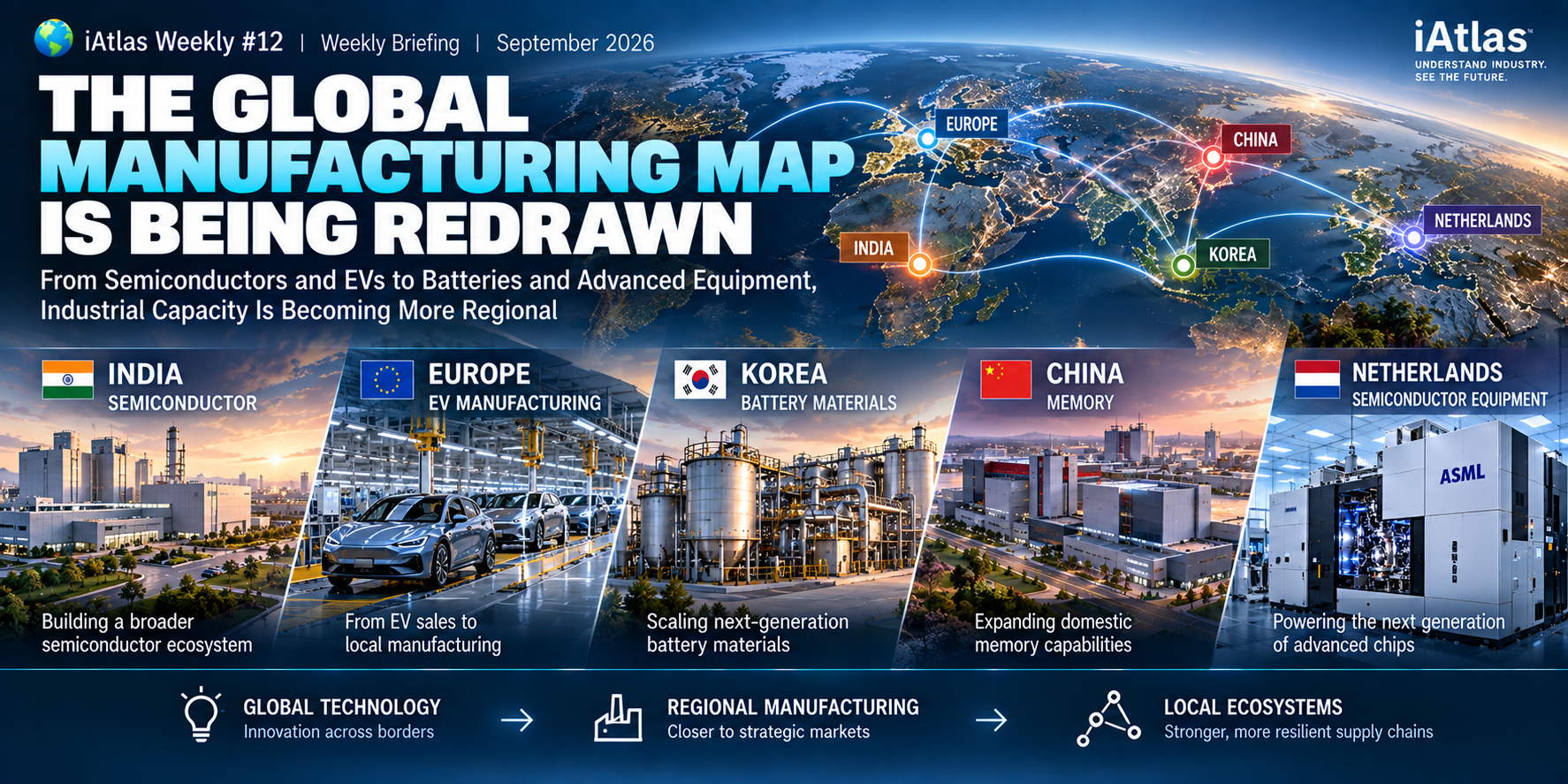
The Global Manufacturing Map Is Being Redrawn
From India’s Semiconductor Push and BYD’s European Factories to Korea’s Battery Materials, Industrial Capacity Is Moving Closer to Strategic Markets
🌍 iAtlas Weekly #12 | Weekly Briefing | September 2026
For decades, globalization followed a relatively simple logic.
Companies looked for the most efficient place to manufacture.
Production became concentrated in regions with:
Lower Costs
Specialized Suppliers
Skilled Workers
Large Industrial Clusters
Efficient Logistics
Products could then be shipped around the world.
That model created extraordinarily powerful manufacturing centers.
China became central to electronics, batteries and industrial manufacturing.
Taiwan became indispensable to advanced semiconductor foundries.
South Korea became a global center for memory and batteries.
Japan retained critical positions in materials and equipment.
Southeast Asia became deeply integrated into electronics assembly and semiconductor packaging.
But the industrial map is beginning to change.
Not because these manufacturing centers are disappearing.
They are not.
Instead, companies and governments are increasingly asking a different question:
Where should strategically important products actually be manufactured?
The answer is creating a new industrial model.
Global Technology
↓
Regional Manufacturing
↓
Local Supply Chains
↓
A More Distributed Industrial Map
The developments covered by iAtlas this week illustrate that transition.
India is trying to build a semiconductor ecosystem.
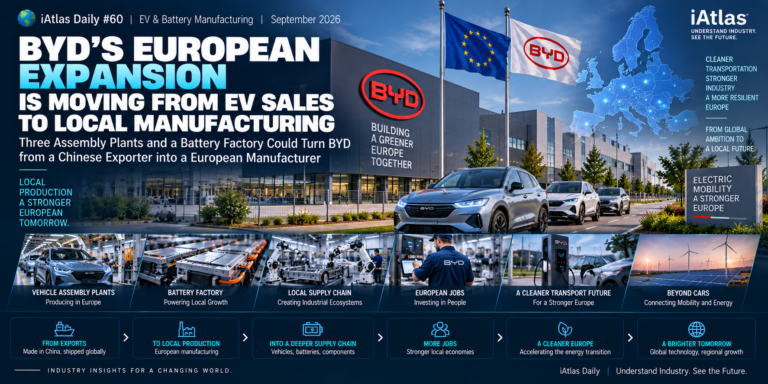
BYD is moving EV manufacturing into Europe.
China is expanding its domestic memory capabilities.
South Korea is scaling next-generation battery materials.
And advanced chipmakers are preparing for a new generation of semiconductor manufacturing equipment.
These stories come from different industries.
But together they reveal the same structural change:
Industrial capacity is becoming strategic again.
🌍 The Big Picture
The global economy is not simply de-globalizing.
That description is too simple.
Companies still depend on international:
Technology
Capital
Materials
Equipment
Customers
and:
Supply Chains
What is changing is the geography of production.
The old model often looked like:
Technology Developed Somewhere
↓
Manufacturing Concentrated Elsewhere
↓
Products Exported Globally
The emerging model increasingly looks like:
Global Technology
↓
Multiple Regional Manufacturing Hubs
↓
Regional Supplier Networks
↓
Regional Markets
This does not eliminate globalization.
It changes its architecture.
🏭 1. Manufacturing Is Becoming a Strategic Capability
For many years, manufacturing location was primarily an economic decision.
Companies optimized around:
Labor Cost
Scale
Supplier Density
Infrastructure
Logistics
Those factors still matter.
But governments and companies increasingly add another variable:
Resilience
The question is no longer simply:
Where can this product be manufactured most cheaply?
It is increasingly:
Where must this product be manufactured so that we can reliably access it?
That distinction matters particularly for:
Semiconductors
Batteries
Critical Minerals
Energy Equipment
Advanced Materials
These products increasingly function as industrial infrastructure.
🇮🇳 2. India Shows How Countries Are Trying to Build New Industrial Ecosystems
India’s semiconductor strategy provides one of the clearest examples.
The first phase focused heavily on attracting semiconductor factories.
But a fab alone does not create a semiconductor industry.
A functioning semiconductor ecosystem requires:
Materials
↓
Equipment
↓
Components
↓
Engineers
↓
Fab
↓
Packaging
↓
Customers
That is why Applied Materials’ planned investment of more than $5 billion in India over the next decade matters.
The investment is expected to span areas including R&D, workforce capabilities and supply-chain development.
The significance is not simply another foreign investment.
It represents the next stage of industrial development:
Attract Factory
↓
Attract Suppliers
↓
Build Talent
↓
Develop Technology
↓
Create Ecosystem
India is attempting to move from semiconductor ambition toward semiconductor infrastructure.
🧩 3. The Factory Is Only the Center of the Network
This principle extends far beyond semiconductors.
A factory creates demand around itself.
Imagine a semiconductor fab.
It needs:
Process Chemicals
Specialty Gases
Vacuum Equipment
Quartz Components
Precision Parts
Maintenance
Logistics
Water
Electricity
Engineers
Once enough manufacturing capacity appears in one region, suppliers have an incentive to move closer.
That creates a feedback loop:
More Factories
↓
More Suppliers
↓
Lower Operating Friction
↓
More Skilled Workers
↓
More Investment
↓
More Factories
This is how an industrial cluster forms.
And it explains why established manufacturing regions are so difficult to reproduce.
🇪🇺 4. BYD Shows the Opposite Movement
India is trying to pull global manufacturing inward.
BYD illustrates another form of the same transformation.
Chinese manufacturers are moving production outward.
BYD’s original European model was relatively straightforward:
Manufacture in China
↓
Export Vehicles
↓
Sell in Europe
But the company’s strategy is increasingly shifting toward:
Manufacture in Europe
↓
Source More Components Locally
↓
Produce Batteries Regionally
↓
Sell to European Customers
BYD expects that its longer-term European manufacturing footprint could eventually include:
Three vehicle assembly plants and one battery factory.
That changes BYD’s role in Europe.
It moves from being primarily:
An Exporter
toward:
A Local Manufacturer
🚗 5. Chinese Manufacturing Capabilities Are Becoming Global
This is an important distinction.
China’s industrial rise was historically associated with:
Made in China
But the next phase may increasingly involve:
Made by Chinese Companies — Outside China
Chinese companies can carry:
Capital
Technology
Production Know-how
Supply-Chain Management
Manufacturing Systems
into overseas markets.
BYD’s European expansion demonstrates how that process can work.
The result could eventually be:
Chinese Technology
European Factory
European Workers
European Suppliers
European Customers
This raises a difficult question.
Where does a Chinese supply chain end and a European supply chain begin?
The answer may become increasingly unclear.
🔋 6. Batteries Show Why Localization Goes Deeper Than Final Assembly
Vehicle assembly is only one layer of an EV supply chain.
The deeper structure looks more like:
Critical Minerals
↓
Battery Materials
↓
Battery Cells
↓
Battery Packs
↓
Vehicle Assembly
↓
Customer
If BYD manufactures vehicles in Europe but imports most batteries and components from China, localization remains relatively shallow.
A European battery factory changes the equation.
It creates demand for:
Cathode Materials
Anode Materials
Electrolytes
Separators
Battery Equipment
Recycling
The deeper manufacturing moves into a region, the stronger the incentive becomes for suppliers to follow.
🇰🇷 7. Korea Shows Another Side of the Same Competition
South Korea already possesses a major battery ecosystem.
The strategic challenge is therefore different.
Korea does not need to create a battery industry from zero.
It needs to keep moving that industry into higher-value technologies.
This week’s silicon-anode investment provides a good example.
HS Hyosung Energy Solution Korea plans to invest approximately ₩1.2 trillion in Ulsan, targeting eventual silicon-anode-material capacity of 20,000 tons per year by 2030.
The technology originates from more than a decade of development by Belgium’s Umicore.
The industrial structure is therefore:
European R&D
↓
Technology Partnership
↓
Korean Scale-Up
↓
Battery Manufacturing
This is another version of the emerging industrial model.
Technology remains global.
Manufacturing becomes strategically regional.
🧪 8. Innovation Is Moving from the Laboratory to the Factory
This also reveals another important change.
Industrial competition increasingly occurs at the transition between:
Technology
and:
Manufacturing
Silicon anodes have been discussed for years.
Their theoretical advantages are well understood.
But the difficult question is not:
Can silicon store more lithium than graphite?
It can.
The difficult question is:
Can silicon-based anode materials be manufactured consistently, economically and at industrial scale?
The path looks like:
Research
↓
Pilot Production
↓
Qualification
↓
Mass Production
↓
Cost Reduction
The companies that successfully complete this transition can turn scientific advantage into industrial advantage.
🇨🇳 9. China Is Building Redundancy Inside Its Own Technology Base
China’s memory industry demonstrates another aspect of regionalization.
Historically, China’s domestic memory structure was relatively clear:
CXMT
→ DRAM
YMTC
→ NAND Flash
But those boundaries are beginning to blur.
CXMT is exploring NAND development while continuing to advance its DRAM technology.
YMTC has also explored DRAM.
The possible future structure becomes:
CXMT
→ DRAM + NAND
YMTC
→ NAND + DRAM
Why duplicate capabilities?
Because from an industrial-policy perspective:
Redundancy creates resilience.
If one supplier encounters:
Technology Problems
Capacity Constraints
Trade Restrictions
or:
Supply Disruptions
another domestic supplier can potentially provide an alternative.
💾 10. Memory Is Becoming Strategic Infrastructure
Memory was historically treated largely as a cyclical semiconductor business.
Prices rose.
Capacity expanded.
Prices fell.
Investment slowed.
That cycle still exists.
But memory is increasingly becoming strategically important because modern computing infrastructure depends on:
DRAM
HBM
NAND
Enterprise SSDs
Memory therefore sits inside:
Data Centers
Cloud Computing
Smartphones
Industrial Systems
Advanced Computing
Countries increasingly care not only about who designs processors.
They care about who can manufacture the memory surrounding them.
That makes CXMT and YMTC strategically important far beyond their current market shares.
⚙️ 11. But Semiconductor Independence Has Limits
Even if a country can manufacture chips domestically, it may still depend on foreign technology.
Consider the semiconductor manufacturing stack:
Chip Design
↓
EDA
↓
Materials
↓
Equipment
↓
Wafer Manufacturing
↓
Packaging
No major semiconductor country controls every layer independently.
That is especially visible in lithography.
At the most advanced level, one company occupies an extraordinary position:
ASML
Its EUV technology is essential to leading-edge semiconductor manufacturing.
And its next-generation High-NA platform pushes that dependency even further.
🔬 12. High-NA Shows How Manufacturing Technology Creates Bottlenecks
ASML’s High-NA EUV systems cost roughly:
$400 million per machine
Yet Intel, Samsung, TSMC and other semiconductor manufacturers are preparing to use the technology.
Why?
Because advanced chip manufacturing is becoming increasingly difficult.
High-NA increases EUV numerical aperture from:
0.33
to:
0.55
allowing significantly smaller features to be patterned.
But the important industrial lesson is broader.
The semiconductor industry can invest tens of billions of dollars in new fabs.
Those fabs still depend on a tiny number of companies supplying critical manufacturing technologies.
A regional fab does not automatically create technological independence.
🧱 13. Localization Has Multiple Layers
This gives us a useful framework.
Industrial localization can occur at several levels.
Level 1 — Final Assembly
Products are assembled locally.
Level 2 — Components
Major components are sourced locally.
Level 3 — Materials
Critical materials are produced locally.
Level 4 — Equipment
Manufacturing equipment is available locally.
Level 5 — Technology
Core process technology and intellectual property are developed locally.
Level 6 — Ecosystem
Suppliers, talent, research institutions and customers reinforce each other.
Many countries currently have:
Level 1–2
Very few possess:
Level 5–6
This is why simply counting factories can be misleading.
🗺️ 14. The New Industrial Map Will Have Different Types of Hubs
Not every country needs to manufacture everything.
Instead, the emerging global economy may contain specialized regional hubs.
United States
Advanced semiconductor manufacturing
R&D
Compute infrastructure
Taiwan
Leading-edge foundry manufacturing
Advanced packaging
South Korea
Memory
Batteries
Advanced materials
Japan
Semiconductor materials
Equipment
Advanced manufacturing
China
Electronics
Batteries
EVs
Expanding semiconductor capabilities
India
Semiconductor design
Packaging
Emerging wafer manufacturing
Europe
Automotive
Industrial equipment
Semiconductor technology
Increasing battery localization
The future industrial system may therefore become:
More Distributed
without becoming:
Fully Independent
🔗 15. Interdependence Is Not Disappearing
This is one of the most important conclusions.
Consider a semiconductor manufactured in India.
Its equipment might come from:
Netherlands
United States
Japan
Its materials could come from:
Japan
Korea
Europe
Its design software could come from:
United States
Its packaging might occur in:
India
or:
Southeast Asia
The chip may then be installed in electronics manufactured elsewhere.
Localization therefore does not eliminate global supply chains.
It reorganizes them.
🌐 16. The New Model Is “Global + Regional”
The old debate often framed industrial strategy as:
Globalization
versus:
Localization
But the emerging model increasingly combines both.
A better description may be:
Global Technology + Regional Production
Companies retain global:
R&D Networks
Technology Platforms
Capital
Customers
But manufacturing capacity becomes more geographically distributed.
This provides companies with:
Market Access
Supply Resilience
Regulatory Compliance
and:
Political Risk Reduction
while preserving global scale.
🏗️ 17. Existing Industrial Infrastructure Becomes More Valuable
BYD’s search for European manufacturing sites demonstrates another important trend.
Building everything from scratch is expensive and slow.
Regions with existing:
Factories
Utilities
Logistics
Workers
Suppliers
have an advantage.
Industrial infrastructure therefore becomes a strategic asset.
An underutilized automotive factory may become valuable again when a new manufacturer enters the market.
A mature chemical cluster may attract battery-material production.
A region with semiconductor engineers may attract equipment R&D.
Industrial history influences future industrial geography.
👨🔬 18. Talent May Be Harder to Replicate Than Factories
Capital can build a factory.
But semiconductor engineers cannot be created overnight.
Neither can:
Battery Scientists
Process Engineers
Equipment Technicians
Materials Specialists
Manufacturing Managers
Industrial clusters accumulate knowledge over decades.
Workers move between companies.
Suppliers learn customer processes.
Universities train specialized engineers.
Manufacturing problems create practical expertise.
This creates something difficult to measure:
Industrial Know-How
That may ultimately be one of the strongest barriers protecting established manufacturing regions.
💰 19. Regionalization Will Be Expensive
There is a cost to building more geographically distributed manufacturing.
The most economically efficient model may be:
One enormous manufacturing hub
But the most resilient model may require:
Multiple manufacturing hubs
That can mean:
Duplicated Factories
Higher Capital Spending
More Inventory
Smaller Production Scale
Higher Operating Costs
Governments are increasingly willing to absorb some of these costs through:
Subsidies
Tax Incentives
Infrastructure Support
Trade Policy
Industrial resilience is therefore not free.
⚖️ 20. Efficiency and Resilience Are Becoming Competing Objectives
For decades, supply-chain strategy heavily prioritized:
Efficiency
Now companies increasingly need to balance:
Efficiency
with:
Resilience
The trade-off looks like:
Maximum Concentration
→ Lower Cost
→ Higher Dependency
versus:
Geographic Diversification
→ Higher Cost
→ Lower Dependency
There is no perfect solution.
The likely outcome is selective diversification.
Companies will regionalize the parts of the supply chain that are:
Strategic
Politically Sensitive
Logistically Difficult
or:
Too Important to Lose
🧭 21. The Most Important Question Is “What Layer?”
This provides a better way to analyze industrial news.
When a company announces a factory, ask:
Which layer of the value chain is moving?
For BYD:
Vehicle Assembly
and eventually:
Battery
For India:
Fab
Packaging
Equipment
and:
R&D
For Korea:
Advanced Battery Materials
For China:
Memory Manufacturing
For ASML:
Critical Semiconductor Equipment
Once we identify the layer, we can ask the more important question:
Which suppliers and technologies will need to move next?
That is where the second-order investment opportunities often appear.
🔄 22. Factories Create Industrial Gravity
Large manufacturing facilities have something similar to gravity.
They pull other industrial activity toward them.
A battery factory attracts:
Material Suppliers
Equipment Companies
Recycling
A semiconductor fab attracts:
Chemical Suppliers
Gas Suppliers
Equipment Service
Precision Components
An automotive factory attracts:
Tier 1 Suppliers
Electronics
Battery Systems
Logistics
This industrial gravity is why major factory announcements matter beyond the factory itself.
They can change the economic structure of an entire region.
📊 23. Watch Capex, Not Just Headlines
Industrial strategy announcements are easy.
Factories are harder.
Competitive production is much harder.
A useful hierarchy is:
Announcement
↓
Investment Commitment
↓
Construction
↓
Equipment Installation
↓
Qualification
↓
Mass Production
↓
Competitive Yield
This is particularly important in semiconductors and advanced battery materials.
A country does not gain industrial capability when a project is announced.
It gains capability when the factory can repeatedly manufacture competitive products.
🏭 24. Manufacturing Is Returning to the Center of Economic Strategy
For decades, many discussions about technology focused primarily on:
Software
Design
Intellectual Property
Those remain enormously important.
But the current industrial cycle is reminding governments and companies of something more basic.
Technology must eventually become:
Physical Products
Processors need fabs.
EVs need battery plants.
Battery chemistry needs material factories.
Advanced semiconductor designs need lithography systems.
Energy infrastructure needs transformers, cables and storage systems.
The physical economy has returned to the center of technology competition.
🌍 25. This Is the New Globalization
The global manufacturing system is not collapsing into isolated national economies.
That would be extraordinarily difficult.
Instead, something more subtle is happening.
The old structure:
Few Manufacturing Centers
↓
Global Exports
is gradually evolving toward:
More Regional Manufacturing Centers
↓
Connected Global Supply Chains
This is not:
The End of Globalization
It may be:
The Regionalization of Globalization
And that distinction will shape industrial investment for years to come.
🧩 Why This Matters
The developments covered this week point toward five structural changes.
Factories are becoming strategic assets.
Manufacturing capacity increasingly influences economic security and technological competitiveness.
Supply chains are moving closer to markets.
BYD’s European expansion illustrates how exports can evolve into regional production.
Countries want deeper industrial ecosystems.
India’s semiconductor strategy increasingly extends beyond fabs toward equipment, suppliers and R&D.
Technology must scale into manufacturing.
Korea’s silicon-anode investment demonstrates why industrialization matters as much as laboratory performance.
Critical bottlenecks remain global.
ASML’s High-NA EUV platform shows that regional manufacturing can still depend on globally concentrated technologies.
🔭 What to Watch Next
Over the next several years, five indicators will show how far this industrial restructuring progresses.
Supplier Localization — Factories matter, but supplier movements reveal whether genuine ecosystems are forming.
Regional Battery Production — BYD’s eventual European battery investment will indicate how deeply Chinese EV manufacturing localizes.
India’s Fab Execution — The transition from announced projects to competitive wafer production remains the critical test.
China’s Semiconductor Equipment Ecosystem — Domestic equipment and materials will determine how deeply semiconductor localization can progress.
Advanced Manufacturing Capex — ASML High-NA adoption, new battery-material facilities and semiconductor fabs will show where the next generation of industrial capacity is actually being built.
🧭 iAtlas Insight
The industrial map is changing.
But the most important change is not simply that factories are moving.
It is that governments and companies are reconsidering what manufacturing means.
A factory is no longer viewed only as:
Production Capacity
It can also represent:
Supply Security
Technology Capability
Employment
Industrial Knowledge
Strategic Independence
and:
Economic Resilience
That is why semiconductor fabs are being built in new regions.
Why Chinese EV manufacturers are establishing European factories.
Why Korea is investing in next-generation battery materials.
And why a $400 million lithography machine can become strategically important to multiple countries simultaneously.
The emerging industrial system will not be completely global.
It will not be completely local.
It will be both.
Technology will remain global. Manufacturing will become more regional. And the countries that connect the two most effectively will shape the next industrial map.
📚 Related Articles
🇮🇳 iAtlas Daily #59: India Is Building More Than Semiconductor Fabs
How India is moving from attracting individual semiconductor projects toward building a broader manufacturing ecosystem.
🇪🇺 iAtlas Daily #60: BYD’s European Expansion Is Moving from EV Sales to Local Manufacturing
How Chinese EV manufacturing capabilities are beginning to move closer to European customers.
💾 iAtlas Daily #61: China’s CXMT Is Moving Beyond DRAM into NAND Flash
How China is broadening domestic memory capabilities and creating greater industrial redundancy.
🔋 iAtlas Daily #62: Korea Is Betting ₩1.2 Trillion on Silicon Anodes
How next-generation battery materials are moving from R&D toward industrial-scale production.
⚙️ iAtlas Daily #63: The $400 Million Machine Reshaping Advanced Chipmaking
How ASML’s High-NA EUV demonstrates the importance of critical manufacturing equipment in the advanced semiconductor supply chain.
🔗 References
- Applied Materials — India semiconductor ecosystem and manufacturing expansion
- BYD — European manufacturing and localization strategy
- Umicore / HS Hyosung — Silicon-carbon anode industrialization
- ASML — High-NA EUV technology and industry adoption
- CXMT / semiconductor industry reporting — China memory manufacturing expansion
ℹ️ About iAtlas
iAtlas is an independent publication covering batteries, semiconductors, OLED, advanced materials, AI, and global industrial trends.
We transform complex industrial developments into clear, reliable, and easy-to-understand insights.
Whether you’re following today’s industry news or building long-term expertise, iAtlas helps you understand not only what happened, but why it matters.
Technology creates change.
Insight creates opportunity.
— iAtlas