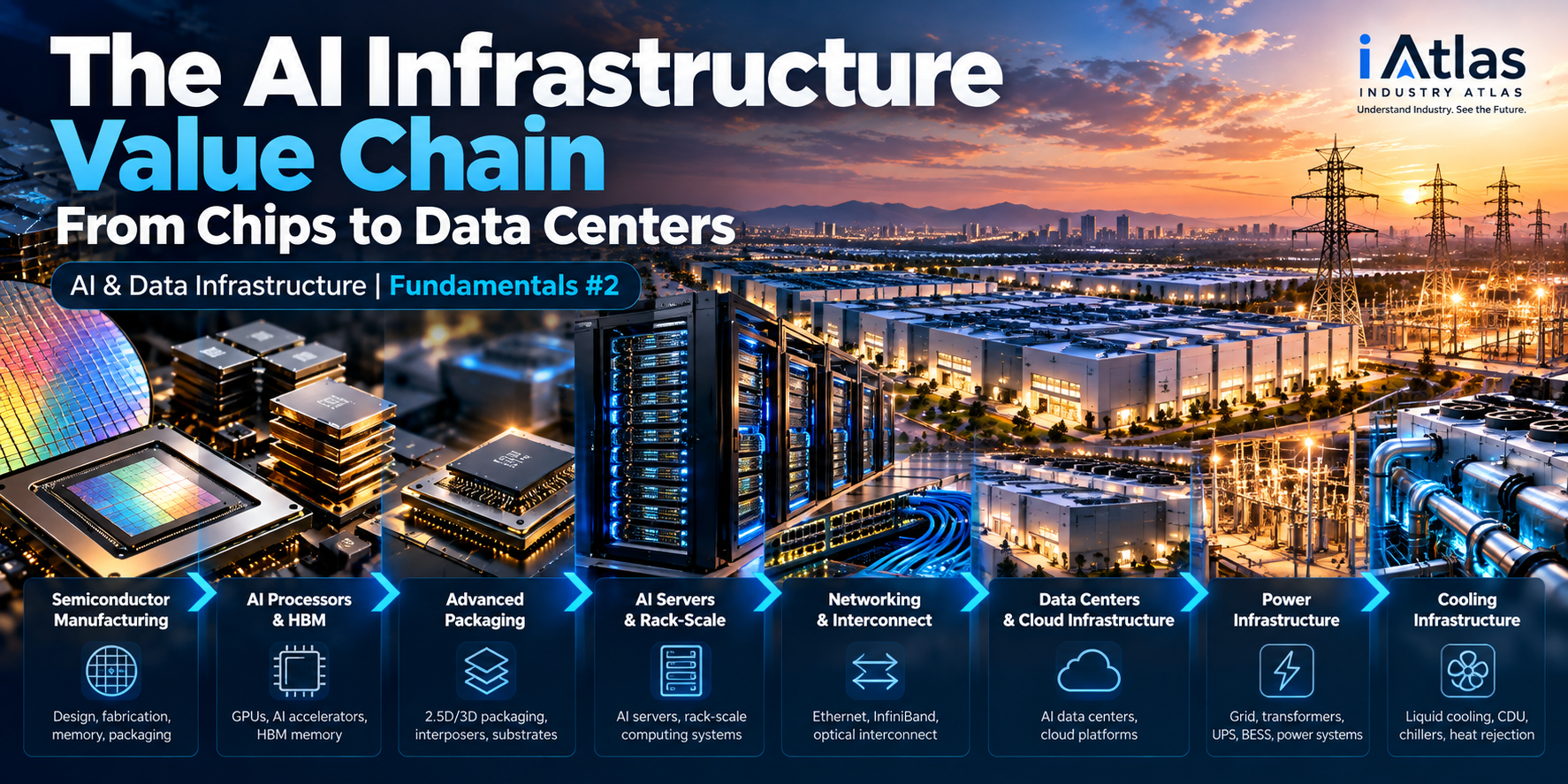
The AI Infrastructure Value Chain: From Chips to Data Centers
AI & Data Infrastructure | Fundamentals #2
Artificial intelligence does not run on a single technology.
Behind every AI model is a chain of physical systems that begins with semiconductor manufacturing and extends all the way to data centers, electricity supply and cooling infrastructure.
This is the AI infrastructure value chain.
Understanding this value chain helps explain why AI investment is spreading across industries that once seemed unrelated — from memory chips and networking equipment to transformers, cooling systems and power generation.
The key idea is simple:
AI demand creates infrastructure demand across multiple layers at the same time.
What Is the AI Infrastructure Value Chain?
The AI infrastructure value chain describes the series of technologies, systems and industries required to create usable AI computing capacity.
A simplified structure looks like this:
Semiconductor Manufacturing
↓
AI Processors & HBM
↓
Advanced Packaging
↓
AI Servers & Rack-Scale Systems
↓
Networking & Interconnect
↓
Data Centers & Cloud Infrastructure
↓
Power Infrastructure
↓
Cooling Infrastructure
Each layer depends on the others.
A powerful AI processor has limited value without enough memory.
A server cannot scale without high-speed networking.
A data center cannot operate without electricity.
And high-density computing cannot function reliably without sufficient cooling.
This interdependence is what makes the AI infrastructure industry different from a traditional hardware market.
It is increasingly a system-level industry.
1. Semiconductor Manufacturing: Where the Value Chain Begins
The physical foundation of AI infrastructure starts with semiconductor manufacturing.
Modern AI processors require some of the most advanced manufacturing technologies in the semiconductor industry.
The chain includes:
- semiconductor design
- wafer fabrication
- advanced process nodes
- memory production
- advanced packaging
- testing and assembly
Companies such as NVIDIA and AMD design AI accelerators, while foundries such as TSMC manufacture advanced logic chips.
At the same time, memory manufacturers including SK hynix and Micron supply HBM used alongside AI processors.
This means AI compute capacity depends on several semiconductor supply chains operating together.
A shortage in one area can affect the entire downstream infrastructure market.
2. AI Processors: Creating Compute Capacity
Once semiconductor manufacturing is complete, the next layer is the AI processor itself.
The most important categories include:
- GPUs
- AI accelerators
- custom ASICs
- CPUs
GPUs have become central to modern AI because they can perform many calculations in parallel.
But the industry is becoming more diverse.
Hyperscalers and technology companies are increasingly developing custom processors designed for specific AI workloads.
The result is a growing market in which multiple processor architectures compete on:
- performance
- energy efficiency
- memory bandwidth
- software compatibility
- system scalability
However, the processor alone does not determine AI performance.
Its ability to access memory and communicate with other processors is equally important.
That leads directly to the next layer.
3. HBM: Supplying Data to the Processor
AI processors constantly need data.
As computing performance increases, the speed at which data can move between memory and the processor becomes critical.
This is where High Bandwidth Memory, or HBM, plays an important role.
HBM uses stacked memory dies positioned close to advanced processors to provide much higher bandwidth than conventional memory architectures.
In modern AI systems, this creates a closely integrated relationship between:
Processor Performance
Memory Bandwidth
Memory Capacity
A shortage of HBM can therefore limit the number of high-performance AI systems that can be produced even when processor supply improves.
This is why memory companies have become major participants in the AI infrastructure value chain.
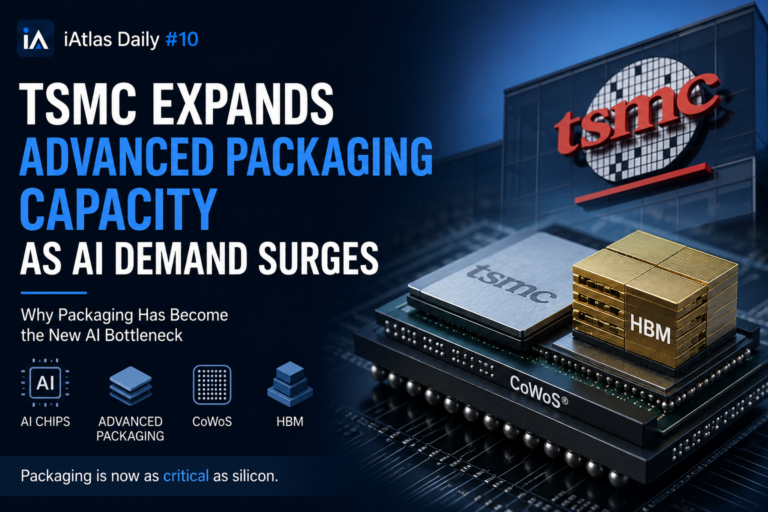
4. Advanced Packaging: Connecting Compute and Memory
Producing advanced processors and HBM separately is not enough.
They must also be integrated into a high-performance package.
This makes advanced semiconductor packaging another critical layer of AI infrastructure.
Modern AI accelerators often combine:
- large logic dies
- multiple HBM stacks
- high-density interconnects
- silicon interposers or advanced substrates
The objective is to move enormous amounts of data between compute and memory while minimizing latency and power consumption.
As AI chips become larger and more complex, packaging has moved from a relatively downstream manufacturing step to a strategic technology.
This also means that AI system production can be constrained by packaging capacity as well as wafer fabrication capacity.
The supply chain is therefore not simply:
More wafers → More AI chips
It is closer to:
Advanced Logic
HBM
Advanced Packaging Capacity
↓
Deployable AI Accelerator
5. AI Servers: Turning Components Into Systems
Processors, memory and packaging create the foundation of compute.
But they still need to be assembled into usable systems.
That is the role of the AI server industry.
An AI server integrates:
- GPUs or accelerators
- CPUs
- memory
- storage
- networking interfaces
- power systems
- cooling components
Companies such as Supermicro, Dell Technologies, HPE and large ODM manufacturers participate at this layer.
But AI infrastructure is increasingly moving beyond the traditional server.
Modern systems are becoming designed at rack scale.
NVIDIA’s DGX GB200, for example, uses a liquid-cooled rack architecture containing 36 Grace CPUs and 72 Blackwell GPUs connected through NVLink. Multiple racks can then be connected through high-speed networking to create much larger AI clusters. NVIDIA
This shift is important.
The basic unit of infrastructure is moving from:
Chip
to
Server
to
Rack
and ultimately to
Cluster
6. Rack-Scale Computing: When the Rack Becomes the Computer
Traditional data-center infrastructure was often built around individual servers.
AI is changing that architecture.
Modern rack-scale systems integrate multiple compute trays, switches, power components and cooling systems so tightly that the entire rack increasingly behaves like one computing system.
NVIDIA’s current rack-scale architecture includes compute trays, NVLink switch trays, top-of-rack networking, power shelves and liquid cooling manifolds as parts of the same system. NVIDIA Docs
This creates a fundamental change in infrastructure design.
The system designer can no longer optimize only the processor.
The rack must be designed simultaneously around:
- compute
- networking
- power
- cooling
- serviceability
- physical density
This is one reason AI infrastructure is moving toward system-level engineering.
7. Networking: Turning Racks Into AI Clusters
A single rack can provide enormous computing power.
But the largest AI workloads require many racks operating together.
That makes networking critical.
AI infrastructure requires several types of connectivity.
Scale-Up Networking
Scale-up networks connect processors within a tightly integrated compute system.
Technologies such as NVLink are designed to provide very high bandwidth and low latency between GPUs.
Scale-Out Networking
Scale-out networks connect multiple servers or racks into larger clusters.
Technologies can include:
- InfiniBand
- high-performance Ethernet
- optical networking
- high-speed NICs
- network switches
NVIDIA’s DGX Grace Blackwell architecture, for example, uses NVLink within the rack while InfiniBand or Ethernet can be used to connect systems across larger clusters. NVIDIA Docs
The distinction is important because AI infrastructure increasingly requires both.
Scale up to make one system larger.
Scale out to connect many systems together.
8. Optical Connectivity: Moving More Data Across the Data Center
As AI clusters grow, the physical distance between computing components also increases.
Copper remains important for short-distance connections, but optical technology becomes increasingly valuable as bandwidth requirements and distances rise.
This creates demand for:
- optical transceivers
- fiber-optic cables
- optical engines
- silicon photonics
- high-speed switches
The networking layer is therefore becoming closely connected to the semiconductor and photonics industries.
AI infrastructure is not only increasing the quantity of data being processed.
It is also increasing the amount of data that must move between processors.
That makes connectivity a core part of AI system performance.
9. Data Centers: Housing the AI Infrastructure Stack
Once compute systems are assembled and networked, they must be installed inside a physical facility.
That facility is the data center.
But AI data centers have different requirements from many traditional IT facilities.
They may require significantly higher:
- rack power density
- electrical capacity
- network bandwidth
- cooling capacity
- floor loading
- water or liquid-cooling infrastructure
The data center therefore acts as the physical integration point for the entire upstream technology stack.
It connects:
Compute
Networking
Power
Cooling
into a functioning AI infrastructure platform.
10. Cloud and Hyperscalers: Converting Infrastructure Into Services
Most businesses will not build their own large-scale AI data centers.
Instead, much of the world’s AI infrastructure is being deployed by hyperscale cloud and technology companies.
Major participants include:
- Amazon
- Microsoft
- Meta
- Oracle
These companies purchase large quantities of computing hardware and build or lease data-center capacity to deliver AI computing services.
This creates another layer in the value chain.
Physical AI infrastructure is transformed into:
- cloud computing
- model training capacity
- inference services
- AI platforms
- enterprise AI services
In other words:
Hardware Infrastructure
↓
Compute Capacity
↓
Cloud Services
↓
AI Applications
This is where the infrastructure value chain connects back to the software economy.
11. Power Infrastructure: Supplying the Data Center
AI computing requires large amounts of electricity.
As data centers grow larger, supplying that electricity becomes increasingly complex.
The power infrastructure layer may include:
- utility grid connections
- substations
- transformers
- switchgear
- UPS systems
- power distribution units
- backup generators
- battery energy storage systems
The International Energy Agency estimates that global data-center electricity consumption could reach around 945 TWh by 2030, roughly double its 2024 level in its base-case outlook. AI-driven accelerated servers are expected to account for almost half of the net increase. IEA
This illustrates an important shift.
The AI infrastructure value chain does not end with the data-center building.
It extends into the broader electricity system.
12. Energy Supply: Where Will the Electricity Come From?
Supplying power equipment is only part of the challenge.
Electricity must also be generated.
That brings another group of industries into the AI infrastructure ecosystem:
- renewable energy
- natural gas
- nuclear power
- battery storage
- transmission
- grid infrastructure
The IEA projects electricity generation used to supply data centers could rise from around 460 TWh in 2024 to more than 1,000 TWh by 2030 in its base case. Renewables are expected to provide a large share of the additional supply, while natural gas, coal and nuclear power also contribute. IEA
This means future AI expansion increasingly depends on the energy system itself.
A data-center developer may be able to acquire GPUs and servers relatively quickly.
Building new power plants, transmission infrastructure or substations can take much longer.
That difference in development timelines creates potential bottlenecks.
13. Cooling: Removing the Heat
Electricity powers the compute infrastructure.
But much of that electricity eventually becomes heat.
As rack density rises, cooling becomes increasingly important.
The cooling layer may include:
- air cooling
- direct-to-chip liquid cooling
- cold plates
- coolant distribution units
- pumps
- manifolds
- heat exchangers
- chillers
- facility water systems
Current high-density rack-scale systems already integrate liquid cooling directly into the computing architecture.
For example, NVIDIA’s DGX GB rack systems use liquid-cooled compute trays connected to rack-level manifolds, while some networking and storage components remain air cooled. NVIDIA Docs
This represents an important change.
Cooling is no longer simply something added after servers are installed.
In advanced AI infrastructure, cooling increasingly needs to be designed together with the compute system.
How Value Moves Through the AI Infrastructure Chain
The value chain can now be viewed as a sequence.
Step 1 — Build the Chips
Advanced logic and memory are manufactured.
↓
Step 2 — Integrate Compute and Memory
Processors, HBM and advanced packaging create AI accelerators.
↓
Step 3 — Build the Computing System
Accelerators are integrated into AI servers and rack-scale systems.
↓
Step 4 — Connect the Systems
High-speed networks link servers and racks into AI clusters.
↓
Step 5 — Build the Data Center
The cluster is installed inside a facility capable of supporting its physical requirements.
↓
Step 6 — Deliver Power
Grid connections, transformers and electrical systems provide electricity.
↓
Step 7 — Remove Heat
Cooling infrastructure keeps the computing environment within operating limits.
↓
Step 8 — Deliver AI Compute
Cloud platforms and data-center operators convert physical infrastructure into usable computing capacity.
The final product is not simply a chip or a server.
It is AI compute capacity.
Why the Value Chain Creates Bottlenecks
The AI infrastructure value chain behaves like a system.
That means total output can be constrained by the weakest layer.
Imagine that GPU supply increases by 50%.
That does not necessarily mean AI computing capacity can increase by 50%.
Other constraints may include:
- HBM availability
- packaging capacity
- network equipment
- data-center construction
- grid connection delays
- transformers
- cooling equipment
The IEA notes that energy infrastructure can require much longer planning and construction timelines than data centers themselves, creating a mismatch between technology deployment and energy-system development. IEA
That is one reason bottlenecks can migrate through the value chain.
First the constraint may be GPUs.
Then HBM.
Then advanced packaging.
Then power availability.
Then cooling.
Understanding where the bottleneck is moving is therefore one of the most important ways to analyze the AI infrastructure industry.
From a Linear Chain to an Integrated Ecosystem
The term value chain can make the industry sound linear.
In reality, modern AI infrastructure is becoming increasingly interconnected.
Compute affects cooling requirements.
Cooling affects facility design.
Networking affects compute efficiency.
Power availability affects data-center location.
Data-center location affects energy sourcing.
And processor architecture can affect all of them.
So rather than a simple chain:
A → B → C → D
AI infrastructure increasingly behaves like a system:
Compute ↔ Memory ↔ Networking ↔ Power ↔ Cooling ↔ Data Center
This is the fundamental industrial shift.
AI infrastructure is moving from a collection of independent technologies toward an integrated physical platform.
Why This Matters for Industry Analysis
Looking at individual markets can hide the bigger picture.
A surge in AI accelerator demand may create downstream opportunities for:
- HBM suppliers
- advanced packaging companies
- server manufacturers
- networking companies
- optical suppliers
- electrical equipment manufacturers
- cooling companies
- data-center developers
- power producers
At the same time, weakness in one layer can slow growth elsewhere.
This is why AI infrastructure should not be analyzed only as:
a semiconductor story
or
a data-center story
or
an electricity story.
It is all three — and more — operating together.
The Bigger Picture
The AI infrastructure value chain begins with microscopic semiconductor structures and ends with enormous industrial facilities consuming large amounts of electricity.
Between those two points lies an expanding ecosystem of technologies and companies.
Chips create compute.
Memory feeds the chips.
Servers organize the compute.
Networks connect it.
Data centers house it.
Power systems energize it.
Cooling systems keep it operating.
And cloud platforms turn the entire physical stack into usable AI capacity.
That is the structure behind the AI economy.
And as AI adoption continues to expand, understanding this value chain will become increasingly important for understanding where the next infrastructure bottlenecks — and opportunities — may emerge.
AI & Data Infrastructure Learning Path
Previous Article
AI & Data Infrastructure Industry Explained
Next Article
From Chip to Data Center: How the AI Infrastructure Ecosystem Works
References
- International Energy Agency (IEA) — Energy and AI: Energy Demand from AI
Data-center electricity demand, accelerated servers and the interaction between AI growth and energy-system constraints. - International Energy Agency (IEA) — Energy and AI: Energy Supply for AI
Outlook for the electricity generation required to support growing global data-center demand. - NVIDIA — DGX GB Rack Scale Systems User Guide
Technical reference covering the compute trays, NVLink switches, power shelves, networking and liquid-cooling architecture of current rack-scale AI systems. - NVIDIA — DGX GB200
Overview of the liquid-cooled GB200 rack-scale architecture combining 36 Grace CPUs and 72 Blackwell GPUs. - NVIDIA — DGX Grace Blackwell Networking
Technical overview of NVLink, InfiniBand and Ethernet within rack-scale and multi-rack AI infrastructure.
ℹ️ About iAtlas
iAtlas is an independent publication covering batteries, semiconductors, OLED, advanced materials, AI, and global industrial trends.
We transform complex industrial developments into clear, reliable, and easy-to-understand insights.
Whether you’re following today’s industry news or building long-term expertise, iAtlas helps you understand not only what happened, but why it matters.
Technology creates change.
Insight creates opportunity.
— iAtlas