

What Is Industrial Infrastructure?
The Hidden Systems Behind Modern Industry
⚡ Industry Infrastructure #1 | 🧭 Fundamentals → Industrial Infrastructure Overview
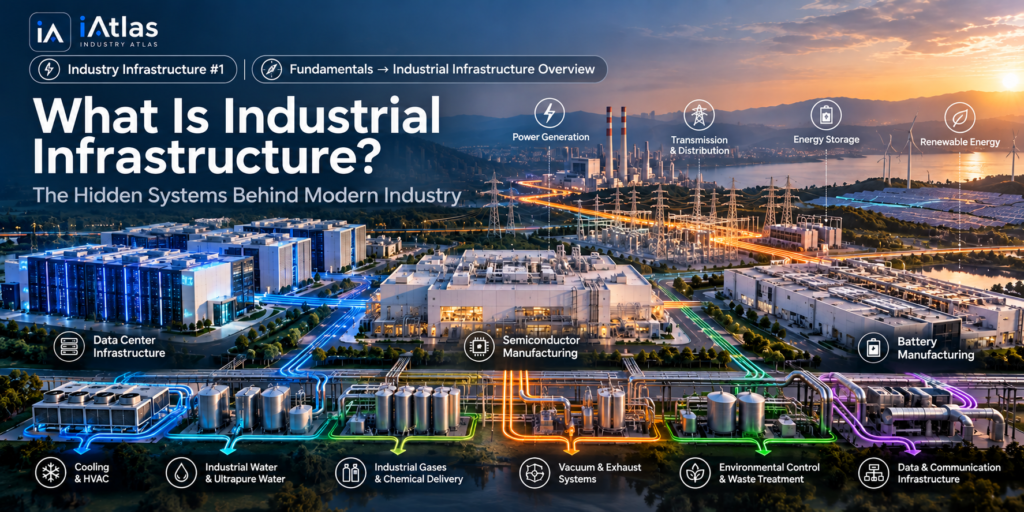
A semiconductor fab can contain some of the most advanced manufacturing equipment in the world.
An AI data center can operate tens of thousands of high-performance processors.
A battery gigafactory can produce cells at enormous scale.
But none of these facilities can operate on production equipment alone.
Behind every advanced factory, data center, laboratory, and energy facility is another layer of technology — industrial infrastructure.
Electricity must arrive at the right voltage and with sufficient reliability. Heat must be removed. Water, gases, chemicals, and vacuum must be supplied where they are needed. Humidity, temperature, contamination, emissions, and waste must be controlled.
These systems rarely receive the same attention as the products being manufactured.
Yet without them, modern industry stops.
Industrial Infrastructure Is the System Behind the System
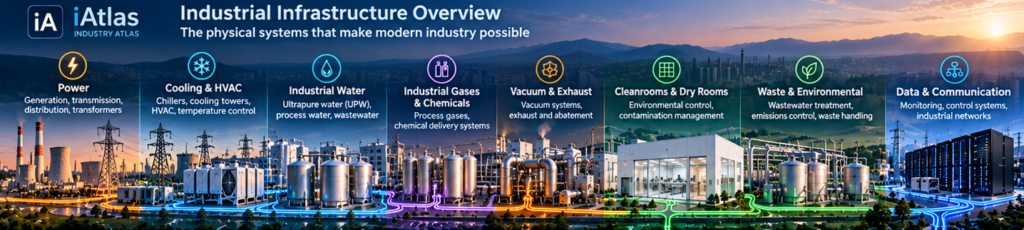
Industrial infrastructure can be understood as the collection of physical systems that allow industrial facilities and technology platforms to operate safely, reliably, and at scale.
It includes areas such as:
- Power generation, transmission, and distribution
- Transformers and substations
- Energy storage
- Cooling and HVAC
- Industrial gases and chemical delivery
- Vacuum and exhaust systems
- Cleanrooms and dry rooms
- Industrial water and ultrapure water
- Wastewater and emissions treatment
- Data and communication infrastructure
These systems are different in function, but they share one important characteristic:
They support another industrial process.
A transformer does not manufacture a semiconductor.
A chiller does not train an AI model.
A dry room does not produce a battery.
But without them, those activities may not be possible.
This is why infrastructure should not be viewed simply as supporting equipment. In many advanced industries, infrastructure has become part of the production capability itself.
Why Industrial Infrastructure Is Becoming More Important
For much of modern industrial history, infrastructure expanded alongside economic growth.
Today, however, several technological shifts are increasing infrastructure requirements at the same time.
1. Electrification Is Increasing Power Demand
More parts of the economy are moving toward electricity.
Electric vehicles are replacing combustion engines. Heat pumps are replacing fossil-fuel heating systems. Industrial processes are becoming more electrified. Data centers are expanding. Advanced manufacturing is requiring increasingly sophisticated utility systems.
The International Energy Agency expects global electricity demand to grow at an average annual rate of around 3.6% between 2026 and 2030.
Industry, electric vehicles, cooling, and data centers are among the major drivers.
This means electricity is no longer simply another utility.
It is becoming one of the central constraints shaping industrial development.
2. AI Is Turning Data Centers Into Major Infrastructure Projects
The rise of artificial intelligence illustrates how quickly a digital technology can become an infrastructure issue.
AI models require large computing clusters.
Those clusters require enormous amounts of electricity.
That electricity requires substations, transformers, switchgear, backup power, UPS systems, and increasingly sophisticated energy-management systems.
High-density AI computing also produces significant amounts of heat, increasing the importance of cooling technologies such as liquid cooling.
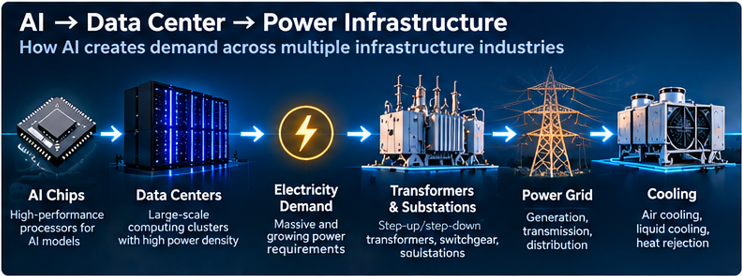
The result is a chain that looks something like this:
AI
↓
Computing
↓
Data Centers
↓
Electricity
↓
Grid Infrastructure
↓
Cooling
↓
Power Equipment
A technology that appears digital at the surface therefore creates demand across multiple physical industries.
This is one of the defining characteristics of modern infrastructure.
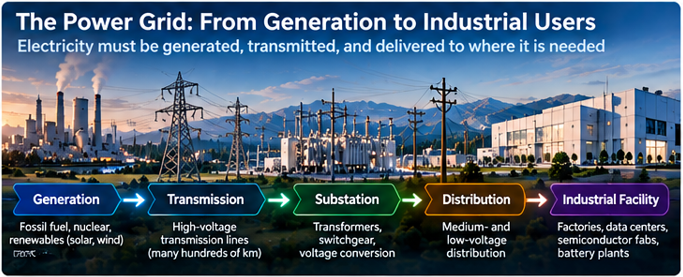
The Power Grid: The Infrastructure Beneath Almost Everything
Nearly every modern industrial system ultimately depends on electricity.
But increasing electricity generation alone is not enough.
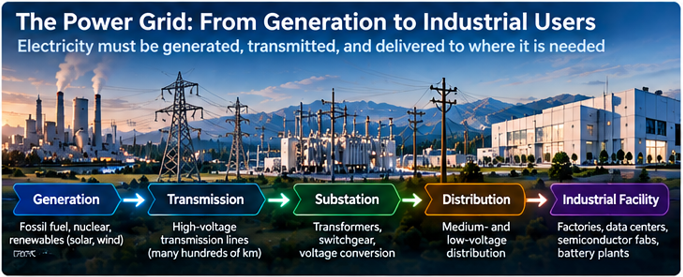
Electricity must be transported from where it is produced to where it is consumed.
That requires:
Generation → Transmission → Substation → Distribution → Industrial Facility
As renewable generation, data centers, electric vehicles, energy storage, and new factories expand, more projects need access to the grid.
This is becoming a significant bottleneck.
According to the IEA, more than 2,500 GW of renewable generation, storage, and large electricity-consuming projects such as data centers are currently waiting in grid connection queues worldwide.
At the same time, global grid investment needs to rise substantially to keep pace with expected electricity demand.
This changes the strategic importance of equipment that was once considered relatively mature.
Transformers, switchgear, cables, substations, transmission systems, and grid-control technologies are increasingly becoming critical parts of the global industrial supply chain.
Data Centers Show How Infrastructure Industries Converge
A modern data center provides a useful example of how infrastructure systems connect.
At the center are servers and processors.
But around them is an extensive infrastructure ecosystem.
Power Infrastructure
Grid connection
→ Substation
→ Transformer
→ Switchgear
→ UPS
→ Power distribution
→ Server rack
Thermal Infrastructure
Processor
→ Cooling system
→ Heat exchanger
→ Chiller or cooling loop
→ Heat rejection
Reliability Infrastructure
Grid power
- Backup generation
- Battery systems
- Power management
These systems must operate continuously and increasingly at very high power density.
This is why the growth of AI is affecting industries far beyond semiconductors.
It is creating opportunities — and bottlenecks — across electrical equipment, cooling, energy storage, construction, power generation, and grid infrastructure.
Advanced Manufacturing Depends on an Even More Complex Infrastructure Layer
Industrial infrastructure becomes even more specialized in advanced manufacturing.
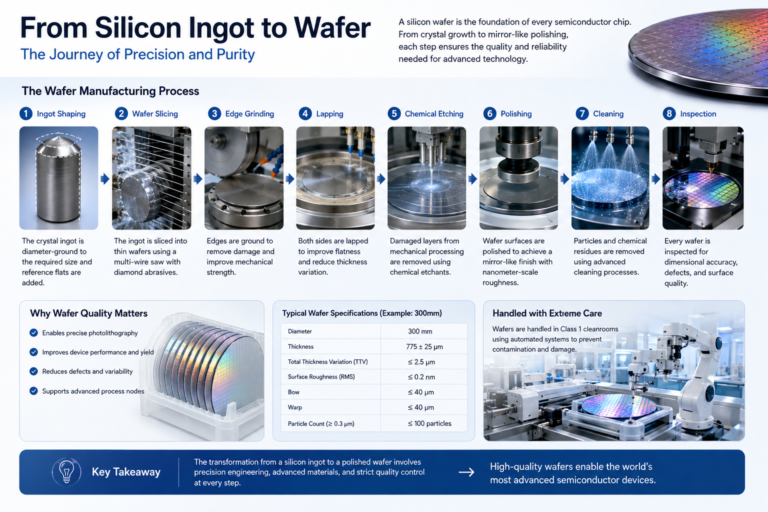
Consider semiconductor production.
A semiconductor fab requires far more than lithography, deposition, etching, and inspection equipment.
Behind the cleanroom are extensive support systems.
These can include:
- High-purity process gases
- Chemical distribution
- Vacuum systems
- Exhaust and abatement
- Chillers
- Temperature control
- Ultrapure water
- Electrical infrastructure
- Cleanroom environmental control
- Waste handling
SEMI describes many of these supporting systems as part of the subfab infrastructure surrounding semiconductor manufacturing.
As semiconductor processes become more complex, these supporting systems become more important as well.
More process steps can mean more gases, more vacuum demand, more cooling, more exhaust treatment, and higher energy consumption.
The manufacturing tool may receive most of the attention.
But the infrastructure around the tool helps determine whether that tool can operate reliably at industrial scale.
Battery Manufacturing Has Its Own Infrastructure Requirements
Battery factories present another example.
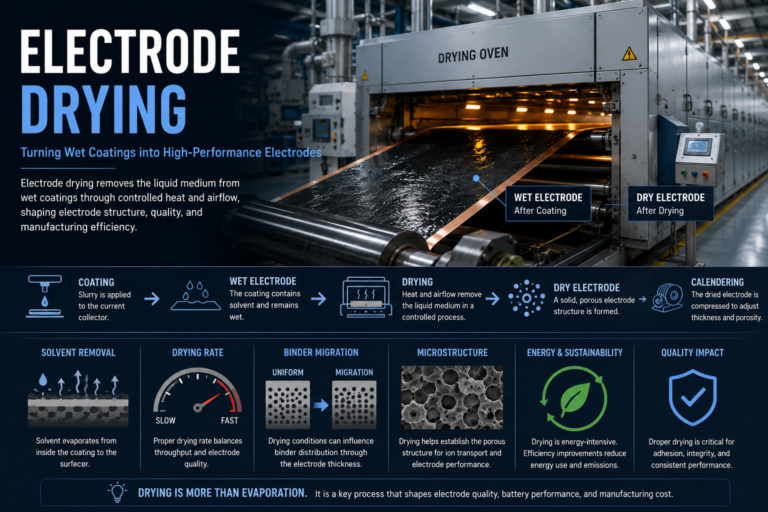
Producing lithium-ion batteries requires large manufacturing equipment, but environmental control can also become part of the process itself.
Certain production stages must be performed under tightly controlled moisture conditions.
That creates demand for:
- Dry rooms
- HVAC systems
- Dehumidification
- Cooling
- Electrical infrastructure
- Process gases
- Safety systems
- Material-handling infrastructure
As battery factories become larger, these systems also become larger.
The infrastructure is therefore not simply a building around the manufacturing line.
It becomes part of manufacturing economics.
Energy consumption, environmental stability, uptime, and utility costs can influence the competitiveness of the facility.
Infrastructure Is Becoming a Supply-Chain Issue
The rapid growth of infrastructure demand creates another challenge.
Many infrastructure assets cannot be expanded instantly.
Transmission lines may require years of permitting and construction.
Large transformers and specialized electrical equipment can have long production lead times.
Water resources may constrain where new factories or data centers can be built.
Grid connections can delay projects even when the facility itself is ready to be constructed.
As a result, companies increasingly need to consider infrastructure much earlier when deciding where and how to invest.
The question is no longer simply:
Where should we build the factory?
It is also:
Is enough electricity available?
Can the grid connection be secured?
Is sufficient cooling available?
Is there enough water?
Can industrial gases and other utilities be supplied?
Can the facility meet environmental requirements?
Infrastructure availability can therefore influence investment decisions across entire industries.
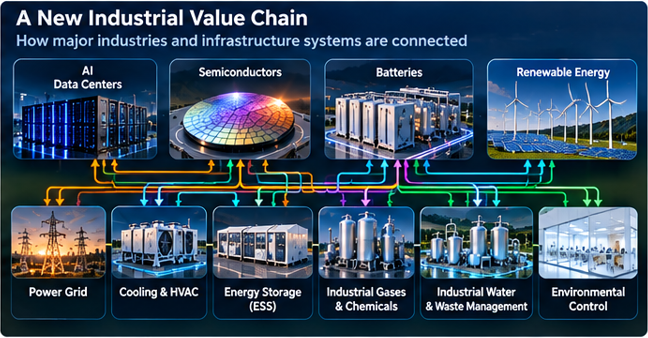
A New Industrial Value Chain Is Emerging
Industrial infrastructure should not be viewed as a single market.
It is better understood as a network of interconnected industries.
AI
AI Chips
↓
Data Centers
↓
Electricity Demand
↓
Transformers & Substations
↓
Power Grid
Renewable Energy
Solar & Wind
↓
Variable Electricity Generation
↓
Grid Expansion
↓
Energy Storage
↓
Power Management
Semiconductor
Semiconductor Fab
↓
Cleanroom & Subfab
↓
Industrial Gases / Vacuum / Cooling / Water
↓
Power & Environmental Infrastructure
Battery
Gigafactory
↓
Dry Room / HVAC / Utilities
↓
Electricity & Environmental Control
↓
Industrial Infrastructure
These connections are important because investment in one industry can create demand in several others.
A semiconductor boom can increase demand for industrial gases.
An AI boom can increase transformer demand.
Renewable-energy expansion can increase demand for energy storage and transmission.
Battery manufacturing expansion can increase demand for dry-room and environmental-control technologies.
Understanding these connections is increasingly important for understanding where industrial growth will occur.
Infrastructure Can Become the Bottleneck
Technology industries are often analyzed through their most visible products.
AI is discussed through GPUs.
Semiconductors are discussed through process nodes.
Batteries are discussed through chemistry and energy density.
Renewable energy is discussed through solar panels and wind turbines.
But the limiting factor may increasingly exist somewhere else.
The question may not be:
Can we produce enough AI chips?
It may become:
Can we supply enough electricity to operate them?
The question may not be:
Can we build another semiconductor fab?
It may become:
Can the location provide enough power, water, gases, cooling, and environmental infrastructure?
The question may not be:
Can we install more renewable generation?
It may become:
Can the transmission network connect it?
That is why infrastructure deserves to be analyzed as an industry of its own.
From Invisible Support System to Strategic Industry
Industrial infrastructure used to be easy to overlook because it operated quietly in the background.
That is changing.
AI, electrification, advanced manufacturing, renewable energy, energy storage, and increasingly complex supply chains are placing unprecedented pressure on the physical systems supporting the global economy.
Power grids must expand.
Data centers need more electricity and cooling.
Semiconductor fabs require increasingly sophisticated utilities.
Battery factories require tightly controlled production environments.
Renewable generation requires transmission and flexibility.
Industrial growth is therefore becoming increasingly dependent on infrastructure growth.
And that creates an important shift in how we should think about technology.
The next major industrial bottleneck may not always come from the technology everyone is watching.
It may come from the infrastructure behind it.
🧭 Industry Infrastructure Learning Path
Industrial infrastructure connects power, energy, data centers, advanced manufacturing, utilities, and environmental systems.
Follow the iAtlas Industry Infrastructure Learning Path to understand how these systems work together — from the basic structure of industrial infrastructure to the technologies, supply chains, and bottlenecks shaping modern industry.
You Are Here → 01. Industrial Infrastructure Fundamentals
01. Industrial Infrastructure Fundamentals
Understand the systems behind modern factories, data centers, energy facilities, and technology industries.
02. Power Grid & Electrification
Explore how electricity moves from generation to industrial users, and why grids, transformers, substations, and transmission are becoming increasingly important.
03. Data Center Infrastructure
Learn how AI and cloud computing are driving demand for power, cooling, energy storage, and electrical infrastructure.
04. Energy Storage & Flexible Power
Understand how grid-scale energy storage supports renewable energy, grid stability, and increasingly electrified economies.
05. Advanced Manufacturing Infrastructure
Explore the infrastructure behind semiconductor fabs, battery gigafactories, OLED manufacturing, and other advanced industrial facilities.
06. Infrastructure Supply Chains
Follow the companies, equipment suppliers, technologies, and industrial ecosystems supporting global infrastructure investment.
07. Industry Connections
See how AI, semiconductors, batteries, energy, manufacturing, and infrastructure increasingly depend on one another.
🔗 Related Articles
Continue exploring the industries and technologies behind modern infrastructure.
Recommended Next
The Infrastructure Behind Modern Industry
See how power, cooling, gases, water, environmental control, and industrial utilities support modern production.
How the Global Power Grid Industry Works
Understand the structure connecting electricity generation, transmission, substations, distribution, and industrial users.
Inside the Data Center Infrastructure Industry
Explore the physical systems supporting cloud computing and AI, from electricity and transformers to UPS systems and cooling.
The Infrastructure Behind a Semiconductor Fab
Discover the utilities and support systems required to operate one of the world’s most complex manufacturing environments.
The Grid-Scale Energy Storage Industry Explained
Understand how large-scale battery storage is becoming part of modern power infrastructure.
References
- International Energy Agency (IEA) — Electricity 2026
- International Energy Agency (IEA) — Modernising Grids in the Age of Electricity
- International Energy Agency (IEA) — Data Centres and Data Transmission Networks
- SEMI — Subfab Infrastructure and Advanced Semiconductor Manufacturing
ℹ️ About iAtlas
iAtlas is an independent publication covering batteries, semiconductors, OLED, advanced materials, AI, and global industrial trends.
We transform complex industrial developments into clear, reliable, and easy-to-understand insights.
Whether you’re following today’s industry news or building long-term expertise, iAtlas helps you understand not only what happened, but why it matters.
Technology creates change.
Insight creates opportunity.
— iAtlas


2 Comments