Unitree IPO Puts Humanoid Robots in the Industrial Spotlight
Why China’s Robotics Race Is Moving From Demonstrations to Commercialization
📰 iAtlas Daily #32 | August 10, 2026
📰 What Happened?
Chinese robotics company Unitree is taking a major step toward the public market as competition in humanoid robotics accelerates.
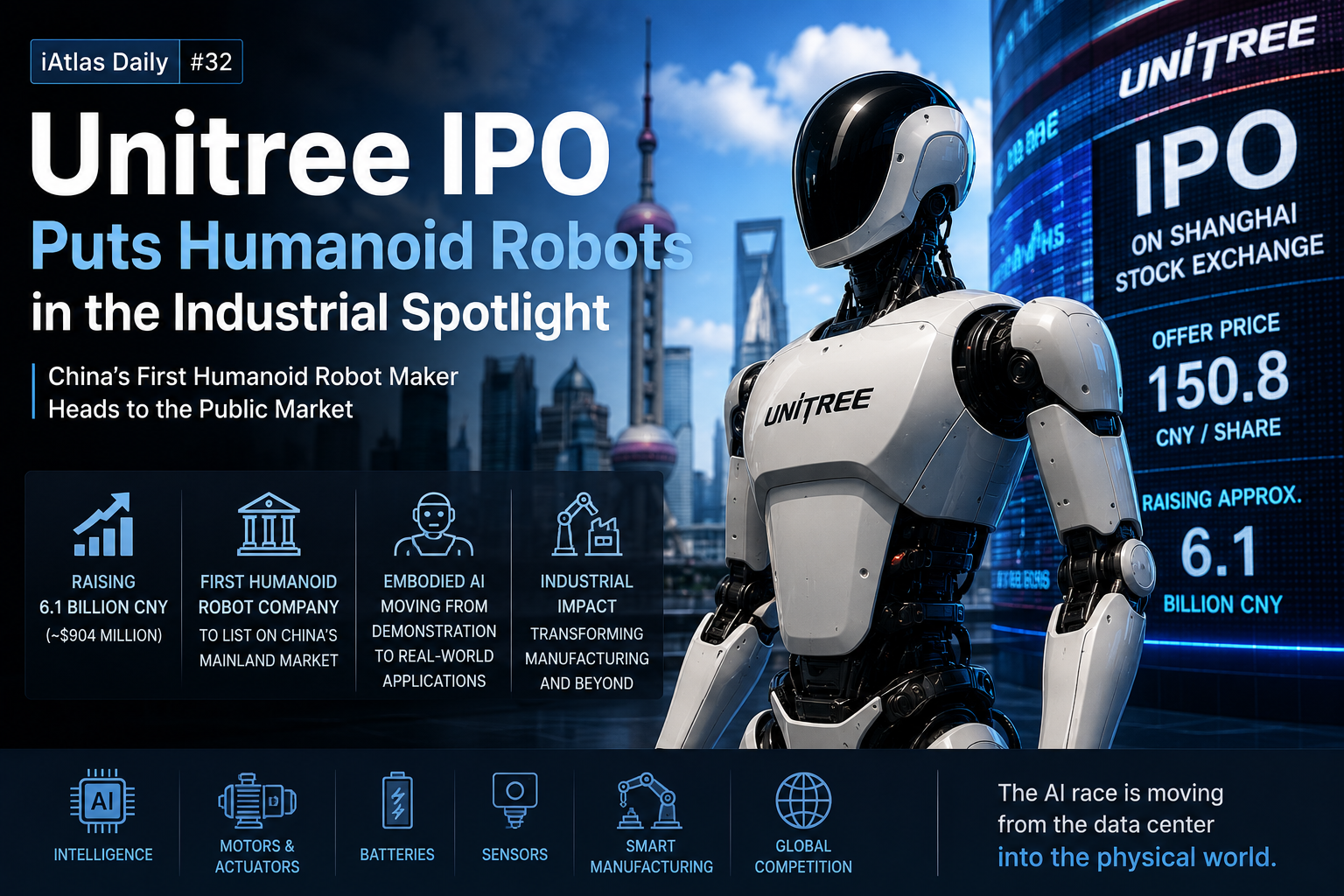
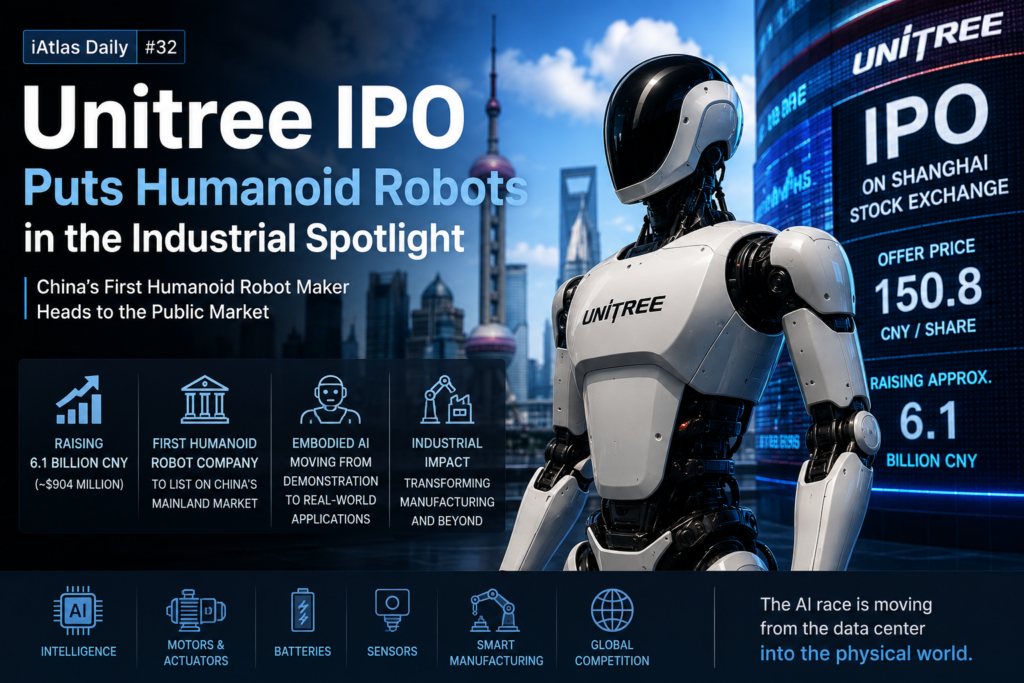
The company has priced its Shanghai initial public offering at 150.8 yuan per share and is seeking to raise approximately 6.1 billion yuan ($904 million).
If completed, the deal would make Unitree the first humanoid robot manufacturer listed on mainland China’s stock market.
The timing is significant.
Humanoid robots have attracted enormous attention through demonstrations of walking, running, dancing, and performing increasingly complex movements.
But the industry is now approaching a much more difficult question:
Can humanoid robots move from impressive demonstrations to commercially useful machines?
🤖 Why Unitree Matters
Founded in Hangzhou in 2016, Unitree initially became known for relatively affordable quadruped robots.
Its humanoid models—including the G1, H1, and R1—have since attracted global attention.
More importantly, Unitree is already generating meaningful revenue.
The company’s revenue increased more than fourfold to nearly 1.7 billion yuan in 2025, while adjusted net profit reached approximately 600 million yuan.
More than 40% of its revenue came from overseas markets during the periods disclosed in its prospectus.
That separates Unitree from many robotics startups that remain primarily in the R&D stage.
💡 Why This Matters
Humanoid Robotics Is Becoming an Industrial Race
The humanoid robot industry is entering a new phase.
Until recently, much of the competition focused on technical demonstrations:
- Walking
- Running
- Balance
- Object manipulation
- Dancing
- Human-like movement
The next phase will be different.
Companies must prove that robots can operate reliably, repeatedly, and economically in real industrial environments.
That means the competitive advantage will increasingly depend on more than AI.
Manufacturing capability will matter too.
🏭 China Has a Manufacturing Advantage
One of Unitree’s most important advantages is its access to China’s manufacturing ecosystem.
Humanoid robots require a surprisingly broad range of components:
⚙️ Motors & Actuators
Robots require compact, high-performance motors and precision actuators to reproduce human movement.
👁️ Sensors
Cameras, LiDAR, force sensors, encoders, and other sensing technologies allow robots to understand their surroundings.
🔋 Batteries
Humanoid robots require compact batteries capable of delivering sufficient power while minimizing weight.
🧠 AI Computing
Processors and AI models enable perception, decision-making, navigation, and increasingly sophisticated physical interaction.
🔩 Precision Components
Bearings, gears, reducers, structural components, and connectors must all operate reliably under repeated mechanical loads.
China’s extensive supply chains across these industries can help robotics companies reduce costs and accelerate product development.
🧠 From AI to Embodied AI
The bigger technological shift is the rise of embodied AI.
Traditional AI operates primarily in digital environments.
Embodied AI connects artificial intelligence with physical machines capable of:
Perceiving → Understanding → Deciding → Acting
Humanoid robots are one of the clearest examples.
Instead of simply answering a question, an AI system could eventually:
- Move materials
- Inspect equipment
- Handle components
- Perform repetitive assembly
- Work in hazardous environments
- Assist human operators
That would transform AI from a software technology into a physical industrial platform.
📈 Why Robotics Companies Need More Capital
Developing humanoid robots is expensive.
Companies must simultaneously invest in:
- Robot hardware
- AI models
- Training data
- Engineers
- Manufacturing capacity
- Component development
And those investments must often be made before large-scale commercial demand has been proven.
This helps explain why Unitree and other Chinese robotics companies are moving toward public markets.
Leju Robotics has also applied for a listing in Shenzhen, while AgiBot began preparing for a Hong Kong IPO in July.
Capital markets could therefore become another important battleground in China’s humanoid robot industry.
⚠️ The Biggest Question: Commercialization
Despite the excitement, humanoid robots are not yet ready to replace human workers at scale.
Current demand still comes heavily from universities, research institutions, and government-backed projects.
Robots also continue to face challenges involving:
- Reliability
- Dexterity
- Battery life
- Cost
- AI capability
- Long-duration operation
Performing a controlled demonstration is very different from operating eight or twelve hours inside a real factory.
That gap is where the next robotics competition will take place.
🌍 Industry Impact
🤖 Robotics
Unitree’s IPO could establish an important valuation benchmark for other humanoid robotics companies.
⚙️ Industrial Automation
Factories could become one of the first major commercial markets if humanoid robots achieve sufficient reliability.
🔋 Battery
Robotics could eventually create another specialized battery market requiring high power density, low weight, safety, and long cycle life.
💻 Semiconductor
AI processors, sensors, motor-control chips, power semiconductors, and memory will all become increasingly important as robot intelligence improves.
🏭 Manufacturing Equipment
Mass production of humanoid robots could eventually create new demand for precision manufacturing, inspection, automation, and testing equipment.
👀 What to Watch
The next phase of the humanoid robot race will be defined by several questions:
- Can Unitree maintain rapid revenue growth?
- Will humanoid robots move into real factories?
- How quickly can production costs decline?
- Which applications will reach commercialization first?
- Can AI models improve robot autonomy?
- How quickly will Chinese competitors scale production?
The most important metric may eventually become much simpler:
How many robots are performing economically useful work every day?
🎯 Atlas Insight
The Unitree IPO represents something larger than one robotics company entering the stock market.
It illustrates how the AI industry itself is changing.
The first AI investment wave focused heavily on:
GPUs → HBM → Data Centers → AI Models
The next wave may increasingly extend into:
Sensors → Motors → Batteries → Robots → Factories
That means AI could become deeply connected with traditional manufacturing industries.
The winners in humanoid robotics may therefore not be determined by AI models alone.
They may be determined by the ability to combine AI, hardware, components, supply chains, and mass manufacturing into one scalable platform.
The AI race is beginning to move from the data center into the physical world.
📚 Related Articles
📰 iAtlas Daily #30 | SK hynix Invests ₩54 Trillion in New Memory Fabs
📰 iAtlas Daily #31 | China Expands Its Lead in the Global EV Battery Market
📊 iAtlas Weekly #5 | Building the AI Infrastructure Era
Sources
- Reuters — What is Unitree and why are China’s humanoid robot makers racing to list?–
- Reuters — Unitree IPO more than 8,000 times oversubscribed by retail investors
- Unitree — Official Website
About iAtlas
iAtlas is an independent publication covering batteries, semiconductors, OLED, advanced materials, AI, and global industrial trends.
We transform complex industrial developments into clear, reliable, and easy-to-understand insights.
Whether you’re following today’s industry news or building long-term expertise, iAtlas helps you understand not only what happened, but why it matters.
Technology creates change.
Insight creates opportunity.
— iAtlas