China’s Battery Recycling Industry Is Entering a New Growth Phase
Why Battery Recycling Is Becoming as Important as Battery Manufacturing
📰 iAtlas Daily #15 | July 21, 2026
🔋 What Happened?
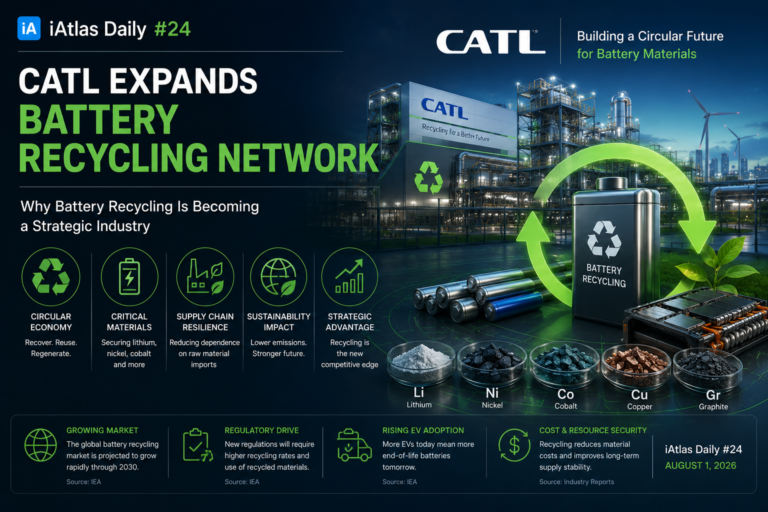
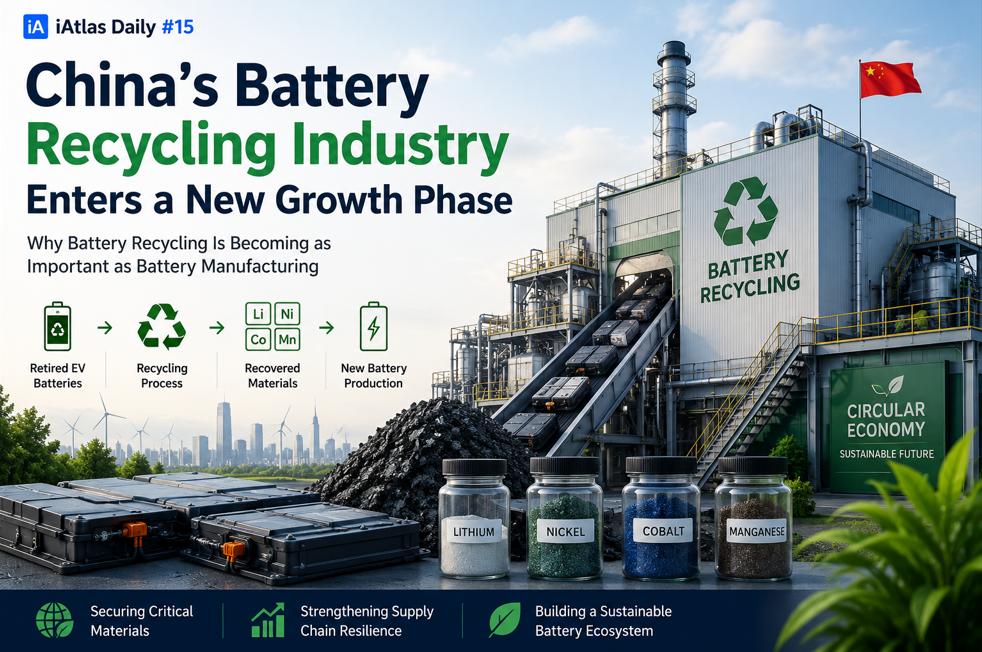
China is rapidly expanding its battery recycling capacity as the first large wave of electric vehicle batteries reaches the end of its service life.
Leading battery manufacturers and recycling companies are increasing investments in facilities capable of recovering valuable materials such as lithium, nickel, cobalt, and graphite. Government policies are also encouraging the development of a more complete circular battery supply chain.
The industry is shifting from simply producing batteries to recovering critical materials that can be reused in future battery manufacturing.
💡 Why It Matters
For years, the battery industry focused on securing raw materials through mining.
That strategy alone may no longer be sufficient.
As EV adoption grows worldwide, millions of batteries will eventually require recycling. Recovering valuable metals from used batteries can reduce dependence on mining, improve supply chain resilience, and lower the environmental impact of battery production.
Battery recycling is becoming an essential part of the battery value chain rather than a separate downstream business.
🌍 Industry Impact
Battery Manufacturers
Companies with strong recycling capabilities may gain better control over future raw material supplies while reducing exposure to commodity price volatility.
Material Suppliers
Demand for recycling technologies, hydrometallurgical processing, and material purification is expected to grow alongside battery production.
Sustainability
Governments in Asia, Europe, and North America are introducing regulations that require higher recycling rates and greater use of recycled battery materials.
As these regulations expand, recycling will become a competitive advantage rather than simply an environmental obligation.
🎯 Atlas Insight
The next generation of battery leaders may not only be the companies that manufacture batteries—but also those that recover the materials inside them.
The industry is moving toward a circular ecosystem where batteries are designed, manufactured, used, collected, recycled, and transformed into new batteries.
Battery recycling is no longer the end of the battery lifecycle.
It is becoming the beginning of the next one.
📚 Related Articles
🔋 Battery #2 | What Are Battery Raw Materials?
Learn why lithium, nickel, cobalt, graphite, and manganese remain essential to modern battery production.
🔋 Battery #6 | How Lithium-Ion Batteries Are Manufactured
Explore how recovered materials can re-enter battery manufacturing and support a more sustainable supply chain.
📰 iAtlas Daily #14 | LG Energy Solution Expands ESS Battery Production Beyond EVs
Discover how battery manufacturers are diversifying beyond EVs while preparing for the industry’s next growth phase.
📊 iAtlas Weekly #2 | AI, Battery & Semiconductor Weekly News
Catch up on the week’s biggest developments across batteries, semiconductors, AI, OLED, and advanced manufacturing.
About iAtlas
iAtlas is an independent publication covering batteries, semiconductors, OLED, advanced materials, AI, and global industrial trends.
We transform complex industrial developments into clear, reliable, and easy-to-understand insights.
Whether you’re following today’s industry news or building long-term expertise, iAtlas helps you understand not only what happened, but why it matters.
Technology creates change.
Insight creates opportunity.
— iAtlas