Battery Formation Equipment Explained: Why the First Charge Determines Battery Life
🔋 iAtlas Battery #26 | ⚙️ Equipment → ⚡ Formation Equipment
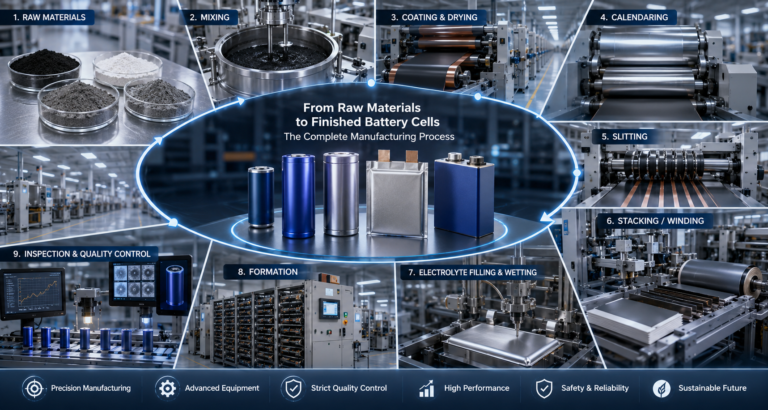
After electrolyte filling and wetting, a lithium-ion battery is still unable to deliver its full performance. The battery must first undergo a carefully controlled process called formation.
During formation, the battery experiences its first charge and discharge cycles under precisely controlled conditions. These initial cycles create a thin protective layer on the anode surface known as the Solid Electrolyte Interphase (SEI).
Although only a few cycles are performed, formation has a lasting impact on battery performance, cycle life, safety, and long-term reliability. Poor formation can permanently reduce battery capacity or increase internal resistance.
Modern battery formation equipment combines precision charging systems, temperature control, automated monitoring, and large-scale data acquisition to ensure every battery cell begins its life under optimal conditions.
In this article, we’ll explore how battery formation equipment works, why the first charge is so important, and the technologies used to improve lithium-ion battery quality.
Table of Contents
- What Is Battery Formation Equipment?
- Why Formation Matters
- Main Components of a Formation Line
- How Battery Formation Works
- Critical Formation Parameters
- Common Formation Defects
- Future Trends in Formation Equipment
- Frequently Asked Questions
- Key Takeaways
1. What Is Battery Formation Equipment?
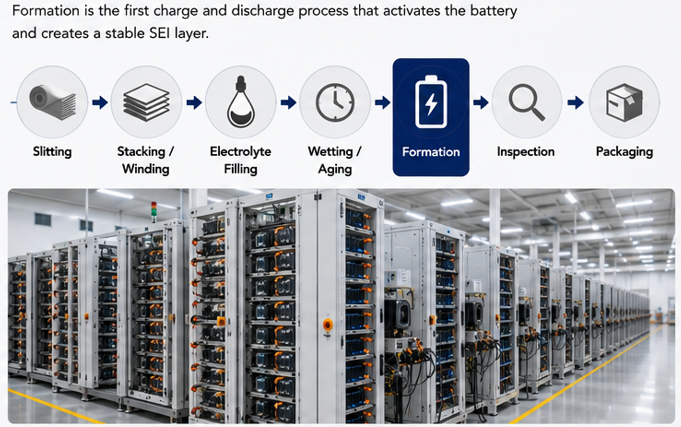
Battery formation equipment performs the first controlled charge and discharge cycles after electrolyte filling.
The primary purpose is not simply to charge the battery but to activate electrochemical reactions that stabilize the cell before it enters normal use.
Formation equipment is used for:
- Cylindrical cells
- Prismatic cells
- Pouch cells
Its main objectives are to:
- Form a stable SEI layer
- Activate electrochemical reactions
- Verify initial cell performance
- Screen defective cells
- Prepare batteries for aging and inspection
Formation is often considered one of the most time-consuming processes in battery manufacturing because cells remain connected to charging equipment for many hours or even days.
2. Why Formation Matters
Formation determines how a battery begins its operating life.
A properly controlled formation process improves long-term battery performance and reliability.
Creating the SEI Layer
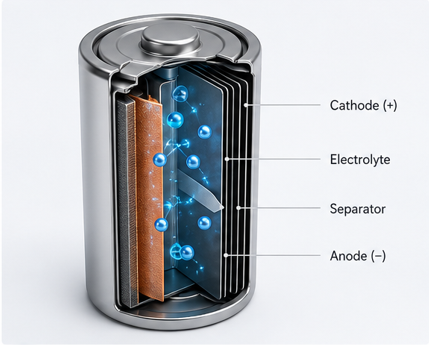
During the first charge, electrolyte reacts with the graphite anode to create the Solid Electrolyte Interphase (SEI).
A stable SEI:
- Protects the anode
- Reduces side reactions
- Improves cycle life
- Increases Coulombic efficiency
Stabilizing Cell Performance
Formation allows the battery chemistry to stabilize before shipment.
This process helps reduce cell-to-cell variation across production batches.
Identifying Defective Cells
Formation equipment continuously measures:
- Voltage
- Current
- Capacity
- Internal resistance
- Temperature
Abnormal cells can be identified before they leave the factory.
3. Main Components of a Formation Line
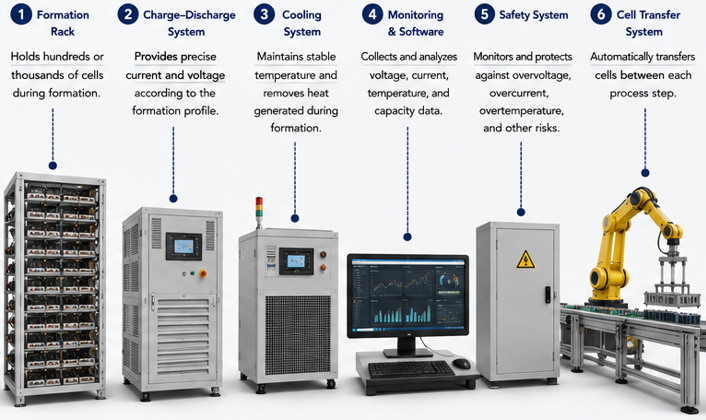
Formation Rack
Large racks hold thousands of battery cells during charging and discharging.
Charge–Discharge System
Programmable power supplies apply highly controlled current and voltage profiles.
Temperature Control System
Formation generates heat.
Cooling systems maintain stable operating temperatures throughout the process.
Data Acquisition System
Every battery channel records:
- Voltage
- Current
- Capacity
- Time
- Temperature
The collected data supports quality control and traceability.
Safety Monitoring
Protection systems detect:
- Overvoltage
- Overcurrent
- Overtemperature
- Abnormal cell behavior
Automated Cell Handling
Robotic systems transport cells between filling, formation, aging, and inspection.
4. How Battery Formation Works
The formation process generally follows these steps:
- Electrolyte-filled cells complete the wetting process.
- Cells are loaded into formation racks.
- A controlled charging profile is applied.
- The battery undergoes one or more charge–discharge cycles.
- The SEI layer forms on the anode surface.
- Cell performance data is recorded.
- Qualified cells move to aging or inspection.
Unlike normal battery charging, formation prioritizes electrochemical stability over speed.
5. Critical Formation Parameters
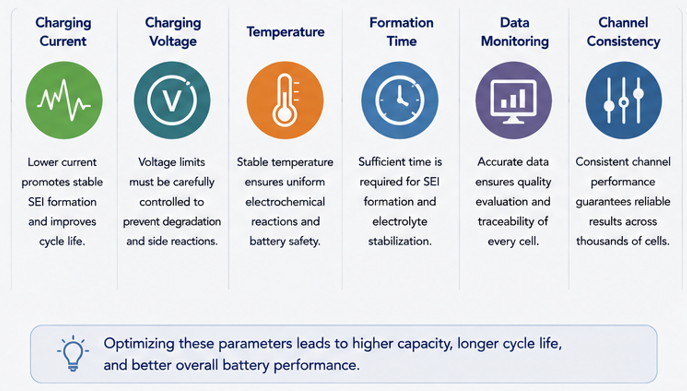
Several process variables influence formation quality.
Charging Current
Lower currents often produce a more stable SEI.
Charging Voltage
Voltage limits must be carefully controlled to prevent degradation.
Temperature
Stable temperatures promote uniform electrochemical reactions.
Formation Time
Formation typically requires many hours depending on battery chemistry.
Data Accuracy
Reliable measurement ensures defective cells are identified correctly.
Channel Consistency
Large production lines require thousands of formation channels to perform consistently.
6. Common Formation Defects
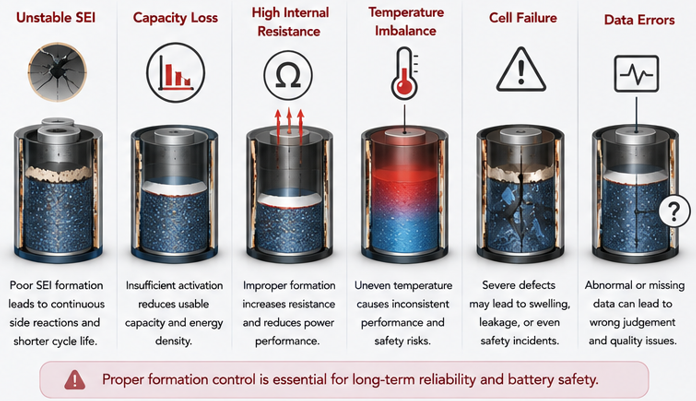
Improper formation conditions may result in:
Unstable SEI
Poor SEI formation reduces cycle life.
Capacity Loss
Abnormal electrochemical reactions lower usable capacity.
High Internal Resistance
Poor formation increases resistance and reduces power output.
Temperature Imbalance
Uneven temperatures create inconsistent cell performance.
Cell Failure
Formation often reveals hidden manufacturing defects.
Data Errors
Incorrect channel measurements may lead to false quality decisions.
7. Future Trends in Formation Equipment
Battery formation technology continues evolving through:
- AI-assisted formation optimization
- Faster formation algorithms
- Energy recovery systems
- Digital twin manufacturing
- High-density formation racks
- Cloud-based manufacturing data
- Equipment designed for solid-state batteries
These technologies reduce production costs while improving battery consistency.
8. Frequently Asked Questions
Why is formation necessary?
Formation creates the protective SEI layer that enables stable battery operation throughout its lifetime.
Why does formation take so long?
Electrochemical reactions occur gradually and require carefully controlled charging conditions to ensure long-term reliability.
Can formation detect defective batteries?
Yes. Formation equipment records electrical data that helps manufacturers identify abnormal cells before shipment.
Does every battery require formation?
Yes. All commercial lithium-ion batteries undergo formation before entering service.
What process follows formation?
After formation, cells typically undergo aging, followed by final inspection, grading, and packaging.
9. Key Takeaways
- Battery formation equipment performs the first controlled charge and discharge cycles of lithium-ion batteries.
- Formation creates the protective SEI layer that determines long-term battery performance.
- Temperature control, charging profiles, and data acquisition are critical for high-quality formation.
- Formation also serves as an important quality-screening process.
- Future formation systems will become faster, smarter, and more energy-efficient through AI and automation.
📚 Key Terms
Battery Formation Equipment
Automated equipment that performs the first controlled charge and discharge cycles of a lithium-ion battery to activate the cell and establish stable electrochemical performance.
Formation
The initial charging and discharging process performed after electrolyte filling. Formation creates the protective SEI layer and verifies the battery’s initial performance.
SEI (Solid Electrolyte Interphase)
A thin protective layer that forms on the anode surface during the first charge. A stable SEI improves cycle life, Coulombic efficiency, and battery safety.
Formation Rack
A multi-channel charging system that holds hundreds or thousands of battery cells during the formation process while recording electrical data.
Charge–Discharge Cycle
A controlled process in which a battery is charged and discharged according to a predefined current and voltage profile.
Data Acquisition System
A monitoring system that records voltage, current, capacity, temperature, and time for every battery channel during formation.
Coulombic Efficiency
The ratio of discharge capacity to charge capacity during a battery cycle. High initial Coulombic efficiency indicates effective SEI formation and low irreversible lithium loss.
🎓 Battery Learning Path
⚙️ Equipment
✅ iAtlas Battery #18 — Mixing Equipment
✅ iAtlas Battery #19 — Coating Equipment
✅ iAtlas Battery #20 — Drying Equipment
✅ iAtlas Battery #21 — Calendaring Equipment
✅ iAtlas Battery #22 — Slitting Equipment
✅ iAtlas Battery #23 — Stacking Equipment
✅ iAtlas Battery #24 — Winding Equipment
✅ iAtlas Battery #25 — Electrolyte Filling Equipment
📍 iAtlas Battery #26 — Formation Equipment (Current)
▶ iAtlas Battery #27 — Inspection Equipment
Welcome to the Equipment Learning Path, where you’ll explore the machines that transform battery materials into safe, reliable, and high-performance lithium-ion batteries.
📖 Continue Reading
⬅ Previous Article
🔋 iAtlas Battery #25
Battery Electrolyte Filling Equipment Explained: How Precision Filling Determines Battery Performance
Learn how precision electrolyte filling ensures uniform wetting, minimizes contamination, and prepares battery cells for formation.
➡ Next Article
🔋 iAtlas Battery #27
Battery Inspection Equipment Explained: How Manufacturers Verify Battery Quality
Discover how inspection equipment detects defects, verifies performance, and ensures every battery cell meets strict quality standards before shipment.
📚 Related Articles
Continue exploring battery manufacturing with these related topics:
- 🔋 iAtlas Battery #23 — Battery Stacking Equipment Explained
- 🔋 iAtlas Battery #24 — Battery Winding Equipment Explained
- 🔋 iAtlas Battery #25 — Battery Electrolyte Filling Equipment Explained
- 🔋 iAtlas Battery #27 — Battery Inspection Equipment Explained
- 📘 SEI (Solid Electrolyte Interphase)
- 📘 Electrolyte
- 📘 Battery Aging
- 📘 Coulombic Efficiency
- 📘 Battery Cell
Additional Library articles will be linked as they are published.
📚 References
Industry & Research
- International Energy Agency (IEA) – Global EV Outlook
- U.S. Department of Energy – Vehicle Technologies Office
- Journal of Power Sources
- Nature Energy
Equipment & Technology
🔷 About iAtlas
iAtlas is an independent publication dedicated to making industrial knowledge more accessible.
From batteries and semiconductors to advanced materials, AI, and global manufacturing, iAtlas transforms complex technologies into practical, easy-to-understand insights.
Whether you’re following today’s industry news or building long-term expertise, iAtlas helps you understand not only what happened, but why it matters.
Technology creates change.
Insight creates opportunity.
— iAtlas