
The Invisible Materials That Could Shape the Future of Technology
Why Solid-State Electrolytes Could Transform Battery Safety, Energy Density, and the Next Generation of Advanced Manufacturing
iAtlas Daily #84 | Advanced Materials & Battery Technology | October 23, 2026
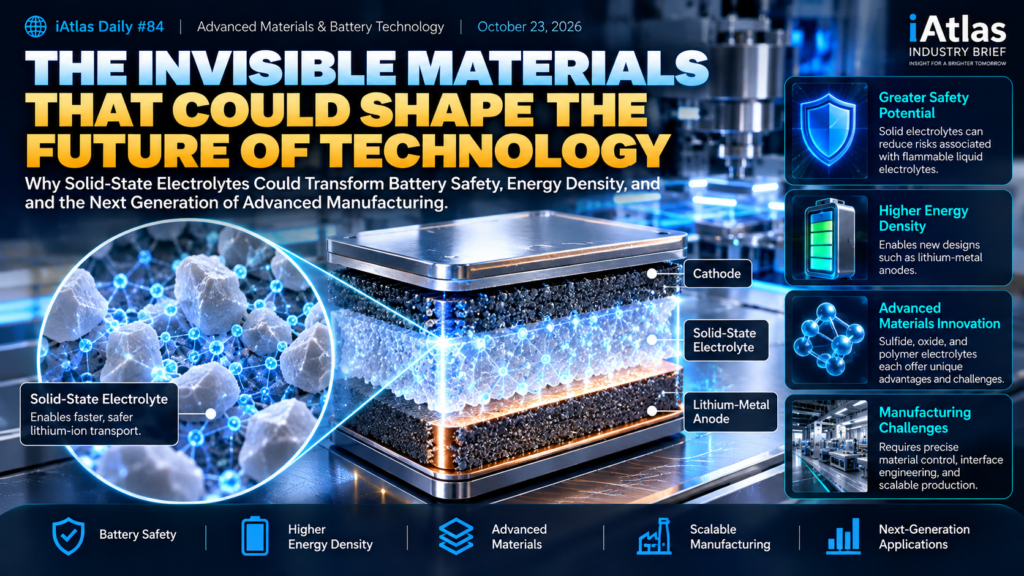
The Future of Technology May Depend on Materials We Cannot See
Solid-state electrolytes could play a critical role in the future of energy storage, enabling new battery designs with the potential for improved safety and higher energy density.
When people think about technological innovation, they often imagine powerful AI chips, electric vehicles, robots, or next-generation electronic devices.
But many technological breakthroughs begin at a much smaller scale.
They depend on materials that most consumers will never see.
Inside a battery, for example, an electrolyte determines how ions move between electrodes. Although it is rarely discussed outside engineering laboratories, this material has a major influence on battery performance, safety, and manufacturing requirements.
Researchers are now developing solid electrolytes that could replace the liquid electrolytes used in conventional lithium-ion batteries.
The potential benefits are significant.
However, the transition from liquid to solid materials introduces new scientific and industrial challenges.
The next major battery breakthrough may depend less on the battery’s visible design and more on the invisible materials operating inside it.
1. What Is a Solid-State Electrolyte?
Every rechargeable lithium-ion battery requires a mechanism for transporting lithium ions between its positive and negative electrodes.
In conventional lithium-ion batteries, this function is typically performed by a liquid electrolyte containing a lithium salt dissolved in organic solvents.
During charging and discharging, lithium ions move through the electrolyte while electrons travel through the external electrical circuit.
A solid-state electrolyte performs a similar ion-transport function, but uses a solid material instead of a conventional liquid electrolyte.
This seemingly simple change can fundamentally alter battery design.
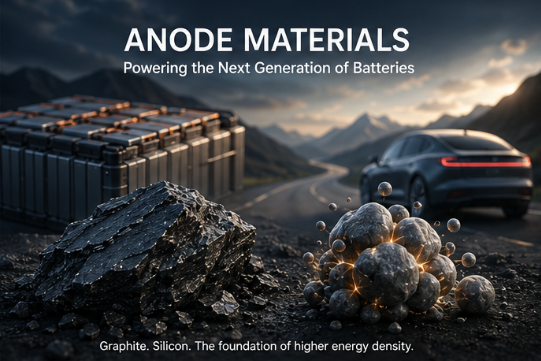
Solid electrolytes can potentially support new electrode combinations, including lithium-metal anodes, which could increase energy density.
They may also reduce some risks associated with flammable liquid electrolytes.
However, replacing a liquid with a solid does not automatically make a battery safer or more powerful.
Performance depends on the electrolyte chemistry, electrode compatibility, cell architecture, and operating conditions.
2. Three Major Types of Solid-State Electrolytes
Researchers are investigating several different material families.
Each offers advantages, but also introduces manufacturing and performance challenges.
Sulfide-Based Electrolytes
Sulfide solid electrolytes are particularly attractive because some compositions demonstrate high lithium-ion conductivity at room temperature.
Their relatively favorable mechanical properties can also help create contact between solid battery components.
However, many sulfide materials are highly sensitive to moisture.
Exposure to water vapor can degrade the material and, for certain compositions, generate toxic hydrogen sulfide gas.
These characteristics make material handling and manufacturing-environment control especially important.
Oxide-Based Electrolytes
Oxide solid electrolytes can offer favorable chemical and thermal stability.
Some oxide materials are comparatively resistant to atmospheric exposure, although their behavior depends on composition and surface conditions.
A major challenge is their mechanical rigidity.
Achieving intimate contact between rigid ceramic electrolytes and electrode materials can be difficult.
Manufacturing may also require specialized ceramic processing, sintering, or interface engineering.
Polymer-Based Electrolytes
Polymer electrolytes offer flexibility and compatibility with certain scalable manufacturing methods.
Their mechanical properties may simplify integration into battery structures.
However, many polymer electrolytes exhibit limited ionic conductivity at room temperature.
Researchers are developing new polymer chemistries and composite materials to improve ion transport without sacrificing mechanical stability.
No single electrolyte family has solved every commercial requirement.
The industry is therefore exploring multiple approaches rather than converging on one universal material.
3. Why the Interface Between Materials Matters
One of the most difficult challenges in solid-state batteries occurs where different solid materials meet.
In conventional liquid-electrolyte batteries, the liquid can wet porous electrode structures and create extensive contact with active materials.
Solid-state batteries behave differently.
Two solid surfaces may appear to touch while still containing microscopic gaps.
These gaps can interrupt ion transport and increase electrical resistance.
Chemical reactions at the interfaces can also form unwanted layers that degrade performance.
Repeated charging and discharging may cause mechanical stress, cracking, or loss of contact.
This is why scientists increasingly focus on interface engineering.
Researchers are developing protective coatings, modified electrode structures, and improved processing methods to stabilize these boundaries.
In September 2026, Oak Ridge National Laboratory highlighted the importance of translating promising solid-state battery materials into complete cells.
Its STAR Lab research emphasizes that strong material-level performance does not necessarily translate into reliable battery-cell performance.
The laboratory investigates interfaces, mechanical changes, and manufacturing conditions that influence practical cell operation.
A high-performance material is only useful if it can function reliably inside a complete battery.
4. Moisture Sensitivity: A Hidden Manufacturing Challenge
For certain solid-state electrolyte materials, particularly sulfide-based systems, moisture exposure represents a major obstacle.
Some sulfide electrolytes react with water vapor, causing structural changes and reduced ionic conductivity.
Certain reactions can also generate hydrogen sulfide, creating additional safety concerns.
A 2026 study published in Advanced Energy Materials examined how moisture exposure affects the thermal stability and safety of sulfide-based solid-state batteries.
The researchers found that moisture-induced reactions could produce harmful byproducts and negatively affect cell stability.
Another 2026 publication in ACS Energy Letters emphasized the need for standardized methods to evaluate moisture stability across different solid electrolytes.
These findings have important industrial implications.
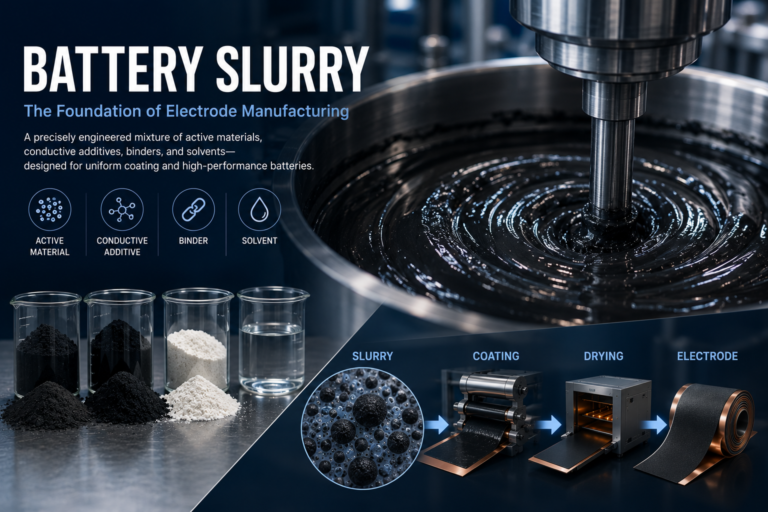
Manufacturers must understand how environmental exposure affects materials during powder preparation, mixing, coating, cell assembly, and storage.
For moisture-sensitive chemistries, controlled environments may be necessary to protect material quality and maintain process consistency.
However, the required conditions cannot be generalized across all solid-state batteries.
Different electrolyte compositions may tolerate different levels of moisture exposure.
The appropriate environmental controls must therefore be determined through material-specific testing and process validation.
5. Scientists Are Developing More Moisture-Resistant Materials
Rather than relying exclusively on increasingly strict environmental controls, researchers are also attempting to improve the materials themselves.
One approach involves modifying the surfaces of sulfide solid electrolytes.
Protective coatings may reduce unwanted reactions while preserving lithium-ion transport.
In research published in Advanced Materials, scientists investigated Prussian blue analog additives to improve the moisture stability of sulfide electrolytes.
The study demonstrated that selected additives could help restore the performance of materials previously degraded by moisture exposure.
Other researchers are exploring organic coatings, surface modifications, and alternative electrolyte compositions.
A 2026 study published in Angewandte Chemie International Edition investigated a fatty-acid-based coating strategy for sulfide electrolytes.
The research demonstrated improved moisture tolerance and electrochemical stability under the tested laboratory conditions.
These findings are promising, but they do not establish universal commercial readiness.
Material improvements must still be evaluated for long-term durability, manufacturing compatibility, cost, and reproducibility.
The broader lesson is important.
Advanced materials can potentially reduce manufacturing constraints, but those improvements must be demonstrated under realistic production conditions.
6. From Laboratory Materials to Industrial Manufacturing
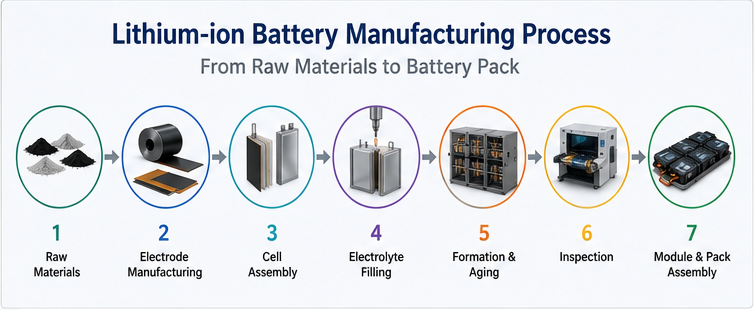
Developing a successful solid electrolyte is only one part of building a commercially viable solid-state battery.
Industrial manufacturing requires repeatability, throughput, consistent quality, and competitive costs.
Solid-state battery production may involve specialized powder handling, particle-size control, mixing, film formation, lamination, pressing, and interface treatments.
Some processes may also require controlled-atmosphere equipment or specialized thermal processing.
The exact requirements depend on the electrolyte chemistry and battery architecture.
Why Manufacturing Scale Matters
A small laboratory cell can be assembled under carefully controlled conditions.
Producing thousands or millions of cells requires a much more robust process.
Small variations in film thickness, material distribution, interfacial contact, or contamination can influence battery performance.
Manufacturers must therefore establish production methods that minimize defects while maintaining high throughput.
In August 2025, Argonne National Laboratory highlighted the potential of advanced electrode-processing technologies to reduce energy consumption and manufacturing costs.
Although these approaches are not exclusive to solid-state batteries, they illustrate the broader importance of manufacturing innovation in next-generation energy storage.
Ultimately, commercial success depends on integrating materials science with reliable production engineering.
7. Industry Implications: New Opportunities Across the Battery Supply Chain
The development of solid-state electrolytes could create opportunities beyond battery-cell manufacturers.
Advanced Materials Suppliers
Companies developing electrolyte powders, interface coatings, polymers, ceramics, and specialized additives could become increasingly important.
Manufacturing Equipment Suppliers
New material requirements may increase demand for precision mixing, coating, lamination, pressing, and inspection technologies.
Environmental Control Technologies
Moisture-sensitive materials could create additional requirements for dry rooms, inert-atmosphere processing, and contamination-control systems.
Automotive and Energy Storage Industries
If solid-state batteries achieve competitive cost, durability, and energy density, they could enable new product designs and applications.
However, commercial adoption will depend on whether these benefits justify the additional complexity of production.
The transition is unlikely to occur uniformly across all battery applications.
Different markets have different priorities for energy density, safety, cost, lifetime, and operating temperature.
iAtlas Insight | The Next Battery Competition Could Be Decided by Materials Engineering
Solid-state electrolytes demonstrate a broader trend across advanced technology industries.
Innovation increasingly depends on controlling materials and interfaces at microscopic scales.
The challenge is not simply discovering a material with exceptional laboratory performance.
It is developing a complete manufacturing system capable of preserving that performance consistently and economically.
Three factors will be particularly important.
1. Material Stability
Electrolytes must maintain their chemical and electrochemical properties under realistic manufacturing and operating conditions.
2. Interface Engineering
Reliable contact between electrodes and solid electrolytes will be essential for battery performance, durability, and safety.
3. Manufacturing Scalability
New materials must be compatible with processes that can deliver consistent quality, high yields, and competitive costs.
For materials suppliers and equipment manufacturers, this transition may create opportunities in advanced coatings, precision processing, contamination control, and specialized manufacturing systems.
For battery manufacturers, competitive advantage may increasingly depend on the ability to integrate materials innovation with production engineering.
The future of solid-state batteries will not be determined by electrolyte performance alone. It will depend on whether advanced materials can be transformed into reliable, scalable, and commercially competitive battery systems.
Related Articles
Battery Fundamentals
Understand the fundamental structure and working principles of lithium-ion batteries, including the roles of electrodes and electrolytes, and discover why new solid-state materials could represent an important step in next-generation battery technology.
Advanced Manufacturing
How Thin Film Deposition Builds Semiconductor Devices Layer by Layer
Learn how advanced deposition and interface-control technologies enable precise material structures in semiconductor manufacturing.
Industrial Competitiveness
The Next Industrial Advantage Is Flexibility
Discover why manufacturing adaptability and process innovation are becoming essential competitive advantages across advanced industries.
References
1. Drying Process of Sulfide-Based All-Solid-State Battery Components (2023)
Research investigating the drying process, adhesion strength, and microstructural changes of sulfide-based solid-state battery components, with MBRAUN equipment referenced in the experimental setup.
Scientific perspective on moisture sensitivity, measurement methods, and manufacturing challenges associated with sulfide and halide solid electrolytes.
Research examining moisture-induced degradation, hydrogen sulfide formation, and safety implications for sulfide-based solid-state batteries.
Research investigating additives that improve moisture tolerance and help restore electrochemical performance.
Study of protective organic coatings designed to improve moisture resistance and electrochemical stability.
6. Argonne National Laboratory — Taking Battery Manufacturing to the Next Level (2025)
Overview of advanced electrode-processing technologies and manufacturing innovations aimed at reducing production costs and energy consumption.
ℹ️ About iAtlas
iAtlas is an independent publication covering batteries, semiconductors, OLED, advanced materials, AI, and global industrial trends.
We transform complex industrial developments into clear, reliable, and easy-to-understand insights.
Whether you’re following today’s industry news or building long-term expertise, iAtlas helps you understand not only what happened, but why it matters.
Technology creates change.
Insight creates opportunity.
— iAtlas