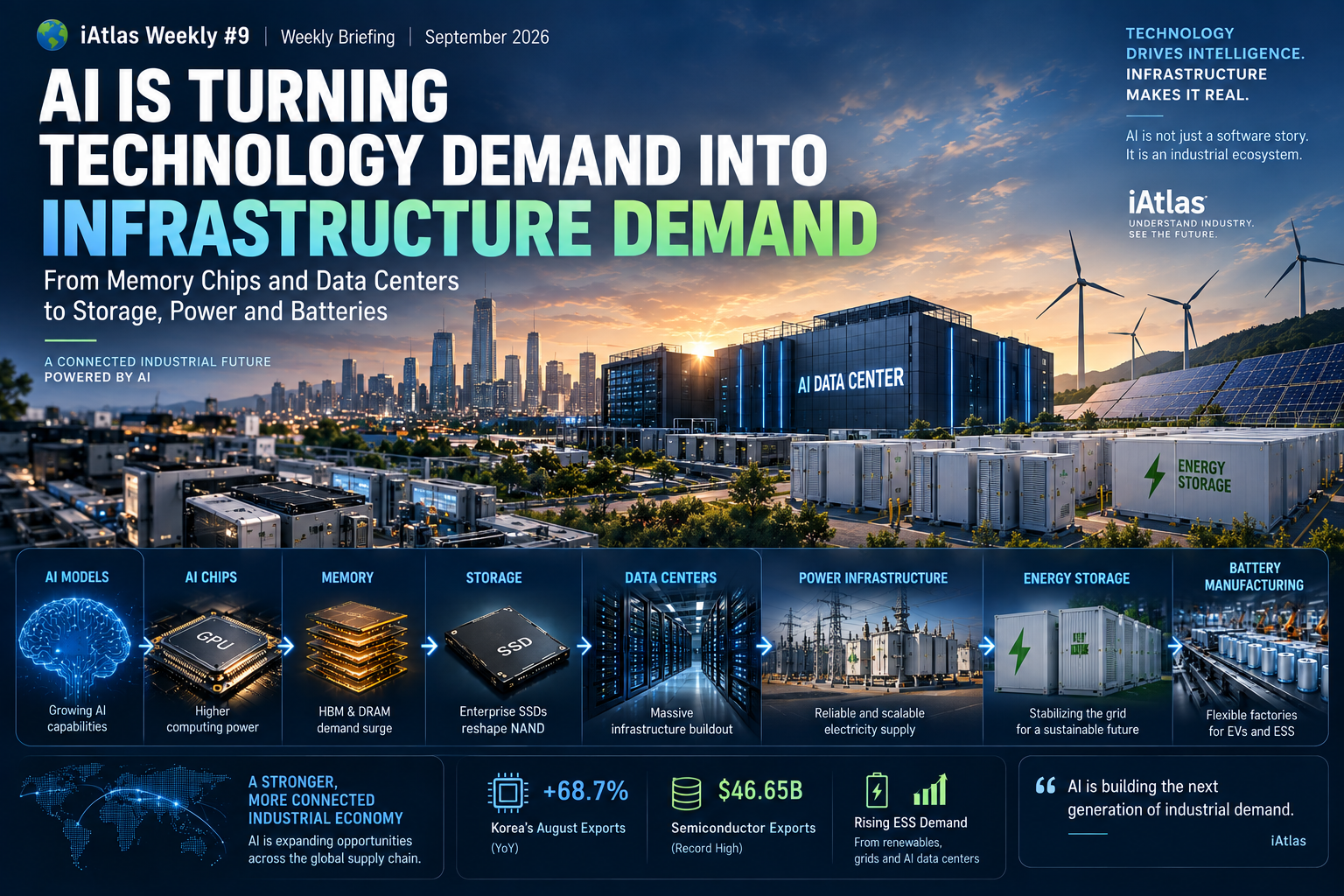
AI Is Turning Technology Demand into Infrastructure Demand
From Memory Chips and Data Centers to Storage, Power and Batteries
📊 iAtlas Weekly #9 | Weekly Briefing | September 2026
The AI Industrial Infrastructure cycle is becoming much larger than the semiconductor boom that started it.
For much of the past two years, the AI investment story could be summarized relatively simply:
AI Models → GPUs → HBM
That chain is no longer enough.
AI systems now require enormous amounts of memory, storage, electricity, cooling, networking and physical data-center capacity. At the same time, the growing power requirements of AI infrastructure are beginning to intersect with another industrial transition: the expansion of energy storage.
The result is a much broader investment cycle:
AI -> Compute -> Memory -> Storage -> Data Centers -> Power Infrastructure ->
Energy Storage -> Battery Manufacturing
The important change is not simply that each of these industries is growing.
It is that they are increasingly becoming part of the same industrial system.
AI is evolving from a semiconductor demand story into an infrastructure demand story.
🌐 The Big Picture
Four developments illustrate the transition.
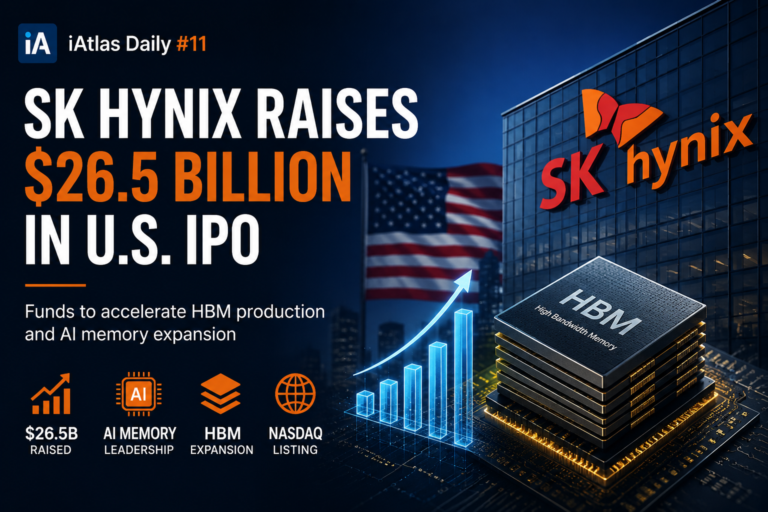
South Korea’s semiconductor exports reached a record level in August as AI memory demand continued to accelerate.
SK Telecom launched a dedicated AI data-center infrastructure platform backed by trillions of won in outside investment.
Enterprise SSDs are absorbing a rapidly increasing share of NAND production as AI inference expands storage requirements.
And Korean battery manufacturers are redirecting portions of EV-oriented manufacturing capacity toward ESS.
At first glance, these developments belong to different industries.
They actually form a connected chain.
Semiconductor
AI requires more computing and memory.
Storage
AI inference creates enormous datasets that must be stored and retrieved.
Data Centers
Those processors and storage systems need physical infrastructure.
Energy
Data centers require reliable and increasingly large electricity supplies.
Batteries
Energy storage becomes part of the infrastructure needed to stabilize and support that power system.
This is the emerging AI Industrial Infrastructure ecosystem.
🧠 1. AI Memory Is Becoming a National Export Engine
The clearest evidence of AI’s industrial impact can be seen in South Korea’s trade statistics.
Official August data released this week showed that Korean exports increased 68.7% year over year to $98.26 billion.
Semiconductor exports nearly tripled to a record:
$46.65 billion
Strong demand for AI-related memory products was a major driver.
That means semiconductors represented almost half of Korea’s total exports during the month.
The significance extends beyond Samsung Electronics and SK hynix.
The underlying demand chain looks like this:
AI Investment -> AI Accelerators -> HBM -> Server DRAM -> Memory Manufacturing -> Korean Semiconductor Exports
AI infrastructure investment is now large enough to influence the trade performance of one of the world’s major manufacturing economies.
That is a remarkable transition.
AI began as a software story.
It is increasingly visible in factory output and national export statistics.
💾 2. The Memory Opportunity Is Expanding Beyond HBM
HBM remains one of the most strategically important technologies in AI computing.
But HBM is no longer the entire memory story.
SK hynix has increasingly described AI memory demand as a broader system opportunity involving HBM, server DRAM, NAND and enterprise SSDs. Its recent AI-memory lineup also spans HBM, DRAM, eSSD and computational-storage technologies.
The reason is simple.
An AI system does not only calculate.
It also needs to store and retrieve enormous quantities of data.
That creates a broader hierarchy:
GPU / Accelerator -> HBM -> Server DRAM -> Enterprise SSD -> NAND Flash
The transition from AI training toward large-scale inference makes the lower layers increasingly important.
Training emphasizes compute performance and memory bandwidth.
Inference adds another requirement:
Data availability.
Models, embeddings, databases, cached information and generated content must be stored somewhere.
As AI applications reach more users, the storage requirement grows with them.
📦 3. Enterprise SSD Is Becoming AI Infrastructure
This is already changing the NAND market.
Enterprise SSDs have rapidly increased their share of NAND demand as hyperscalers expand AI server infrastructure.
This is important because the NAND industry historically depended heavily on consumer markets such as:
- smartphones
- PCs
- consumer SSDs
AI introduces a different source of demand:
Data Centers -> AI Servers -> Inference -> Enterprise Storage -> NAND
And enterprise products can carry significantly greater value than commodity consumer storage.
The competitive implications are substantial.
Samsung remains a major NAND producer.
SK hynix gains strategic exposure through both its NAND technology and Solidigm’s enterprise SSD business.
Micron is shifting more production toward enterprise products.
Kioxia and SanDisk continue advancing NAND architectures.
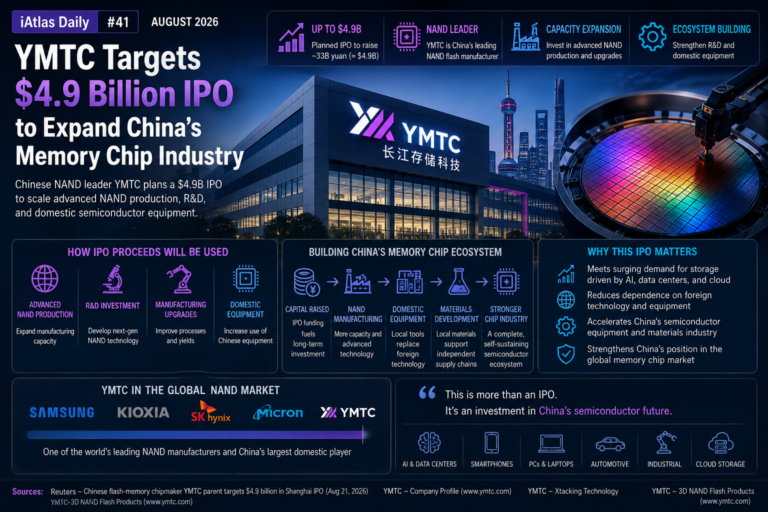
And China’s YMTC is rapidly expanding its manufacturing position.
AI storage is therefore creating another semiconductor battleground.
🏢 4. Chips Need Somewhere to Operate
There is a physical limit to the semiconductor story.
A GPU has little value unless it can be installed and operated.
That requires a data center.
SK Telecom’s creation of SK Horizon illustrates how quickly this part of the AI ecosystem is expanding.
The company announced in late August that SK Horizon would combine existing data-center infrastructure and submarine-cable assets, while investment funds managed by KKR and an IMM Investment-Stonebridge consortium would provide approximately KRW 3.08 trillion in equity investment.
SK Telecom is effectively building an infrastructure structure around three functions:
SK Telecom
AI Strategy & Partnerships
↓
SK Horizon
Data Center Operations & Connectivity
↓
SK Hyper
Large-Scale New AI Data Center Development
The important word here is not simply AI.
It is infrastructure.
⚡ 5. Power May Become the Next AI Bottleneck
Data centers turn digital demand into physical demand.
Every AI accelerator requires electricity.
So does every memory module.
Every SSD.
Every network switch.
And every cooling system required to remove the heat generated by them.
The infrastructure chain therefore continues:
AI Chips -> Servers -> Data Centers -> Cooling -> Power Distribution -> Grid
As data centers become larger, access to electricity can determine where projects are built and how quickly they can expand.
This creates new opportunities for industries that previously appeared far removed from artificial intelligence.
Electrical Equipment
Transformers
Switchgear
UPS
Power distribution systems
Thermal Management
Liquid cooling
Chillers
Heat exchangers
Pumps
Construction
Steel
Cables
Piping
Mechanical systems
Energy
Generation
Transmission
Renewables
Energy storage
AI capital expenditure is therefore spreading into traditional industrial sectors.
🔋 6. Batteries Are Entering the AI Infrastructure Chain
This is where the week’s battery developments become particularly interesting.
Korean battery manufacturers are increasingly redirecting production capacity from EV applications toward ESS.
And the shift is continuing.
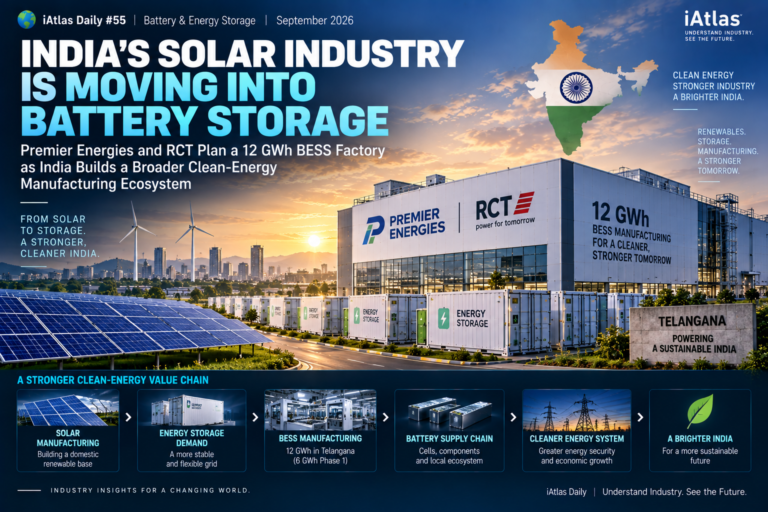
On August 30, SK On announced an agreement to supply U.S.-based NeoVolta Power with 9 GWh of LFP battery cells for ESS between 2027 and 2032.
The cells will be produced at SK On’s Georgia facility, and the companies may expand their cooperation by another 9 GWh.
That is significant because the Georgia manufacturing footprint was built primarily around the EV market.
The same industrial asset can increasingly support:
EV Batteries
↓
ESS Batteries
The demand behind ESS comes from several directions:
Renewable Energy
Grid Modernization
AI Data Centers
↓
Energy Storage Demand
AI is therefore beginning to influence battery demand indirectly through electricity infrastructure.
🏭 7. Battery Factories Are Becoming Manufacturing Platforms
The battery industry’s response reveals another important industrial trend.
For years, gigafactory strategy was largely about scale.
Companies asked:
How many gigawatt-hours can this factory produce?
The next question may be different:
How many different markets can this factory serve?
LG Energy Solution, Samsung SDI and SK On are all increasing their exposure to stationary energy storage as the EV market develops more unevenly than expected.
That encourages a transition from:
Dedicated EV Factory
toward:
Flexible Battery Manufacturing Platform
capable of serving:
EV
ESS
UPS
BBU
Industrial Applications
Potentially, the strategic value of a battery factory will increasingly depend on both capacity and flexibility.
🔗 8. The Semiconductor and Battery Industries Are Starting to Connect
Semiconductors and batteries have traditionally been treated as separate industrial sectors.
AI infrastructure is beginning to connect them.
Consider the complete chain.
Computing Layer
GPU
Accelerator
↓
Memory Layer
HBM
DRAM
↓
Storage Layer
Enterprise SSD
NAND
↓
Infrastructure Layer
Data Center
Networking
Cooling
↓
Power Layer
Grid
UPS
ESS
↓
Energy Storage Layer
Battery Cells
LFP Materials
Battery Manufacturing
This is an important shift for industrial analysis.
Looking at each sector individually can miss the larger investment cycle.
The better question is increasingly:
What infrastructure does AI demand create next?
🌏 9. Korea Has an Unusual Position in This Emerging Ecosystem
South Korea sits at the intersection of several of these industries.
Semiconductors
Samsung Electronics
SK hynix
Batteries
LG Energy Solution
Samsung SDI
SK On
AI Infrastructure
SK Telecom and other data-center developers
Electrical & Power Equipment
A large domestic industrial manufacturing base
Materials & Equipment
Established semiconductor and battery supply chains
Few economies have major global companies across both memory semiconductors and rechargeable batteries.
That could become strategically valuable if AI infrastructure increasingly connects the two.
But Korea also faces challenges.
AI data centers require enormous electricity supply.
Battery materials remain globally distributed.
Advanced semiconductor manufacturing remains exposed to trade and geopolitical tensions.
And U.S.-Korea discussions over semiconductor investment are continuing as Washington considers new chip-import tariff policy.
So Korea’s opportunity is significant — but increasingly tied to industrial policy, energy policy and global supply-chain strategy.
📈 10. The Investment Cycle Is Moving Downstream
The broader AI investment cycle can be viewed in stages.
Phase 1 — Compute
GPU / AI Accelerator
Phase 2 — Memory
HBM / DRAM
Phase 3 — Packaging
Advanced Packaging / Hybrid Bonding
Phase 4 — Storage
Enterprise SSD / NAND
Phase 5 — Infrastructure
Data Centers / Networking / Cooling
Phase 6 — Power
Grid / Transformer / UPS
Phase 7 — Energy Storage
ESS / Battery
Each new layer increases the number of industries exposed to AI capital expenditure.
This is why the economic impact of AI can continue expanding even if GPU growth eventually moderates.
The infrastructure surrounding the processors may become an investment cycle of its own.
🧩 What Changed This Week?
Four signals stand out.
AI demand is now visible in national trade data.
Korea’s record August semiconductor exports demonstrate the scale of the memory boom.
AI memory is broadening.
HBM remains critical, but DRAM, NAND and enterprise SSDs are increasingly part of the opportunity.
Data centers are becoming strategic industrial assets.
SK Horizon shows how telecommunications, infrastructure capital and AI computing are converging.
Battery factories are gaining a second growth market.
SK On’s new U.S. ESS agreement provides fresh evidence that EV-oriented manufacturing capacity is increasingly being redirected toward stationary storage.
Taken together, these are not four separate stories.
They are four stages of the same infrastructure expansion.
🔭 What to Watch Next
The next few months should show whether this thesis continues to strengthen.
Memory: Watch HBM4 production, server DRAM pricing and enterprise SSD demand.
Data Centers: Watch SK Horizon and SK Hyper, along with power procurement for new Korean AI data-center projects.
Power: Transformer, switchgear, cooling and grid investment may become increasingly important indicators of AI infrastructure growth.
ESS: Watch additional LG Energy Solution, Samsung SDI and SK On contracts, especially projects tied to North American data centers and power grids.
Battery Manufacturing: The pace at which existing EV lines can be converted to LFP ESS production will reveal how flexible Korean battery manufacturing has become.
Policy: Semiconductor tariffs, local-content rules and energy policy could increasingly determine where AI infrastructure is built.
🧭 Atlas Insight
The most important AI story may no longer be artificial intelligence itself.
It may be the industrial system required to make artificial intelligence possible.
The chain keeps expanding:
AI Models -> GPUs -> HBM -> DRAM -> Enterprise SSD -> Data Centers ->
Power Infrastructure -> ESS -> Battery Manufacturing
Each layer creates demand for the next.
And every step moves AI further from a purely digital industry and deeper into the physical economy.
The next phase of the AI boom will be measured not only in model performance or semiconductor shipments, but in factories, megawatts, storage capacity and industrial infrastructure.
That is the larger transition behind this week’s developments.
Technology demand is becoming infrastructure demand.
📚 Related Articles
📰 iAtlas Daily #38: AI Data Centers Are Creating a New Industrial Equipment Boom
The broader connection between AI computing and physical infrastructure.
📰 iAtlas Daily #14: LG Energy Solution Accelerates ESS Battery Production
An earlier look at the battery industry’s shift toward stationary energy storage.
🔋 Battery Manufacturing Process Explained: From Raw Materials to Battery Pack
The manufacturing foundation behind the industry’s transition toward more flexible battery production.
🔗 References
- SK hynix Newsroom — AI Memory & Infrastructure
- SK hynix — Q2 2026 Financial Results and AI Memory Outlook
- SK Telecom Newsroom — SK Horizon AI Data Center Infrastructure
- Reuters — SK On and NeoVolta ESS Battery Agreement
- Reuters — Korea-U.S. Semiconductor Investment Discussions
About iAtlas
iAtlas is an independent publication covering batteries, semiconductors, OLED, advanced materials, AI, and global industrial trends.
We transform complex industrial developments into clear, reliable, and easy-to-understand insights.
Whether you’re following today’s industry news or building long-term expertise, iAtlas helps you understand not only what happened, but why it matters.
Technology creates change.
Insight creates opportunity.
— iAtlas