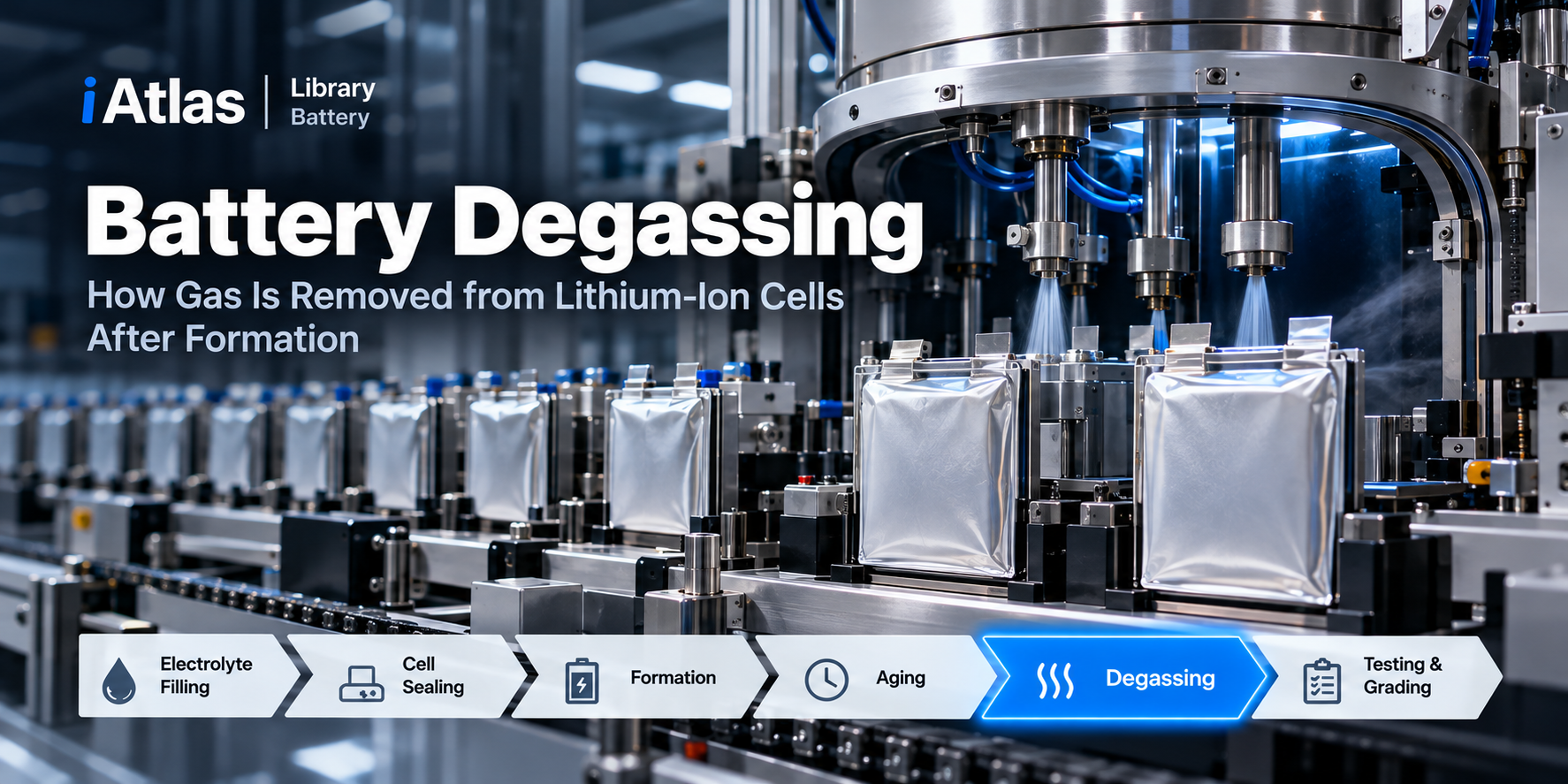
Battery Degassing Explained: How Gas Is Removed from Lithium-Ion Cells After Formation
Understanding Gas Generation, Vacuum Degassing, Pouch Cell Processing, Cell Swelling, and Quality Control in Lithium-Ion Battery Manufacturing
Topic: Processes
Process Stage: Cell Finishing
Content Type: Manufacturing
Learning Path: Battery Manufacturing
Related Industries: Electric Vehicles · Energy Storage Systems · Consumer Electronics
Last Updated: October 2026

Industry Snapshot
During the initial formation of a lithium-ion battery, electrochemical reactions occur between the electrodes and electrolyte.
These reactions are essential for establishing protective interfacial layers, particularly the solid electrolyte interphase (SEI) on the anode.
However, some reactions also generate gases.
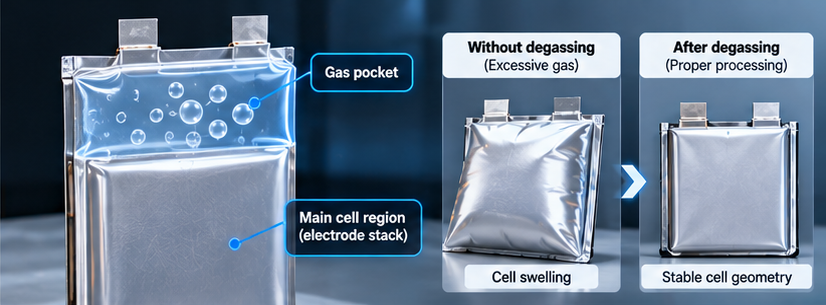
If these gases remain trapped inside a battery cell, they can increase internal pressure, cause swelling, and interfere with the intended internal structure of the cell.
Battery degassing is a manufacturing process used to remove accumulated gases from cells when their design and production method require it.
The process is particularly important for pouch-type lithium-ion batteries, where gases generated during formation can accumulate in a dedicated gas pocket before being evacuated.
A simplified process is:
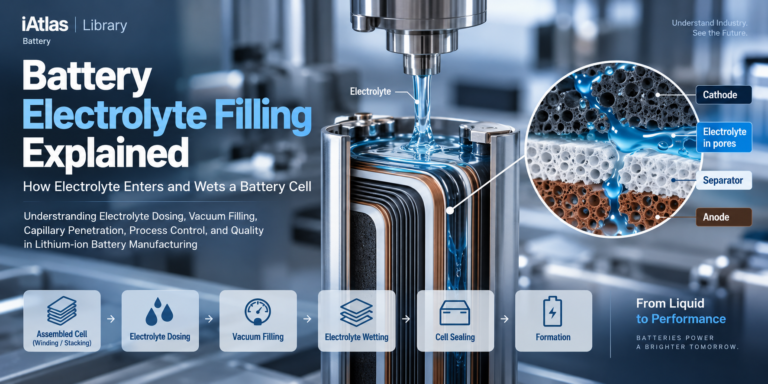
Electrolyte Filling → Formation → Gas Generation → Degassing → Final Sealing
Depending on the manufacturing method, aging, additional formation cycles, and quality-control operations may occur before or after degassing.
Degassing is not simply removing air. It is a controlled manufacturing operation that removes gases generated inside a battery during electrochemical formation.
At a Glance
| Category | Description |
|---|---|
| Process | Battery Degassing |
| Manufacturing Stage | Cell Finishing |
| Primary Purpose | Removal of accumulated formation gases |
| Main Gas Source | Electrolyte decomposition and interfacial side reactions |
| Most Common Application | Pouch-cell manufacturing |
| Typical Equipment | Vacuum chamber, sealing equipment, gas handling system |
| Key Variables | Vacuum pressure, evacuation time, temperature, sealing conditions |
| Major Risks | Cell swelling, gas retention, electrolyte loss, sealing defects |
| Quality Objective | Stable cell geometry, controlled internal gas content, reliable sealing |
| Related Processes | Formation, Aging, Final Sealing, Testing & Grading |
1. What Is Battery Degassing?
Battery degassing is the controlled removal of gas that accumulates during the manufacturing and initial electrochemical activation of a lithium-ion cell.
It is most commonly associated with pouch-cell production, although gas generation is relevant to other cell formats as well.
During formation, the electrolyte interacts with electrode surfaces, producing protective interfacial layers and sometimes gaseous reaction products.
These gases may include:
- Carbon dioxide (CO₂)
- Carbon monoxide (CO)
- Hydrogen (H₂)
- Light hydrocarbons
The actual gas composition depends on electrode materials, electrolyte formulation, additives, formation conditions, and other factors.
In pouch-cell manufacturing, accumulated gas is commonly directed into a temporary gas pocket.
The cell is then processed through a controlled evacuation and sealing operation.
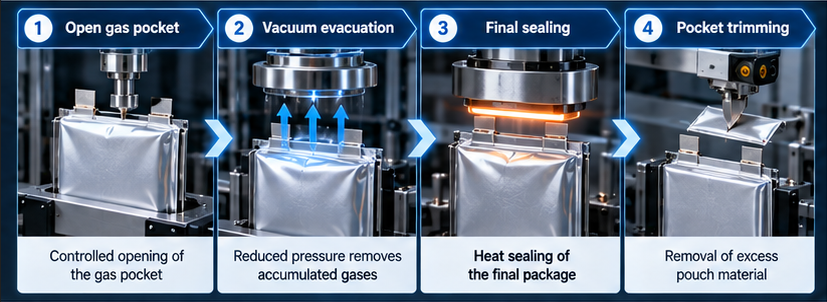
Simplified Degassing Process
Conceptual pouch-cell degassing sequence. Actual equipment and process order vary by manufacturer.
The process must remove gas while minimizing electrolyte loss and preserving the cell’s mechanical integrity.
2. Why Does Gas Form During Battery Formation?
Gas generation is associated with several electrochemical and chemical reactions.
2.1 Electrolyte Decomposition
Lithium-ion batteries commonly use organic carbonate-based electrolytes.
During initial charging, some electrolyte components undergo reduction or oxidation reactions at electrode surfaces.
These reactions contribute to interfacial layer formation but may also generate gaseous byproducts.
2.2 SEI Formation
The SEI is essential for the long-term operation of many lithium-ion batteries.
It helps suppress continuous electrolyte decomposition while allowing lithium ions to pass.
However, its initial formation consumes some electrolyte and lithium inventory and may produce gases.
2.3 Electrode–Electrolyte Side Reactions
Additional reactions can occur depending on:
- Electrode chemistry
- Electrolyte composition
- Additive formulation
- Temperature
- Voltage conditions
- Moisture and contamination levels
Not all gas generation is abnormal.
Some gas evolution is expected during formation, while excessive gas generation may indicate an undesirable manufacturing or material condition.

3. Why Is Gas Removal Important?
Gas accumulation can affect battery performance, safety, and manufacturing consistency.
Cell Swelling
In pouch cells, internal gas pressure can cause visible expansion of the flexible packaging.
Excessive swelling can interfere with downstream handling and dimensional requirements.
Electrode Contact
Trapped gas can contribute to nonuniform contact and mechanical pressure distribution within the electrode stack.
This may affect electrochemical consistency.
Electrolyte Distribution
Gas pockets can interfere with uniform electrolyte wetting and local ionic transport.
Manufacturing Quality
Gas retention can complicate final sealing, dimensional inspection, and downstream cell assembly.
Long-Term Reliability
Abnormal gas generation can be an indicator of undesirable side reactions, although degassing itself does not eliminate their underlying causes.
4. How Does Vacuum Degassing Work?
Vacuum degassing uses reduced external pressure to encourage accumulated gas to leave the cell through an accessible gas pocket or temporary opening.
A typical pouch-cell degassing operation involves several stages.
- Cell positioning: The formed cell is placed into a degassing chamber or fixture with its gas pocket accessible.
- Controlled opening: The gas pocket is opened or pierced using a controlled mechanism.
- Vacuum evacuation: Reduced pressure removes accumulated gases through the opening.
- Final sealing: The package is heat-sealed to create its permanent closure.
- Gas-pocket removal: The excess pouch material is trimmed where required.
- Quality inspection: Seal integrity, dimensions, and other acceptance criteria are evaluated.
The exact sequence varies with equipment design. Some systems combine evacuation and sealing within a single machine.
5. Pouch Cell Degassing
Pouch cells are particularly associated with degassing because their flexible packaging can incorporate a temporary gas collection area.
What Is a Gas Pocket?
A gas pocket is an additional section of pouch packaging designed to collect gas generated during formation.
During manufacturing, gas can migrate from the main electrode-containing region into this pocket.
The gas pocket is subsequently evacuated, isolated by final sealing, and typically removed.
Why Not Seal the Cell Permanently Before Formation?
A pouch cell must be sufficiently enclosed to retain electrolyte and support formation.
However, permanently removing the gas-pocket region before formation could leave generated gases trapped inside the finished package.
Manufacturers therefore commonly use a staged sealing process.
This allows gas removal before the final package geometry is established.
Final Sealing
After gas evacuation, heat-sealing equipment forms the permanent seal.
Seal quality depends on factors such as:
- Temperature
- Pressure
- Sealing time
- Pouch laminate properties
- Surface cleanliness
- Electrolyte contamination at the seal area
An inadequate seal can create a pathway for electrolyte leakage or environmental contamination.
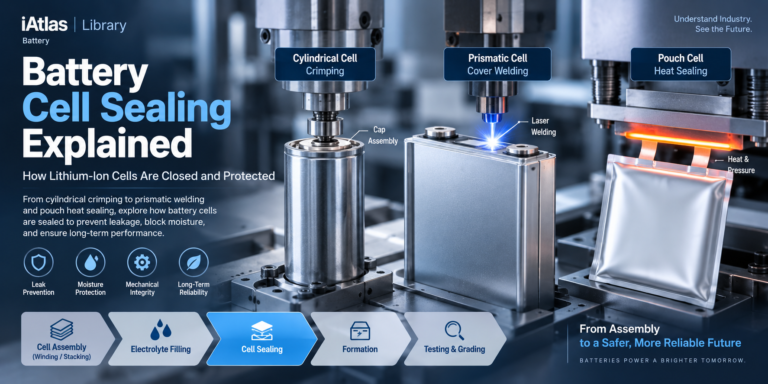
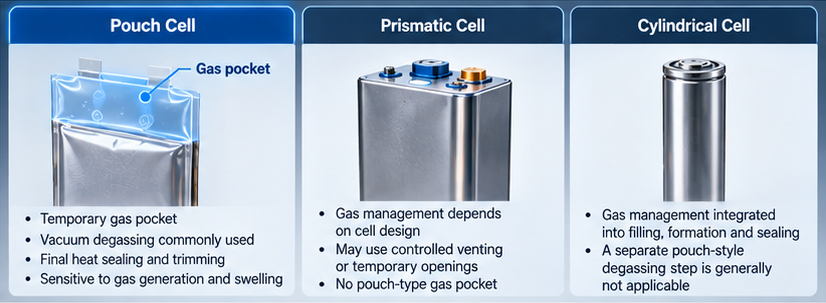
6. Degassing Differences by Battery Cell Format
Not every battery cell undergoes the same degassing operation.
| Cell Format | Gas Management Approach | Manufacturing Considerations |
|---|---|---|
| Pouch | Dedicated gas pocket and vacuum degassing are commonly used | Final heat sealing and pocket trimming |
| Prismatic | Depends on the enclosure, filling port, and cell design | Gas management may involve controlled venting or processing through a temporary opening |
| Cylindrical | Gas management is integrated into filling, formation, and sealing design | A separate pouch-style gas-pocket degassing step is generally not applicable |
A critical distinction is that gas generation occurs across cell formats, but the manufacturing response is cell-design-specific.
The presence of a pressure-relief vent on a finished cell should not be confused with routine manufacturing degassing.
7. Degassing Equipment and Vacuum Systems
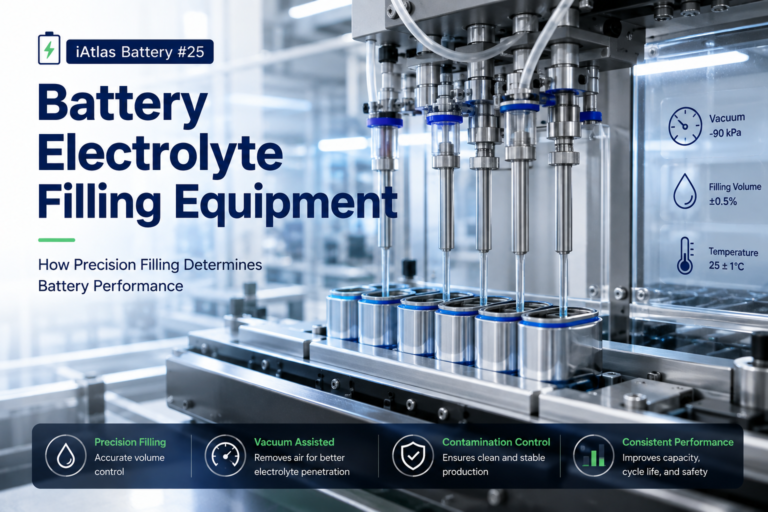
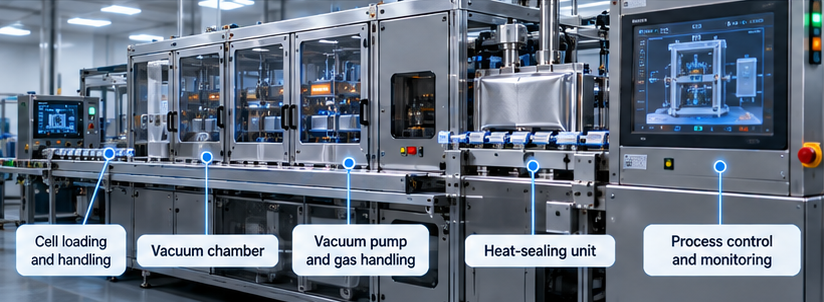
Industrial degassing equipment must integrate several mechanical and process-control functions.
Vacuum Chamber
Provides a controlled environment for evacuating accumulated gas.
Vacuum Pump
Creates the required pressure differential for gas removal.
Pump selection depends on the process conditions, gas composition, vapor loading, and required performance.
Opening Mechanism
Provides controlled access to the gas pocket or evacuation region.
Heat-Sealing Unit
Creates the permanent pouch seal after evacuation.
Cell Handling System
Positions and transfers cells while minimizing damage and contamination.
Process Control System
Monitors variables such as vacuum pressure, evacuation duration, temperature, and sealing parameters.
Exhaust and Vapor Management
Formation gases and electrolyte vapors may require appropriate collection, treatment, or exhaust controls.
The equipment must be compatible with the actual chemicals and hazards present.
8. Critical Process Parameters
The effectiveness of degassing depends on controlling multiple variables.
| Parameter | Why It Matters |
|---|---|
| Vacuum Pressure | Determines the evacuation conditions |
| Evacuation Time | Affects how completely accessible gas can be removed |
| Cell Temperature | Influences gas behavior and electrolyte vapor pressure |
| Cell Position | Affects gas-pocket accessibility and liquid distribution |
| Sealing Temperature | Influences laminate bonding |
| Sealing Pressure | Affects seal formation and consistency |
| Sealing Time | Influences seal strength and process repeatability |
| Electrolyte Carryover | Can cause material loss and seal contamination |
Why Stronger Vacuum Is Not Always Better
Lower absolute pressure can promote gas evacuation, but it may also increase electrolyte evaporation or liquid carryover.
Therefore, vacuum conditions must be validated rather than simply maximized.
The correct settings depend on the electrolyte system, pouch design, equipment, and manufacturing requirements.
9. Degassing and Electrolyte Loss
Electrolyte loss is one of the key risks during vacuum degassing.
A lithium-ion electrolyte contains volatile organic solvents whose vapor pressure depends on composition and temperature.
Under reduced pressure, some solvent evaporation can occur.
If evacuation conditions are excessive or poorly controlled, the process may remove not only accumulated gas but also valuable electrolyte.
Potential consequences include:
- Reduced electrolyte inventory
- Altered electrolyte composition
- Nonuniform wetting
- Seal contamination
- Reduced manufacturing consistency
This creates an important process trade-off:
Sufficient Gas Removal + Minimal Electrolyte Loss
The optimal process must balance both objectives.
10. Common Degassing Defects and Quality Issues
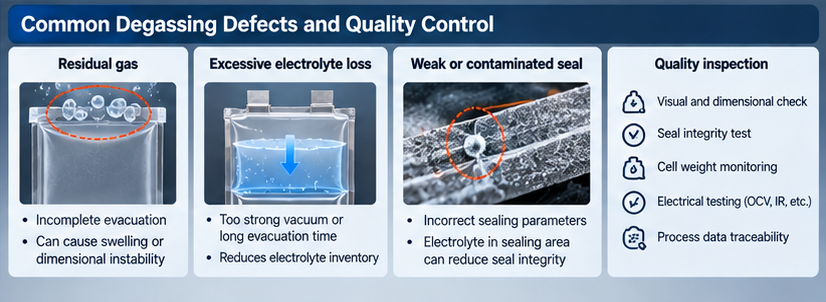
Several defects may occur if the degassing process is not properly controlled.
| Defect | Possible Cause | Potential Consequence |
|---|---|---|
| Residual Gas | Incomplete evacuation | Swelling or dimensional instability |
| Excessive Electrolyte Loss | Excessive vacuum exposure or liquid carryover | Reduced electrolyte inventory |
| Weak Seal | Incorrect sealing parameters | Leakage or moisture ingress |
| Seal Contamination | Electrolyte present in sealing area | Reduced seal integrity |
| Pouch Damage | Mechanical handling or opening defects | Packaging failure |
| Inconsistent Cell Geometry | Uneven pressure or gas retention | Downstream assembly difficulties |
These problems illustrate why degassing requires precise integration of mechanical handling, vacuum control, and sealing technology.
11. Quality Control After Degassing
After degassing and final sealing, manufacturers evaluate whether the cell meets the required quality specifications.
Visual and Dimensional Inspection
Checks for swelling, deformation, pouch damage, and dimensional irregularities.
Seal Integrity Testing
Evaluates whether the permanent seal provides adequate containment and protection.
Cell Weight Monitoring
Can help identify abnormal mass changes, although it does not independently establish electrolyte loss.
Electrical Testing
OCV, internal resistance, capacity, and other measurements may be performed in subsequent quality-control stages.
Process Data Traceability
Records may include:
- Cell identification
- Vacuum pressure profile
- Evacuation duration
- Sealing temperature and pressure
- Inspection results
- Equipment identification
Traceability allows manufacturers to investigate defects and identify relationships between process conditions and cell quality.
12. Degassing, Moisture Control, and Dry-Room Manufacturing
Moisture control is essential throughout lithium-ion battery manufacturing, particularly during electrolyte handling and before cells are permanently sealed.
Common lithium-ion electrolytes containing LiPF₆ are sensitive to water.
Moisture contamination can contribute to electrolyte decomposition and the formation of harmful reaction products, including HF under relevant conditions.
Degassing equipment must therefore be integrated with appropriate environmental controls.
Depending on the production design, these may include:
- Dry-room environments
- Controlled-atmosphere enclosures
- Low-moisture transfer systems
- Vacuum-compatible equipment
- Sealed electrolyte handling
- Appropriate exhaust treatment
Vacuum degassing and moisture control perform different functions.
Vacuum degassing removes accumulated gases, while dry-room and controlled-atmosphere systems limit environmental contamination.
A vacuum process does not automatically guarantee a sufficiently dry manufacturing environment.
13. Degassing and Manufacturing Automation
High-volume battery manufacturing requires consistent process control and automated material handling.
Modern degassing systems can integrate:
Cell Identification → Automated Loading → Vacuum Processing → Final Sealing → Inspection → Data Recording
Automation can improve repeatability and reduce manual handling.
However, the process remains sensitive to cell geometry, packaging materials, electrolyte properties, and equipment settings.
14. Degassing and Production Efficiency
Degassing equipment must be sized to match the output of upstream formation operations.
Production capacity depends on:
- Cells processed per cycle
- Total cycle time
- Equipment availability
- Loading and unloading time
- Seal processing time
- Inspection requirements
A simplified throughput relationship is:
\[ Q=\frac{N\times3600}{t} \]
Where:
- \(Q\) = theoretical cells processed per hour
- \(N\) = cells processed per cycle
- \(t\) = total cycle time in seconds
For example, if a machine processes 12 cells in a 90-second cycle:
\[ Q=\frac{12\times3600}{90}=480 \]
The theoretical capacity is 480 cells per hour, before accounting for downtime, rejected cells, and other operational losses.
Manufacturers must ensure that degassing capacity does not constrain the overall cell-finishing production line.
iAtlas Insight
Battery degassing demonstrates how electrochemical behavior directly influences manufacturing equipment design.
Gas generation during formation is not only a battery chemistry issue.
It affects:
- Cell packaging architecture
- Vacuum equipment requirements
- Manufacturing automation
- Electrolyte consumption
- Sealing quality
- Production throughput
- Quality-control strategies
The relationship can be summarized as:
Electrode & Electrolyte Chemistry
↓
Gas Generation During Formation
↓
Cell Packaging & Gas Management
↓
Vacuum Degassing
↓
Final Sealing & Quality Control
For equipment manufacturers, the challenge is not simply achieving the lowest possible vacuum pressure.
It is developing a repeatable process that removes accumulated gases while preserving electrolyte inventory and package integrity.
For battery manufacturers, improvements in formation chemistry and gas-management design can potentially reduce downstream processing complexity.
Ultimately, degassing connects three important aspects of battery manufacturing:
Electrochemistry + Mechanical Engineering + Process Control
As battery manufacturers seek higher production efficiency and more consistent cell quality, this integration will remain important.
Did You Know?
- Gas generation during formation is not necessarily evidence of a defective battery.
- Pouch cells commonly use temporary gas pockets to collect formation gases.
- Degassing is often combined with final pouch sealing.
- Excessive vacuum exposure can increase electrolyte evaporation.
- Gas composition depends on electrolyte chemistry, electrode materials, and formation conditions.
- Cylindrical, prismatic, and pouch cells require different gas-management approaches.
- Degassing cannot correct the underlying cause of excessive gas generation.
- Vacuum processing and dry-room moisture control serve different purposes.
FAQ
What is battery degassing?
Battery degassing is a manufacturing operation used to remove gases generated inside lithium-ion cells, particularly after initial electrochemical formation.
Why do lithium-ion batteries generate gas during formation?
Electrolyte decomposition and electrode–electrolyte interfacial reactions can produce gaseous byproducts during initial charging.
Do all lithium-ion batteries require degassing?
Not all cells require a separate degassing operation. The process depends on cell format, packaging design, and manufacturing strategy.
Why is degassing important for pouch cells?
Pouch cells use flexible packaging, so accumulated gas can cause swelling. A temporary gas pocket allows gas to be collected and removed before final sealing.
What equipment is used for battery degassing?
Equipment may include vacuum chambers, vacuum pumps, opening mechanisms, heat-sealing units, automated handling systems, and process-control equipment.
Can excessive vacuum damage a battery?
Improperly controlled vacuum processing may cause excessive electrolyte evaporation, liquid carryover, or packaging-related defects.
Is battery degassing the same as vacuum drying?
No. Vacuum drying primarily removes moisture or residual solvents from materials or components. Degassing removes accumulated gases from a cell during manufacturing.
What comes after battery degassing?
In the iAtlas Battery Manufacturing Learning Path, the next topic is Battery Cell Testing & Grading. Actual factory sequences can differ.
Battery Manufacturing Learning Path
Overview
– Battery Manufacturing Process
Electrode Manufacturing
Cell Assembly
- Battery Cell Assembly
- Battery Electrode Notching
- Battery Electrode Winding
- Battery Electrode Stacking
- Battery Electrolyte Filling
- Battery Cell Sealing
Cell Finishing
- Battery Formation
- Battery Aging
- Battery Degassing (Current)
- Battery Cell Testing & Grading
System Assembly
- Battery Module Assembly
- Battery Pack Assembly
Explore More
Cell Finishing
- Battery Formation
- Battery Aging
- Battery Degassing (Current)
- Battery Cell Testing & Grading
Related Manufacturing Processes
- Battery Electrolyte Filling
- Battery Cell Sealing
- Battery Formation
Related Technical Concepts
- Solid Electrolyte Interphase (SEI)
- Electrolyte Decomposition
- Vacuum Processing
- Pouch Cell Manufacturing
- Battery Dry-Room Technology
- Battery Quality Control
References
1. VDMA / PEM RWTH Aachen — Production Process of a Lithium-Ion Battery Cell (2026)
Industry reference covering lithium-ion battery cell manufacturing, formation, degassing, final sealing, and finishing processes.
2. U.S. Department of Energy — Argonne National Laboratory
Battery research covering electrochemical reactions, materials, manufacturing, and battery performance.
3. Oak Ridge National Laboratory — Battery Manufacturing Research
Research into advanced battery manufacturing, process development, and manufacturing technologies.
ℹ️ About iAtlas
iAtlas is an independent publication covering batteries, semiconductors, OLED, advanced materials, AI, and global industrial trends.
We transform complex industrial developments into clear, reliable, and easy-to-understand insights.
Whether you’re following today’s industry news or building long-term expertise, iAtlas helps you understand not only what happened, but why it matters.
Technology creates change.
Insight creates opportunity.
— iAtlas