Battery Slitting Equipment Explained: 7 Ways Precision Cutting Improves Battery Quality
🔋 iAtlas Battery #22 | ⚙️ Equipment → ✂️ Slitting Equipment
After electrodes have been coated, dried, and calendared, they are still produced as wide continuous rolls. Before battery cells can be assembled, these wide electrodes must be cut into narrow strips with precise dimensions.
This process is called slitting.
Although slitting appears to be a simple cutting operation, it directly affects electrode quality, cell consistency, and manufacturing yield. Poor slitting can create burrs, dust, edge cracks, and dimensional variations that lead to internal short circuits or assembly problems.
Modern battery slitting equipment combines precision rotary knives, tension control, web guiding systems, and inline inspection to ensure every electrode meets strict dimensional requirements.
In this article, we’ll explore how battery slitting equipment works, why it is essential in lithium-ion battery manufacturing, and the technologies driving higher precision and efficiency.
Table of Contents
- What Is Battery Slitting Equipment?
- Why Electrode Slitting Matters
- Main Components of a Slitting Line
- How Battery Slitting Works
- Critical Slitting Parameters
- Common Slitting Defects
- Future Trends in Slitting Equipment
- Frequently Asked Questions
- Key Takeaways
1. What Is Battery Slitting Equipment?
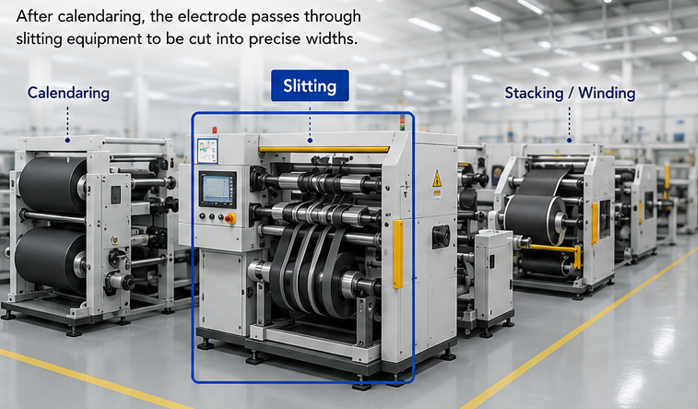
Battery slitting equipment cuts wide electrode rolls into narrow strips with highly accurate widths before they are assembled into battery cells.
Following the calendaring process, the electrode has already reached its target thickness and density. The next step is to divide the continuous roll into dimensions that match the cell design.
Depending on the battery format, slit electrodes may later be used for:
- Cylindrical cells
- Prismatic cells
- Pouch cells
Typical requirements include:
- Precise width tolerance
- Smooth edge quality
- Minimal burr formation
- Stable roll tension
- Clean winding after cutting
Even a small dimensional error can affect downstream processes such as stacking, winding, or tab welding.
2. Why Electrode Slitting Matters
Slitting is not simply about cutting electrodes to size—it is a quality-control process that ensures every electrode entering cell assembly meets tight dimensional and surface-quality standards.
Maintaining Dimensional Accuracy
Each battery design requires a specific electrode width.
If the slit width varies beyond specification, problems may occur during:
- Electrode stacking
- Jelly-roll winding
- Separator alignment
- Cell sealing
Modern battery slitting equipment therefore maintains width tolerances within fractions of a millimeter.
Improving Edge Quality
The cut edge of an electrode has a direct impact on battery reliability.
Poor edge quality may result in:
- Burrs
- Edge cracking
- Particle detachment
- Metal exposure
These defects increase the risk of internal short circuits and reduce long-term cell reliability.
Supporting High-Speed Production
Modern battery factories operate at increasingly high line speeds.
Slitting equipment must therefore maintain cutting accuracy while processing long electrode rolls continuously without compromising quality.
3. Main Components of a Slitting Line
Battery slitting systems combine multiple modules that work together to deliver precise and repeatable cutting.
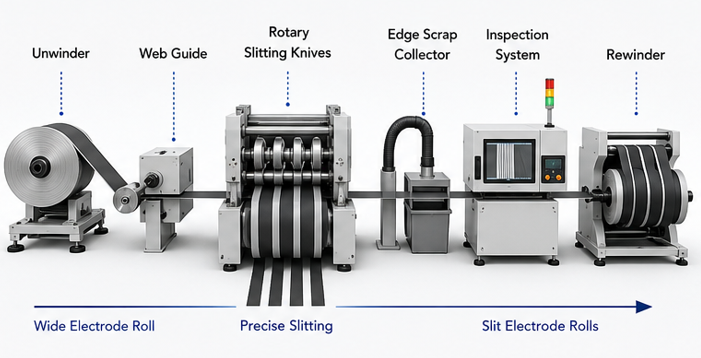
Unwinder
The unwinder feeds the electrode roll into the slitting line while maintaining stable web tension.
Web Guide System
Sensors continuously monitor electrode position and automatically correct lateral movement.
Proper web alignment ensures that the cutting blades remain accurately positioned throughout production.
Rotary Slitting Knives
Circular rotary knives perform the cutting operation.
The blades are manufactured with extremely high precision and are designed to maintain sharpness over extended production runs.
Knife material and geometry influence:
- Cutting quality
- Burr formation
- Blade life
- Dust generation
Edge Scrap Collection
Small strips removed from the electrode edges are collected through a dedicated vacuum or waste-handling system.
Efficient scrap removal prevents contamination of the production line.
Inspection System
Vision cameras and measurement systems inspect:
- Electrode width
- Edge quality
- Surface defects
- Cutting consistency
Defective material can be identified before reaching the next manufacturing stage.
Rewinder
The finished electrode strips are rewound into individual rolls under carefully controlled tension.
Proper rewinding prevents wrinkles, telescoping, and edge deformation.
4. How Battery Slitting Works
The calendared electrode enters the slitting machine as a continuous roll.
The process follows several steps:
- The unwinder feeds the electrode.
- The web guide aligns the electrode.
- Rotary knives cut the electrode into multiple strips.
- Edge scrap is removed.
- Inline inspection verifies cutting quality.
- Individual strips are rewound for the next process.
Throughout the operation, sensors continuously monitor web position and tension to ensure consistent cutting performance.
The slit electrode rolls are then transferred to either the stacking or winding process, depending on the battery cell design.
5. Critical Slitting Parameters
Several process variables determine slitting quality.
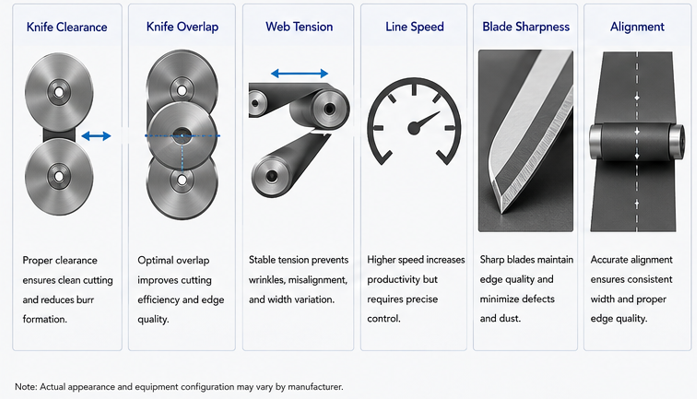
Knife Clearance
Knife clearance refers to the distance between the upper and lower blades.
Improper clearance may increase burr formation or produce rough edges.
Knife Overlap
The amount of blade overlap influences cutting efficiency and edge quality.
Correct overlap minimizes deformation while maintaining a clean cut.
Blade Sharpness
Blade wear gradually reduces cutting quality.
Regular inspection and replacement are essential for maintaining stable production.
Web Tension
Stable web tension prevents:
- Wrinkles
- Width variation
- Misalignment
- Poor rewinding
Line Speed
Higher production speeds improve productivity but require more precise control of blade stability and web handling.
Alignment
Accurate alignment between the web and cutting blades ensures consistent strip width across the entire roll.
6. Common Slitting Defects
Improper slitting conditions may produce several defects.
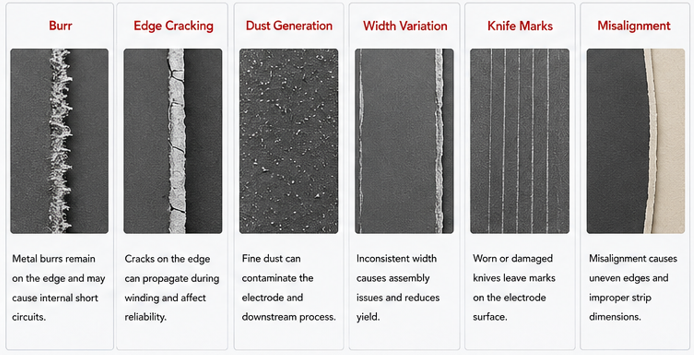
Burr Formation
Metal burrs are one of the most critical defects.
Excessive burrs may damage the separator or increase the risk of internal short circuits.
Edge Cracking
Poor cutting conditions may create cracks along the electrode edge.
These cracks can propagate during winding or cycling.
Dust Generation
Cutting generates fine particles.
If dust is not effectively removed, contamination may affect later manufacturing processes.
Width Variation
Inconsistent strip width can complicate stacking and winding while reducing cell consistency.
Knife Marks
Damaged or worn blades may leave visible marks on the electrode surface.
Misalignment
Improper web guiding may shift the cutting position, producing uneven electrode dimensions.
7. Future Trends in Slitting Equipment
Battery slitting technology continues to evolve as production capacity increases.
Key trends include:
- Higher-speed production lines
- AI-assisted blade monitoring
- Automatic knife positioning
- Vision-based edge inspection
- Predictive maintenance
- Reduced dust-generation technologies
- Improved automation for roll handling
These innovations help manufacturers improve both productivity and product quality while reducing operating costs.
8. Frequently Asked Questions
Why is slitting performed after calendaring?
Calendaring establishes the final electrode thickness and density. Slitting then cuts the electrode into the required widths without changing these properties.
What is the biggest quality concern during slitting?
Burr formation is one of the most critical concerns because burrs may damage separators and increase the risk of internal short circuits.
How is cutting quality monitored?
Modern production lines use vision systems, laser measurement, and dimensional inspection to monitor edge quality and strip width in real time.
Does slitting generate waste?
Yes. Small edge strips and cutting dust are generated and are typically removed using dedicated scrap collection and vacuum systems.
Can worn blades affect battery performance?
Yes. Worn blades increase burrs, edge damage, and dimensional variation, all of which may reduce manufacturing yield and cell reliability.
9. Key Takeaways
- Battery slitting equipment precisely cuts wide electrode rolls into cell-ready strips.
- Cutting quality directly affects assembly accuracy, safety, and manufacturing yield.
- Rotary knives, web guides, inspection systems, and tension control work together to maintain consistent quality.
- Burrs, edge cracking, dust, and width variation are the most common slitting defects.
- Future slitting equipment will rely increasingly on automation, AI-based monitoring, and advanced inspection technologies.
📚 Key Terms
Slitting
The process of cutting wide battery electrodes into narrow strips with precise dimensions before cell assembly.
Rotary Slitting Knife
A circular precision blade used to cut continuously moving electrode rolls.
Knife Clearance
The controlled gap between the upper and lower cutting blades that influences edge quality.
Burr
A small metal projection left on the cut edge of an electrode after slitting.
Web Guide
An automatic alignment system that keeps the electrode centered during production.
Web Tension
The controlled pulling force applied to the moving electrode throughout the slitting process.
Edge Scrap
The narrow strips removed from both sides of an electrode during slitting to achieve the final width.
🎓 Battery Learning Path
⚙️ Equipment
✅ iAtlas Battery #18 — Mixing Equipment
✅ iAtlas Battery #19 — Coating Equipment
✅ iAtlas Battery #20 — Drying Equipment
✅ iAtlas Battery #21 — Calendaring Equipment
📍 iAtlas Battery #22 — Slitting Equipment (Current)
▶ iAtlas Battery #23 — Stacking & Winding Equipment
▶ iAtlas Battery #24 — Electrolyte Filling Equipment
▶ iAtlas Battery #25 — Formation Equipment
▶ iAtlas Battery #26 — Inspection Equipment
Welcome to the Equipment Learning Path, where you’ll explore the machines that power modern lithium-ion battery manufacturing.
📖 Continue Reading
⬅ Previous Article
🔋 iAtlas Battery #21
Battery Calendaring Equipment Explained: How Roll Pressing Improves Battery Performance
Learn how precision roll pressing controls electrode thickness, density, and porosity before slitting.
➡ Next Article
🔋 iAtlas Battery #23
Battery Stacking & Winding Equipment Explained: How Cells Take Their Final Shape
Discover how stacking and winding transform finished electrodes into complete battery cells.
📚 References
- International Energy Agency (IEA)
- U.S. Department of Energy – Vehicle Technologies Office
- Battery University
- Nature Energy (Battery Manufacturing Research)
🔷 About iAtlas
iAtlas is an independent publication covering batteries, semiconductors, OLED, advanced materials, AI, and global industrial trends.
We transform complex industrial developments into clear, reliable, and easy-to-understand insights.
Whether you’re following today’s industry news or building long-term expertise, iAtlas helps you understand not only what happened, but why it matters.
Technology creates change.
Insight creates opportunity.
— iAtlas