
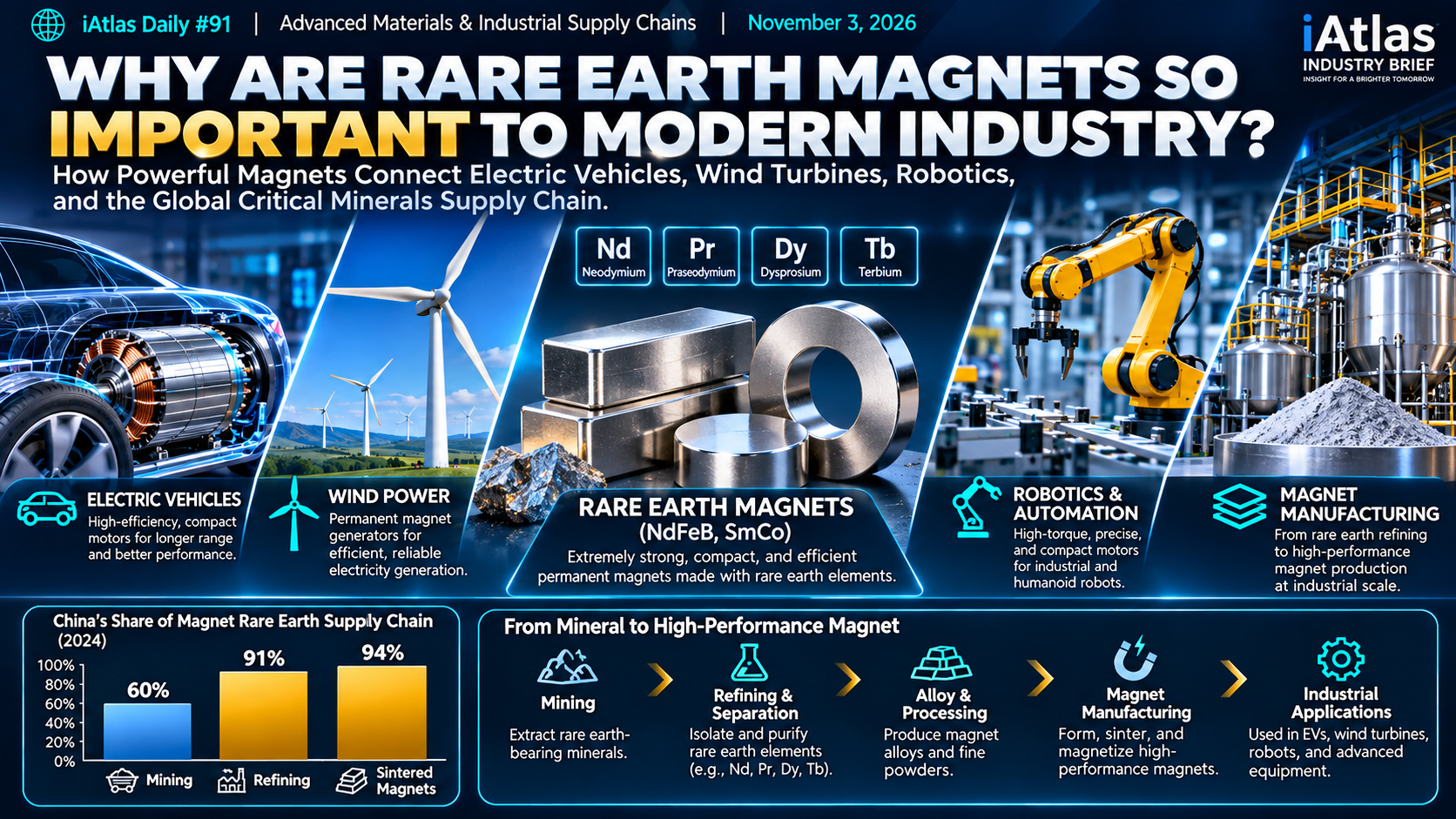
Why Are Rare Earth Magnets So Important to Modern Industry?
How Powerful Magnets Connect Electric Vehicles, Wind Turbines, Robotics, and the Global Critical Minerals Supply Chain
iAtlas Daily #91 | Advanced Materials & Industrial Supply Chains | November 3, 2026
The Small Components Behind Some of the World’s Biggest Industries
What do an electric vehicle, a wind turbine, and an industrial robot have in common?
They all depend on technologies that convert electricity into motion—or motion into electricity.
And many of these systems rely on a surprisingly small but powerful component: a permanent magnet.
Not every electric motor or wind turbine requires rare earth magnets. Several alternative designs exist.
However, high-performance rare earth permanent magnets are especially valuable when engineers need powerful magnetic fields, compact dimensions, and high efficiency.
These characteristics make them important in electric vehicles, renewable energy, industrial automation, electronics, and advanced manufacturing.
But their significance extends beyond engineering.
Rare earth magnets have become a strategic industrial resource because the technologies that depend on them are expanding while their supply chains remain highly concentrated.
According to the International Energy Agency (IEA), demand for the four principal magnet rare earth elements—neodymium, praseodymium, dysprosium, and terbium—has approximately doubled since 2015.
The same analysis highlights a major vulnerability: China dominates several critical stages of the supply chain, particularly refining and finished magnet production.
Understanding rare earth magnets therefore requires looking at three connected questions.
Why are they so useful?
How are they manufactured?
And why is it so difficult for other countries to establish independent supply chains?
1. What Are Rare Earth Magnets?
Rare earth magnets are permanent magnets manufactured using alloys containing certain rare earth elements.
A permanent magnet generates a magnetic field without requiring a continuous external electrical supply.
This distinguishes it from an electromagnet, which relies on an electric current to produce its magnetic field.
Two important commercial families are:
- Neodymium-iron-boron (NdFeB) magnets
- Samarium-cobalt (SmCo) magnets
NdFeB magnets are particularly important because they can deliver extremely strong magnetic performance relative to their size.
Why Are They Called Rare Earth Magnets?
Rare earth elements are a group of 17 chemical elements, including the 15 lanthanides, scandium, and yttrium.
Despite their name, many rare earth elements are not exceptionally rare in the Earth’s crust.
The difficulty is finding economically recoverable deposits and separating individual elements from complex mineral mixtures.
Rare earth elements often occur together and have similar chemical properties.
This makes refining and separation technically demanding.
The industrial challenge is therefore not simply locating rare earth minerals.
It is producing the specific materials required by manufacturers at the necessary purity, consistency, and cost.
2. Which Rare Earth Elements Are Used in High-Performance Magnets?
Four elements are particularly important to the NdFeB magnet supply chain.
| Element | Symbol | Main Function |
|---|---|---|
| Neodymium | Nd | Provides strong magnetic performance |
| Praseodymium | Pr | Often used alongside neodymium in magnet alloys |
| Dysprosium | Dy | Helps maintain resistance to demagnetization at elevated temperatures |
| Terbium | Tb | Can improve high-temperature magnetic performance |
Neodymium and praseodymium form the foundation of many high-performance magnet compositions.
Dysprosium and terbium are often added in smaller quantities when higher temperature resistance is needed.
However, not every NdFeB magnet contains all four elements.
Magnet manufacturers adjust compositions and processing methods according to performance requirements.
Why Does Temperature Matter?
A magnet used in a small electronic device operates under very different conditions from one installed inside an electric vehicle motor.
Electric motors generate heat during operation.
If a magnet loses too much of its magnetic strength at elevated temperatures, motor performance and reliability may be affected.
Dysprosium and terbium can improve resistance to demagnetization, although their use introduces additional cost and supply-chain considerations.
Engineers therefore try to achieve the required magnetic performance while minimizing dependence on expensive or difficult-to-source elements.
3. Why Are Rare Earth Magnets Important for Electric Vehicles?
An electric vehicle converts electrical energy from its battery into mechanical motion.
The electric motor performs this conversion.
Many electric vehicles use permanent magnet synchronous motors because they can offer high efficiency and strong power density.
How Does a Permanent Magnet Motor Work?
A simplified electric motor contains two major components.
Stator
The stationary part of the motor contains electrical windings.
When controlled electrical currents flow through these windings, they create a rotating magnetic field.
Rotor
The rotating part may contain permanent magnets.
The interaction between the stator’s magnetic field and the rotor’s magnets generates torque.
That torque drives the vehicle through its drivetrain.
Why Use Rare Earth Magnets?
High-performance magnets can help engineers achieve:
- Compact motor dimensions
- High torque density
- Efficient operation
- Reduced motor weight
- Strong performance across a wide operating range
These characteristics are valuable in electric vehicles, where efficiency, packaging space, and vehicle weight all matter.
Do All EVs Need Rare Earth Magnets?
No.
Electric vehicles can also use induction motors, electrically excited synchronous motors, and other motor designs that do not require rare earth permanent magnets.
These alternatives can reduce supply-chain dependence.
However, they introduce their own engineering trade-offs involving efficiency, motor size, cost, control systems, and manufacturing complexity.
The appropriate design depends on the vehicle’s performance targets and overall system architecture.
Rare earth magnets are important to EV manufacturing, but they are not technically indispensable to every electric vehicle.
4. How Do Rare Earth Magnets Support Wind Power?
Wind turbines convert the movement of air into electrical energy.
As wind turns the turbine blades, the rotor drives a generator.
Some wind turbine generators use permanent magnets to create the magnetic field required for electricity generation.
Why Permanent Magnet Generators?
Permanent magnet generators can offer advantages in efficiency, compactness, and system design.
They are particularly relevant to certain direct-drive and medium-speed wind turbine configurations.
In direct-drive systems, the generator can operate without a conventional high-speed gearbox.
This can simplify parts of the drivetrain, although the generator itself may become larger.
How Much Magnet Material Is Required?
The amount varies significantly by turbine design and generator architecture.
According to Natural Resources Canada, some modern wind turbine designs can use up to approximately two tonnes of NdFeB magnets.
That figure should not be interpreted as a universal requirement for every turbine.
Some wind turbines use generator designs that require little or no rare earth permanent magnet material.
Why This Matters for Energy Infrastructure
As wind power capacity expands, demand for permanent magnet generators can create additional demand for magnet materials.
This connects renewable energy development to mining, chemical processing, metallurgy, and precision manufacturing.
A wind turbine may produce clean electricity for decades, but its manufacturing supply chain can depend on materials sourced and processed across multiple countries.
5. Why Are Rare Earth Magnets Important for Robotics?
Robotics is another emerging area of interest.
Industrial robots rely on electric motors and actuators to produce controlled movement.
These systems must repeatedly position mechanical components with high precision.
Precision Motion Control
A robotic joint may need to deliver:
- Accurate positioning
- High torque
- Fast response
- Compact dimensions
- Low weight
- Reliable repeated operation
Permanent magnet motors are widely used in industrial automation because they can provide favorable combinations of these characteristics.
Humanoid Robots
Humanoid robots create additional engineering challenges.
A humanoid robot may contain many powered joints in its arms, legs, hands, and torso.
Reducing actuator size and weight can be important for energy efficiency, mobility, and mechanical design.
High-performance permanent magnets may support compact actuator development.
However, the actual material requirements depend on the motor technology and actuator architecture selected by each manufacturer.
Is Robotics Already the Largest Driver of Rare Earth Demand?
No.
Electric vehicles, wind turbines, and established industrial applications currently represent more significant sources of magnet demand.
Robotics could become a more important growth market if large-scale deployment accelerates.
But the size and timing of that opportunity remain uncertain.
The critical point is that the same magnet technologies can support multiple industries.
A material used in an EV motor may also be important in industrial automation, robotics, and precision equipment.
6. How Are Rare Earth Magnets Manufactured?
The rare earth magnet supply chain involves several stages.
It is much more complicated than extracting a mineral and shipping it directly to a motor manufacturer.
Stage 1 — Mining
Rare earth-bearing minerals are extracted from suitable deposits.
The composition of these deposits varies by location.
Not every deposit contains the same proportion of commercially valuable magnet rare earth elements.
Stage 2 — Separation and Refining
Rare earth elements must be separated from other materials and, often, from one another.
Industrial processing may involve chemical leaching, solvent extraction, precipitation, and other separation techniques.
The goal is to produce individual rare earth compounds at the required purity.
This stage requires specialized chemical engineering, environmental controls, and process expertise.
Stage 3 — Metal and Alloy Production
Refined rare earth compounds are converted into metals.
These metals are then combined with other materials to produce magnet alloys.
For NdFeB magnets, the principal alloy system contains neodymium or neodymium-praseodymium, iron, and boron.
Additional elements may be incorporated to adjust performance.
Stage 4 — Magnet Manufacturing
One common manufacturing route for high-performance sintered NdFeB magnets involves:
- Alloy production
- Powder preparation
- Magnetic alignment and pressing
- Sintering and heat treatment
- Machining and finishing
- Surface coating
- Magnetization and quality inspection
Each step affects the final magnet’s performance.
Powder characteristics, microstructure, temperature control, and processing consistency are particularly important.
Stage 5 — Component Integration
Finished magnets are installed into motors, generators, actuators, and other products.
Their performance must meet the requirements of the final application.
For automotive or industrial equipment, reliability and consistency can be just as important as maximum magnetic strength.
7. Why Is China So Dominant in the Rare Earth Magnet Supply Chain?
China has developed a strong position across several stages of rare earth production.
However, its dominance is not identical at every stage.
The distinction between mining, refining, and magnet manufacturing is essential.
China’s Share of the Magnet Rare Earth Supply Chain
| Supply Chain Stage | China’s Share in 2024 |
|---|---|
| Magnet rare earth mining | Approximately 60% |
| Magnet rare earth refining | Approximately 91% |
| Sintered rare earth magnet manufacturing | Approximately 94% |
Source: IEA, Global Critical Minerals Outlook 2025. These figures refer to the magnet rare earth supply chain and related sintered magnet manufacturing, not all mineral production.
The figures reveal an important pattern.
China’s position becomes stronger further downstream.
Its share of refining is higher than its share of mining.
Its position in sintered magnet manufacturing is even more concentrated.
Why Is Refining So Important?
Mining creates access to raw materials.
But manufacturers need separated and processed materials that meet precise technical specifications.
A country may possess substantial mineral reserves while still depending on foreign companies to refine those minerals.
Why Is Magnet Manufacturing Important?
Producing a high-performance magnet requires more than access to neodymium or praseodymium.
Manufacturers need expertise in alloy processing, powder metallurgy, magnetic alignment, heat treatment, and quality control.
They also need reliable access to equipment, materials, and customers.
This makes the finished magnet manufacturing stage a particularly difficult part of the supply chain to replicate.
Owning rare earth deposits does not automatically create an independent rare earth magnet industry.
8. Why Are Rare Earth Export Controls Such a Major Concern?
Rare earth supply chains have become closely connected to industrial policy and international trade.
In 2025, China introduced export controls covering certain heavy rare earth elements and related products.
These measures demonstrated how changes in export licensing can affect downstream manufacturers.
The IEA reported that restrictions and licensing disruptions in 2025 created difficulties for some automotive manufacturers outside China.
Some companies experienced production adjustments or temporary shutdowns before export volumes recovered.
Why Can a Small Material Create a Large Industrial Problem?
A high-performance electric motor may contain a relatively small quantity of rare earth magnets compared with its total weight.
But if those magnets are unavailable, the entire motor may be impossible to complete.
This creates a supply-chain vulnerability.
A component can be strategically important even when it represents only a small percentage of a finished product’s cost.
Supply Risk Is Not Only About Quantity
Manufacturers must also consider:
- Export licensing requirements
- Material specifications
- Supplier qualification
- Processing capacity
- Delivery schedules
- Inventory availability
- Price volatility
These factors can affect manufacturing decisions before a complete supply shortage occurs.
For automotive companies, the ability to obtain qualified magnets consistently may be more important than simply finding the lowest-priced supplier.
9. Can Other Countries Build Alternative Supply Chains?
Several countries are investing in rare earth mining, refining, and magnet manufacturing.
The United States, Australia, Japan, European countries, and others are seeking to reduce dependence on highly concentrated supply chains.
Mining Expansion
New mines can diversify raw material production.
However, mine development requires exploration, permitting, financing, infrastructure, and processing facilities.
Refining Capacity
Building chemical separation and refining facilities is a major challenge.
These operations require technical expertise, environmental management, and economically viable processing methods.
Magnet Manufacturing
Finished magnet production requires specialized manufacturing technology.
It also depends on consistent access to metals and alloys.
Even if mining and refining capacity expands, downstream magnet production may remain a bottleneck.
The Economic Challenge
New suppliers must compete with established manufacturers that already benefit from industrial scale, accumulated expertise, and integrated supply chains.
Customers may also require extensive qualification before adopting new magnet suppliers.
This creates a difficult investment problem.
New projects need customers and financing.
But customers often prefer suppliers with proven manufacturing performance.
Long-term purchasing agreements, industrial partnerships, and public policy support may help address these barriers.
10. Can Rare Earth Magnets Be Replaced?
Reducing rare earth dependence is an important research and engineering objective.
However, replacement is not a single solution.
Different applications have different requirements.
Alternative Motor Designs
Some electric motors do not require permanent magnets.
Induction motors and electrically excited synchronous motors are two examples.
These technologies can reduce reliance on rare earth materials.
But they may involve trade-offs in size, efficiency, complexity, and system design.
Ferrite Magnets
Ferrite magnets are relatively inexpensive and do not depend on rare earth elements.
However, their magnetic performance is generally lower than that of high-performance NdFeB magnets.
Using ferrite magnets may require changes in motor design.
Reduced Heavy Rare Earth Content
Magnet manufacturers can improve microstructure and processing techniques to reduce the amount of dysprosium or terbium required.
For example, grain boundary diffusion techniques can help concentrate certain performance-enhancing elements where they are most effective.
This can reduce material consumption while maintaining necessary magnetic characteristics.
Recycling
Rare earth magnets can potentially be recovered from used motors, electronics, industrial equipment, and manufacturing scrap.
Recycling may involve direct reuse, magnet-to-magnet processing, or chemical recovery.
However, collection, separation, contamination, and economic viability remain important challenges.
Which Solution Is Best?
There is no universal answer.
For some applications, alternative motors may be suitable.
For others, high-performance NdFeB magnets may remain the preferred engineering solution.
Recycling and improved magnet design can also complement new mining and refining investment.
The most resilient supply strategy may involve several approaches rather than relying on a single technology.
11. Why Does Magnet Manufacturing Quality Matter?
Rare earth magnets are not interchangeable commodities in every application.
Their performance depends on material composition and manufacturing quality.
Magnetic Strength
Magnets must provide the required magnetic field for the intended product.
Temperature Performance
Magnets used in high-temperature environments must resist excessive demagnetization.
Corrosion Resistance
NdFeB magnets can be vulnerable to corrosion without appropriate protection.
Surface coatings and environmental controls are therefore important.
Dimensional Accuracy
Motor and actuator designs may require magnets with tight dimensional tolerances.
Manufacturing Consistency
Industrial customers need consistent performance across large production volumes.
A magnet that performs well in a laboratory may still require substantial development before it can be manufactured economically at scale.
This creates opportunities for companies specializing in powder metallurgy, precision machining, coatings, process control, and quality inspection.
12. What Could Change by 2030?
Several trends could reshape the rare earth magnet industry over the remainder of the decade.
Trend 1 — Continued Growth in Electrification
Electric vehicles and wind power are expected to remain important demand drivers.
The IEA’s 2025 outlook projected magnet rare earth demand to exceed 120,000 tonnes by 2030 under its Stated Policies Scenario.
This is a scenario-based projection rather than a guaranteed outcome.
Trend 2 — Greater Focus on Supply Diversification
Governments and manufacturers are likely to continue supporting alternative refining and magnet manufacturing capacity.
However, developing competitive supply chains will take time.
Trend 3 — More Efficient Magnet Designs
Manufacturers may increasingly seek to reduce heavy rare earth content without compromising performance.
Trend 4 — Expansion of Recycling
Recycling could become more important as larger quantities of EV motors and other magnet-containing products reach the end of their service lives.
In the near term, manufacturing scrap may remain an important feedstock because end-of-life collection volumes depend on product lifetimes.
Trend 5 — New Demand From Automation
Robotics, industrial automation, and precision motion systems may contribute to long-term demand growth.
The extent of this growth will depend on commercialization and deployment rates.
Industry Implications | A Small Component With a Large Industrial Footprint
Rare earth magnets connect multiple industries that are often analyzed separately.
| Industry | Main Application | Strategic Consideration |
|---|---|---|
| Electric Vehicles | Traction motors | Efficiency, cost, supply security |
| Wind Energy | Permanent magnet generators | Material demand, generator design |
| Industrial Robotics | Servo motors and actuators | Precision, torque density, reliability |
| Electronics | Compact motors and components | Miniaturization, manufacturing scale |
| Advanced Materials | Magnet alloys and coatings | Material performance and processing |
| Chemical Processing | Rare earth separation and refining | Purity, process control, environmental management |
| Manufacturing Equipment | Powder processing, sintering, inspection | Quality, yield, production capacity |
For material suppliers, the opportunity extends beyond mining.
Refining, metal production, magnet manufacturing, equipment integration, and recycling all create potential areas for industrial development.
For manufacturers, the priority is not simply purchasing rare earth materials.
It is securing qualified components that meet performance, reliability, and delivery requirements.
For investors, supply-chain position may be as important as the size of a company’s mineral reserves.
iAtlas Insight | The Real Competition Is Beyond the Mine
Rare earth magnets illustrate an important principle of modern industrial competition.
The strategic value of a material depends not only on where it is found, but on who can transform it into a reliable industrial product.
Mining is only the beginning.
A complete supply chain requires chemical separation, refining, metallurgy, precision manufacturing, and integration into final products.
This explains why rare earth supply diversification is difficult.
Opening new mines does not immediately solve the shortage of refining or magnet manufacturing capacity.
It also explains why a relatively small component can have such a large influence on global manufacturing.
A high-performance magnet may represent only a small portion of an electric vehicle or industrial robot.
But without a suitable magnet—or an alternative motor design—the finished product may not meet its required specifications.
Looking toward 2030, the most important developments may therefore occur in three areas.
First, manufacturing capacity. More regions will seek to develop competitive refining and magnet production.
Second, material efficiency. Engineers will continue working to achieve the required performance with fewer constrained materials.
Third, supply-chain resilience. Companies will place greater emphasis on qualified suppliers, reliable delivery, and diversified sourcing.
The future of rare earth magnets will not be determined by mining alone.
It will be shaped by the ability to convert critical materials into high-performance products at industrial scale.
In modern manufacturing, controlling a material is valuable. Mastering the technology that transforms it is even more important.
Related Articles
Industry Infrastructure
What Is Industrial Infrastructure?
Understand the power, utility, environmental control, and manufacturing systems that support modern industrial production.
Global Industrial Supply Chains
Why Industrial Supply Chain Competition Is Moving Upstream
Explore why upstream materials, specialized equipment, and processing capabilities increasingly determine industrial competitiveness.
Industrial Manufacturing Strategy
The Next Industrial Advantage Is Flexibility
Discover why adaptable manufacturing systems and resilient industrial operations matter in rapidly changing markets.
References
1. International Energy Agency — Rare Earth Elements
An analysis of magnet rare earth demand, supply concentration, export restrictions, and diversification challenges.
2. International Energy Agency — Global Critical Minerals Outlook 2025
Research covering rare earth supply chains, refining concentration, magnet manufacturing, and demand projections.
3. U.S. Geological Survey — Mineral Commodity Summaries 2026: Rare Earths
Official data on rare earth production, resources, industry structure, and supply developments.
4. Natural Resources Canada — Critical Minerals Value Chains: Permanent Magnets
Explanation of permanent magnet manufacturing, material requirements, and applications in electric vehicles and wind turbines.
5. International Energy Agency — Renewables 2025
Industry outlook addressing renewable energy supply chains and the concentration of rare earth production for wind turbine magnets.
ℹ️ About iAtlas
iAtlas is an independent publication covering batteries, semiconductors, OLED, advanced materials, AI, and global industrial trends.
We transform complex industrial developments into clear, reliable, and easy-to-understand insights.
Whether you’re following today’s industry news or building long-term expertise, iAtlas helps you understand not only what happened, but why it matters.
Technology creates change.
Insight creates opportunity.
— iAtlas