
Why Is the Power Grid Becoming a Bottleneck for AI Growth?
How Data Center Electricity Demand Is Reshaping Power Infrastructure, Energy Investment, and the Global AI Industry
iAtlas Daily #90 | AI & Energy Infrastructure | November 2, 2026
The AI Revolution Has an Electricity Problem
Artificial intelligence is advancing at an extraordinary pace.
New AI models are becoming more capable. Technology companies are building increasingly powerful data centers. Businesses are integrating AI into software, manufacturing, research, and everyday operations.
But behind this digital transformation lies a physical challenge.
The AI power grid bottleneck is emerging as one of the most important constraints on the industry’s expansion.
AI systems need enormous computing resources. Those computers require electricity, cooling, power distribution equipment, and reliable connections to the electrical grid.
Building a new data center can take only a few years.
Building the electricity infrastructure needed to support it may take considerably longer.
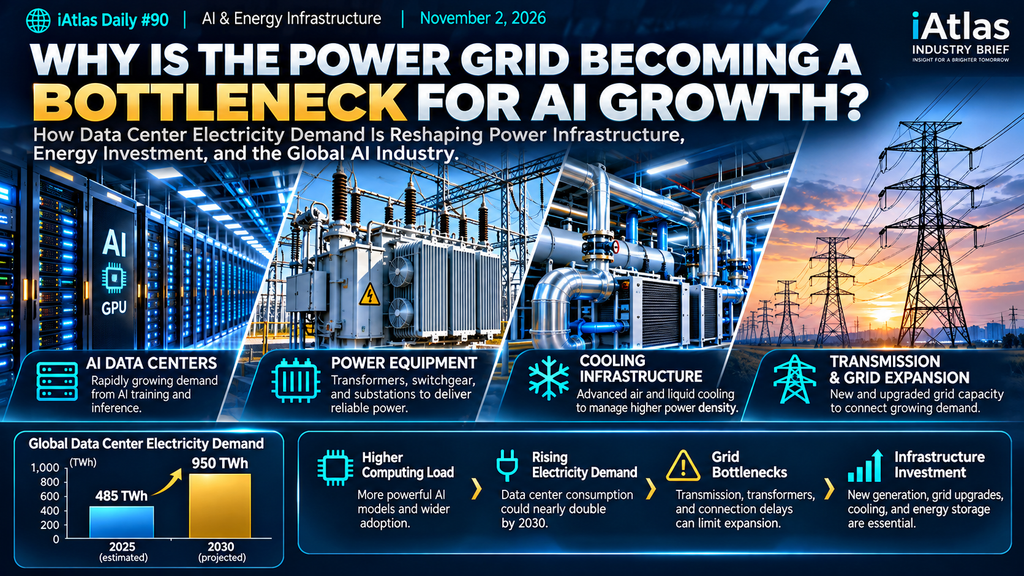
According to the International Energy Agency (IEA), global data center electricity consumption reached approximately 485 terawatt-hours (TWh) in 2025 and could increase to around 950 TWh by 2030.
That would represent roughly 3% of global electricity demand by the end of the decade.
The challenge is not simply producing more electricity.
It is delivering sufficient power to the right locations, at the right time, with the reliability required for expensive computing infrastructure.
As a result, competition in AI is expanding beyond semiconductors and software.
Electricity availability is becoming a strategic factor in determining where AI infrastructure can grow.
1. Why Does AI Require So Much Electricity?
Traditional data centers support websites, cloud storage, business applications, and online services.
AI data centers perform many of these functions, but they also operate specialized computing systems designed for demanding workloads.
These systems often contain large numbers of graphics processing units (GPUs) or other AI accelerators.
AI Training
Training an advanced AI model involves processing enormous datasets through computationally intensive operations.
Large clusters of accelerators work together, often for extended periods.
This requires substantial computing power and supporting infrastructure.
AI Inference
Inference occurs when a trained model generates a response, analyzes an image, processes information, or performs another task.
An individual inference request may require much less computing than a major training run.
However, inference demand can become significant when millions of users and applications interact with AI systems continuously.
As AI adoption expands, inference may become an increasingly important source of electricity demand.
Higher Power Density
Modern AI servers can consume considerably more power than many conventional enterprise servers.
When large numbers of accelerators are installed in a single rack, power density increases.
This creates additional requirements for electrical distribution, thermal management, and cooling.
Electricity is therefore needed not only for computation, but also for the infrastructure that keeps computing equipment operating safely.
2. How Fast Is Data Center Electricity Demand Growing?
The scale of expected growth is substantial.
The IEA’s 2026 Key Questions on Energy and AI report projects that global data center electricity consumption could rise from approximately 485 TWh in 2025 to around 950 TWh in 2030.
The report also indicates that electricity consumption from AI-focused data centers could grow considerably faster than overall data center consumption.
Global Data Center Electricity Demand
| Year | Electricity Consumption | Status |
|---|---|---|
| 2024 | Approximately 415 TWh | IEA estimate |
| 2025 | Approximately 485 TWh | IEA estimate |
| 2030 | Approximately 950 TWh | IEA central projection |
Source: IEA, Energy and AI (2025); Key Questions on Energy and AI (2026). Figures cover all data centers, not AI workloads alone.
The figures illustrate how rapidly digital infrastructure is becoming a significant electricity consumer.
However, global percentages do not tell the whole story.
Local Demand Matters More Than Global Share
A data center may represent only a small fraction of national electricity consumption.
But several large facilities concentrated in the same region can place substantial pressure on local transmission and distribution networks.
This is particularly important in regions where data center development is concentrated around existing technology hubs.
Electricity infrastructure must be capable of supplying the actual load at each location.
A country may have sufficient total generation capacity while still experiencing local grid constraints.
For data center developers, available power in the right location can matter more than total electricity production across an entire country.
3. Why Can’t the Power Grid Expand as Quickly as AI?
The main problem is a mismatch between development timelines.
Technology companies can order computing equipment, lease facilities, and expand server capacity relatively quickly.
Electricity infrastructure operates on a different schedule.
Transmission Lines
Large transmission projects require engineering, permitting, land access, construction, and coordination with grid operators.
The IEA has reported that new transmission lines in advanced economies can take approximately four to eight years to develop.
Substations
Large data centers may require new substations or upgrades to existing infrastructure.
These facilities contain transformers, switchgear, protection systems, and other equipment needed to deliver electricity safely.
Transformers
Transformers adjust voltage levels so electricity can move efficiently through transmission and distribution networks.
Large power transformers are specialized industrial products.
Their manufacturing involves electrical steel, copper or aluminum conductors, insulation systems, precision assembly, and extensive testing.
Expanding production capacity cannot always happen immediately.
Grid Connection Approval
Before connecting a major new load, utilities and system operators must evaluate whether the network can support it.
Additional infrastructure may be required to prevent reliability problems.
This creates a challenge for data center developers.
A completed building does not automatically mean that sufficient electrical power is available.
According to the IEA’s 2025 assessment, grid constraints could put approximately 20% of planned global data center capacity at risk of connection delays by 2030.
This is a modeled risk, not a prediction that exactly one-fifth of projects will be delayed.
4. Transformers Are Becoming Strategically Important Equipment
AI is often associated with advanced semiconductor chips.
But the expansion of AI infrastructure also depends on conventional industrial equipment.
Transformers are a particularly important example.
What Does a Transformer Do?
Electricity is transmitted at high voltages to reduce losses over long distances.
Before it reaches data center equipment, the voltage must be adjusted through several stages.
Transformers perform this function.
A large data center may depend on multiple transformers within utility infrastructure, substations, and facility power-distribution systems.
Why Manufacturing Capacity Matters
Large transformers require specialized materials, production equipment, skilled workers, and quality assurance.
Their supply chains include:
- Electrical steel
- Copper and aluminum conductors
- Insulation materials
- Transformer oil or alternative insulating systems
- Cooling equipment
- Monitoring and protection components
Manufacturers must also meet demanding electrical and thermal performance requirements.
As electricity infrastructure investment increases, demand for these components may rise.
An Industrial Opportunity
Companies supplying transformers, switchgear, power cables, and substation equipment may benefit from grid expansion.
However, demand growth does not automatically translate into higher profitability.
Manufacturing capacity, material costs, labor availability, contract pricing, and competition will influence commercial outcomes.
The AI infrastructure race is creating opportunities for industries far removed from software development.
5. Cooling Is Another Critical Infrastructure Challenge
AI processors generate substantial heat.
That heat must be removed to maintain stable operating conditions.
As server power density increases, cooling becomes more challenging.
Air Cooling
Traditional data centers often use air-based cooling systems.
Fans and air-conditioning equipment move heat away from servers.
Air cooling remains useful for many applications.
However, very high-density computing configurations may require more advanced approaches.
Liquid Cooling
Liquid cooling uses a circulating fluid to transfer heat from computing equipment.
Direct-to-chip liquid cooling can move heat away from processors through cold plates.
Other configurations may use immersion cooling, where suitable electronic components operate in specially engineered dielectric fluids.
These systems differ in design, operating requirements, and commercial maturity.
Why Cooling Affects Electricity Demand
Cooling equipment consumes energy.
Pumps, fans, chillers, and heat-rejection systems can contribute to total facility electricity consumption.
The appropriate cooling strategy depends on rack density, climate, facility design, water availability, and operating economics.
Power Usage Effectiveness
One common data center efficiency metric is Power Usage Effectiveness, or PUE.
PUE compares total facility electricity consumption with the electricity consumed by IT equipment.
PUE = Total Facility Energy / IT Equipment Energy
A lower PUE generally indicates less overhead energy consumption relative to IT equipment.
However, PUE does not measure the useful computing work performed.
It also does not, by itself, capture water consumption, carbon emissions, or overall sustainability.
Efficient cooling can reduce infrastructure overhead, but growing computing demand may still increase total electricity consumption.
6. Where Will the Additional Electricity Come From?
Meeting rising data center electricity demand will require a combination of generation technologies.
No single energy source can satisfy every region’s requirements.
The appropriate mix depends on local electricity markets, available infrastructure, reliability needs, cost, and environmental policies.
Renewable Energy
Solar and wind power can provide substantial electricity generation.
Their costs and development timelines can make them attractive for new energy investment.
However, their output varies with weather conditions and time of day.
Storage, transmission, flexible demand, and complementary generation resources may be needed to support reliable electricity supply.
Natural Gas
Natural gas power plants can provide dispatchable electricity.
They may be considered in regions where rapid growth in demand creates a need for additional reliable generation.
However, new projects face equipment lead times, fuel-price exposure, emissions considerations, and permitting requirements.
Nuclear Power
Nuclear power can provide large amounts of low-carbon electricity with high availability.
Technology companies have shown interest in nuclear generation as a potential long-term source of reliable power.
Small modular reactors, or SMRs, are also attracting attention.
But many proposed SMR projects still face licensing, financing, construction, and commercialization challenges.
Energy Storage
Battery energy storage systems can help manage fluctuations in electricity supply and demand.
They can also support backup power, peak management, and grid services, depending on their design and operating arrangements.
However, batteries do not generate electricity.
Their economic value depends on how they are charged, discharged, and integrated with the broader power system.
A Diversified Energy Strategy
The IEA expects renewable energy, natural gas, and other generation sources to contribute to rising data center demand.
The resulting mix will vary significantly by region.
For AI infrastructure developers, the important question is not simply which energy source is best.
It is which combination can deliver reliable, affordable, and sufficiently timely electricity.
7. Can Data Centers Help Reduce Pressure on the Grid?
Data centers are usually discussed as electricity consumers.
But some may also become more flexible participants in the energy system.
Workload Scheduling
Certain computing tasks may be scheduled around electricity availability or prices.
For example, some non-urgent workloads could potentially be shifted to periods when electricity supply is more abundant.
However, not every workload is flexible.
Real-time AI services require rapid responses, and major computing clusters may have operational constraints.
Geographic Flexibility
Some computing workloads may be assigned to facilities in different regions.
This could allow operators to take advantage of available electricity capacity.
However, data movement, latency, regulatory requirements, and infrastructure costs can limit this approach.
On-Site Energy Storage
Battery systems can help manage peak electricity demand and provide operational resilience.
Under suitable conditions, they may also participate in grid-support services.
Better Planning
Utilities and data center operators can improve infrastructure planning by sharing more accurate information about expected electricity demand.
This is particularly important because announced projects do not always become operational.
The IEA’s 2026 analysis emphasizes that grid bottlenecks, equipment supply, financing, and project execution can all influence how quickly data center electricity demand grows.
The future relationship between AI and electricity networks may involve more coordination—not simply larger power connections.
8. The United States Shows How Significant the Challenge Could Become
The United States is one of the largest markets for data center development.
AI investment is increasing demand for computing infrastructure, while electricity systems must also support broader economic activity.
A 2026 update from Lawrence Berkeley National Laboratory estimates that data centers could account for approximately 11.8% of total U.S. electricity consumption by 2030 in its reference case.
Its scenario range is approximately 9.5% to 15.3%.
These are projections based on assumptions about equipment deployment, electricity consumption, cooling performance, and other factors.
They are not guaranteed outcomes.
Why Regional Conditions Matter
Data center projects tend to concentrate in locations with established fiber networks, available land, suitable business conditions, and access to electricity.
This can create strong local demand growth.
Even if national generation capacity expands, regional transmission or distribution constraints may remain.
Competition for Electricity Infrastructure
Utilities must plan for demand from multiple sectors.
These include:
- Data centers
- Semiconductor manufacturing
- Battery factories
- Electric vehicle charging
- Industrial electrification
- Residential and commercial development
New infrastructure must support these demands without undermining reliability or affordability.
As a result, electricity planning is becoming increasingly connected to industrial development strategy.
9. What Does This Mean for South Korea and Other Manufacturing Economies?
South Korea has a strong position in semiconductors, electronics, batteries, and digital infrastructure.
The expansion of AI creates opportunities across these industries.
But it also raises important questions about electricity infrastructure.
Semiconductor Manufacturing
Advanced semiconductor fabrication requires reliable electricity and sophisticated facility infrastructure.
Power interruptions can disrupt sensitive production processes.
AI Data Centers
Large computing facilities need dependable grid connections, efficient cooling, and appropriate locations.
Battery Manufacturing
Battery factories require electricity for production equipment, environmental control, and supporting facilities.
Industrial Clusters
When data centers and advanced manufacturing facilities are concentrated in the same region, infrastructure planning becomes especially important.
These observations do not mean that South Korea faces the same grid constraints as every U.S. data center market.
Actual conditions depend on local transmission capacity, generation availability, regulation, and project location.
Nevertheless, the broader lesson applies.
Industrial competitiveness increasingly depends on coordinating technology investment with electricity infrastructure development.
Countries that can provide reliable power and efficient project execution may have advantages in attracting energy-intensive investment.
10. Which Industries Could Benefit From AI-Driven Power Investment?
The expansion of AI data centers creates a broader industrial supply chain.
| Industry | Important Technologies | Potential Opportunity |
|---|---|---|
| Power Equipment | Transformers, switchgear, substations | Grid connection and network upgrades |
| Transmission Infrastructure | High-voltage cables, transmission systems | Electricity delivery capacity |
| Cooling Systems | Liquid cooling, chillers, pumps, heat exchangers | High-density computing facilities |
| Power Electronics | UPS, rectifiers, converters, power semiconductors | Efficient and reliable power distribution |
| Energy Storage | Battery systems, power conversion systems | Backup power and grid flexibility |
| Power Generation | Gas turbines, renewable generation, nuclear equipment | Additional electricity supply |
| Engineering & Construction | Electrical engineering, facility integration | New data centers and grid projects |
These opportunities will not develop at the same speed.
Some equipment categories may experience strong demand while others face slower project execution.
Supply constraints can also create difficulties for customers.
For example, longer transformer delivery times may increase project costs or delay facility commissioning.
Investors and industrial companies should therefore distinguish between announced spending, actual equipment orders, manufacturing deliveries, and completed infrastructure.
11. The Economics of AI Infrastructure Are Changing
AI investment is often measured through semiconductor purchases and data center construction spending.
But the true cost of operating AI infrastructure includes much more.
A large AI facility may require:
- Computing hardware
- Networking equipment
- Electrical infrastructure
- Cooling systems
- Grid connection investment
- Maintenance and replacement equipment
- Electricity purchases
- Land, construction, and financing
The economics become more complicated when electricity infrastructure is unavailable.
The Cost of Delay
A data center that is physically complete but cannot receive sufficient power may be unable to operate at its planned capacity.
This can delay revenue generation while financing and other costs continue.
The Cost of Reliability
Power interruptions can affect computing availability and service performance.
Reliable electrical infrastructure therefore has economic value beyond the price of electricity itself.
The Cost of Efficiency
More efficient processors, cooling systems, and electrical equipment can reduce electricity consumption per unit of computing work.
However, efficiency improvements do not necessarily reduce total electricity demand if AI usage grows faster.
The New Competitive Equation
AI infrastructure competitiveness increasingly depends on several factors working together:
Computing Performance + Power Availability + Energy Efficiency + Infrastructure Reliability + Total Cost
A company with advanced AI chips may still face limitations if it cannot deploy them in facilities with sufficient electricity.
This changes how infrastructure investment should be evaluated.
12. Three Possible Scenarios for AI Power Infrastructure by 2030
The relationship between AI growth and electricity infrastructure remains uncertain.
Three broad scenarios illustrate the possible outcomes.
Scenario A — Infrastructure Keeps Pace
Grid investment accelerates.
Equipment manufacturing capacity expands.
Data center developers improve location selection and energy planning.
In this scenario, electricity infrastructure supports continued AI growth without becoming a persistent system-wide barrier.
Scenario B — Regional Bottlenecks Persist
Some regions expand successfully while others face long connection queues and equipment shortages.
Data center developers increasingly compete for locations with available electricity capacity.
This could shift investment toward regions with stronger infrastructure.
Scenario C — Power Constraints Reshape AI Deployment
Electricity limitations become a major factor in computing investment decisions.
Companies prioritize more efficient AI models, specialized chips, flexible workloads, and alternative infrastructure locations.
The industry may place greater emphasis on useful computing output per unit of electricity.
These scenarios are analytical possibilities rather than predictions.
Different regions may experience different combinations of these conditions.
Industry Implications | Electricity Is Becoming Part of the AI Supply Chain
The growth of AI is creating opportunities and challenges across several sectors.
Technology Companies
Electricity access, cooling capacity, and facility development timelines are becoming important factors in infrastructure strategy.
Electric Utilities
Utilities must manage large new loads while maintaining system reliability and controlling infrastructure costs.
Power Equipment Manufacturers
Demand for transformers, switchgear, cables, and electrical components may support additional manufacturing investment.
Energy Developers
Renewable generation, dispatchable power, storage, and other energy technologies may benefit from rising electricity demand.
Semiconductor Companies
Processor efficiency and system-level power consumption are becoming increasingly important product characteristics.
Industrial Investors
Evaluating AI infrastructure requires understanding electricity availability, equipment lead times, project execution, and capital requirements.
Governments
Energy policy, industrial development, permitting, and electricity affordability are becoming more closely connected.
The broader implication is that AI growth can influence industries far beyond computing.
iAtlas Insight | The Next AI Bottleneck May Be Outside the Data Center
For much of the AI boom, attention has focused on computing power.
Companies have competed to develop faster processors, larger models, and more capable software.
But the physical infrastructure required to support AI is becoming equally important.
This creates a fundamental mismatch.
AI technology can advance through rapid development cycles.
Electrical infrastructure often requires years of planning, manufacturing, permitting, and construction.
The result is a new industrial challenge.
A company may be able to purchase advanced computing equipment but still struggle to secure the electricity required to operate it.
This suggests three important shifts.
1. From Computing Capacity to Usable Computing Capacity
The number of available GPUs is not the same as the number of GPUs that can be operated reliably.
Power availability and cooling infrastructure determine how much installed computing hardware can actually be used.
2. From Data Center Construction to Infrastructure Integration
Successful AI projects require coordination between computing systems, electrical equipment, cooling, utilities, and energy suppliers.
The data center is becoming part of a larger industrial system.
3. From Technology Competition to Infrastructure Competition
Regions with available electricity, reliable networks, and efficient infrastructure development may become more attractive for AI investment.
This could influence the geographic distribution of future data centers and related industries.
The most important conclusion is that electricity is no longer merely an operating expense for AI infrastructure.
It is becoming a factor in determining where, when, and how AI can scale.
The next stage of the AI revolution will depend not only on how much computing power companies can build, but on how much computing power the energy system can actually support.
Related Articles
Industry Infrastructure
What Is Industrial Infrastructure?
Discover the essential systems behind modern industry, including power generation, electricity transmission, data centers, industrial utilities, cooling, and environmental control infrastructure.
Industrial Infrastructure
The Next Industrial Advantage Is Flexibility
Explore why adaptable manufacturing and infrastructure systems are becoming important competitive advantages.
Global Supply Chains
Why Industrial Supply Chain Competition Is Moving Upstream
Understand how specialized components, materials, and manufacturing equipment influence industrial competitiveness.
Semiconductor Manufacturing
How Thin Film Deposition Builds Semiconductor Devices Layer by Layer
Discover one of the essential manufacturing technologies behind modern semiconductor devices.
References
1. International Energy Agency — Key Questions on Energy and AI (2026)
Updated global data center electricity projections, AI power-density trends, infrastructure bottlenecks, and investment challenges.
2. International Energy Agency — Energy and AI (2025)
Foundational analysis of electricity demand, energy supply, grid development, and AI-related infrastructure requirements.
3. International Energy Agency — AI and Energy Security
Research examining electricity-system constraints, grid connection delays, and risks affecting planned data center capacity.
U.S. data center electricity consumption estimates and projections through 2030, including the reference-case and scenario range.
5. Electric Power Research Institute — Powering Intelligence 2026
Scenario-based analysis of U.S. data center electricity demand and the potential implications for regional power systems.
6. International Energy Agency — Energy Demand From AI
Technical explanation of data center electricity consumption, computing equipment, cooling, and projected demand growth.
ℹ️ About iAtlas
iAtlas is an independent publication covering batteries, semiconductors, OLED, advanced materials, AI, and global industrial trends.
We transform complex industrial developments into clear, reliable, and easy-to-understand insights.
Whether you’re following today’s industry news or building long-term expertise, iAtlas helps you understand not only what happened, but why it matters.
Technology creates change.
Insight creates opportunity.
— iAtlas