OLED Competition Is Moving from Panels to Materials
China’s Expanding OLED Capacity Is Creating a New Race to Control the Materials, Components and Technology Behind the Display
🖥️ iAtlas Daily #57 | OLED Materials & Display Supply Chain | September 2026
The global OLED Materials Supply Chain is becoming a more important part of the competition between Korean and Chinese display manufacturers.
For years, the OLED industry was largely discussed through panel makers.
Samsung Display
LG Display
BOE
TCL CSOT
Visionox
But a display panel is only the final result of a much deeper manufacturing system.
Behind every OLED panel sits a network of:
Organic Materials
↓
Deposition Equipment
↓
Masks & Patterning
↓
Encapsulation
↓
Backplanes
↓
Process Technology
↓
OLED Panel
As China rapidly expands OLED production capacity, competition is beginning to move deeper into this supply chain.
Universal Display Corporation recently acknowledged increasing localization pressure within China while emphasizing its technology, patent portfolio and continued investment in the Chinese market. The company has also opened a new applications and technology center in Chengdu, close to BOE’s R&D operations.
The message is becoming clear:
The next phase of OLED competition will not be decided only by who builds the most panel capacity. It will also depend on who controls the materials and technology inside those fabs.
🖥️ The Big Story
China’s OLED manufacturing capacity is expanding rapidly.
BOE began mass production at its Gen 8.7 B16 RGB OLED facility in June 2026, while Samsung Display’s A6 line followed in July. Visionox has begun bringing equipment into its V5 facility, and TCL CSOT is preparing equipment for its t8 project. Counterpoint estimates that display-equipment spending will rise 57% year over year in 2026, with OLED equipment spending rising 74%.
This is already changing the industry’s manufacturing map.
But building a fab does not automatically create a complete OLED industry.
A fab needs:
Materials
Equipment
Components
Process Know-how
Intellectual Property
Qualified Suppliers
China’s next challenge is therefore increasingly upstream.
🧪 1. An OLED Panel Begins with Materials
OLED stands for:
Organic Light-Emitting Diode
Unlike an LCD, which relies on a separate backlight, OLED pixels generate their own light.
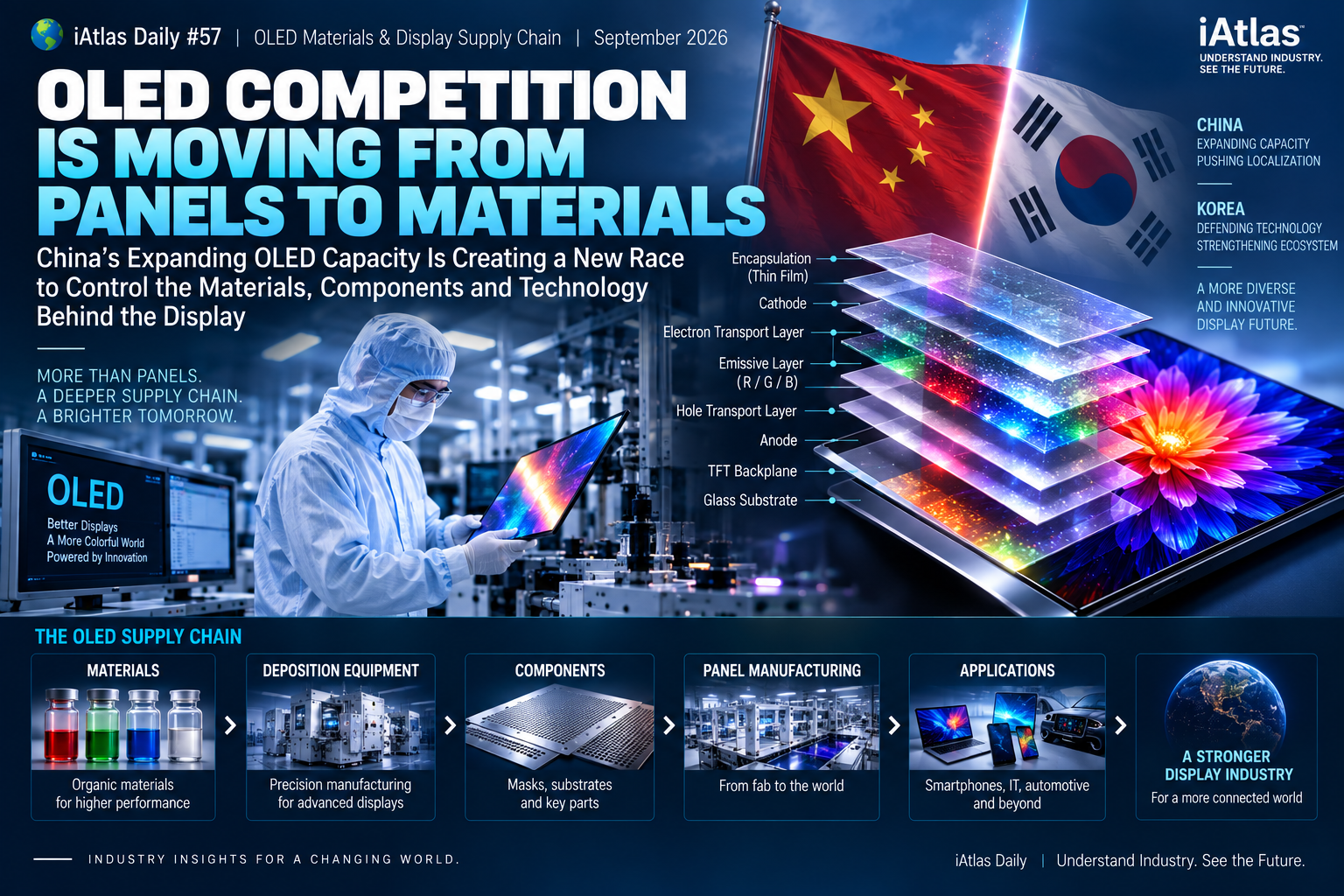
At a simplified level, an OLED device contains multiple functional layers.
Cathode
↓
Electron Injection / Transport Layers
↓
Emissive Layer
↓
Hole Transport / Injection Layers
↓
Anode
Each layer performs a different function.
And each depends on highly specialized materials.
The final display may be only millimeters thick.
But its performance depends on molecular-level engineering.
🔬 2. OLED Materials Determine Performance
OLED materials influence several of the characteristics consumers ultimately experience.
Brightness
How much light can the device generate?
Efficiency
How much electricity is required?
Lifetime
How quickly does the organic material degrade?
Color
How accurately can red, green and blue light be produced?
Thermal Stability
Can performance remain stable under operating conditions?
This means materials are not simply consumables.
They can determine the competitiveness of the panel itself.
🎨 3. The Emissive Layer Is Particularly Important
One of the most important parts of an OLED stack is the emissive layer.
A simplified structure may include:
Host Material
Dopant
↓
Light Emission
The host helps manage energy inside the emissive layer.
The dopant plays a critical role in determining emitted light and efficiency.
This creates specialized material markets around:
Red Emitters
Green Emitters
Blue Emitters
and the host materials supporting them.
The performance of these materials directly affects the display.
💡 4. Blue Remains One of OLED’s Hardest Problems
Not all OLED colors are equally easy to optimize.
Blue OLED materials have historically presented greater challenges around:
Lifetime
Efficiency
Stability
This is why next-generation blue-emitter technologies attract significant industry attention.
A breakthrough in blue OLED can potentially improve:
Power Consumption
↓
Brightness
↓
Panel Lifetime
↓
Overall Display Performance
Materials innovation can therefore change the economics of the entire panel.
🏭 5. China Has Already Built the Panel Capacity
The first stage of China’s OLED expansion focused heavily on fabs.
Companies including:
BOE
Visionox
TCL CSOT
Tianma
have invested aggressively in OLED manufacturing.
The newest phase is particularly important because the industry is moving toward larger substrates for IT OLED.
Gen 8.6/8.7 lines are designed to improve the economics of producing displays for:
Laptops
Tablets
Monitors
and potentially other larger applications.
Counterpoint says Gen 8.7 will account for 61% of total OLED equipment investment in 2026.
The capacity race is therefore well underway.
The question now becomes:
Who supplies those fabs?
🇨🇳 6. China Is Pushing OLED Localization Deeper
This is where the industry is beginning to change.
China’s broader manufacturing strategy increasingly emphasizes local supply chains.
OLED is no exception.
Universal Display executives said this month that there are local pressures in China to localize elements of the OLED supply chain, while arguing that the company expects to maintain a strong competitive position through its technology and intellectual-property portfolio.
That means China’s OLED strategy is evolving from:
Domestic Panel Manufacturing
toward:
Domestic Panel Manufacturing
Domestic Materials
Domestic Equipment
Domestic Components
The same upstream movement is appearing across multiple advanced industries.
🧬 7. But OLED Materials Are Difficult to Replace
Localizing an OLED material is not simply about producing a chemically similar molecule.
A material must perform consistently inside a production process.
That requires:
Purity
↓
Performance
↓
Stability
↓
Process Compatibility
↓
Qualification
↓
Mass Production
This creates a significant barrier.
Panel makers cannot easily switch critical materials if the change affects:
Yield
Lifetime
Color
or Reliability.
Qualification therefore becomes a competitive moat.
🧪 8. Purity Is Critical
Advanced electronic materials require extremely tight contamination control.
OLED materials are no exception.
Impurities can affect:
- emission performance
- electrical characteristics
- device lifetime
- manufacturing yield
This creates an entire industrial capability around:
Chemical Synthesis
↓
Purification
↓
Analysis
↓
Quality Control
↓
Customer Qualification
In other words, OLED material manufacturing is not simply chemistry.
It is high-purity industrial chemistry.
🏗️ 9. A New OLED Fab Creates an Entire Supplier Market
When a new OLED fab begins operation, the investment opportunity extends beyond the panel manufacturer.
A simplified ecosystem includes:
Materials
Organic emitters
Hosts
Transport materials
Encapsulation materials
Photoresists
Process chemicals
Equipment
Deposition
Etch
Cleaning
Inspection
Encapsulation
Components
Masks
Vacuum components
Precision motion systems
Sensors
Infrastructure
High-purity gases
Vacuum
Utilities
Cleanrooms
The real economic impact of a new OLED fab therefore spreads far beyond panel production.
⚙️ 10. Gen 8.6 Is Expanding the Equipment Opportunity
China’s expansion is also creating a major display-equipment investment cycle.
BOE and Samsung Display have already started Gen 8.7 IT OLED mass production, while Visionox and TCL CSOT are preparing alternative approaches including photo-patterning and inkjet-based technologies.
This creates multiple competing manufacturing architectures.
The industry is not simply asking:
Who has the largest fab?
It is also asking:
Which process architecture will deliver the best cost, yield and performance?
That decision affects the entire equipment and materials ecosystem.
🖨️ 11. Different OLED Processes Can Create Different Supply Chains
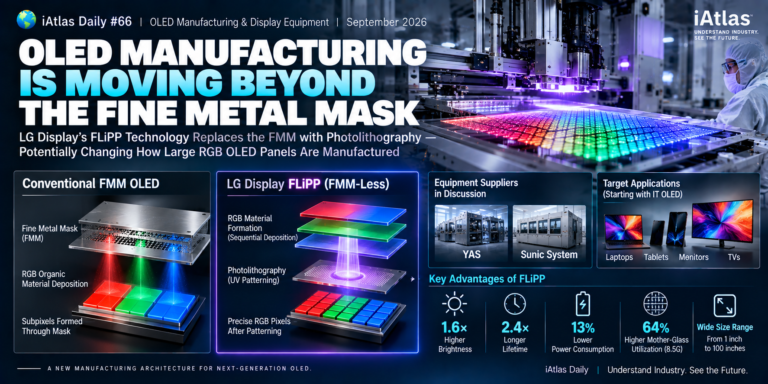
Traditional OLED manufacturing relies heavily on vacuum deposition and Fine Metal Masks.
A simplified process:
OLED Material
↓
Evaporation
↓
Fine Metal Mask
↓
Patterned Deposition
Alternative approaches are emerging.
For example:
Inkjet Printing
OLED material is deposited through printing.
Photolithographic Patterning
OLED structures are patterned using semiconductor-like techniques.
These technologies could change demand for:
Materials
Masks
Deposition Equipment
Patterning Equipment
Process Chemicals
So the technology race can reshape the supplier landscape.
🇰🇷 12. Korea Still Has an Important Ecosystem Advantage
Korea’s OLED strength is not based only on Samsung Display and LG Display.
Over many years, the country has built an ecosystem involving:
Materials
Equipment
Components
Process Engineering
Panel Manufacturing
This ecosystem creates accumulated manufacturing knowledge.
That is difficult to reproduce quickly.
Samsung Display is also continuing large-scale investment. A September agreement involving Samsung Display, local government, KEPCO and K-water outlined a phased KRW 67 trillion investment centered on Asan, including new OLED and next-generation display production infrastructure.
Korea therefore is not standing still while China expands.
🌏 13. The Competition Is Becoming Ecosystem vs Ecosystem
The old comparison looked like:
Samsung Display
vs.
BOE
But that comparison is becoming too simple.
The real competition increasingly looks like:
Korea
Materials
Equipment
Panel Makers
Process Technology
Customers
vs.
China
Materials
Equipment
Panel Makers
Process Technology
Domestic Market
The competitive unit is becoming:
The OLED Ecosystem
not merely the panel manufacturer.
🧠 14. Intellectual Property Is Another Layer
Materials competition is also tied closely to intellectual property.
Universal Display said it holds more than 7,000 patents globally and emphasized that this portfolio remains important to commercial OLED technology.
That adds another layer to the supply chain:
Material
↓
Manufacturing Process
↓
Patent
↓
License
↓
Panel
A country can manufacture a material locally while still depending on intellectual property developed elsewhere.
Localization therefore has several dimensions.
📍 15. Global Material Suppliers Are Moving Closer to Chinese Customers
Another interesting signal comes from Universal Display itself.
Rather than withdrawing from China as local competition increases, the company has expanded its presence.
It recently opened an applications laboratory and technology center in Chengdu, near BOE’s R&D operations, and has expanded its local organization.
This illustrates an important industrial pattern.
Localization does not necessarily mean:
Domestic Company Replaces Foreign Company
It can also mean:
Foreign Supplier Localizes Operations
↓
Closer Customer Collaboration
↓
Faster Qualification
↓
Stronger Local Ecosystem
Supply-chain localization can therefore increase competition while simultaneously attracting global suppliers.
🚗 16. OLED Is Expanding Beyond Smartphones
Another reason the materials opportunity matters is that OLED applications are broadening.
The industry is expanding toward:
Notebook PCs
Tablets
Monitors
Automotive Displays
Foldables
Large Displays
Universal Display recently highlighted IT and automotive applications as important longer-term OLED growth areas even while near-term smartphone demand remains challenging.
A larger application base means:
More Panel Area
↓
More OLED Production
↓
More Material Consumption
This increases the strategic importance of the materials supply chain.
🚘 17. China Is Already Gaining Ground in Automotive Displays
The broader display market shows how quickly industrial leadership can shift.
Omdia forecasts China-based panel makers will account for 65.2% of global automotive display shipments in the second half of 2026, compared with 28.1% in 2019.
Much of today’s automotive-display volume remains LCD.
But as OLED expands into vehicles, China’s existing automotive customer relationships and manufacturing scale could become important.
That gives Chinese suppliers another incentive to strengthen the OLED materials and technology ecosystem.
🔄 18. Localization Usually Moves Upstream
The pattern should look familiar.
First:
Panel Manufacturing
Then:
Equipment
Then:
Components
Then:
Materials
Eventually:
Raw Materials / IP / Core Technology
This is almost exactly the same industrial pattern we saw in semiconductor high-purity quartz.
Localization tends to move deeper over time.
🔗 19. Semiconductor and OLED Supply Chains Share a Pattern
Daily #54 examined semiconductor high-purity quartz.
The structure was:
Chip
↓
Equipment
↓
Quartz Component
↓
High-Purity Material
OLED follows a similar structure:
OLED Panel
↓
Deposition Equipment
↓
Process Component
↓
OLED Material
↓
High-Purity Chemical
Different industries.
Same industrial logic.
Once manufacturing capacity is localized, the next competition moves upstream.
🧩 Why This Matters
The OLED Materials Supply Chain is becoming more strategic for five reasons.
China is building enormous OLED manufacturing capacity.
New fabs create demand for materials, equipment and components.
Localization is moving upstream.
Chinese industrial policy increasingly targets the supply chain behind the panel.
Materials influence panel performance.
Efficiency, lifetime and color depend heavily on material technology.
Qualification creates barriers.
OLED materials cannot simply be replaced without extensive process validation.
Korea’s advantage is broader than panel capacity.
Its mature materials, equipment and manufacturing ecosystem remains an important competitive asset.
🔭 What to Watch
Chinese OLED Material Suppliers
Watch whether domestic suppliers gain qualification for more critical layers.
Blue OLED
Material breakthroughs could significantly alter power efficiency and panel performance.
Universal Display
Watch how global material leaders respond to increasing Chinese localization pressure.
Gen 8.6 / 8.7
BOE, Samsung Display, Visionox and TCL CSOT are creating a new manufacturing battlefield.
Inkjet Printing
CSOT’s strategy could alter the conventional OLED materials and equipment supply chain.
Photo-Patterned OLED
Visionox’s approach could create another competing manufacturing architecture.
Automotive OLED
China’s rapidly growing automotive-display position deserves particular attention.
🧭 iAtlas Insight
OLED competition is entering a deeper phase.
Building a panel fab is visible.
Building the industrial ecosystem behind it is much harder to see.
But that hidden ecosystem may ultimately determine competitiveness.
The real OLED manufacturing chain is:
High-Purity Chemicals
↓
OLED Materials
↓
Equipment & Components
↓
Process Technology
↓
Panel Manufacturing
↓
Device
China has already made substantial progress at the panel-manufacturing layer.
The next challenge is moving further upstream.
Korea, meanwhile, must defend not only its panel technology but the materials, equipment and manufacturing ecosystem accumulated over decades.
The next OLED race may not be decided on the display surface. It may be decided inside the materials and processes that make the display possible.
📚 Related Articles
📰 iAtlas Daily #35: China’s Gen 8.6 OLED Expansion Challenges Korea’s Display Leadership
🔗 References
Counterpoint Research — Gen 8.7 OLED Push Lifts Display Equipment CAPEX 57%
Omdia — China-Based Panel Makers to Capture 65% of Automotive Display Shipments
UBI Research — 2026 China OLED Supply Chain Management Analysis
About iAtlas
iAtlas is an independent publication covering batteries, semiconductors, OLED, advanced materials, AI, and global industrial trends.
We transform complex industrial developments into clear, reliable, and easy-to-understand insights.
Whether you’re following today’s industry news or building long-term expertise, iAtlas helps you understand not only what happened, but why it matters.
Technology creates change.
Insight creates opportunity.
— iAtlas