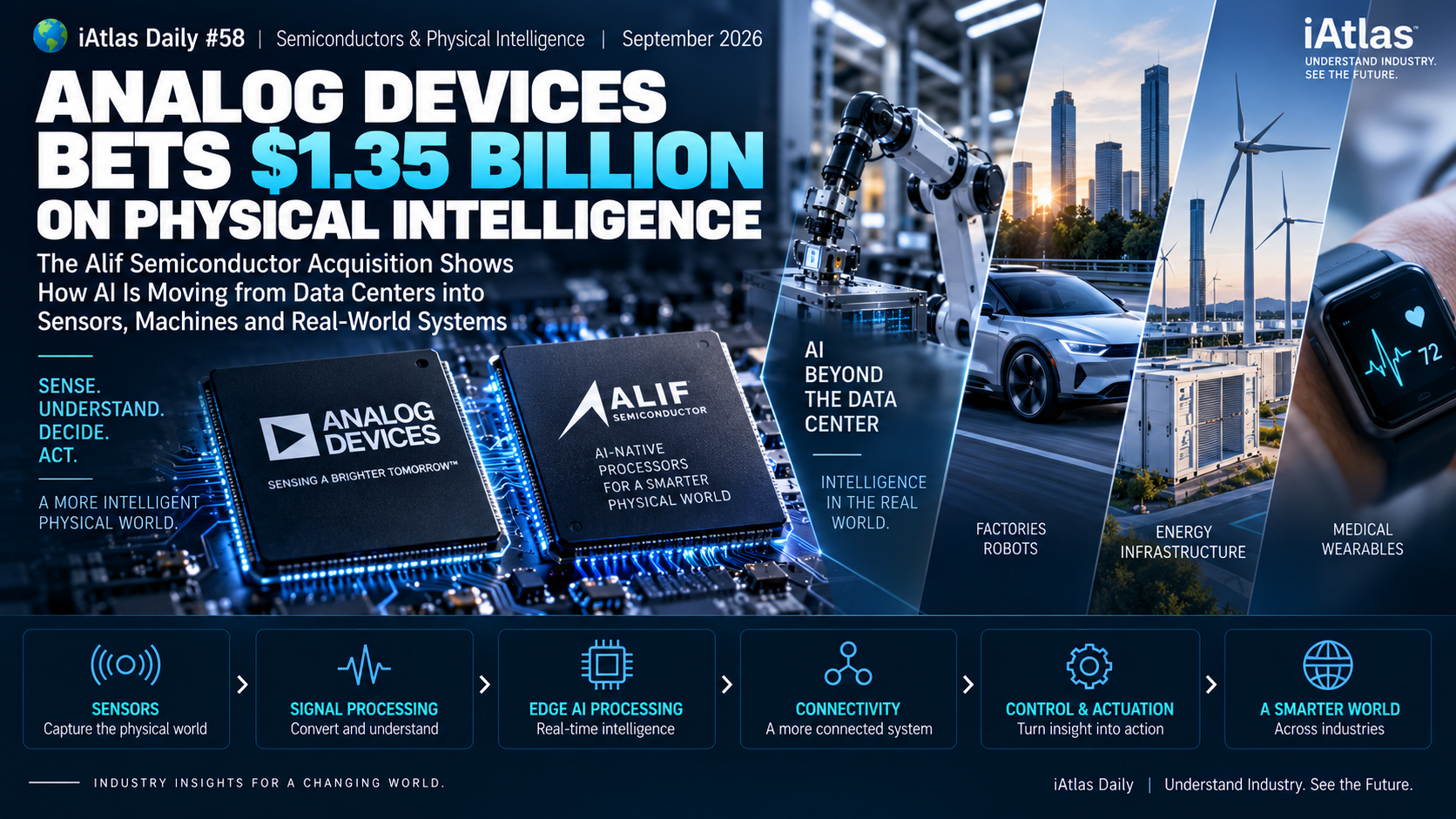
Analog Devices Bets $1.35 Billion on Physical Intelligence
The Alif Semiconductor Acquisition Shows How AI Is Moving from Data Centers into Sensors, Machines and Real-World Systems
🤖 iAtlas Daily #58 | Semiconductors & Physical Intelligence | September 2026
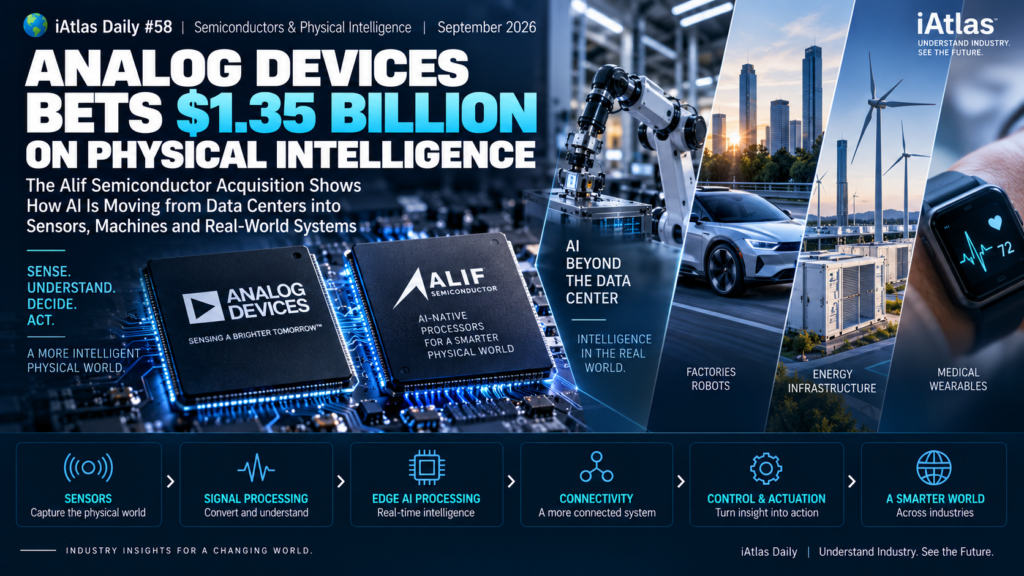
Artificial intelligence is beginning to move beyond the data center.
For much of the AI boom, the semiconductor industry’s attention has centered on:
GPUs
↓
HBM
↓
AI Servers
↓
Data Centers
But the next phase of AI could increasingly take place somewhere very different:
Factories
Robots
Vehicles
Energy Systems
Medical Devices
Wearables
On September 9, Analog Devices announced an agreement to acquire Alif Semiconductor for $1.35 billion in cash, bringing Alif’s AI-native microcontrollers and fusion processors together with ADI’s sensing, signal processing, power and connectivity technologies.
Analog Devices calls this emerging category:
Physical Intelligence
The idea is straightforward.
Instead of sending every signal to the cloud, machines can increasingly:
Sense
↓
Understand
↓
Decide
↓
Act
locally and in real time.
The next AI semiconductor opportunity may not only be inside the data center. It may be inside the machines interacting with the physical world.
🤖 The Big Story
Analog Devices and Alif Semiconductor have entered into a definitive acquisition agreement.
Under the agreement:
$1.35 Billion
will be paid upfront in cash.
ADI may also pay:
Up to $200 Million
in additional contingent consideration.
The boards of both companies have approved the transaction, which is expected to close before the end of 2026, subject to customary conditions and regulatory review.
But the strategic logic is more interesting than the transaction price.
ADI already has strong positions across:
Sensing
Signal Processing
Power Management
Connectivity
Industrial Systems
Alif adds:
AI-Native Microcontrollers
Fusion Processors
Integrated NPUs
Edge AI Processing
Sensor Fusion
Together, the companies want to build systems capable of interpreting the physical world locally.
🧠 1. What Is Physical Intelligence?
Generative AI primarily operates in the digital world.
It processes:
Text
Images
Audio
Video
Physical systems operate differently.
A robot or industrial machine may need to interpret:
Motion
Temperature
Pressure
Sound
Vibration
Radio Signals
Position
and other real-world signals.
ADI describes Physical Intelligence as enabling systems to sense, reason and act locally in real time.
The basic architecture becomes:
Physical World
↓
Sensor
↓
Signal Processing
↓
AI Processor
↓
Decision
↓
Actuator
↓
Physical World
AI becomes part of a closed physical loop.
📡 2. Everything Begins with a Sensor
AI cannot understand the physical world directly.
It first needs data.
That is where sensors become important.
Consider an industrial motor.
Sensors may measure:
Vibration
Temperature
Current
Sound
Those signals can reveal whether the motor is operating normally.
The traditional model might send the information elsewhere for analysis.
An intelligent edge system can increasingly process it locally.
Motor
↓
Sensor
↓
Analog Signal
↓
Signal Processing
↓
AI Inference
↓
Maintenance Decision
This is one reason Analog Devices is strategically interesting in the Physical AI market.
Its existing technologies sit very close to the physical world.
🔄 3. The Analog-to-Digital Boundary Becomes Strategic
The real world is largely analog.
Temperature does not naturally exist as digital bits.
Neither do:
- pressure
- vibration
- light
- sound
- magnetic fields
Sensors convert physical phenomena into electrical signals.
Those signals then need to be conditioned, converted and interpreted.
The chain looks like:
Physical Signal
↓
Sensor
↓
Analog Front End
↓
ADC
↓
Digital Processing
↓
AI
This boundary between the physical and digital worlds has been a core market for Analog Devices for decades.
Adding AI processing deeper into that chain expands what the system can do locally.
🧩 4. Why Alif Semiconductor?
Alif specializes in highly power-efficient processors designed for edge AI.
Its products combine technologies including:
Microcontroller Cores
Neural Processing Units
Graphics
Connectivity
Security
Power Management
Alif’s heterogeneous architecture is designed to assign different workloads to the most appropriate computing resources.
That matters at the edge because there are strict limits on:
Power
Heat
Memory
Latency
A factory sensor cannot necessarily use a 1,000-watt AI accelerator.
It needs a very different type of semiconductor.
⚡ 5. Edge AI Has a Different Power Problem
Data-center AI is largely about maximizing computational performance within massive infrastructure.
Edge AI often has the opposite constraint.
The device may need to operate with:
A Few Watts
or even:
Milliwatts
The optimization target changes.
Data Center AI
Maximum compute density.
Edge AI
Maximum intelligence per watt.
This requires different processor architectures.
The semiconductor opportunity therefore expands beyond high-performance GPUs.
⏱️ 6. Latency Can Make Cloud AI Impractical
Consider an industrial robot.
A sensor detects an obstacle.
If the robot needs to:
Send Data to Cloud
↓
Wait for Processing
↓
Receive Response
↓
Stop
the delay may be unacceptable.
Instead:
Sensor
↓
Local AI
↓
Immediate Decision
↓
Robot Stops
Edge processing can reduce latency dramatically.
For systems interacting with humans or moving machinery, milliseconds can matter.
🔐 7. Local AI Can Also Improve Privacy and Security
Sending every sensor signal to the cloud is not always desirable.
Industrial systems may handle:
Proprietary Process Data
Machine Information
Sensitive Audio
Health Data
Security Information
On-device processing can allow some information to remain local.
Instead of:
Raw Data → Cloud
the system can perform:
Raw Data → Local AI → Result
and transmit only the necessary information.
This can reduce bandwidth requirements and potentially improve privacy.
🏭 8. Industrial Automation Is a Natural Market
Factories already contain enormous numbers of sensors and controllers.
Traditional industrial automation often follows:
Sensor
↓
PLC / Controller
↓
Rule-Based Logic
↓
Machine
Physical Intelligence introduces another layer:
Sensor
↓
Signal Processing
↓
AI
↓
Adaptive Decision
↓
Machine
Possible applications include:
Predictive Maintenance
Machine Vision
Anomaly Detection
Quality Inspection
Motion Control
Robotics
This makes industrial automation one of the clearest potential markets for edge AI.
🤖 9. Robotics Could Be One of the Biggest Opportunities
Robots need to interpret multiple forms of information simultaneously.
For example:
Camera
Force Sensor
Position Sensor
Microphone
Motion Sensor
↓
Sensor Fusion
↓
AI Decision
↓
Movement
Alif’s processors are specifically designed to support sensor fusion and low-latency inference. ADI lists robotics among the markets where the acquisition could expand its opportunity.
The semiconductor architecture inside robots could therefore become increasingly sophisticated.
🚗 10. Vehicles Are Another Physical AI Platform
Modern vehicles already contain:
Cameras
Radar
Ultrasonic Sensors
IMUs
Battery Sensors
Temperature Sensors
Audio Systems
As vehicles become more intelligent, more processing moves closer to these sensors.
The architecture becomes:
Sensor
↓
Edge Processor
↓
Vehicle Decision
rather than sending critical decisions to remote cloud infrastructure.
This is another reason low-power AI processing matters.
⚡ 11. Energy Systems Can Become Intelligent at the Edge
ADI also identified energy as one of the addressable markets expanded by the Alif acquisition.
Modern energy infrastructure contains increasingly distributed equipment:
Solar Inverters
Battery Systems
Transformers
Motors
Charging Infrastructure
Grid Equipment
Each generates data.
Edge intelligence could allow equipment to monitor:
Temperature
Vibration
Electrical Signals
Operating Conditions
and react locally.
That creates another connection between semiconductors and physical infrastructure.
🏥 12. AI Is Moving into Medical and Wearable Devices
The acquisition also targets digital health and wearables.
These devices face particularly strict constraints.
They often require:
Low Power
Small Size
Privacy
Real-Time Processing
Consider a wearable health device.
Biological Signal
↓
Sensor
↓
Signal Processing
↓
On-Device AI
↓
Health Insight
If more analysis happens locally, devices may become more capable without constantly communicating with the cloud.
☁️ 13. Edge AI Does Not Replace the Cloud
This distinction is important.
The future is unlikely to be:
Cloud AI
or
Edge AI
Instead:
Cloud AI + Edge AI
The cloud remains ideal for:
- training large models
- massive-scale inference
- centralized analytics
- complex workloads
The edge is useful for:
- immediate response
- low power
- privacy
- offline operation
- sensor processing
The architecture becomes distributed.
Cloud
↕️
Edge
↕️
Physical World
Intelligence moves across multiple layers.
🧠 14. The AI Semiconductor Market Is Fragmenting
The first phase of the AI semiconductor boom was heavily concentrated around accelerators.
The next phase is becoming more diverse.
Cloud AI
GPU
AI Accelerator
HBM
Edge AI
MCU
NPU
Sensor Processor
Physical AI
Sensor
Signal Processor
AI Processor
Power Management
Connectivity
The addressable semiconductor ecosystem becomes much broader.
🔬 15. Analog Semiconductors Become Relevant to AI
This is perhaps the most interesting implication of the deal.
AI is usually associated with digital processors.
But once AI interacts with the physical world, analog technologies become critical.
The real chain is:
Physical World
↓
Analog
↓
Data Conversion
↓
Digital
↓
AI
↓
Analog / Control
↓
Physical Action
The analog and digital worlds begin to converge.
This is precisely where ADI believes it has an advantage.
💰 16. The Acquisition Is Part of a Broader ADI Strategy
The Alif deal does not stand alone.
Earlier in 2026, Analog Devices agreed to acquire Empower Semiconductor for $1.5 billion, strengthening its position in high-density power delivery for AI compute. That transaction was completed in July.
Taken together, the moves point toward two sides of the AI market:
AI Infrastructure
Power Delivery → Data Center Compute
and
Physical Intelligence
Sensor → Edge Processing → Machine
ADI is positioning itself at both ends.
📈 17. The Addressable Market Becomes Much Larger
ADI says the Alif acquisition expands its addressable opportunities across:
Industrial
Data Center Infrastructure
Defense
Energy
Robotics
Digital Health
Wearables.
This demonstrates how broad Physical AI could become.
It is not a single product category.
It is a computing layer that can be embedded into many existing industries.
🧱 18. Physical AI Creates Another Industrial Supply Chain
Once AI moves into machines, demand spreads through another ecosystem.
Sensors
↓
Analog Semiconductors
↓
MCUs / NPUs
↓
Connectivity
↓
Power Electronics
↓
Motors & Actuators
↓
Robots / Machines
↓
Industrial Systems
This is fundamentally different from the data-center supply chain.
It creates opportunities for companies that may not traditionally be viewed as AI leaders.
🔄 19. AI Is Moving from Centralized to Distributed Intelligence
The first AI boom concentrated intelligence inside enormous data centers.
The next phase could distribute it across billions of devices.
Think of:
Factory Machines
Robots
Cars
Medical Devices
Energy Equipment
Wearables
Each device may contain relatively modest AI compute.
But collectively, the market could become enormous.
This creates a different scaling model:
Cloud AI
Few locations × enormous compute
Physical AI
Huge number of devices × smaller compute
Both can coexist.
🧩 Why This Matters
The Analog Devices–Alif acquisition reveals several important semiconductor trends.
AI is expanding beyond data centers.
Industrial machines, robots and energy systems are becoming AI platforms.
Sensors are becoming strategically important.
AI needs a way to understand the physical world.
Analog and digital technologies are converging.
Physical intelligence requires both.
Power efficiency matters.
Edge AI cannot rely on the same architectures as hyperscale AI.
Semiconductor opportunities are broadening.
The AI market increasingly extends from GPUs into MCUs, NPUs, sensors, connectivity and power management.
🔭 What to Watch
Transaction Closing
The deal is expected to close before the end of 2026, subject to regulatory and other customary conditions.
Industrial Edge AI
Watch whether predictive maintenance and machine intelligence become mainstream factory applications.
Robotics
Sensor fusion and local inference could become increasingly important as robotics expands.
Low-Power NPUs
Efficiency may become the defining competitive metric for edge processors.
Sensor Fusion
Combining multiple physical signals could become one of the most important capabilities in Physical AI.
Analog Semiconductor M&A
More acquisitions may follow as traditional analog companies build AI-processing capabilities.
Cloud-to-Edge Architecture
Watch how AI workloads divide between centralized infrastructure and local devices.
🧭 iAtlas Insight
The first AI semiconductor race was about processing digital information faster.
The next race may be about understanding the physical world.
That changes the semiconductor stack.
A robot does not only need an AI processor.
It needs:
Sensors
↓
Signal Processing
↓
AI Compute
↓
Connectivity
↓
Power
↓
Control
↓
Actuation
The acquisition of Alif Semiconductor gives Analog Devices another piece of that system.
And it highlights a broader shift.
AI is moving from:
Understanding Information
toward:
Understanding the World
and eventually:
Acting in the World.
The next frontier of AI may not be another data center. It may be the machine standing on the factory floor.
📚 Related Articles
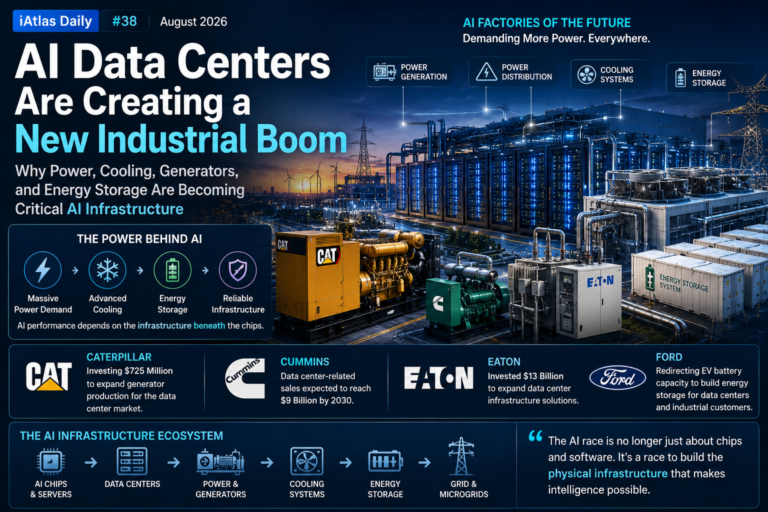
📰 iAtlas Daily #38: AI Data Centers Are Creating a New Industrial Equipment Boom
How AI data centers are expanding demand for power, cooling and industrial equipment.
📰 iAtlas Daily #10: TSMC Advanced Packaging Expansion Signals the Next AI Boom
Why AI compute demand is driving another manufacturing bottleneck upstream.
🔗 References
Analog Devices — Official Alif Semiconductor Acquisition Announcement
Reuters — Analog Devices to Buy Alif Semiconductor for $1.35 Billion
About iAtlas
iAtlas is an independent publication covering batteries, semiconductors, OLED, advanced materials, AI, and global industrial trends.
We transform complex industrial developments into clear, reliable, and easy-to-understand insights.
Whether you’re following today’s industry news or building long-term expertise, iAtlas helps you understand not only what happened, but why it matters.
Technology creates change.
Insight creates opportunity.
— iAtlas