Battery Electrolyte Explained: How It Works | iAtlas
🔋 iAtlas Battery #6 | 🧪 Materials → 💧 Electrolyte
Battery Electrolyte at a Glance
A battery electrolyte is the medium that allows lithium ions to move between the cathode and anode while preventing electrons from flowing directly inside the battery. Electrolytes are essential for battery performance, charging speed, cycle life, and safety.
Table of Contents
- What Is a Battery Electrolyte?
- How Electrolytes Work
- Main Components
- Why Moisture Is Dangerous
- Future Electrolyte Technologies
- Key Figures
- Frequently Asked Questions
Introduction
Although the electrolyte occupies only a portion of a lithium-ion battery, it plays an essential role in enabling electrochemical reactions.
Without a battery electrolyte, lithium ions could not travel between the cathode and anode, making charging and discharging impossible.
Modern lithium-ion batteries rely on carefully engineered electrolyte formulations that balance conductivity, safety, chemical stability, and long-term durability.
What Is a Battery Electrolyte?
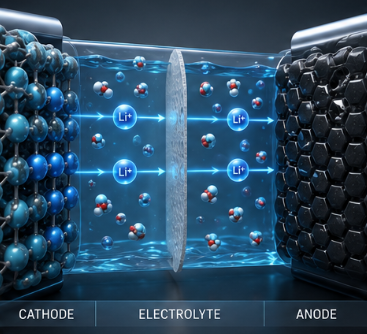
A battery electrolyte is an ion-conducting medium located between the cathode and anode.
Unlike metals, which conduct electrons, the electrolyte transports only lithium ions while blocking electron flow.
This separation allows electrical energy to be delivered through the external circuit instead of inside the battery.
How Electrolytes Work
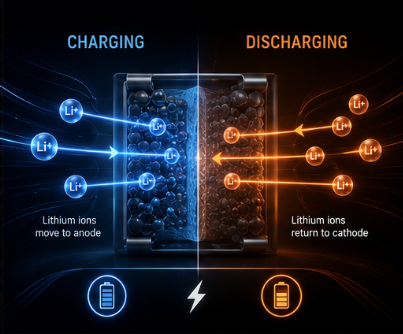
During charging:
- Lithium ions leave the cathode.
- The electrolyte transports the ions.
- Lithium ions are stored in the anode.
During discharge:
- Lithium ions return to the cathode.
- Electrons flow through the external circuit.
- Electrical energy powers external devices.
The electrolyte acts as the highway that enables this continuous ion movement.
Main Components of Battery Electrolytes
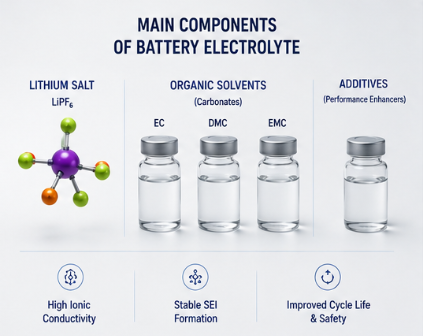
Commercial lithium-ion battery electrolytes typically consist of three major components.
Lithium Salt
The most common lithium salt is LiPF₆ (Lithium Hexafluorophosphate) because it provides high ionic conductivity and stable battery performance.
Other lithium salts include:
- LiBF₄
- LiFSI
- LiTFSI
Organic Solvents
The lithium salt is dissolved in a mixture of organic carbonate solvents such as:
- Ethylene Carbonate (EC)
- Dimethyl Carbonate (DMC)
- Ethyl Methyl Carbonate (EMC)
- Diethyl Carbonate (DEC)
These solvents provide the medium through which lithium ions travel.
Electrolyte Additives
Small quantities of additives improve battery performance by enhancing:
- SEI formation
- High-voltage stability
- Fast charging
- Cycle life
- Thermal stability
Why Moisture Is Dangerous
Electrolytes are extremely sensitive to moisture.
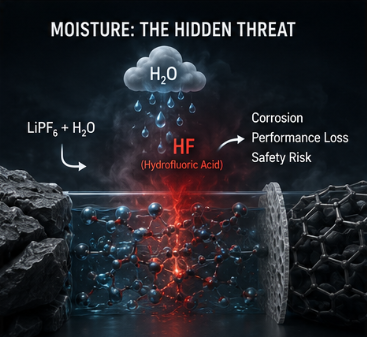
Even trace amounts of water can react with lithium salts such as LiPF₆ to generate hydrofluoric acid (HF).
Potential consequences include:
- Reduced battery performance
- Corrosion of internal components
- Lower cycle life
- Increased safety risks
For this reason, electrolyte filling is performed in ultra-dry manufacturing environments.
Future Electrolyte Technologies
Researchers continue developing advanced electrolyte technologies.
Examples include:
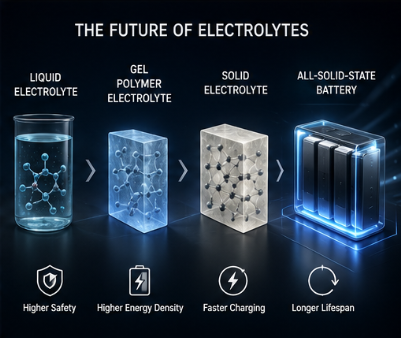
- Solid electrolytes
- Gel polymer electrolytes
- Flame-retardant electrolytes
- High-voltage electrolytes
- Localized high-concentration electrolytes
These technologies aim to improve battery safety while enabling higher energy density and faster charging.
Key Figures
| Property | Typical Liquid Electrolyte |
|---|---|
| Lithium Salt | LiPF₆ |
| Ion Transport | Lithium ions |
| Electron Conductivity | None |
| Moisture Sensitivity | Very High |
| Operating Voltage | Up to ~4.5 V |
| Main Function | Ion Transport |
Frequently Asked Questions
What does a battery electrolyte do?
It transports lithium ions between the cathode and anode while preventing electrons from flowing inside the battery.
Why can’t electrons pass through the electrolyte?
The electrolyte is designed to conduct ions rather than electrons, forcing electrons to travel through the external circuit and power the device.
Why is moisture harmful?
Moisture reacts with lithium salts to form hydrofluoric acid (HF), which damages battery components and reduces performance.
Will solid electrolytes replace liquid electrolytes?
Solid electrolytes are considered one of the most promising future technologies, but liquid electrolytes remain the commercial standard today.
Key Takeaways
- Battery electrolytes enable lithium-ion transport.
- LiPF₆ is the most widely used lithium salt.
- Organic solvents determine ionic conductivity.
- Moisture control is critical for battery manufacturing.
- Future batteries may adopt solid electrolytes for improved safety.
🎓 Battery Learning Path
🧪 Materials
✅🔋 iAtlas Battery #4 — Cathode
✅🔋 iAtlas Battery #5 — Anode
📍🔋 iAtlas Battery #6 — Electrolyte (Current)
▶ 🔋 iAtlas Battery #7 — Separator
Next Learning Path: 🔋 Cell Design
📖 Continue Reading
⬅ Previous Article
🔋 iAtlas Battery #5
Anode Materials Explained: Graphite, Silicon, and Beyond
Learn how anode materials influence charging speed, battery capacity, and long-term durability.
➡ Next Article
🔋 iAtlas Battery #7
Battery Separator Explained: The Safety Barrier Inside Lithium-ion Batteries
Discover why separators are one of the most important safety components inside every lithium-ion battery. improve battery safety and performance.
References
- International Energy Agency (IEA)
- U.S. Department of Energy – Vehicle Technologies Office
- Battery University
- Nature Energy (Battery Manufacturing Research)
About iAtlas
iAtlas is an independent publication covering batteries, semiconductors, OLED, advanced materials, AI, and global industrial trends.
We transform complex industrial developments into clear, reliable, and easy-to-understand insights.
Whether you’re following today’s industry news or building long-term expertise, iAtlas helps you understand not only what happened, but why it matters.
Technology creates change.
Insight creates opportunity.
— iAtlas