
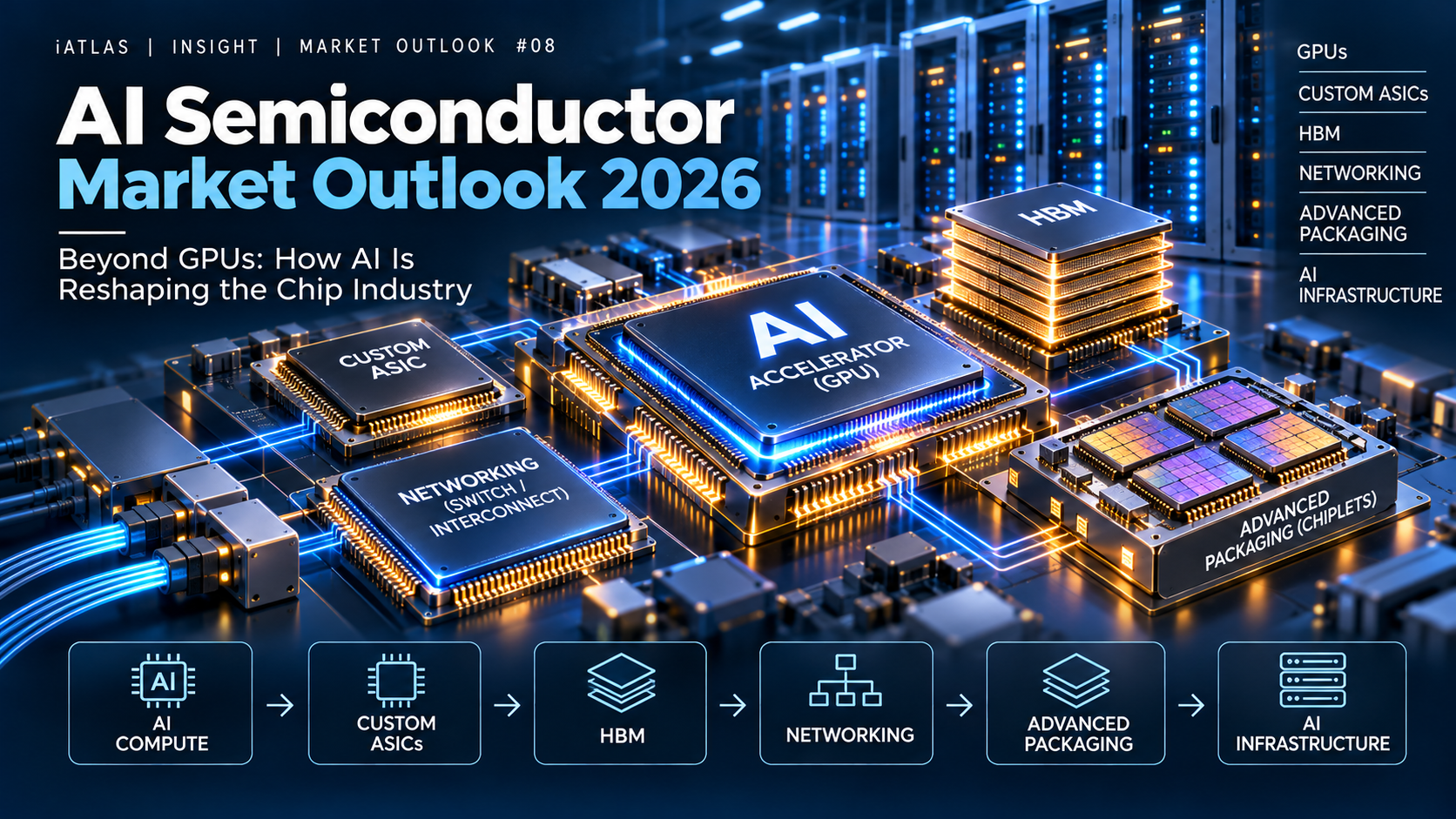
AI Semiconductor Market Outlook 2026
Beyond GPUs: How AI Is Reshaping the Chip Industry
iAtlas | Insight | Market Outlook #08
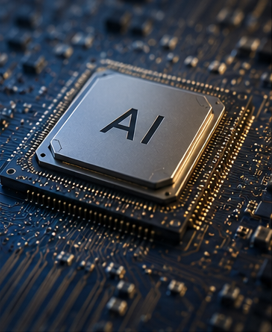
The AI semiconductor market outlook for 2026 shows that the AI chip industry is rapidly expanding beyond GPUs.
The first phase of generative AI was largely defined by one question:
How many AI accelerators can data centers obtain?
That question still matters.
But today’s AI infrastructure requires far more than a single type of processor.
Modern AI systems depend on an increasingly complex semiconductor stack that includes:
AI Accelerators
CPUs
Custom ASICs
HBM
Networking Chips
DPUs
Storage Controllers
Power Semiconductors
Advanced Packaging
The Semiconductor Industry Association and Deloitte estimate that a leading AI server rack contains more than 4,500 packaged chips, representing roughly 95% of the rack’s content value.
Their 2026 study estimates that annual semiconductor revenue associated with AI data centers could exceed $1.2 trillion by 2028 if current infrastructure expansion continues.
The AI semiconductor opportunity is therefore becoming much larger than the GPU market.
AI is beginning to reshape the architecture, manufacturing and economics of the entire semiconductor industry.
Key Takeaways
- AI semiconductor demand is expanding from GPUs into custom accelerators, CPUs, memory, networking, storage, power and foundational chips.
- A modern AI server rack can contain more than 4,500 packaged semiconductors and around 20,000 individual dies.
- NVIDIA’s Vera Rubin platform demonstrates the transition from individual GPUs toward rack-scale AI systems built from multiple specialized processors.
- Custom AI accelerators are becoming a major market: Broadcom reported $16.7 billion of AI semiconductor revenue in fiscal Q3 2026, up 221% year over year.
- AMD’s MI400 generation shows that competition is increasingly occurring at the rack and system level, not only between individual GPUs.
- HBM, advanced packaging and leading-edge foundry capacity remain critical bottlenecks.
- Networking is becoming part of the AI-compute architecture as clusters scale from thousands toward much larger numbers of accelerators.
- AI-driven investment is supporting record semiconductor-equipment spending, forecast by SEMI at approximately $165.9 billion in 2026.
- The competitive battlefield is shifting from chip performance toward complete AI-system performance per watt and per dollar.
1. AI Is Driving an Extraordinary Semiconductor Cycle
The broader semiconductor market is already experiencing exceptional growth.
Global semiconductor sales reached $159.7 billion in August 2026, according to the Semiconductor Industry Association.
Cumulative sales through August surpassed $1 trillion for the first time, and SIA projects worldwide semiconductor sales to exceed $1.6 trillion in 2026.
AI is not the only source of semiconductor demand.
Automotive, industrial electronics, communications, smartphones and other applications remain important.
But AI has become one of the strongest incremental growth engines.
The reason is relatively simple.
AI requires enormous amounts of computing infrastructure.
And almost every layer of that infrastructure contains semiconductors.
The value chain therefore begins with AI models but quickly expands outward:
More AI Models
↓
More Training & Inference
↓
More Data Centers
↓
More Semiconductor Content
↓
More Manufacturing Investment
AI is becoming an infrastructure-driven semiconductor cycle.
2. The AI Chip Market Is Much Bigger Than GPUs
GPUs became the symbol of the generative-AI boom because they are exceptionally well suited to highly parallel workloads.
But a GPU cannot operate by itself.
A modern AI server requires multiple semiconductor categories.
The SIA-Deloitte study divides AI infrastructure into several major chip groups.
Advanced Logic
- GPUs
- AI accelerators
- ASICs
- CPUs
- FPGAs
- DPUs
- Networking processors
Memory
- HBM
- DRAM
- SRAM
- NAND
Analog & Foundational Chips
- Power-management devices
- Controllers
- Transceivers
- Sensors
- Other support ICs
A single AI rack can contain more than 4,500 packaged chips and approximately 20,000 individual semiconductor dies.
This fundamentally changes how the AI semiconductor market should be viewed.
The market is not:
AI = GPU
It is increasingly:
AI = Complete Semiconductor System
3. NVIDIA Is Moving From GPUs to AI Platforms
NVIDIA remains the dominant reference point for AI computing.
But even NVIDIA’s own product strategy demonstrates that the market is moving beyond individual GPUs.
Its Vera Rubin platform entered full production in 2026.
Rather than being one processor, Vera Rubin combines several specialized chips:
- Rubin GPU
- Vera CPU
- NVLink 6 switch
- ConnectX-9 SuperNIC
- BlueField-4 DPU
- Spectrum-6 Ethernet switch
- Additional inference acceleration
NVIDIA describes these components as one integrated AI-computing platform designed for training, post-training and agentic inference.
That architecture illustrates a major change.
The competitive unit is increasingly shifting from:
GPU
to:
Rack
and eventually:
AI Factory
NVIDIA said in May 2026 that Vera Rubin was ramping into full production across a global ecosystem of server and manufacturing partners.
The implication is significant.
Winning the AI semiconductor market increasingly requires control over multiple layers of the system.
4. AMD Is Competing at the Rack Scale
AMD is following a similar direction.
Its MI400 generation expands competition beyond discrete accelerators toward complete rack-scale AI infrastructure.
The AMD Instinct MI455X includes up to 432 GB of HBM4 and up to 23.3 TB/s of theoretical memory bandwidth.
AMD’s Helios architecture combines 72 MI455X GPUs into a rack-scale system designed for large AI workloads.
The company announced production deployment of its Helios platform in 2026 as part of a broader strategy spanning:
- AI accelerators
- CPUs
- Networking
- Software
- Rack-scale infrastructure
AMD also emphasizes open standards including UALink, UEC and OCP-based infrastructure.
This creates another dimension of competition.
Future customers may evaluate not simply:
Which GPU is fastest?
but:
Which complete platform provides the best performance, energy efficiency, software compatibility and total cost of ownership?
AI semiconductor competition is moving upward from components toward systems.
5. Custom AI Accelerators Are Becoming a Major Market
GPUs offer enormous flexibility.
But not every AI workload needs a general-purpose accelerator.
Hyperscale cloud companies operate enormous computing fleets.
At that scale, designing custom silicon can create substantial benefits.
A custom ASIC can be optimized around specific workloads, potentially improving:
- Performance
- Power efficiency
- Cost
- Memory architecture
- Networking
- Data-center utilization
This is becoming one of the most important changes in the AI semiconductor market.
Broadcom reported $16.7 billion in AI semiconductor revenue during fiscal Q3 2026, representing 221% year-over-year growth.
The company said demand for both custom AI accelerators and networking remained very strong and forecast approximately $21.7 billion in AI semiconductor revenue for the following quarter.
This demonstrates that AI infrastructure is creating a large market outside merchant GPUs.
The future could increasingly involve two parallel models:
Merchant Accelerators
Broad platforms sold to many customers.
Custom Accelerators
Silicon optimized for individual hyperscalers or specific workloads.
Both markets can grow simultaneously.
6. Training and Inference Create Different Chip Requirements
The first generative-AI investment wave focused heavily on training.
Training large foundation models requires enormous clusters of high-performance accelerators.
But the AI market is increasingly expanding toward inference.
Inference occurs whenever a trained AI model actually answers a question, analyzes an image, writes code or performs another task.
As AI adoption spreads, inference workloads can become enormous.
This changes semiconductor requirements.
Training generally emphasizes:
- Maximum performance
- Large-scale parallel computing
- Massive memory bandwidth
Inference may place greater emphasis on:
- Cost per token
- Energy efficiency
- Latency
- Utilization
- Workload specialization
Agentic AI creates another layer.
Systems may execute many internal reasoning, tool and verification steps before producing a final result.
NVIDIA specifically positions Vera Rubin around training, post-training, test-time scaling and agentic inference.
This could expand the addressable market for increasingly specialized accelerators.
7. HBM Has Become Part of the Compute Architecture
As covered in Market Outlook #06, HBM is one of the clearest examples of AI reshaping another semiconductor category.
AI processors need enormous quantities of data.
Compute performance becomes less useful if memory cannot supply that data quickly enough.
HBM addresses this problem by placing vertically stacked memory extremely close to the accelerator.
The relationship becomes:
More AI Compute
↓
More Memory Bandwidth
↓
More HBM
↓
More Advanced DRAM Capacity
↓
More Advanced Packaging
HBM is therefore no longer simply a memory product.
It has become part of the architecture of the AI accelerator itself.
This also means accelerator growth directly influences memory investment.
SEMI expects memory-related equipment spending to grow strongly through 2028, driven by HBM and advanced DRAM requirements.
8. Advanced Packaging Is Becoming a Critical Bottleneck
AI processors are becoming too complex to treat packaging as a simple final assembly step.
A high-performance AI package can combine:
GPU / ASIC
Multiple HBM Stacks
Chiplets
High-Density Interconnects
Advanced Substrate
The package itself becomes part of system performance.
As discussed in Market Outlook #07, technologies such as:
- CoWoS
- 2.5D integration
- 3D stacking
- Hybrid bonding
- Chiplets
are becoming strategically important.
SEMI forecasts assembly and packaging equipment sales to rise to approximately $6.7 billion in 2026, with continued expansion through 2028 as AI and HBM devices become more complex.
AI semiconductor supply can therefore be constrained even when enough processor wafers exist.
Packaging capacity, HBM availability and substrate supply must all scale together.
9. Networking Is Becoming Part of AI Compute
Traditional data centers connected large numbers of relatively independent servers.
AI clusters behave differently.
Thousands of accelerators often need to work on one computing problem simultaneously.
This requires enormous amounts of communication between chips.
Networking therefore becomes part of the computing architecture.
NVIDIA’s Vera Rubin platform includes:
- NVLink switching
- ConnectX networking
- Spectrum Ethernet
- BlueField DPUs
alongside CPUs and GPUs.
Broadcom’s AI semiconductor growth similarly combines custom accelerators with networking demand.
This creates another semiconductor growth chain:
More AI Accelerators
↓
Larger Clusters
↓
More Network Bandwidth
↓
More Switch Silicon
↓
More Optical Connectivity
↓
More Networking Semiconductors
As AI systems scale, moving data between processors becomes almost as important as processing the data itself.
10. Optics Could Become the Next Semiconductor Bottleneck
Electrical connections work extremely well over short distances.
But as AI clusters grow, sending enormous quantities of data electrically becomes increasingly power intensive.
This is increasing interest in:
Silicon Photonics
and
Co-Packaged Optics
NVIDIA’s 2026 Vera Rubin platform includes Spectrum-X Ethernet Photonics as part of its infrastructure roadmap.
SEMI likewise identifies co-packaged optics and photonic integration as important technologies for scaling future AI systems.
The AI semiconductor stack could therefore continue expanding:
Compute
↓
Memory
↓
Networking
↓
Optics
Future AI systems may depend increasingly on the integration of electronic and photonic technologies.
11. Power Is Becoming a Semiconductor Problem
AI data centers consume enormous amounts of electricity.
But before that electricity reaches the accelerator, it passes through multiple power-conversion and management stages.
A modern AI rack requires semiconductor devices for:
- Voltage regulation
- Power conversion
- Current control
- Power distribution
- Protection
- Monitoring
The SIA-Deloitte study emphasizes that AI racks contain not only advanced logic and memory but also large numbers of analog and foundational semiconductors, including power chips, controllers and transceivers.
This creates an important insight.
The AI boom can benefit semiconductor categories that receive much less attention than GPUs.
A processor may be the most expensive chip.
But an AI system cannot function without hundreds or thousands of supporting devices.
12. Leading-Edge Foundry Capacity Remains Essential
The strongest AI accelerators require the world’s most advanced manufacturing processes.
That places leading-edge foundry capacity at the center of AI infrastructure.
TSMC reported that 2 nm already represented 8% of wafer revenue in Q3 2026, while 3 nm represented 33%.
The company said it continues to hold strong conviction in the AI megatrend and is expanding capacity at an unprecedented pace.
In October 2026, TSMC said nearly 20 fabs worldwide were in progress and announced additional 3 nm expansion to support multiyear customer demand.
This shows how AI demand propagates into manufacturing.
More AI Accelerators
↓
More Leading-Edge Wafers
↓
More Fab Capacity
↓
More Semiconductor Equipment
↓
More Materials
The semiconductor capital-investment cycle extends far beyond chip designers.
13. AI Is Driving Record Equipment Investment
SEMI expects global semiconductor manufacturing equipment sales to reach approximately $165.9 billion in 2026, up 23.2% year over year.
The organization expects continued growth toward approximately $229.5 billion by 2028.
Several AI-related markets are contributing simultaneously:
Leading-Edge Logic
Accelerators and high-performance processors.
Advanced Memory
HBM and server DRAM.
Advanced Packaging
Chiplets and heterogeneous integration.
Testing
More complex multi-die systems.
The investment chain therefore becomes:
AI Demand
↓
Chip Demand
↓
Capacity Expansion
↓
Equipment Demand
↓
Materials Demand
AI is becoming a capital-equipment story as much as a semiconductor-device story.
14. Software Is Part of the Semiconductor Moat
Hardware specifications alone do not determine which accelerator platform wins.
Software has become one of the most important competitive advantages.
Developers need:
- AI frameworks
- Compilers
- Libraries
- Optimization tools
- Debugging
- Deployment software
- Cluster-management tools
NVIDIA’s CUDA ecosystem has been a major part of its competitive strength.
AMD is attempting to build an alternative through ROCm and open AI infrastructure standards.
Custom ASICs introduce another model.
Hyperscalers can integrate hardware directly with their internal software stacks.
This makes the AI semiconductor market unusual.
Competition occurs simultaneously across:
Silicon
Packaging
Memory
Networking
Software
The best individual chip may not necessarily create the strongest overall platform.
15. The Market Is Moving Toward Full-Stack Competition
The AI semiconductor industry originally looked relatively simple:
CPU
↓
GPU
↓
AI Training
That architecture is rapidly evolving.
The new structure resembles:
CPU
GPU / ASIC
HBM
DPU
Networking
Storage
Power
Advanced Packaging
Software
Different companies will control different layers.
NVIDIA is building vertically across much of the stack.
AMD is building a competing rack-scale platform.
Broadcom is expanding through custom accelerators and networking.
Memory companies are moving deeper into HBM and system co-development.
Foundries and packaging companies are increasingly critical to product execution.
The AI semiconductor market is therefore becoming a competition between ecosystems.
16. AI Semiconductors Are Expanding Beyond Data Centers
Data centers currently dominate AI semiconductor investment.
But the next growth layer could extend much further.
AI processing is beginning to move into:
- PCs
- Smartphones
- Industrial equipment
- Robotics
- Autonomous vehicles
- Edge devices
- Cameras
- Factory automation
These applications will not necessarily use the same chips as a hyperscale AI cluster.
They may prioritize:
- Low power
- Real-time response
- Smaller form factors
- Local inference
- Cost
AMD, for example, describes its AI opportunity as spanning data centers, PCs, edge computing and embedded systems.
This could eventually create a second AI-semiconductor expansion phase.
AI Infrastructure
Centralized computing.
AI Everywhere
Distributed intelligence across devices and machines.
The semiconductor architectures required for these markets will be very different.
17. The Biggest Risks Are Also Growing
The AI semiconductor outlook is exceptionally strong, but several risks deserve attention.
AI CapEx Concentration
Much of today’s incremental demand is supported by a relatively small number of hyperscale technology companies.
A major reduction in their capital spending could affect the entire semiconductor supply chain.
Supply Bottlenecks
AI systems require simultaneous availability of:
- Leading-edge logic
- HBM
- Advanced packaging
- Networking
- Power
- Data-center infrastructure
A shortage in one area can constrain the entire system.
Electricity
New AI infrastructure increasingly depends on sufficient power-generation and grid capacity.
TSMC now says it monitors customer data-center construction and power-supply conditions as part of capacity planning.
Rapid Technology Cycles
AI chips are advancing extremely quickly.
New generations can change competitive positions within a short period.
Geopolitics
AI accelerators are increasingly subject to export restrictions and national-security policy.
Economics
Customers ultimately need AI infrastructure to generate sufficient economic value to justify enormous capital expenditure.
The long-term opportunity may be large.
But investment cycles are unlikely to move upward indefinitely without periods of adjustment.
iAtlas Outlook
The AI semiconductor market outlook suggests that the industry is moving beyond its first phase.
AI Semiconductor 1.0
AI Models
↓
GPU Demand
↓
Accelerator Shortage
↓
Rapid Capacity Expansion
That phase created the initial AI semiconductor boom.
The emerging phase is much broader.
AI Semiconductor 2.0
Training + Inference + Agentic AI
↓
GPU + Custom ASIC
↓
HBM
↓
Advanced Packaging
↓
Networking
↓
Power & Optics
↓
Rack-Scale Systems
↓
AI Infrastructure
The key shift is from chip-level competition to system-level competition.
A powerful accelerator is still essential.
But future AI performance increasingly depends on how effectively:
compute
memory
networking
power
and
software
work together.
That is why companies are moving toward complete platforms rather than standalone chips.
And this is why the economic impact of AI is spreading across the semiconductor supply chain.
The winners of the next AI semiconductor cycle may not simply be the companies that produce the fastest GPU.
They may be the companies and ecosystems capable of solving the entire AI computing problem:
performance
memory bandwidth
connectivity
energy efficiency
manufacturing
software
cost
at massive scale.
AI began by transforming demand for accelerators.
It is now beginning to transform the semiconductor industry itself.
Continue Reading
Previous Market Outlook
Advanced Packaging Market Outlook 2026
Why Packaging Is Becoming Strategic
Next Market Outlook
Global Foundry Market Outlook 2026
Why Leading-Edge Manufacturing Is Becoming More Strategic
References
- Semiconductor Industry Association (SIA) — Powering AI: The Semiconductor Ecosystem at the Foundation of Data Centers
- Semiconductor Industry Association (SIA) — Year-to-Date Global Semiconductor Sales Top $1 Trillion Through August
- NVIDIA — Vera Rubin Opens Agentic AI Frontier
- NVIDIA — Vera Rubin Ramps Into Full Production
- AMD — Instinct MI400 Series
- Broadcom — Fiscal Q3 2026 Financial Results
- TSMC — Q3 2026 Quarterly Results
- SEMI — Global Semiconductor Equipment Forecast 2026–2028
ℹ️ About iAtlas
iAtlas is an independent publication covering batteries, semiconductors, OLED, advanced materials, AI, and global industrial trends.
We transform complex industrial developments into clear, reliable, and easy-to-understand insights.
Whether you’re following today’s industry news or building long-term expertise, iAtlas helps you understand not only what happened, but why it matters.
Technology creates change.
Insight creates opportunity.
— iAtlas
One Comment