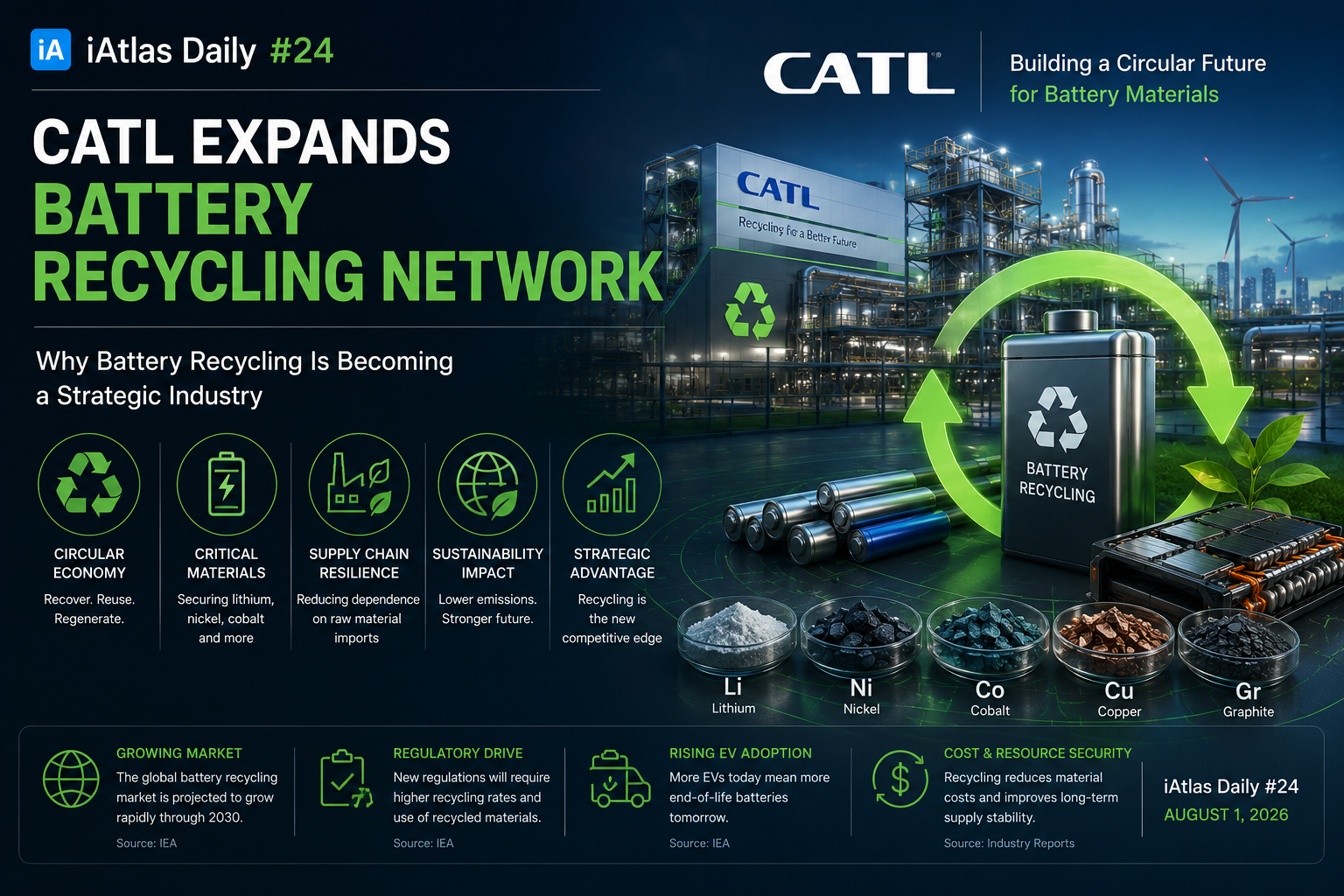
CATL Expands Battery Recycling Network
Why Battery Recycling Is Becoming a Strategic Industry
📰 iAtlas Daily #24 | July 31, 2026
CATL Battery Recycling Expansion
As global electric vehicle adoption accelerates, battery manufacturers are increasingly focusing not only on producing batteries but also on recovering valuable materials after their useful life.
CATL is continuing to expand its battery recycling network to secure long-term supplies of lithium, nickel, cobalt, and other critical battery materials. Rather than relying solely on newly mined resources, the company is investing in circular supply chains that recover and reuse valuable materials from retired batteries.
The expansion reflects a broader industry trend in which battery recycling is becoming an essential part of battery manufacturing rather than a separate downstream business.
💡 Why This Move Matters
Battery recycling is no longer simply an environmental initiative.
It has become a strategic manufacturing capability.
Recovering valuable materials helps manufacturers:
- Reduce dependence on raw material imports
- Improve supply chain resilience
- Lower long-term material costs
- Support sustainability goals
- Prepare for future battery demand
As global EV production continues to increase, access to critical minerals is expected to become one of the industry’s most important competitive advantages.
🌍 Industry Impact
Battery Manufacturers
Companies are increasingly investing in closed-loop recycling systems to recover materials and reduce exposure to volatile commodity prices.
Material Suppliers
Recovered lithium, nickel, cobalt, and graphite can supplement primary mining and improve supply stability.
Equipment Companies
Growing recycling capacity creates additional demand for dismantling, sorting, crushing, hydrometallurgy, and refining equipment.
Governments
Many countries are introducing regulations that encourage higher battery recycling rates and greater use of recycled materials in future battery production.
👀 What to Watch
Several developments will shape the future of battery recycling:
- Expansion of commercial recycling capacity
- Improvements in lithium recovery efficiency
- New recycling regulations
- Growth of second-life battery applications
- Increasing demand for recycled battery materials
🎯 Atlas Insight
The next phase of battery competition will not be defined only by who builds the most batteries.
It will also depend on who can recover, refine, and reuse the materials inside those batteries most efficiently.
Battery recycling is evolving from an environmental responsibility into a core manufacturing capability.
Companies that establish strong recycling ecosystems today may gain significant cost, supply chain, and sustainability advantages over the coming decade.
📚 Related Articles
🔋 iAtlas Battery #14 | Battery Recycling Explained
Learn how lithium-ion batteries are collected, dismantled, and processed to recover valuable materials.
🔋 Atlas Library | What Is Lithium-ion battery?
Understand why lithium remains one of the most important raw materials in modern batteries.
Sources
- CATL. Battery Recycling.
- CATL. Global Energy Circularity Commitment (GECC).
- International Energy Agency (IEA). Battery recycling innovation surging as countries seek to strengthen critical mineral supply and energy security.
- International Energy Agency (IEA). Global EV Outlook 2026 – Electric Vehicle Batteries.
- Reuters. Volkswagen and CATL collaborate on lithium battery development.
About iAtlas
iAtlas is an independent publication covering batteries, semiconductors, OLED, advanced materials, AI, and global industrial trends.
We transform complex industrial developments into clear, reliable, and easy-to-understand insights.
Whether you’re following today’s industry news or building long-term expertise, iAtlas helps you understand not only what happened, but why it matters.
Technology creates change.
Insight creates opportunity.
— iAtlas