Battery Pack Architecture Explained: Modules, Packs, and Cell-to-Pack (CTP)
🔋 iAtlas Battery #9 | 🔋 Cell Design → 📦 Battery Pack Architecture
Introduction
A single lithium-ion battery cell cannot power an electric vehicle on its own.
Instead, hundreds or even thousands of battery cells are carefully connected into modules and battery packs. This architecture determines not only the battery’s voltage and capacity but also its safety, thermal performance, maintenance, and manufacturing cost.
In recent years, battery manufacturers have introduced Cell-to-Pack (CTP) technology, eliminating traditional modules to improve energy density and simplify production.
Understanding battery pack architecture is essential for anyone studying modern EV batteries.
Table of Contents
- What Is Battery Pack Architecture?
- Battery Cells
- Battery Modules
- Battery Packs
- What Is Cell-to-Pack (CTP)?
- Advantages and Challenges
- Frequently Asked Questions
What Is Battery Pack Architecture?
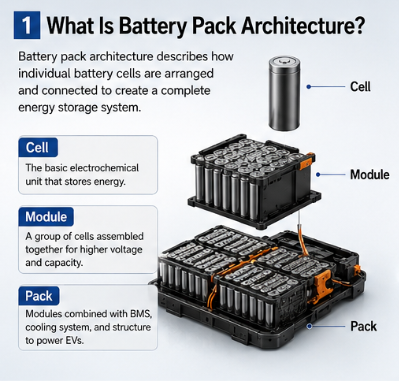
Battery pack architecture describes how individual battery cells are arranged and connected to create a complete energy storage system.
A typical EV battery consists of three levels:
- Battery Cell
- Battery Module
- Battery Pack
Each level serves a different engineering purpose, balancing electrical performance, safety, serviceability, and manufacturing efficiency.
Battery Cells
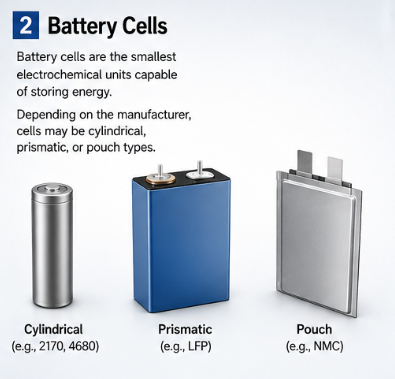
Battery cells are the smallest electrochemical units capable of storing energy.
Depending on the manufacturer, cells may be cylindrical, prismatic, or pouch types.
Hundreds of these cells are connected together to achieve the voltage and capacity required for electric vehicles.
Battery Modules
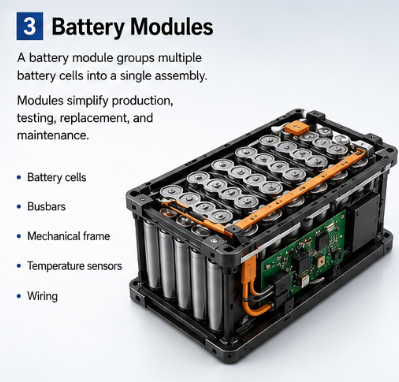
A battery module groups multiple battery cells into a single assembly.
Modules simplify production, testing, replacement, and maintenance.
Typical module components include:
- Battery cells
- Busbars
- Mechanical frame
- Temperature sensors
- Wiring
Battery Packs
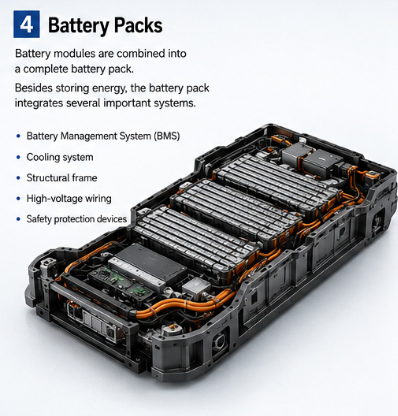
Battery modules are combined into a complete battery pack.
Besides storing energy, the battery pack integrates several important systems:
- Battery Management System (BMS)
- Cooling system
- Structural frame
- High-voltage wiring
- Safety protection devices
The battery pack is the component installed directly into an electric vehicle.
What Is Cell-to-Pack (CTP)?
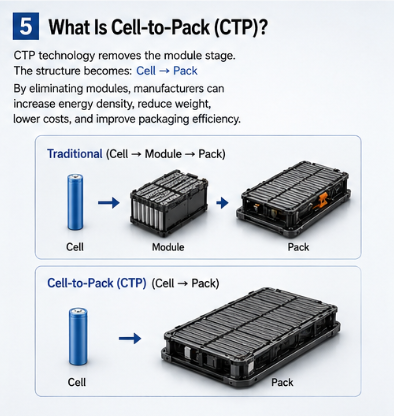
Traditional battery packs follow this structure:
Cell → Module → Pack
CTP technology removes the module stage.
The structure becomes:
Cell → Pack
By eliminating modules, manufacturers can:
- Increase volumetric energy density
- Reduce weight
- Lower manufacturing costs
- Improve packaging efficiency
Companies such as CATL and BYD have adopted CTP technology in mass production.
Advantages and Challenges
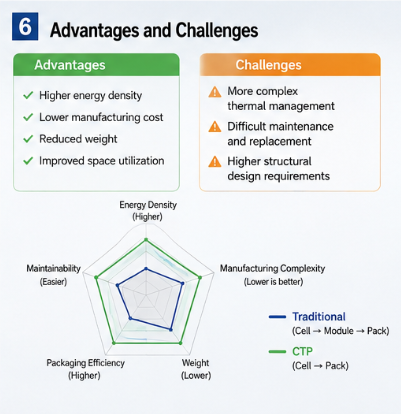
Advantages
- Higher energy density
- Lower manufacturing cost
- Reduced weight
- Improved space utilization
Challenges
- More complex thermal management
- Difficult maintenance and replacement
- Higher structural design requirements
Key Figures
| Architecture | Structure |
|---|---|
| Traditional | Cell → Module → Pack |
| CTP | Cell → Pack |
| Comparison | Traditional | CTP |
|---|---|---|
| Energy Density | High | Higher |
| Manufacturing Complexity | Moderate | Lower |
| Weight | Higher | Lower |
| Packaging Efficiency | Good | Excellent |
Frequently Asked Questions
Why are battery modules used?
Battery modules simplify manufacturing, testing, maintenance, and improve safety by organizing battery cells into manageable units.
What is Cell-to-Pack (CTP)?
Cell-to-Pack technology eliminates battery modules, allowing battery cells to be integrated directly into the battery pack.
Which companies use CTP?
CATL, BYD, and several other EV battery manufacturers have commercialized Cell-to-Pack battery systems.
Is CTP always better?
Not necessarily. While CTP offers higher energy density and lower manufacturing costs, it also introduces greater complexity in thermal management and maintenance.
Key Takeaways
- Battery packs are built from individual battery cells.
- Traditional EV batteries consist of Cells → Modules → Packs.
- Cell-to-Pack (CTP) removes battery modules to improve efficiency.
- CTP technology reduces weight while increasing energy density.
- Battery pack architecture plays a critical role in EV performance and safety.
🎓 Battery Learning Path
🔋 Cell Design
✅🔋 iAtlas Battery #8 — Cell Formats
📍🔋 iAtlas Battery #9 — Battery Pack Architecture (Current)
▶ 🔋 iAtlas Battery #10 — Battery Management System (BMS)
▶ 🔋 iAtlas Battery #11 — Thermal Management
▶ 🔋 iAtlas Battery #12 — Cell-to-Pack (CTP) & Cell-to-Chassis (CTC)
Prerequisite: Complete the 📘 Fundamentals and 🧪 Materials learning paths before starting 🔋 Cell Design.
📖 Continue Reading
⬅ Previous Article
🔋 iAtlas Battery #8
Cylindrical vs. Prismatic vs. Pouch Cells: Understanding Battery Cell Formats
Compare the three major battery cell formats and understand how each design influences battery performance, packaging efficiency, and EV applications.
➡ Next Article
🔋 iAtlas Battery #10
Battery Management System (BMS) Explained: The Brain of Every EV Battery
Discover how a Battery Management System monitors voltage, temperature, and charging to maximize battery performance, safety, and lifespan.
References
- International Energy Agency (IEA)
- U.S. Department of Energy – Vehicle Technologies Office
- Battery University
- Nature Energy (Battery Manufacturing Research)
About iAtlas
iAtlas is an independent publication covering batteries, semiconductors, OLED, advanced materials, AI, and global industrial trends.
We transform complex industrial developments into clear, reliable, and easy-to-understand insights.
Whether you’re following today’s industry news or building long-term expertise, iAtlas helps you understand not only what happened, but why it matters.
Technology creates change.
Insight creates opportunity.
— iAtlas