Cylindrical vs. Prismatic vs. Pouch Cells: Understanding Battery Cell Formats
🔋 iAtlas Battery #8 | 🔋 Cell Design → 📦 Cell Formats
Battery Cell Formats at a Glance
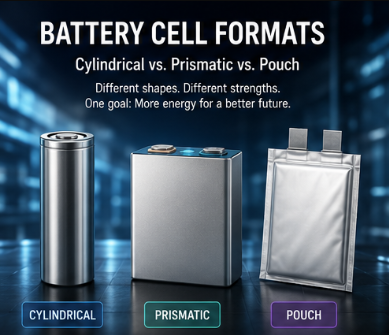
Battery cell formats define the physical shape of a lithium-ion battery. The three dominant designs—cylindrical, prismatic, and pouch cells—each offer different advantages in manufacturing, thermal management, packaging efficiency, and cost.
Table of Contents
- What Are Battery Cell Formats?
- Cylindrical Cells
- Prismatic Cells
- Pouch Cells
- Comparison Table
- Which Cell Format Is Best?
- Frequently Asked Questions
Introduction
When people compare electric vehicle batteries, they often focus on chemistry such as LFP or NCM. However, the battery cell format is equally important because it determines how the battery is packaged, cooled, manufactured, and integrated into a vehicle.
Today, the global EV market relies on three main battery cell formats:
- Cylindrical cells
- Prismatic cells
- Pouch cells
Each format has strengths and trade-offs, and manufacturers choose the one that best fits their design philosophy and performance goals.
What Are Battery Cell Formats?
A battery cell format refers to the physical shape and enclosure of a battery cell.
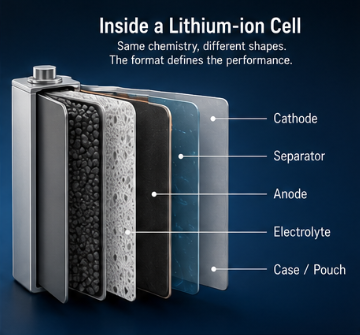
Although different formats can use the same cathode, anode, electrolyte, and separator materials, their mechanical design significantly affects:
- Energy density
- Cooling efficiency
- Structural strength
- Manufacturing complexity
- Cost
Cylindrical Cells
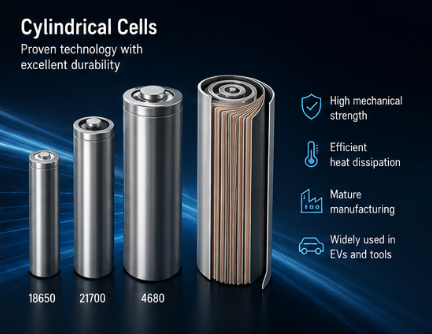
Cylindrical cells are the oldest and most mature lithium-ion battery format.
Well-known examples include the 18650, 21700, and 4680 cells.
Advantages
- Excellent mechanical strength
- Mature manufacturing process
- Efficient heat dissipation
- High production consistency
Limitations
- Lower packing efficiency
- More inactive space between cells
These cells are widely used in electric vehicles, power tools, and consumer electronics.
Prismatic Cells
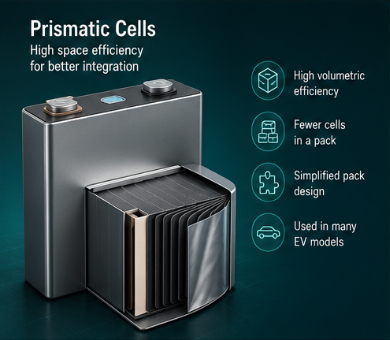
Prismatic cells use a rigid rectangular metal casing.
They reduce unused space inside battery packs, allowing higher packaging efficiency.
Advantages
- High volumetric efficiency
- Fewer cells required
- Simplified battery pack design
Limitations
- More complex manufacturing
- Cooling design can be challenging
Prismatic cells are commonly used by many automotive manufacturers.
Pouch Cells
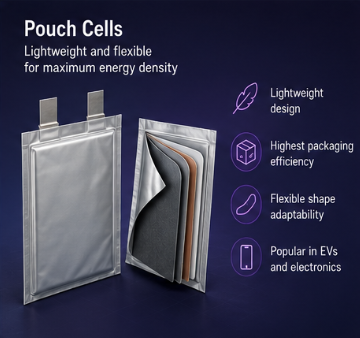
Pouch cells use a flexible laminated aluminum film instead of a rigid metal case.
This design provides excellent packaging efficiency while reducing weight.
Advantages
- Lightweight
- Highest packaging efficiency
- Flexible design
Limitations
- Lower mechanical rigidity
- Swelling management required
- Greater protection needed
Pouch cells are popular in EVs, smartphones, and high-energy battery applications.
Comparison of Battery Cell Formats
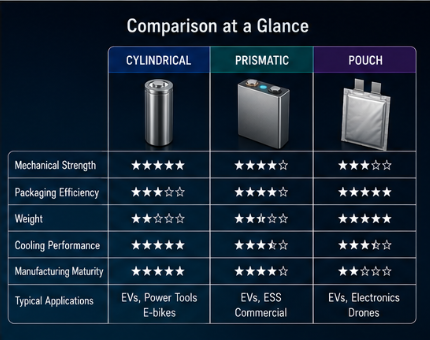
| Feature | Cylindrical | Prismatic | Pouch |
|---|---|---|---|
| Mechanical Strength | Excellent | High | Moderate |
| Packaging Efficiency | Medium | High | Excellent |
| Weight | Medium | Medium | Low |
| Cooling | Excellent | Good | Good |
| Manufacturing Maturity | Excellent | High | Medium |
| Typical Applications | EVs, Tools | EVs, ESS | EVs, Electronics |
Which Battery Cell Format Is Best?
There is no universally superior battery cell format.
- Choose cylindrical cells when durability, consistency, and scalable manufacturing are priorities.
- Choose prismatic cells for efficient battery pack integration.
- Choose pouch cells when lightweight design and maximum packaging efficiency are required.
The optimal choice depends on the intended application rather than a single performance metric.
Key Figures
| Cell Format | Typical Example | Common Applications |
|---|---|---|
| Cylindrical | 18650 / 21700 / 4680 | EVs, Power Tools |
| Prismatic | Rectangular Metal Cell | EVs, ESS |
| Pouch | Laminated Film Cell | EVs, Consumer Electronics |
Frequently Asked Questions
What is the most common battery cell format?
Cylindrical cells remain one of the most widely used formats due to their mature manufacturing process and strong mechanical durability.
Why do some EVs use pouch cells?
Pouch cells offer excellent packaging efficiency and lower weight, making them attractive for applications where energy density is a priority.
What is the advantage of prismatic cells?
Prismatic cells reduce unused space inside the battery pack, improving volumetric energy density and simplifying pack assembly.
Is the 4680 battery a cylindrical cell?
Yes. Tesla’s 4680 battery is a cylindrical lithium-ion cell designed to improve energy density and manufacturing efficiency.
Key Takeaways
- Battery cell formats determine the physical structure of lithium-ion batteries.
- Cylindrical cells provide excellent durability and mature manufacturing.
- Prismatic cells improve packaging efficiency.
- Pouch cells maximize lightweight design and flexibility.
- Cell format selection depends on the application and design priorities.
🎓 Battery Learning Path
📘 Fundamentals
✅ 🔋 iAtlas Battery #1 — Manufacturing Process
✅ 🔋 iAtlas Battery #2 — How Batteries Work
✅ 🔋 iAtlas Battery #3 — Materials Overview
✅ 🔋 iAtlas Battery #4 — Cathode
✅ 🔋 iAtlas Battery #5 — Anode
✅ 🔋 iAtlas Battery #6 — Electrolyte
✅ 🔋 iAtlas Battery #7 — Separator
📍🔋 iAtlas Battery #8 — Cell Formats (Current)
▶ 🔋 iAtlas Battery #9 — Battery Pack Architecture
▶ 🔋 iAtlas Battery #10 — Battery Management System (BMS)
▶ 🔋 iAtlas Battery #11 — Thermal Management
▶ 🔋 iAtlas Battery #12 — Cell-to-Pack (CTP) & Cell-to-Chassis (CTC)
Complete the Fundamentals path before exploring Materials, Manufacturing, Equipment, Companies, and Markets.
📖 Continue Reading
⬅ Previous Article
🔋 iAtlas Battery #7
Separator Explained: The Safety Barrier Inside Lithium-ion Batteries
Learn how separators prevent internal short circuits while allowing lithium-ion transport.
➡ Next Article
🔋 iAtlas Battery #9
Battery Pack Architecture Explained: Modules, Packs, and Cell-to-Pack (CTP)
Discover how battery cells are assembled into modules and packs, and how Cell-to-Pack (CTP) technology improves energy density and manufacturing efficiency.
References
- International Energy Agency (IEA)
- U.S. Department of Energy – Vehicle Technologies Office
- Battery University
- Nature Energy (Battery Manufacturing Research)
About iAtlas
iAtlas is an independent publication covering batteries, semiconductors, OLED, advanced materials, AI, and global industrial trends.
We transform complex industrial developments into clear, reliable, and easy-to-understand insights.
Whether you’re following today’s industry news or building long-term expertise, iAtlas helps you understand not only what happened, but why it matters.
Technology creates change.
Insight creates opportunity.
— iAtlas