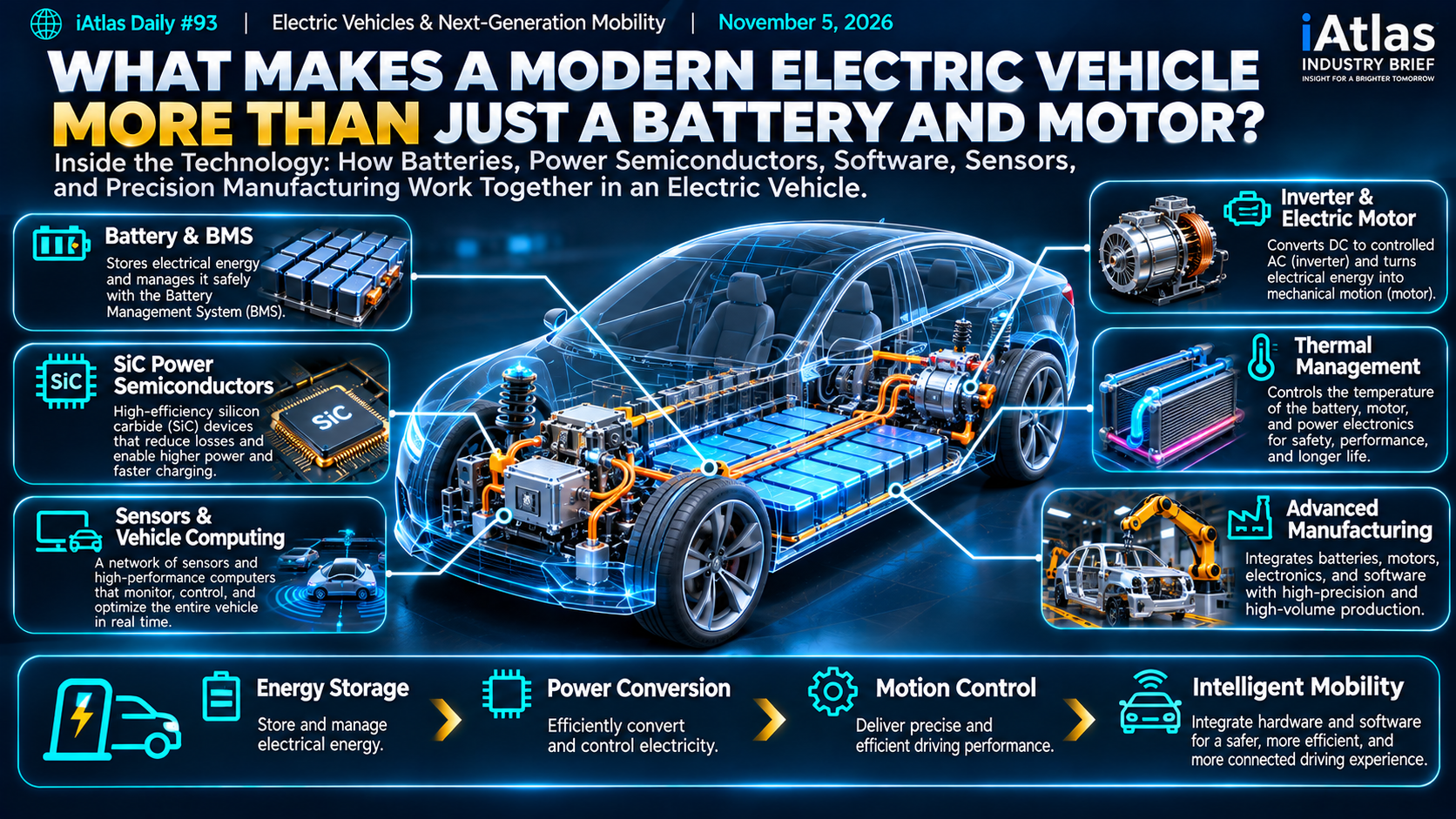
What Makes a Modern Electric Vehicle More Than Just a Battery and Motor?
Inside the Technology: How Batteries, Power Semiconductors, Software, Sensors, and Precision Manufacturing Work Together in an Electric Vehicle
iAtlas Daily #93 | Electric Vehicles & Next-Generation Mobility | November 5, 2026
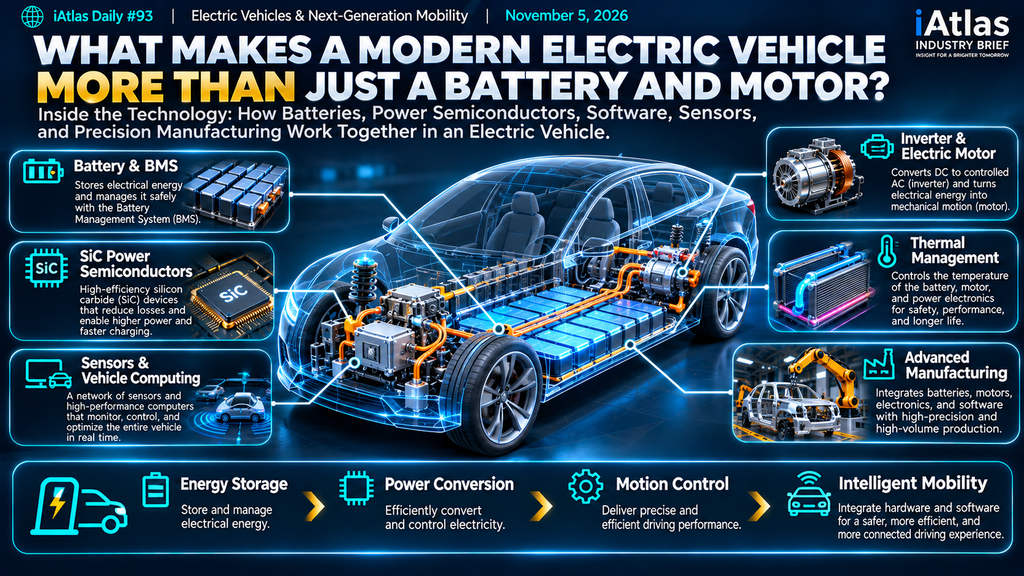
An Electric Vehicle Is More Than an Electric Powertrain
What makes one electric vehicle more efficient, safer, faster-charging, or more affordable than another?
At first glance, the answer seems straightforward.
A larger battery provides more energy. A powerful motor delivers better acceleration. And a faster charger reduces waiting time.
But the reality is considerably more complicated.
Modern electric vehicle technology is built around an interconnected system of batteries, power electronics, thermal management, sensors, software, and advanced manufacturing processes.
Two electric vehicles with similar battery capacities can deliver different driving ranges.
Two vehicles using comparable motors can achieve different levels of efficiency.
And two models supporting similar charging power can behave differently during an actual charging session.
These differences emerge from the way individual technologies work together.
The battery must store energy safely.
The inverter must convert electricity efficiently.
The motor must deliver the required torque.
The cooling system must control temperature.
And software must coordinate everything in real time.
Understanding a modern electric vehicle therefore requires looking beyond its battery and motor.
It requires understanding the complete engineering system.
1. What Are the Main Components Inside an Electric Vehicle?
A battery electric vehicle, or BEV, uses stored electrical energy to power one or more electric motors.
Unlike a conventional gasoline vehicle, it does not require an internal combustion engine for propulsion.
However, replacing the engine with an electric motor does not eliminate the need for complex engineering.
Instead, it changes which technologies are most important.
The Main EV Systems
| Component | Main Function | Why It Matters |
|---|---|---|
| Battery Pack | Stores electrical energy | Range, cost, safety |
| Battery Management System | Monitors and manages the battery | Reliability, charging, battery life |
| Inverter | Converts DC electricity to controlled AC | Motor efficiency and performance |
| Electric Motor | Converts electricity into mechanical motion | Acceleration, efficiency |
| Reduction Gear | Transfers motor torque to the wheels | Drivetrain performance |
| DC-DC Converter | Supplies lower-voltage electrical systems | Vehicle electronics |
| Onboard Charger | Converts incoming AC to DC for battery charging | AC charging capability |
| Thermal Management | Controls operating temperatures | Range, charging, durability |
| Vehicle Control Software | Coordinates powertrain operation | Efficiency, safety, driving behavior |
| Sensors and Computing | Support vehicle functions and driver assistance | Control, safety, automation |
These systems are connected electrically, mechanically, and digitally.
Improving one component does not necessarily improve the vehicle unless the other systems can support it.
For example, increasing charging power is useful only when the battery, cooling system, charging equipment, and electrical architecture can handle it.
An electric vehicle performs as a system, not as a collection of independent components.
2. The Battery Pack: More Than Energy Storage
The battery is one of the most expensive and technically important components in an electric vehicle.
Its main purpose is to store electrical energy and release it when needed.
But battery performance depends on much more than capacity.
Battery Capacity
Battery capacity is commonly expressed in kilowatt-hours, or kWh.
A larger battery can store more energy.
However, additional battery capacity also increases weight, material requirements, and potentially cost.
This means a larger battery does not automatically produce a proportionally longer driving range.
Battery Chemistry
Different battery chemistries offer different advantages.
Lithium Iron Phosphate (LFP)
LFP batteries generally offer attractive cost characteristics, good cycle life, and favorable thermal stability.
They are widely used in many mass-market electric vehicles.
Nickel-Rich Lithium-Ion Batteries
Chemistries such as NMC and NCA can provide high energy density.
This can be valuable for vehicles requiring longer driving ranges or reduced battery weight.
However, material costs, thermal management, and manufacturing requirements differ from those of LFP.
Battery Architecture
Battery cells must be integrated into a larger pack.
Common cell formats include cylindrical, prismatic, and pouch designs.
Manufacturers may use conventional module-based packs or more integrated cell-to-pack architectures.
Some are also exploring structural battery packs, where the battery assembly contributes to vehicle structure.
These approaches affect packaging efficiency, manufacturing complexity, repairability, and cost.
Why Battery Integration Matters
A battery cell may perform well during laboratory testing.
But its behavior can change when thousands of cells are integrated into a vehicle.
Electrical connections, cooling, mechanical protection, and software controls become essential.
The final battery pack must deliver consistent performance under vibration, temperature changes, charging cycles, and real-world driving conditions.
3. The Battery Management System: The Battery’s Control Center
A modern battery pack requires continuous monitoring.
This is the responsibility of the Battery Management System, or BMS.
The BMS combines electronic hardware, sensors, and software to help keep the battery within its intended operating limits.
What Does a BMS Monitor?
A typical system monitors or estimates:
- Cell and pack voltages
- Electrical current
- Battery temperatures
- State of Charge (SOC)
- State of Health (SOH)
- Cell balancing requirements
- Operating faults and protection conditions
State of Charge
SOC estimates how much usable energy remains in the battery.
It is similar to a fuel gauge, although battery energy estimation is more complex than measuring liquid fuel in a tank.
State of Health
SOH estimates how the battery’s condition has changed over time.
Battery aging can reduce available capacity and affect internal resistance.
The exact calculation depends on the manufacturer’s algorithms and measurement methods.
Cell Balancing
Battery cells do not always age or operate identically.
Small differences can develop between cells.
Balancing systems help manage these differences so the pack can operate more effectively.
Why the BMS Matters for Fast Charging
Charging a battery too aggressively under unsuitable conditions can increase degradation or create safety risks.
The BMS helps determine appropriate charging limits based on battery conditions.
For example, charging power may be reduced when the battery is too cold, too hot, or approaching a high state of charge.
This explains why a vehicle advertised as supporting high charging power does not necessarily maintain that power throughout the entire charging session.
The BMS helps determine how much of the battery’s theoretical performance can be used safely in everyday driving.
4. The Inverter: The Technology Between the Battery and Motor
The battery stores and supplies direct current, or DC.
Many electric vehicle traction motors operate using controlled alternating current, or AC.
The inverter connects these two systems.
What Does an Inverter Do?
An inverter converts DC electricity from the battery into controlled AC electricity for the motor.
By adjusting the electrical output, the inverter helps control motor speed and torque.
During regenerative braking, the energy flow can reverse.
The motor acts as a generator, and the inverter helps convert the recovered electrical energy into a form suitable for the battery.
Why Inverter Efficiency Matters
Every electrical conversion creates some losses.
These losses produce heat and reduce the energy available for propulsion.
Even relatively small efficiency improvements can matter because the inverter operates repeatedly during vehicle use.
A more efficient inverter may contribute to:
- Reduced electrical losses
- Lower cooling requirements
- Improved driving efficiency
- More compact powertrain designs
Why This Is Important for Semiconductor Companies
The inverter relies on power semiconductor devices.
These devices switch and control large electrical currents at high speed.
As electric vehicles evolve, power semiconductor technology is becoming an important source of performance differentiation.
5. Why Are Silicon Carbide Power Semiconductors Important?
Conventional silicon power semiconductors have supported electric vehicles for many years.
However, higher-voltage and higher-performance electrical systems create opportunities for alternative semiconductor materials.
One important material is silicon carbide, or SiC.
What Is Silicon Carbide?
Silicon carbide is a compound semiconductor material.
It belongs to a class of materials known as wide-bandgap semiconductors.
Compared with conventional silicon devices, appropriately designed SiC power devices can offer advantages in high-voltage operation, switching performance, and efficiency.
Why Use SiC in EV Inverters?
SiC power devices can help reduce switching and conduction losses in suitable designs.
They can also support higher-voltage electrical architectures.
Potential benefits include:
- Improved power conversion efficiency
- Reduced heat generation
- Higher power density
- Smaller supporting components
- Improved system-level design flexibility
However, these benefits depend on the complete inverter design.
Why Doesn’t Every EV Use SiC?
SiC devices can be more expensive than conventional silicon alternatives.
Their manufacturing also involves demanding crystal growth, wafer processing, device fabrication, and packaging requirements.
Automakers must evaluate whether the performance advantages justify the cost.
For some vehicles, silicon-based solutions remain economically attractive.
The Manufacturing Connection
SiC power semiconductor production creates demand for specialized materials, semiconductor equipment, precision processing, and advanced packaging.
This is one reason the electric vehicle industry is closely connected to the semiconductor supply chain.
An improvement in power semiconductor technology can influence vehicle efficiency without changing the battery chemistry.
6. Electric Motors: Why Design Matters More Than Maximum Power
Electric motors convert electrical energy into mechanical motion.
In an EV, the motor drives the wheels through a drivetrain that typically includes a reduction gear.
But electric motors are not all designed the same way.
Permanent Magnet Motors
Many electric vehicles use permanent magnet synchronous motors.
These motors can offer high efficiency and strong torque density.
Some designs rely on rare earth permanent magnets containing neodymium and other elements.
This connects EV manufacturing to the rare earth materials supply chain.
Induction Motors
Induction motors do not require permanent magnets in the rotor.
They use electromagnetic induction to generate torque.
These motors can reduce dependence on rare earth magnet materials, although their efficiency and operating characteristics differ from permanent magnet designs.
Electrically Excited Motors
Some manufacturers use electrically excited synchronous motors.
These create rotor magnetic fields using electrical excitation rather than permanent magnets.
The approach can reduce rare earth dependence but introduces different control and design requirements.
What Determines Motor Performance?
Motor performance depends on several factors:
- Magnetic design
- Electrical losses
- Rotor and stator geometry
- Cooling
- Operating speed
- Power electronics
- Manufacturing precision
Maximum power is only one specification.
A motor must also perform efficiently across the operating conditions encountered during everyday driving.
7. Why Is Thermal Management So Important?
Temperature affects nearly every major EV system.
The battery, motor, inverter, and other electrical components generate heat.
Environmental conditions also influence their operation.
Battery Temperature
Lithium-ion batteries generally perform best within a controlled temperature range.
Low temperatures can reduce available power and charging capability.
High temperatures can accelerate degradation and increase safety concerns.
Motor and Inverter Temperature
Electric motors and power electronics generate heat during operation.
Excessive temperature can reduce performance and component reliability.
Cabin Heating and Cooling
Heating or cooling the passenger cabin consumes energy.
In some conditions, this can noticeably affect driving range.
Integrated Thermal Systems
Modern EVs may use combinations of:
- Liquid cooling circuits
- Heat exchangers
- Refrigerant systems
- Heat pumps
- Battery heaters
- Temperature sensors
- Electronic control systems
Some vehicle architectures integrate several thermal functions to improve efficiency.
Why Thermal Management Influences Charging
Fast charging generates heat inside the battery and associated electrical systems.
If heat cannot be controlled effectively, charging power may need to decrease.
This means charging performance depends on more than the charger’s maximum power rating.
Battery chemistry, cooling hardware, and software controls must work together to achieve repeatable fast-charging performance.
8. What Is the Difference Between 400V and 800V EV Architectures?
Electric vehicles use high-voltage electrical systems to transfer power between the battery, inverter, motor, and charging components.
Many vehicles have historically used systems commonly described as 400V architectures.
Higher-voltage systems, often referred to as 800V architectures, are increasingly used in certain high-performance and fast-charging vehicles.
These labels describe voltage classes rather than exact fixed operating voltages.
Why Does Voltage Matter?
Electrical power can be expressed as:
Power = Voltage × Current
For the same electrical power, increasing voltage allows current to decrease.
Lower current can reduce resistive losses in conductors.
A Simplified Example
Consider a system transferring 200 kW.
At 400V, the idealized current would be approximately 500A.
At 800V, it would be approximately 250A.
Actual vehicle operating conditions and electrical losses are more complex, but the principle is important.
Potential Advantages of Higher Voltage
- Reduced current for a given power level
- Potentially lower resistive losses
- Opportunities for lighter conductors
- Support for high-power charging
- Greater flexibility in powertrain design
Why Isn’t Every Vehicle 800V?
Higher-voltage systems require compatible electrical components.
These may include the battery pack, inverter, insulation, contactors, charging hardware, and protection systems.
The additional cost and engineering complexity must be justified.
A well-designed 400V vehicle can still deliver strong efficiency and charging performance.
The voltage architecture is one design decision within a much larger system.
9. Why Is Fast Charging More Complicated Than Charger Power?
Charging speed is one of the most visible differences between electric vehicles.
Manufacturers often advertise maximum charging power.
But peak power does not describe the entire charging experience.
AC Charging
During AC charging, the vehicle’s onboard charger converts incoming AC electricity into DC electricity for the battery.
The onboard charger’s capacity and available AC supply influence charging speed.
DC Fast Charging
During DC fast charging, the external charging equipment supplies regulated DC power to the vehicle.
The vehicle’s battery system communicates with the charger and controls the charging process.
The Charging Curve
Charging power changes during a charging session.
It can depend on:
- Battery temperature
- State of charge
- Cell chemistry
- Battery condition
- Charging equipment
- Vehicle control software
A vehicle may accept high power when conditions are favorable, then gradually reduce charging power as the battery fills.
Why Preconditioning Matters
Some vehicles prepare their battery temperature before reaching a fast charger.
This process is called battery preconditioning.
It can help the battery reach a temperature more suitable for fast charging.
The Real Performance Metric
For drivers, the time required to charge between practical states of charge can be more useful than peak charging power alone.
For example, charging time from 10% to 80% SOC often provides a better comparison than maximum kW.
Even that metric must be interpreted alongside battery size, temperature, charger capability, and test conditions.
10. Sensors and Computers: Why EVs Are Becoming Software-Defined Vehicles
A modern EV contains more than an electric powertrain.
It also contains digital systems that monitor and control vehicle functions.
Vehicle Sensors
Depending on the model and features, sensors may include:
- Cameras
- Radar
- Ultrasonic sensors
- Temperature sensors
- Current and voltage sensors
- Wheel-speed sensors
- Inertial sensors
- LiDAR in selected vehicles
Different sensors support different functions.
Some monitor powertrain operation.
Others support braking, stability control, parking, and driver assistance.
Vehicle Computing
Modern vehicles use electronic control units and increasingly powerful computing platforms.
These systems coordinate propulsion, safety, infotainment, connectivity, and advanced driver-assistance functions.
Software-Defined Vehicles
A software-defined vehicle is designed so that software plays an increasingly important role in delivering and updating vehicle functions.
Some vehicles support over-the-air software updates.
These can improve certain features without requiring physical replacement of hardware.
However, updates remain subject to hardware capabilities, safety requirements, and regulatory constraints.
Does More Computing Mean Autonomous Driving?
No.
Advanced driver assistance and fully autonomous driving are different capabilities.
A vehicle with powerful computers and multiple sensors is not automatically capable of operating without human supervision.
Autonomous driving requires robust perception, decision-making, control, validation, and safety systems.
Its capabilities must be evaluated according to the actual operational conditions and level of automation.
The modern EV is becoming a computing platform, but computing power alone does not guarantee autonomous capability.
11. Regenerative Braking: How EVs Recover Energy
One advantage of electric propulsion is the ability to recover some energy during deceleration.
This is called regenerative braking.
How Does It Work?
During acceleration, the battery supplies electricity to the motor.
During regenerative braking, the motor operates as a generator.
It converts some of the vehicle’s kinetic energy into electrical energy.
That electricity can then be returned to the battery.
Why Does It Matter?
Regenerative braking can improve energy efficiency, particularly in driving conditions involving frequent deceleration.
However, energy recovery is not perfect.
Some energy is lost through electrical conversion, mechanical resistance, and other processes.
What Limits Regeneration?
The amount of energy recovered depends on:
- Battery state of charge
- Battery temperature
- Motor and inverter capabilities
- Vehicle speed
- Tire traction
- Braking requirements
Conventional friction brakes remain necessary.
Regenerative braking illustrates how the battery, motor, inverter, and software must operate together.
12. Why Does EV Manufacturing Require So Many Different Technologies?
The complexity of an EV is not limited to its design.
Manufacturing requires coordination across several industrial sectors.
Battery Manufacturing
Battery production includes electrode processing, cell assembly, electrolyte filling, formation, testing, and pack integration.
Some processes require carefully controlled moisture levels.
Power Semiconductor Manufacturing
Silicon and SiC devices require specialized semiconductor fabrication processes.
Material defects, wafer quality, packaging, and thermal performance can influence production yield and reliability.
Motor Manufacturing
Electric motors require precision manufacturing of stators, rotors, windings, magnets, and mechanical components.
Electronics Assembly
Inverters, BMS modules, and control systems rely on electronic components, circuit boards, sensors, and power modules.
Vehicle Body Manufacturing
The vehicle structure must provide crash protection, mechanical strength, and manufacturing efficiency.
Manufacturers use combinations of stamping, welding, adhesives, castings, and other joining methods.
Some automakers have adopted large structural castings to reduce part counts and simplify selected assembly operations.
However, these methods involve trade-offs in tooling investment, quality control, repairability, and manufacturing flexibility.
Software Integration
Electronic systems must operate together reliably.
Testing includes electrical performance, thermal behavior, functional safety, cybersecurity, and vehicle-level validation.
Why This Matters
An electric vehicle combines technologies from several industries:
Battery + Semiconductor + Advanced Materials + Electronics + Software + Precision Manufacturing
A bottleneck in any one of these areas can affect the cost, quality, or availability of the final vehicle.
13. What Actually Determines EV Driving Range?
Battery capacity is important, but it is not the only factor.
A simplified relationship is:
Driving Range ≈ Usable Battery Energy ÷ Energy Consumption per Distance
For example, if a vehicle has 60 kWh of usable battery energy and consumes 0.15 kWh per kilometer under a particular test condition, its calculated range would be approximately 400 kilometers.
Actual driving range will vary.
Important Factors
Battery Capacity
More usable stored energy can support longer driving distances.
Powertrain Efficiency
Motor, inverter, and drivetrain losses affect how much energy reaches the wheels.
Vehicle Weight
Heavier vehicles generally require more energy during acceleration and climbing.
Aerodynamics
Air resistance becomes increasingly important at highway speeds.
Tires
Rolling resistance influences energy consumption.
Temperature
Cold or hot weather can affect battery performance and thermal-system energy consumption.
Driving Conditions
Speed, traffic, elevation, and driving style influence range.
Why Two Similar EVs Can Perform Differently
Two vehicles with the same battery capacity may have different motor designs, inverter efficiencies, aerodynamics, weights, tires, and thermal management systems.
Their real-world range can therefore differ significantly.
This is why EV engineering must be evaluated at the complete vehicle level.
14. How Is the Global EV Industry Changing?
The electric vehicle market continues to expand, but growth differs significantly by region.
According to the IEA’s Global EV Outlook 2026, global electric car sales exceeded 20 million in 2025.
Electric cars represented approximately one-quarter of global new car sales.
The IEA projects sales of around 23 million electric cars in 2026, representing approximately 28% of the global market.
These figures include battery electric vehicles and plug-in hybrid electric vehicles under the IEA’s electric car definition.
China
China remains the largest electric vehicle manufacturing and sales market.
The country has developed extensive supply chains for batteries, power electronics, vehicles, and related materials.
Europe
Europe remains an important EV market, supported by regulations, industrial investment, and expanding model availability.
However, affordability and competition remain important challenges.
United States
EV development continues, but sales growth and policy conditions differ from those in China and Europe.
South Korea
South Korea plays an important role in the global EV supply chain through battery manufacturers, semiconductor companies, materials suppliers, and automakers.
The IEA reports that electric car sales in South Korea increased by approximately 65% in 2025, exceeding 200,000 vehicles.
The country’s EV sales share reached approximately 11%.
The Competitive Shift
Competition is moving beyond battery capacity and vehicle acceleration.
Automakers increasingly compete through:
- Energy efficiency
- Charging performance
- Manufacturing cost
- Software capabilities
- Battery supply chains
- Vehicle reliability
- Production scale
The companies that integrate these capabilities effectively may have advantages over competitors that focus on individual components.
15. What Could Define the Next Generation of Electric Vehicles?
Several technologies may influence EV development toward 2030.
More Affordable Batteries
LFP, improved lithium-ion designs, and emerging chemistries may help manufacturers reduce costs.
Sodium-ion batteries could become attractive for selected applications, although their energy density and commercialization requirements differ from those of mainstream lithium-ion technologies.
Improved Power Electronics
SiC and other semiconductor technologies may support more efficient electrical systems.
Better Thermal Management
More integrated thermal architectures could improve charging performance and energy efficiency.
Higher-Voltage Charging
Higher-voltage electrical systems may support faster charging where suitable infrastructure is available.
More Integrated Manufacturing
Automakers may continue exploring cell-to-pack integration, structural battery systems, large castings, and automated assembly.
Advanced Vehicle Software
Vehicle computing and software architectures may become more important for efficiency, diagnostics, connectivity, and driver assistance.
Material Supply Diversification
Automakers may seek alternatives to expensive or geographically concentrated materials, including certain battery metals and rare earth magnets.
Not every technology will be adopted by every manufacturer.
The commercial winners will depend on cost, reliability, manufacturability, customer needs, and infrastructure availability.
Industry Implications | EV Competition Is Becoming a Systems Engineering Challenge
| Industry | Key Technologies | Industrial Significance |
|---|---|---|
| Battery | LFP, NMC, BMS, pack architecture | Range, cost, safety |
| Semiconductor | SiC, silicon power devices, controllers | Efficiency, electrical performance |
| Advanced Materials | Rare earth magnets, copper, aluminum | Motors, wiring, weight |
| Thermal Systems | Heat pumps, liquid cooling, heat exchangers | Charging, durability, efficiency |
| Electronics | Sensors, control units, power modules | Vehicle coordination and safety |
| Software | Energy management, diagnostics, ADAS | Efficiency, functionality |
| Manufacturing | Battery assembly, casting, automation | Yield, scale, production cost |
| Infrastructure | Charging networks, electricity distribution | Charging convenience and adoption |
The table illustrates why EV development creates opportunities across multiple industries.
Battery suppliers are important, but they represent only one part of the value chain.
Power semiconductor manufacturers, motor suppliers, thermal-system companies, electronics producers, and manufacturing equipment suppliers also influence vehicle performance.
This creates both opportunities and risks.
A manufacturer may develop an advanced component but struggle to achieve commercial success if the overall vehicle architecture does not benefit sufficiently from it.
Conversely, strong system integration can create advantages even without using the most expensive components.
iAtlas Insight | The Best EV Is Not Necessarily the One With the Biggest Battery
Electric vehicles are often compared using a few visible specifications.
Battery capacity.
Maximum driving range.
Motor power.
Charging speed.
These numbers matter.
But they do not fully explain why one electric vehicle performs better than another.
A larger battery may improve range, but it also increases weight and cost.
A powerful motor may deliver impressive acceleration, but efficiency matters during everyday driving.
A high peak charging rate may look attractive, but the actual charging curve determines how quickly energy is added.
The real advantage comes from integration.
1. Efficiency Is a System-Level Result
Battery chemistry, power electronics, motor design, aerodynamics, and thermal management all influence energy consumption.
Improving one component can create benefits elsewhere in the vehicle.
2. Manufacturing Determines Affordability
Advanced technology must be produced consistently and economically.
Battery yield, semiconductor quality, motor manufacturing, and assembly efficiency all affect vehicle cost.
3. Software Connects Hardware Performance
The BMS, inverter controller, thermal management system, and vehicle software coordinate how energy is stored, converted, and used.
Their interaction helps determine the vehicle’s real-world behavior.
4. Supply Chains Influence Technology Choices
Material availability, semiconductor capacity, and manufacturing expertise can influence which technologies automakers adopt.
The best technical solution is not always the best commercial solution.
The larger lesson is that an electric vehicle should not be understood as a battery-powered version of a conventional car.
It is an integrated industrial technology platform.
The future of electric vehicles will be determined not by a single breakthrough, but by how effectively batteries, semiconductors, software, materials, and manufacturing work together.
Related Articles
Battery Fundamentals
What Is a Lithium-Ion Battery?
Understand the electrochemical foundation of the battery technologies used in most modern electric vehicles.
Industry Infrastructure
What Is Industrial Infrastructure?
Explore the power, utilities, environmental controls, and manufacturing systems that support advanced industrial production.
Semiconductor Manufacturing
How Thin Film Deposition Builds Semiconductor Devices Layer by Layer
Learn how precision semiconductor manufacturing processes support the electronics used throughout modern industry.
Industrial Supply Chains
Why Industrial Supply Chain Competition Is Moving Upstream
Discover why materials, specialized components, and manufacturing capabilities are increasingly important to industrial competitiveness.
References
1. International Energy Agency — Global EV Outlook 2026
Global EV sales, technology trends, battery manufacturing, charging infrastructure, and regional market developments.
2. U.S. Department of Energy — How Do All-Electric Cars Work?
Official explanation of electric vehicle components, including the battery pack, electric motor, power electronics, charging systems, and thermal management.
3. National Highway Traffic Safety Administration — Electric and Hybrid Vehicles
Vehicle battery systems, electric motors, inverters, charging components, and safety considerations.
4. U.S. Department of Energy — Electric Drive Systems Research and Development
Research priorities involving power electronics, electric motors, advanced materials, thermal management, and manufacturability.
Research on silicon carbide power electronics, efficiency, thermal performance, and reliability.
6. Australian Government — Electric Vehicle Batteries and Motors
Accessible technical explanation of energy flow, electric motors, power electronics, and regenerative braking.
7. Kia — Electric Vehicle Owner’s Manual: Main Components
Manufacturer documentation describing onboard chargers, inverters, DC-DC converters, vehicle controllers, and electric drivetrains.
ℹ️ About iAtlas
iAtlas is an independent publication covering batteries, semiconductors, OLED, advanced materials, AI, and global industrial trends.
We transform complex industrial developments into clear, reliable, and easy-to-understand insights.
Whether you’re following today’s industry news or building long-term expertise, iAtlas helps you understand not only what happened, but why it matters.
Technology creates change.
Insight creates opportunity.
— iAtlas