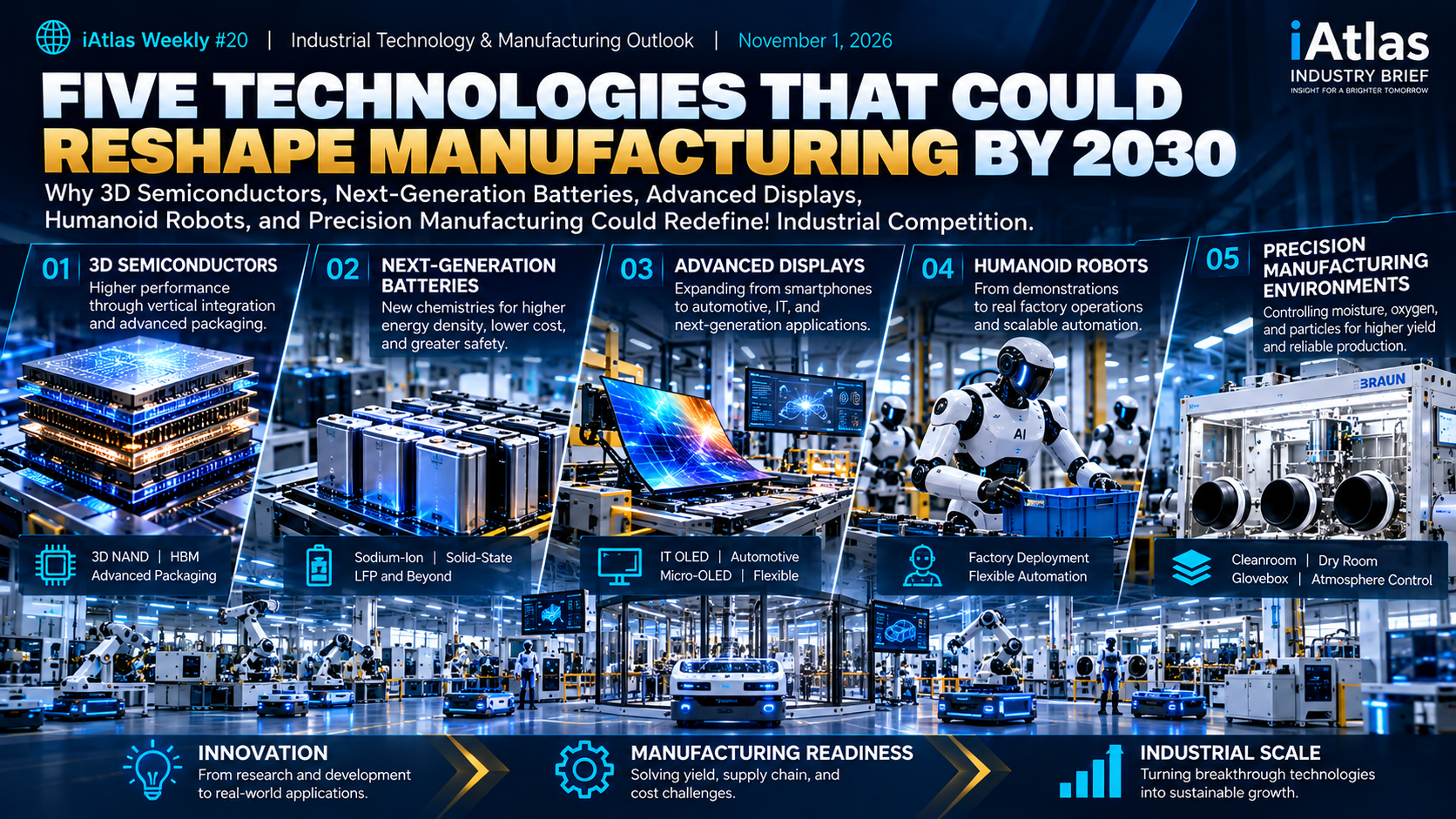
Five Technologies That Could Reshape Manufacturing by 2030
Why 3D Semiconductors, Next-Generation Batteries, Advanced Displays, Humanoid Robots, and Precision Manufacturing Could Redefine Industrial Competition
iAtlas Weekly #20 | Industrial Technology & Manufacturing Outlook | November 1, 2026
The Next Industrial Revolution May Happen Inside Factories
How will manufacturing technologies 2030 reshape the factories of the future?
The answer may be very different from the futuristic images often associated with industrial innovation.
Not every factory will be filled with humanoid robots. Not every electric vehicle will use a solid-state battery. And not every semiconductor will rely on the most advanced manufacturing node.
Instead, the next industrial transformation is likely to emerge from several technologies developing at different speeds.
Semiconductors are becoming more three-dimensional.
Battery manufacturers are experimenting with new chemistries.
Display technology is expanding beyond smartphones.
Robots are beginning to move from demonstrations into real production environments.
And manufacturers are paying closer attention to something less visible: the atmosphere surrounding their materials and processes.
These developments share an important characteristic.
Their commercial success depends not only on technological breakthroughs, but on the ability to manufacture them reliably, repeatedly, and economically.
This week’s iAtlas Weekly examines five technologies that could reshape manufacturing by 2030—and the industrial challenges that will determine how far they advance.
1. Three-Dimensional Semiconductors: Building Performance Vertically
For decades, semiconductor progress has been closely associated with making transistors smaller.
Smaller transistors have enabled manufacturers to integrate more computing capability into limited physical space.
But continued miniaturization is becoming increasingly difficult and expensive.
This is encouraging manufacturers to explore new ways of increasing performance and density.
One of the most important approaches is to build semiconductor structures vertically.
From Smaller Transistors to Three-Dimensional Architectures
Three-dimensional semiconductor technologies are not all the same.
3D NAND increases memory density by stacking memory-cell layers vertically.
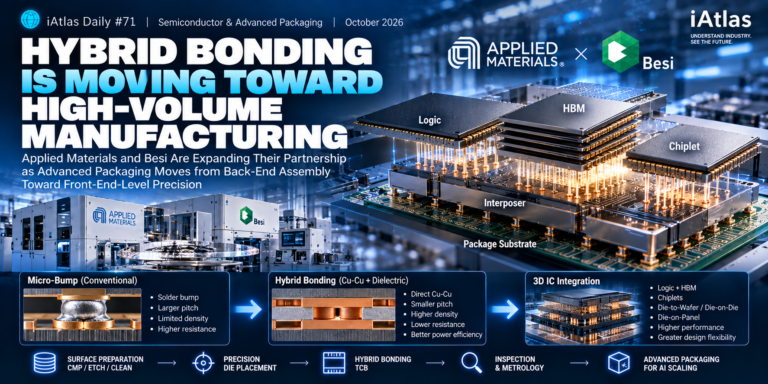
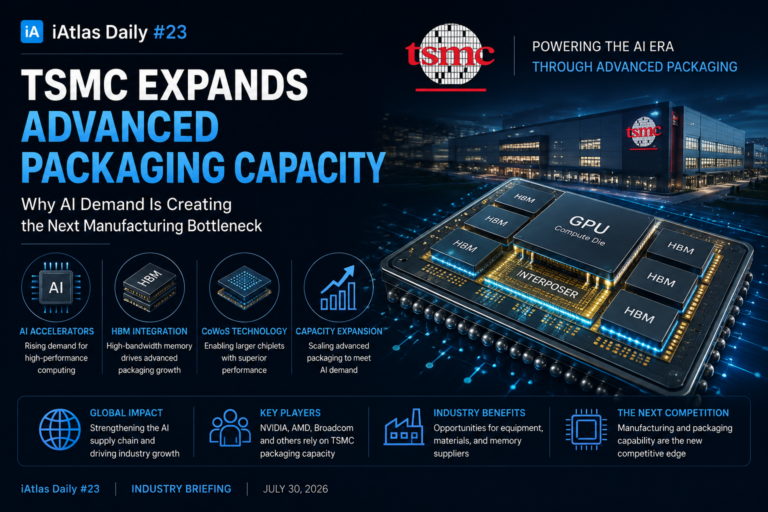
High Bandwidth Memory (HBM) uses vertically stacked DRAM dies connected through advanced interconnect technologies to provide high memory bandwidth.
Advanced packaging integrates multiple chips or chiplets into a package using sophisticated interconnect structures.
Each approach addresses different performance and manufacturing requirements.
Together, they demonstrate a broader shift in semiconductor engineering.
Instead of relying exclusively on smaller individual transistors, manufacturers are increasingly using architecture and integration to improve system performance.
Why This Matters for Manufacturing
Three-dimensional structures introduce new challenges.
More layers and more complex interconnections can increase the importance of deposition, etching, inspection, bonding, thermal management, and testing.
For example, advanced packaging requires precise alignment and reliable connections between different semiconductor components.
HBM production depends on advanced memory fabrication as well as sophisticated stacking and packaging processes.
As complexity increases, manufacturing equipment becomes more strategically important.
SEMI’s July 2026 forecast projects global semiconductor manufacturing equipment sales of approximately $229.5 billion in 2028, supported by investment in leading-edge logic, advanced memory, testing, and packaging.
This is a forecast rather than a guaranteed outcome, but it illustrates the scale of expected manufacturing investment.
The 2030 Outlook
By 2030, three-dimensional integration could become even more important in high-performance computing, memory, and specialized semiconductor applications.
However, the key competition will not simply be about who can stack the most layers.
It will also involve yield, thermal performance, manufacturing complexity, and cost.
The semiconductor industry is moving toward a future in which system integration matters almost as much as transistor scaling.
2. Next-Generation Batteries: More Than a Race for Energy Density
Battery technology is entering a period of diversification.
Lithium-ion batteries remain the dominant rechargeable technology for electric vehicles and many energy-storage applications.
However, different applications increasingly demand different combinations of cost, safety, energy density, durability, and temperature performance.
This creates opportunities for alternative battery chemistries.
Two important examples are sodium-ion batteries and solid-state batteries.
Sodium-Ion Batteries: Competing Through Cost and Material Availability
Sodium-ion batteries replace lithium-based charge carriers with sodium ions.
One potential advantage is reduced dependence on lithium.
They may also offer useful performance characteristics in low-temperature environments, depending on the cell design.
However, sodium-ion batteries generally have lower energy density than leading lithium-ion chemistries.
According to the IEA’s Global EV Outlook 2026, recent sodium-ion cells can reach approximately 175 Wh/kg, compared with up to 205 Wh/kg for advanced LFP cells and 265 Wh/kg for certain NMC cells.
These figures are technology examples, not universal specifications for every commercial cell.
The difference matters because energy density influences how much energy a battery can store for a given weight.
Sodium-ion batteries may therefore find stronger early opportunities in stationary energy storage, short-range mobility, and industrial equipment than in long-range premium electric vehicles.
Solid-State Batteries: Promising, but Difficult to Manufacture
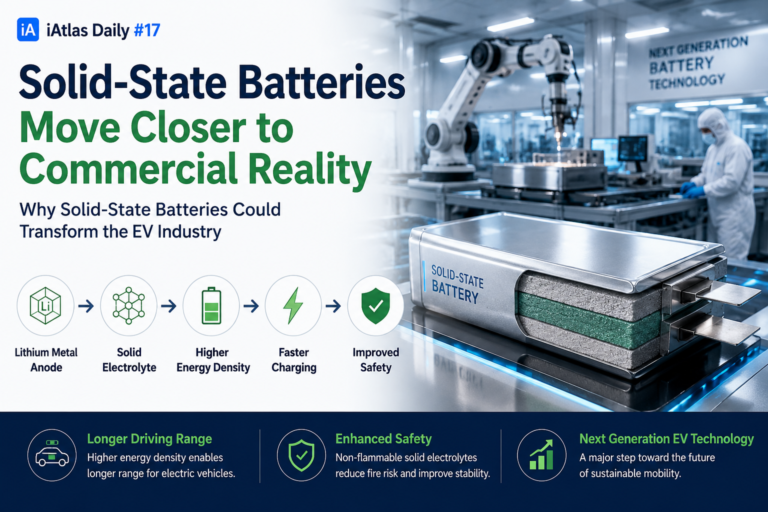
Solid-state batteries use solid electrolytes instead of relying entirely on conventional liquid-electrolyte systems.
Certain designs may enable improved safety characteristics or higher energy density.
But there are significant engineering challenges.
These can include:
- Maintaining reliable contact between solid materials
- Managing interfaces between electrodes and electrolytes
- Controlling mechanical pressure
- Achieving long cycle life
- Manufacturing cells at competitive cost
Some solid electrolyte materials also require careful environmental control during processing.
The IEA’s 2026 assessment emphasizes that all-solid-state batteries remain at an early stage of industrial scale-up, with manufacturing complexity and cost presenting important obstacles.
The 2030 Outlook
Battery markets may become more segmented.
LFP could remain highly competitive in cost-sensitive applications.
Sodium-ion batteries could expand where their characteristics provide a practical advantage.
Solid-state batteries may enter selected premium or specialized markets before achieving broader adoption.
The most successful battery technology will not necessarily be the chemistry with the highest laboratory performance.
It will be the chemistry that delivers the best combination of performance, reliability, manufacturing yield, and cost for a particular application.
3. Advanced Displays: Moving Beyond the Smartphone Era
The display industry has spent years competing over smartphone screen performance.
Higher resolution, brighter panels, thinner designs, and improved energy efficiency have all contributed to product differentiation.
But the next phase of display growth may be increasingly influenced by applications outside traditional smartphones.
IT OLED: A New Manufacturing Opportunity
OLED technology is expanding into laptops, tablets, and other IT products.
These applications often require larger panels and different performance characteristics from smartphone displays.
Manufacturers must consider brightness, lifetime, power consumption, panel uniformity, and production economics.
Larger display substrates can create additional manufacturing challenges.
Panel yield and material utilization become important factors in determining profitability.
Automotive Displays: Reliability Becomes Critical
Automotive displays are another area of opportunity.
Modern vehicles increasingly use digital instrument clusters, central infotainment screens, and additional passenger displays.
Some premium vehicles also use curved or integrated display architectures.
Automotive applications introduce demanding requirements.
Displays may need to withstand wide temperature variations, vibration, prolonged operating periods, and strict reliability testing.
A visually impressive panel is not sufficient.
It must remain dependable throughout the vehicle’s intended service life.
Micro-OLED and Near-Eye Displays
Micro-OLED technology is also attracting attention for augmented-reality and virtual-reality applications.
These displays can provide high pixel density within a small area.
However, commercialization depends on more than resolution.
Brightness, efficiency, thermal performance, optics, and manufacturing yield all influence the overall product.
The 2030 Outlook
By 2030, display manufacturers may serve a more diversified set of end markets.
Smartphones will remain important, but automotive, IT, industrial, and near-eye applications could create additional opportunities.
This diversification may also require manufacturers to develop more specialized production technologies.
The next display competition may be defined less by screen size alone and more by how effectively display technology adapts to different products and operating environments.
4. Humanoid Robots: From Impressive Demonstrations to Factory Economics
Humanoid robots have become one of the most visible symbols of advanced automation.
Recent demonstrations show robots walking, carrying objects, manipulating components, and interacting with their surroundings.
But performing a task in a demonstration is very different from performing it reliably in a factory.
Industrial production requires repeatability, safety, predictable operating costs, and integration with existing equipment.
Why Factories Are Interested
Traditional industrial robots are highly effective at repetitive tasks in structured environments.
However, many factories still rely on human workers for activities that require flexibility.
Examples include material handling, component sequencing, and certain assembly-support operations.
Humanoid robots are being investigated as a possible way to automate some of these tasks without completely redesigning existing workspaces.
Real Factory Experience Is Beginning
BMW has provided an important example of industrial humanoid testing.
According to BMW’s September 2026 report, Figure 02 robots participated in production-related operations at its Spartanburg facility in 2025.
The pilot involved handling more than 90,000 components over approximately 1,250 operating hours and supported production associated with more than 30,000 BMW X3 vehicles.
BMW and Figure AI have also discussed further development using Figure 03 for more complex logistics and sequencing tasks.
These projects demonstrate progress toward industrial deployment.
However, pilot performance does not automatically establish that humanoid robots are commercially competitive across an entire factory.
Four Major Barriers
Battery and Runtime
Robots must operate for useful periods without excessive charging interruptions.
Actuators and Mechanical Durability
Motors, gears, joints, and other motion systems must provide accurate and repeatable movement while tolerating industrial use.
Perception and Control
Robots must identify objects, respond to changing conditions, and operate safely around people and equipment.
Economics
The robot’s total cost must be justified by its actual productive output.
That includes acquisition, maintenance, energy, integration, downtime, and supervision.
The 2030 Outlook
Humanoid robots could become more common in selected manufacturing and logistics operations by 2030.
But broad adoption will depend on whether they outperform alternative automation methods economically.
In some factories, a conventional robot arm, conveyor, or automated mobile robot may remain the better solution.
The industrial value of humanoid robots will be measured not by how human they look, but by how reliably and economically they complete useful work.
5. Precision Manufacturing Environments: The Invisible Technology Behind Advanced Products
The fifth technology is less visible than the others.
It does not appear as a new battery chemistry, a futuristic display, or a humanoid robot.
Instead, it is the ability to control the manufacturing environment.
As advanced materials become more sensitive and manufacturing processes become more precise, environmental control becomes increasingly important.
Different Industries, Different Contamination Risks
Semiconductor manufacturers must manage particles and other contaminants that can create defects.
Battery manufacturers often need low-humidity environments to protect moisture-sensitive materials.
OLED production requires protection against unwanted exposure to oxygen and moisture during sensitive stages.
Some perovskite materials and solid-state battery components also require specialized handling conditions.
These industries do not all need the same environmental specifications.
But they share a need for controlled, repeatable manufacturing conditions.
Cleanrooms, Dry Rooms, and Gloveboxes
A cleanroom primarily controls airborne particles and other specified contaminants.
A dry room maintains low humidity across a production area.
A glovebox provides an enclosed atmosphere that can be controlled for oxygen, moisture, and selected gases.
These technologies address different requirements and can be combined when necessary.
Why Environmental Control Affects Economics
Contamination can reduce manufacturing yield.
It can also cause material degradation, rework, reliability problems, and wasted production capacity.
Preventing these problems may require investment in gas purification, filtration, dehumidification, sensors, and process integration.
The relevant question is whether that investment reduces total manufacturing cost or improves product quality sufficiently to justify it.
The 2030 Outlook
As advanced manufacturing becomes more complex, atmosphere and contamination control may become more closely integrated with production equipment.
Manufacturers may increasingly use monitoring data to optimize environmental conditions for specific processes.
Rather than applying the strictest possible specification everywhere, companies will need to determine where environmental control creates the greatest value.
One of the most important manufacturing technologies of the next decade may be the ability to control what cannot be seen.
6. Comparing the Five Technologies: What Could Change by 2030?
The five technologies differ significantly in commercial maturity.
Some are already central to industrial production.
Others are still transitioning from laboratory research or pilot programs.
| Technology | Current Position | Main Manufacturing Challenge | Potential 2030 Impact |
|---|---|---|---|
| 3D semiconductors | Commercial and expanding | Yield, integration, thermal management | Higher computing and memory performance |
| Next-generation batteries | Mixed: commercial sodium-ion scale-up, earlier-stage all-solid-state | Cost, durability, production scale | More specialized energy-storage markets |
| Advanced displays | Commercial with expanding applications | Yield, lifetime, manufacturing economics | Broader automotive, IT, and wearable markets |
| Humanoid robots | Pilot and early deployment | Reliability, safety, total operating cost | Selective automation of flexible tasks |
| Precision manufacturing environments | Established technology with evolving requirements | Process integration, energy use, cost | Higher yield and more consistent advanced-material production |
These are qualitative assessments, not forecasts of market size or adoption rates.
The table reveals an important distinction.
Some technologies create new products.
Others improve the ability to manufacture those products.
Both can generate substantial industrial value.
7. What Will Determine the Winners?
Technological superiority alone rarely guarantees commercial success.
By 2030, several factors are likely to separate successful industrial technologies from promising demonstrations.
Manufacturing Yield
Can companies produce the technology consistently at acceptable defect rates?
A breakthrough that performs well in a laboratory may remain uneconomical if production yield is low.
Supply Chain Readiness
Are the necessary materials, components, equipment, and specialized manufacturing capabilities available?
New technologies may face bottlenecks in components that receive less public attention than the final product.
Capital Expenditure
Can manufacturers justify the investment required to build or upgrade production facilities?
Advanced manufacturing often requires substantial upfront capital.
Product Reliability
Can the technology perform consistently over its intended lifetime?
This is especially important for automotive components, batteries, industrial robots, and electronic devices.
Customer Demand
Does the technology solve a problem customers are willing to pay to address?
Even impressive engineering may struggle commercially without a clear economic benefit.
These factors are interconnected.
A company may develop a superior technology but fail to scale it.
Another company may achieve stronger market results through a less advanced technology that is easier and cheaper to manufacture.
8. The Industrial Supply Chain Could Change More Than the Final Products
One of the most important consequences of these technologies may occur upstream.
The public usually sees finished products: electric vehicles, smartphones, computers, robots, and displays.
But every finished product depends on a network of specialized suppliers.
Three-dimensional semiconductors create demand for advanced deposition, etching, bonding, inspection, and packaging equipment.
New battery chemistries require materials development, electrode processing, testing, and environmental-control solutions.
Advanced displays depend on deposition equipment, encapsulation materials, inspection systems, and manufacturing expertise.
Humanoid robots require actuators, motors, sensors, power electronics, batteries, and precision mechanical components.
Controlled manufacturing environments require filtration, dehumidification, gas purification, monitoring, and system integration.
This creates a potentially important industrial pattern.
The companies that enable new technologies to be manufactured may capture significant value even when they do not produce the final consumer product.
For industrial equipment and materials suppliers, the central question is therefore not only which technology will win.
It is which manufacturing challenges will become more difficult—and which solutions customers will need to overcome them.
9. Three Possible Manufacturing Scenarios for 2030
The next four years could produce different outcomes depending on technology development, investment, and market conditions.
Scenario A: Gradual Industrial Evolution
Established technologies continue improving.
Three-dimensional semiconductor integration expands.
Lithium-ion batteries remain dominant while alternative chemistries grow in selected applications.
Advanced displays reach additional markets.
Humanoid robots remain concentrated in specialized tasks.
Environmental-control technologies become more integrated into production systems.
This scenario represents continued progress without a dramatic transformation of every factory.
Scenario B: Accelerated Commercialization
Manufacturing breakthroughs reduce costs faster than expected.
Advanced battery chemistries become commercially competitive in more applications.
Humanoid robots demonstrate reliable operation and attractive economics in selected production environments.
Advanced packaging and display manufacturing capabilities expand rapidly.
This scenario would create stronger demand for specialized materials, equipment, and manufacturing infrastructure.
Scenario C: Manufacturing Bottlenecks Slow Adoption
Promising technologies encounter persistent challenges.
Battery production costs remain high.
Robotic reliability and integration costs limit adoption.
Advanced semiconductor manufacturing becomes increasingly capital-intensive.
Supply chain concentration creates constraints.
In this scenario, technological progress continues, but commercialization advances more slowly than public expectations.
The most likely outcome may involve elements of all three scenarios across different industries.
Industry Implications | Where Should Companies Focus?
The transition toward advanced manufacturing creates different priorities for different industry participants.
Semiconductor Companies
Invest in architectures and manufacturing processes that improve performance without sacrificing yield and cost competitiveness.
Battery Manufacturers
Match battery chemistry and production investment to the needs of specific end markets.
Display Manufacturers
Develop products and manufacturing capabilities for automotive, IT, and emerging applications while protecting margins.
Robotics Companies
Prioritize reliable factory tasks, integration, maintenance, and measurable productivity over demonstrations alone.
Equipment and Materials Suppliers
Identify the process bottlenecks that could become more important as new technologies move toward commercial production.
Industrial Investors
Evaluate manufacturing readiness, customer adoption, capital requirements, and supply chain positioning—not only technical performance.
Across these industries, the most valuable opportunities may emerge where technology development intersects with difficult manufacturing problems.
iAtlas Insight | The Real Race Is From Innovation to Industrialization
The five technologies examined this week represent very different areas of innovation.
Yet they point toward the same conclusion.
The industrial winners of 2030 may not be the companies announcing the most dramatic breakthroughs today.
They may be the companies that can transform promising technologies into reliable and profitable manufacturing systems.
This transformation requires progress through three stages.
Stage 1 — Technical Feasibility
Can the technology work?
A laboratory result, prototype, or demonstration establishes that a concept is possible.
But it does not prove commercial readiness.
Stage 2 — Manufacturing Readiness
Can the technology be produced consistently?
At this stage, yield, equipment performance, materials availability, quality control, and process integration become critical.
Stage 3 — Economic Scalability
Can the technology compete commercially?
A successful industrial technology must provide sufficient value to justify its manufacturing and operating costs.
This is where many promising innovations face their greatest challenge.
A better battery must be manufacturable.
A more powerful semiconductor must be produced at acceptable yield.
A humanoid robot must complete useful tasks reliably.
An advanced display must maintain quality over its intended lifetime.
And all of these technologies may depend on manufacturing environments that protect sensitive materials and processes.
The next industrial transformation will therefore be about more than discovering new technologies.
It will be about developing the industrial capabilities required to produce them at scale.
Innovation creates possibilities. Manufacturing determines which possibilities become industries.
Related Articles
Semiconductor Technology
How Thin Film Deposition Builds Semiconductor Devices Layer by Layer
Explore one of the foundational processes supporting increasingly complex semiconductor structures.
Battery Technology
Understand the fundamental battery technology against which emerging chemistries must compete.
Industrial Strategy
The Next Industrial Advantage Is Flexibility
Learn why adaptable manufacturing systems are becoming increasingly valuable.
Supply Chains
Why Industrial Supply Chain Competition Is Moving Upstream
Examine why materials, components, and manufacturing equipment are becoming strategically important.
References
Industry outlook covering advanced memory, leading-edge semiconductor manufacturing, testing, and advanced packaging investment.
2. International Energy Agency — Global EV Outlook 2026: Electric Vehicle Batteries
Analysis of battery costs, manufacturing, sodium-ion development, and solid-state battery commercialization challenges.
3. International Energy Agency — Global EV Outlook 2026: Manufacturing and Trade
Research on electric vehicle and battery manufacturing capacity, supply chain concentration, and industrial competitiveness.
4. BMW Group — Humanoid Robots in Production at Plant Leipzig (September 2026)
Official reporting on BMW’s humanoid robot projects, factory integration, and the earlier Figure 02 pilot in Spartanburg.
5. Figure AI — Figure 03 Arrives at BMW (June 2026)
Company reporting on the Figure 03 platform and its development for factory logistics and sequencing tasks.
6. SEMI — Semiconductor Industry Association and Equipment Market Information
Industry resources on semiconductor manufacturing technologies and equipment market developments.
ℹ️ About iAtlas
iAtlas is an independent publication covering batteries, semiconductors, OLED, advanced materials, AI, and global industrial trends.
We transform complex industrial developments into clear, reliable, and easy-to-understand insights.
Whether you’re following today’s industry news or building long-term expertise, iAtlas helps you understand not only what happened, but why it matters.
Technology creates change.
Insight creates opportunity.
— iAtlas