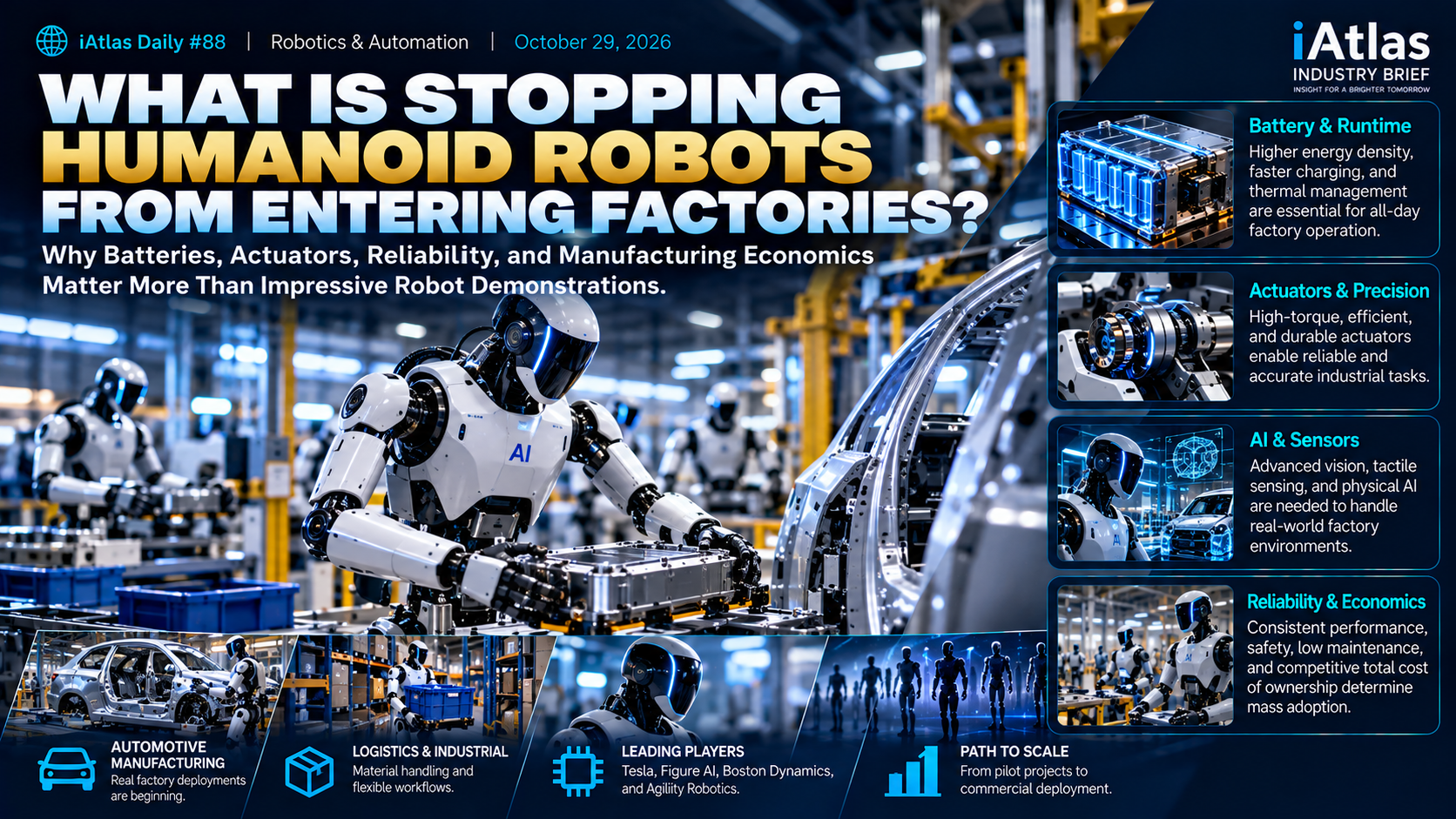
What Is Stopping Humanoid Robots from Entering Factories?
Why Batteries, Actuators, Reliability, and Manufacturing Economics Matter More Than Impressive Robot Demonstrations
iAtlas Daily #88 | Robotics & Automation | October 29, 2026
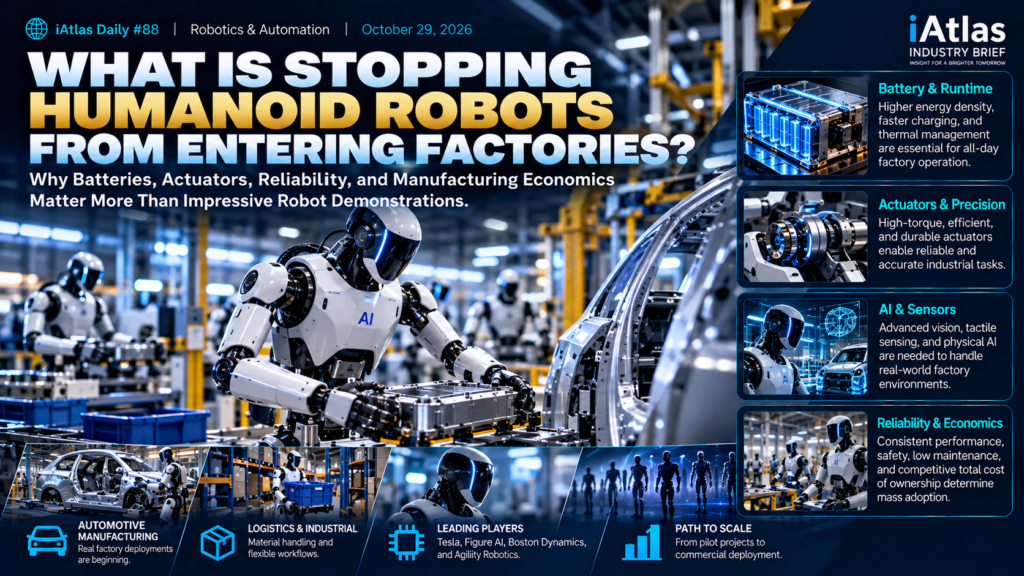
Humanoid Robots Are Entering Factories—but Scaling Them Is Another Challenge
Humanoid robots in manufacturing are moving beyond research laboratories and technology demonstrations into real industrial environments.
For years, videos of humanoid robots walking, running, dancing, and performing complex movements have attracted enormous attention.
These demonstrations show how rapidly robotics technology is advancing.
But factories operate under very different conditions.
A robot in a demonstration may perform a task for several minutes. A robot in a manufacturing facility must perform useful work repeatedly, safely, and economically.
It must handle unexpected situations, maintain accuracy, avoid disrupting production, and operate alongside existing equipment and employees.
Some companies are already testing or deploying humanoid robots in industrial facilities.
BMW has worked with Figure AI to integrate humanoid robots into automotive production. Hyundai Motor Group and Boston Dynamics are preparing Atlas for manufacturing applications. Agility Robotics has deployed its Digit robots in logistics environments.
These developments suggest that humanoid robots are beginning to find practical applications.
However, the transition from successful pilots to widespread commercial deployment remains difficult.
The biggest challenge is no longer simply making a humanoid robot move. It is making that robot a reliable and economically valuable part of an industrial production system.
1. Why Do Factories Need Humanoid Robots?
Industrial robots are not new.
Automotive manufacturers have used robotic arms for welding, painting, material handling, and assembly for decades.
These systems are highly effective when tasks are predictable and work environments are carefully designed.
So why develop humanoid robots?
The answer is flexibility.
Many factories were designed around human workers.
Their layouts include workstations, shelves, tools, carts, and equipment that people can access without major modifications.
A humanoid robot could potentially operate within some of these environments.
Instead of rebuilding an entire production line around fixed automation, manufacturers may be able to introduce mobile robots that perform selected tasks using existing infrastructure.
Potential applications include:
- Moving and sorting components
- Loading and unloading production equipment
- Handling materials between workstations
- Performing repetitive inspection tasks
- Supporting physically demanding operations
- Working in areas that are difficult to automate economically
However, a humanoid form is not automatically the best solution.
For highly repetitive tasks, conventional robotic arms, conveyors, and automated mobile robots may remain faster, cheaper, and more reliable.
The commercial opportunity for humanoids is strongest where mobility, manipulation, and adaptability create value that conventional automation cannot easily deliver.
2. BMW and Figure AI: From Demonstration to Factory Work
One of the most important industrial examples comes from BMW’s Spartanburg manufacturing plant in the United States.
BMW collaborated with Figure AI to test and deploy its Figure 02 humanoid robot in automotive production.
The robot performed a sheet-metal handling task, positioning components for subsequent manufacturing operations.
According to BMW and Figure AI, the deployment produced measurable results.
BMW’s Figure 02 Deployment
| Reported Metric | Result |
|---|---|
| Components handled | More than 90,000 |
| Operating time | Approximately 1,250 hours |
| Vehicles supported | More than 30,000 BMW X3 vehicles |
| Typical working schedule | 10-hour shifts, five days per week |
These figures demonstrate that humanoid robots can perform selected industrial tasks over extended periods.
However, they do not establish that humanoids are ready to replace entire manufacturing workforces.
The deployment focused on a defined task within an existing production environment.
It was an important industrial validation, not proof of universal autonomy.
Figure 03: A More Complex Challenge
In June 2026, BMW and Figure AI announced the next phase of their collaboration involving Figure 03.
The new project focuses on parts sequencing in manufacturing logistics.
Instead of repeatedly placing similar sheet-metal components, the robot must handle parts that may arrive in different orientations and positions.
It must recognize objects, manipulate them accurately, and coordinate movement across a changing workspace.
This is a more demanding problem.
The shift from repetitive handling to adaptable logistics illustrates how humanoid robotics is progressing toward more flexible industrial tasks.
But it also shows why scaling remains challenging.
A robot must perform consistently when the real world does not match a perfectly controlled demonstration.
3. Boston Dynamics Atlas: Preparing for Automotive Manufacturing
Boston Dynamics is developing Atlas as a fully electric humanoid robot designed for industrial applications.
In January 2026, the company introduced the product version of Atlas and outlined plans for manufacturing-related deployments.
The company subsequently established a training and validation operation with Hyundai Motor Group.
Robotics Metaplant Application Center
In September 2026, Boston Dynamics announced the opening of its Robotics Metaplant Application Center at Hyundai Motor Group Metaplant America in Georgia.
The facility is designed to train and evaluate Atlas robots in realistic manufacturing environments.
Initial tasks include automotive parts sequencing and material handling.
These activities may appear relatively simple compared with advanced vehicle assembly.
However, they require capabilities that are difficult to reproduce reliably.
A robot must identify components, manipulate objects, maintain balance, and coordinate movements within a changing industrial environment.
Hyundai Motor Group has outlined a roadmap targeting initial Atlas parts-sequencing applications in 2028, with broader assembly-related applications planned from 2030, subject to successful validation.
This timeline is important.
It demonstrates that major manufacturers are treating humanoid robotics as a long-term industrialization project rather than assuming immediate mass deployment.
4. The First Major Challenge: Batteries and Operating Time
Humanoid robots require electrical power for several functions.
These include:
- Joint motors and actuators
- Computing hardware
- Cameras and sensors
- Communication systems
- Balance and motion control
- Object manipulation
Unlike a stationary industrial robot connected to a continuous power supply, a mobile humanoid must often carry its own energy source.
This creates a fundamental engineering trade-off.
A larger battery can increase operating time, but it also adds weight.
Additional weight can increase the energy required for movement.
It may also affect balance, mechanical design, and actuator requirements.
Why Runtime Matters
Factories measure productivity across shifts, not short demonstrations.
A humanoid robot that requires frequent charging may be less productive than expected.
Manufacturers therefore need to optimize:
Battery Capacity: Enough stored energy to complete useful work.
Energy Efficiency: Lower power consumption during movement and manipulation.
Charging Strategy: Efficient charging or battery replacement without excessive downtime.
Thermal Management: Reliable operation of batteries, motors, and computing systems.
The relevant metric is not simply maximum battery capacity.
It is how much useful industrial work the robot can perform per unit of energy and operating time.
5. Actuators: The Mechanical Foundation of Humanoid Robots
Actuators convert electrical energy into mechanical movement.
They allow a humanoid robot to move its arms, legs, hands, and other joints.
These components are among the most important technologies in humanoid robotics.
A robot may contain many actuators, each with different performance requirements.
Some joints require substantial torque.
Others require high precision, fast response, or compact dimensions.
Why Actuators Are Difficult to Optimize
Industrial humanoid actuators must balance several competing requirements.
Torque: Sufficient force to lift objects and maintain stability.
Precision: Accurate positioning for assembly and material handling.
Efficiency: Low energy consumption during repetitive movement.
Weight: Compact construction to avoid excessive mechanical mass.
Durability: Reliable performance through repeated operating cycles.
Cost: Manufacturing economics suitable for commercial deployment.
An actuator that performs exceptionally well in one area may create disadvantages elsewhere.
For example, a powerful motor may increase weight and energy consumption.
A highly precise actuator may be expensive or difficult to manufacture at scale.
This is why humanoid robotics creates opportunities for suppliers of motors, gear systems, bearings, sensors, power electronics, and advanced mechanical components.
6. Sensors and AI: Understanding an Unpredictable Factory
Factories are not perfectly predictable environments.
Components may arrive in different positions.
Objects can shift inside containers.
Workers and mobile equipment may move through shared spaces.
Lighting conditions and visual obstructions can change.
A humanoid robot must respond to these variations.
Vision Systems
Cameras help robots identify objects, understand their surroundings, and estimate positions.
However, visual recognition alone is insufficient.
A robot must also determine how to interact with an object safely and accurately.
Force and Tactile Sensing
When handling components, a robot must control gripping force.
Too little force can cause an object to slip.
Too much force can damage it.
Tactile and force-related sensing can help improve manipulation.
Balance and Motion Control
Humanoid robots must coordinate multiple joints while maintaining stability.
This becomes especially challenging when carrying objects, changing direction, or working in confined spaces.
Physical AI
Physical AI combines perception, decision-making, and action.
Instead of relying exclusively on fixed instructions, robots can use learned models to adapt to changing situations.
Figure AI’s Helix system is one example of this approach.
However, successful AI demonstrations do not automatically guarantee reliable industrial performance.
Manufacturers must validate how systems behave across many operating conditions, including unexpected events.
7. Reliability and Safety: The Difference Between a Demo and a Factory
Reliability is one of the most important requirements in industrial automation.
A manufacturing robot must operate predictably over long periods.
Unexpected failures can interrupt production, damage equipment, or create safety risks.
Humanoid robots introduce additional challenges because they combine mobility, multiple actuators, autonomous decision-making, and human interaction.
Key Reliability Questions
How often does the robot fail to complete a task?
Can it recover from an unsuccessful attempt?
How much maintenance does it require?
How long does it take to restore operation after a failure?
Can it operate safely near employees?
These questions matter more to factory operators than impressive movement demonstrations.
Safety Engineering
A robot operating near people must account for collisions, unexpected movements, falling objects, and loss of balance.
Safety systems may include:
- Emergency stopping mechanisms
- Collision detection and avoidance
- Force and speed limitations
- Protected operating zones
- Safety-rated control functions
- Risk assessment and operational procedures
Appropriate safeguards depend on the robot, task, and workplace.
Existing industrial robot safety standards provide important foundations, but mobile humanoids can introduce additional risk-assessment challenges.
BMW’s early humanoid deployment required coordination across occupational safety, factory IT, logistics, and production management.
This illustrates why robot commercialization is an industrial systems-engineering challenge, not merely a hardware-development problem.
8. Manufacturing Economics: Can a Humanoid Robot Justify Its Cost?
Even if a humanoid robot can perform a task, factories must determine whether using it makes economic sense.
The purchase price is only one part of the calculation.
A robot also requires maintenance, software support, charging infrastructure, integration, supervision, and potential replacement components.
Total Cost of Ownership
A simplified industrial evaluation considers:
Initial Investment: Robot acquisition and deployment costs.
Operating Costs: Electricity, maintenance, software, and consumables.
Integration Costs: Changes to workflows, equipment, and factory systems.
Productivity: Number of successfully completed tasks per hour.
Availability: Percentage of scheduled time the robot is operational.
Service Life: Useful operating life before major replacement or refurbishment.
Safety and Quality: Costs associated with errors, damage, or operational incidents.
A robot that performs tasks slowly or requires frequent intervention may offer limited economic value even if its purchase price declines.
The Productivity Equation
A useful way to evaluate deployment is:
Effective Productivity = Successful Tasks Completed ÷ Total Scheduled Operating Time
This includes time lost to charging, maintenance, recovery, and interruptions.
A second important measure is:
Cost per Successful Task = Total Operating Cost ÷ Successfully Completed Tasks
These measures are often more useful than comparing robot purchase prices alone.
The strongest commercial applications will be those where robots can deliver consistent productivity at competitive lifetime costs.
9. Agility Robotics: A Different Path Through Logistics
Agility Robotics offers another perspective on industrial humanoid commercialization.
Its Digit robot is designed primarily for material-handling and logistics applications.
Unlike robots developed mainly to demonstrate general-purpose humanlike capabilities, Digit has been deployed in selected warehouse workflows.
Agility and GXO announced a commercial Robots-as-a-Service agreement in 2024.
The deployment focused on repetitive material-handling operations.
In September 2026, Agility announced Digit 5, describing a roadmap toward expanded manipulation capabilities and broader industrial workflows.
The company also reported operational milestones from its existing deployments.
These results suggest that logistics may provide an early market for humanoid and bipedal mobile robots.
Warehouses often contain repetitive handling tasks, structured workflows, and measurable productivity requirements.
However, even within logistics, conventional automation remains an important competitor.
Humanoid robots must demonstrate that their flexibility creates enough additional value to justify their complexity.
10. Industry Implications: Opportunities Beyond Robot Manufacturers
The humanoid robotics industry could create opportunities across multiple manufacturing sectors.
| Industry Segment | Potential Opportunity | Major Challenge |
|---|---|---|
| Battery Manufacturers | Compact, high-performance battery packs | Runtime, safety, weight |
| Actuator Suppliers | Motors, reducers, precision motion systems | Torque, efficiency, durability |
| Semiconductor Companies | AI processors, motor-control chips, power devices | Performance per watt |
| Sensor Manufacturers | Cameras, force sensors, encoders | Accuracy, reliability, cost |
| Materials Suppliers | Lightweight structures and durable components | Strength, weight, production cost |
| Factory Automation | Integration with production and logistics systems | Safety, uptime, interoperability |
This industrial structure is important.
The humanoid robotics market is not limited to companies assembling complete robots.
It also depends on a broad network of component suppliers, software developers, equipment manufacturers, and industrial customers.
As the industry matures, competition may increasingly focus on the ability to manufacture robots consistently and support them throughout their operating lives.
iAtlas Insight | The Real Breakthrough Will Be Industrial Reliability
Humanoid robots are often evaluated by how closely they resemble human movement.
Can they walk naturally?
Can they climb stairs?
Can they pick up unfamiliar objects?
These are important technical achievements.
But factories evaluate technology differently.
A manufacturer needs to know whether a robot can complete useful work safely, repeatedly, and economically.
This creates three stages of industrial commercialization.
Stage 1 — Technical Demonstration
The robot proves that it can perform a task.
Stage 2 — Operational Validation
The robot performs that task repeatedly under real factory conditions.
Stage 3 — Economic Scalability
The robot delivers sufficient productivity and reliability to justify deployment across multiple facilities.
Some humanoid companies are already progressing through the second stage in selected applications.
The third stage remains the central challenge.
The next major breakthrough may not be a robot performing an extraordinary movement.
It may be a robot performing an ordinary industrial task thousands of times with minimal interruption.
The future of humanoid robotics will be decided not by the most impressive demonstration, but by the most reliable and economically useful deployment.
Related Articles
Semiconductor Manufacturing
How Thin Film Deposition Builds Semiconductor Devices Layer by Layer
Understand how advanced semiconductor manufacturing supports the processors, sensors, and electronic components used in intelligent robotic systems.
Industrial Strategy
The Next Industrial Advantage Is Flexibility
Explore why flexible manufacturing systems are becoming increasingly important as industrial companies adapt to changing production requirements.
Industrial Supply Chains
Industrial Competition Is Moving Deeper into the Supply Chain
Learn why component suppliers, materials producers, and specialized manufacturing technologies are becoming strategically important across emerging industries.
References
Official information on the Figure 02 deployment, production results, and the Figure 03 logistics project.
2. Figure AI — Figure 02 Contributed to the Production of 30,000 Cars at BMW (November 2025)
Deployment results including component handling, operating hours, and lessons learned from automotive manufacturing.
3. Figure AI — Figure 03 Arrives at BMW (June 2026)
Technical overview of parts sequencing, whole-body coordination, and adaptive manipulation in automotive logistics.
4. Boston Dynamics — Boston Dynamics Opens Robotics Metaplant Application Center (September 2026)
Official announcement of Atlas training and validation for automotive manufacturing applications.
5. Hyundai Motor Group — Inside the Robotics Race: Atlas Learns the Real World (September 2026)
Overview of Atlas training, industrial data collection, and Hyundai’s humanoid robotics commercialization roadmap.
Company update on industrial deployment experience, material-handling applications, and future commercial expansion.
Official announcement of Digit’s commercial logistics deployment and Robots-as-a-Service model.
ℹ️ About iAtlas
iAtlas is an independent publication covering batteries, semiconductors, OLED, advanced materials, AI, and global industrial trends.
We transform complex industrial developments into clear, reliable, and easy-to-understand insights.
Whether you’re following today’s industry news or building long-term expertise, iAtlas helps you understand not only what happened, but why it matters.
Technology creates change.
Insight creates opportunity.
— iAtlas