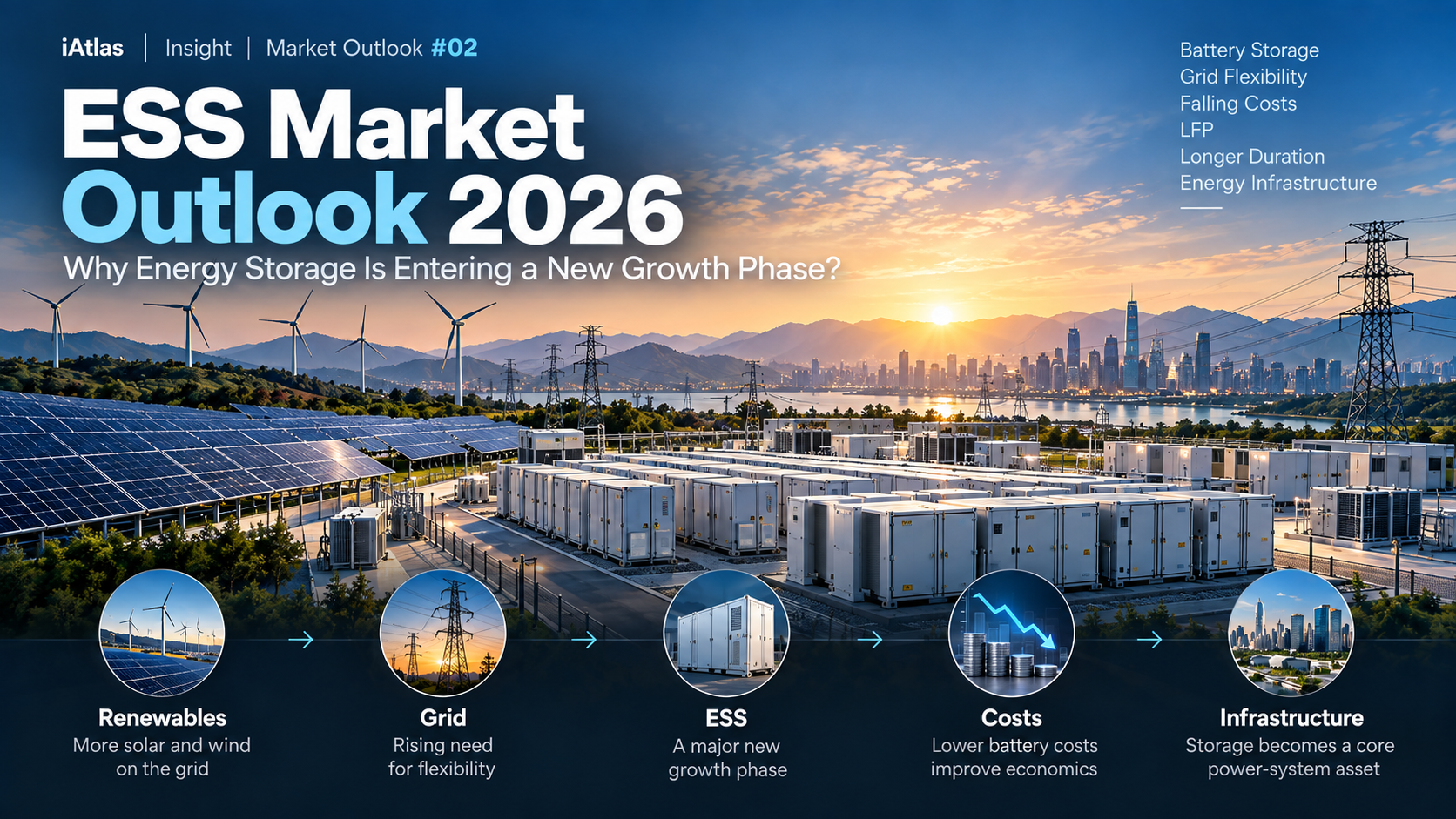
ESS Market Outlook 2026
Why Energy Storage Is Entering a New Growth Phase
iAtlas | Insight | Market Outlook #02
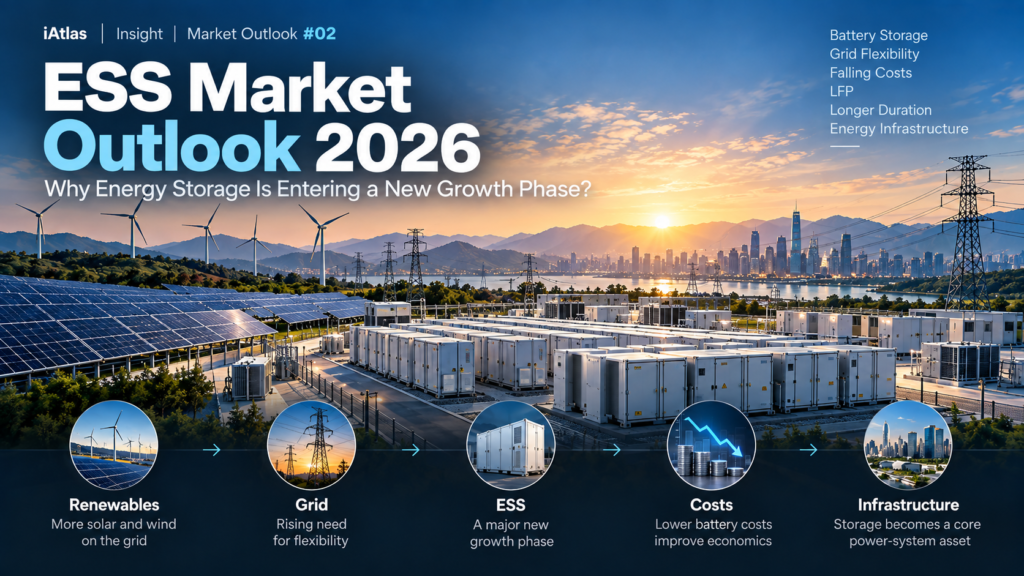
The ESS market outlook for 2026 points to a new phase of growth.
Energy storage systems were once viewed mainly as supporting infrastructure for renewable energy. Today, they are becoming a core part of modern power systems.
Solar and wind capacity is expanding. Electricity demand is rising. Data centers and electrification are creating new loads. Power grids are becoming more congested, while utilities need greater flexibility to balance supply and demand.
At the same time, falling battery costs and the rapid expansion of LFP technology are making large-scale battery storage increasingly competitive.
The result is a structural shift:
ESS is moving from a supporting technology to a major energy infrastructure market.
Key Takeaways
- Global ESS battery shipments are expanding rapidly, reaching 461.3 GWh in the first half of 2026, up 71% year over year. SNE Research
- Growth is becoming more geographically diversified, with markets outside China accounting for 56% of global shipments in 1H26. SNE Research
- Battery storage was the fastest-growing power technology in 2025, with 108 GW of new capacity deployed worldwide. IEA
- Around 90% of battery-storage deployments now use LFP chemistry, reflecting the importance of cost, cycle life and frequent charging. IEA
- Utility-scale systems dominate today’s market, but residential and commercial ESS are also expanding.
- Longer-duration battery projects are becoming more common as renewable penetration increases.
- The biggest constraints may increasingly shift from battery availability toward grid connections, permitting, revenue models and project economics.
1. The ESS Market Is Accelerating
Battery energy storage is one of the fastest-growing parts of the global battery industry.
According to SNE Research, global lithium-ion ESS battery shipments reached approximately 461.3 GWh during the first half of 2026, compared with 269.7 GWh a year earlier.
That represents growth of approximately 71% year over year. SNE Research
This growth follows an already strong expansion in battery-storage deployment.
The IEA reported that 108 GW of new battery-storage capacity was installed globally in 2025, around 40% more than in 2024. Global installed battery-storage capacity was already eleven times higher than in 2021. IEA
These two figures measure different things.
Battery shipments in GWh indicate the amount of battery energy capacity supplied to the ESS market.
Installed power capacity in GW measures the rate at which operating storage systems can charge or discharge electricity.
Both indicators, however, point in the same direction:
Energy storage is scaling rapidly.
2. Why Is ESS Growing So Quickly?
ESS growth is not driven by one factor.
Several structural changes in the electricity system are happening simultaneously.
More Renewable Energy
Solar and wind generation vary according to weather and time of day.
Solar production can be abundant during the afternoon but decline rapidly as evening electricity demand remains high.
Battery storage allows electricity generated earlier in the day to be shifted to periods when it is more valuable.
Rising Electricity Demand
Electrification is increasing demand from transportation, buildings and industry.
At the same time, new large electricity consumers such as data centers are adding concentrated loads to power systems.
Grid Congestion
Electricity generation and consumption do not always occur in the same place.
Grid expansion can take years.
Battery storage can provide additional flexibility and, in certain situations, reduce or defer some network investment requirements. The IEA identifies battery storage as an increasingly important tool for balancing power systems and managing grid constraints. IEA
Together, these trends are turning flexibility into a valuable part of the electricity system.
And batteries are becoming one of the most important technologies providing that flexibility.
3. ESS Is Becoming a Global Market
China remains the world’s largest individual ESS market.
But one of the most important developments in 2026 is that growth is spreading beyond China.
SNE Research estimates that China received approximately 202.5 GWh of ESS battery shipments during the first half of 2026.
Meanwhile, North America, Europe and other markets collectively received approximately 258.7 GWh.
For the first time, non-China markets represented more than half — approximately 56% — of global ESS shipments. SNE Research
This diversification is strategically important.
It suggests that ESS demand is becoming less dependent on a single national market and more connected to global energy-system investment.
The IEA similarly reports strong storage momentum not only in China, the United States and Europe, but also in markets such as Australia and parts of the Middle East. IEA
The ESS growth story is therefore becoming increasingly global.
4. Utility-Scale Storage Is Leading the Market
Not all energy-storage systems serve the same purpose.
ESS can broadly be divided into:
Utility-Scale Storage
Large systems connected directly to electricity grids.
Commercial & Industrial Storage
Systems installed at factories, offices, data centers or other commercial facilities.
Residential Storage
Smaller battery systems installed alongside residential solar or for backup power.
Today, utility-scale systems represent the largest part of the market.
According to the IEA, around 80% of new battery-storage capacity added globally in 2025 was utility-scale, while the remainder was installed behind the meter by commercial and residential users. IEA
Utility-scale batteries can provide multiple services:
- Energy shifting
- Peak-demand support
- Frequency regulation
- Grid balancing
- Renewable integration
- Capacity provision
- Congestion management
This ability to perform several functions is one reason batteries are becoming increasingly valuable within power systems.
5. Falling Costs Are Changing ESS Economics
One of the strongest drivers of ESS growth is declining battery cost.
The economics of battery-storage projects have improved substantially over the past several years.
The IEA reports that utility-scale battery project costs fell by around 40% in 2024 to approximately USD 150/kWh. IEA
Battery pack prices also continued declining afterward.
Lower costs change the market in several ways.
More Projects Become Economically Viable
A project that could not generate sufficient returns at higher battery prices may become attractive when system costs decline.
Longer Storage Durations Become More Affordable
Adding additional battery capacity to extend discharge time becomes less expensive.
Storage Can Enter More Markets
Regions with less mature energy-storage markets can begin deploying projects as economics improve.
The ESS market therefore benefits from a reinforcing mechanism:
Lower Battery Costs
↓
Better Project Economics
↓
More ESS Deployment
↓
Greater Manufacturing Scale
↓
Further Cost Optimization
This is one of the most important forces behind the current market expansion.
6. LFP Has Become the Dominant ESS Chemistry
The growth of lithium iron phosphate — LFP — has fundamentally changed stationary battery storage.
ESS applications usually prioritize different characteristics from premium electric vehicles.
Maximum energy density is less important when a battery sits in a container or stationary facility.
Instead, developers often prioritize:
- Cost
- Cycle life
- Safety
- Durability
- Frequent charging and discharging
These requirements fit LFP particularly well.
According to the IEA, LFP now represents approximately 90% of global battery-storage deployments. Five years earlier, its share was below 50%. IEA
This chemistry shift also links the ESS market closely with China’s battery industry.
China has built enormous LFP manufacturing capacity and supply-chain expertise.
As ESS grows, competition over LFP cells, system integration, power electronics and project execution is therefore likely to become increasingly important.
7. Storage Duration Is Getting Longer
Another important change is occurring in the design of ESS projects.
Historically, many battery projects were designed for relatively short periods of operation.
Two-hour systems remain common.
But as renewable-energy penetration increases, electricity systems increasingly need batteries capable of shifting larger amounts of energy over longer periods.
The IEA notes that while most projects remain concentrated around approximately two hours, an increasing number are being developed with four hours or more of storage duration. IEA
Examples differ by region.
California has developed a large concentration of four-hour battery systems.
Australia is moving toward longer average storage durations.
China’s average duration for new-type energy storage has also increased.
Some governments are beginning to support projects capable of eight hours or more. IEA
This creates an important market question:
How far can lithium-ion batteries economically extend storage duration?
For shorter-duration flexibility, lithium-ion currently holds a very strong position.
For longer-duration requirements, alternative technologies may eventually compete more actively.
These could include:
- Flow batteries
- Sodium-ion batteries
- Thermal storage
- Compressed-air storage
- Pumped hydro
- Other long-duration energy-storage technologies
The market could therefore gradually divide by storage duration and application, rather than being dominated by one technology everywhere.
8. AI and Data Centers Add Another Layer to the ESS Story
The rise of AI infrastructure creates another potential source of energy-storage demand.
Data centers require large amounts of reliable electricity.
But the connection between AI and ESS is more complicated than simply saying:
More AI = More Batteries.
Data centers already use battery-based uninterruptible power supplies, or UPS, primarily to bridge short power interruptions.
The IEA estimates that battery-based UPS capacity additions, mainly associated with data centers, increased approximately 30% to 45 GW in 2025. IEA
However, UPS and grid-scale ESS perform different functions.
UPS systems primarily protect critical loads during outages.
Grid-scale ESS provides electricity-system flexibility.
The more important long-term connection may therefore be indirect:
AI Growth
↓
More Data Centers
↓
Higher Electricity Demand
↓
More Generation & Grid Investment
↓
Greater Need for Flexibility
↓
More Energy Storage
This relationship could become increasingly important as AI infrastructure expands.
9. The Biggest Bottleneck May Move Beyond Batteries
Rapid battery manufacturing expansion means that battery-cell availability may not always be the main constraint on ESS growth.
Other bottlenecks are becoming more important.
Grid Connection
Large numbers of generation, storage and demand projects are waiting for connections in many electricity markets.
The IEA describes grid capacity as an emerging bottleneck worldwide. IEA
Permitting
Large battery projects can encounter lengthy planning and approval processes.
Safety
Fire safety, site design and community concerns can affect project approvals.
Revenue Uncertainty
ESS can earn money through multiple mechanisms — energy arbitrage, ancillary services, capacity markets and other grid services.
But these revenue streams can change as markets mature.
Financing
Storage projects require investors to understand future electricity-market conditions and revenue opportunities.
The IEA notes that despite large project pipelines, some battery projects face delays related to grid connections, permitting, uncertain revenues and access to financing. IEA
This means the competitive landscape is changing.
The ESS business is not simply about producing batteries.
It increasingly requires expertise in:
Battery Cells + System Integration + Power Electronics + Software + Grid Connection + Financing + Project Operation
10. How Large Could the Market Become?
The long-term potential is substantial.
In its Net Zero Emissions scenario, the IEA estimates that global energy-storage capacity would need to expand to approximately 1,500 GW by 2030.
Battery storage would represent around 1,200 GW, accounting for the vast majority of that increase. IEA
This is a scenario rather than a guaranteed forecast.
But it illustrates the scale of storage that could be required if renewable deployment continues rapidly and electricity systems become more electrified.
The strategic significance of ESS therefore extends beyond the battery industry.
Storage sits at the intersection of:
Battery Manufacturing
↓
Renewable Energy
↓
Electricity Markets
↓
Grid Infrastructure
↓
Data Centers
↓
Energy Security
That intersection is what makes ESS one of the most important emerging industrial markets.
iAtlas Outlook
The ESS market outlook remains strongly positive, but the nature of competition is changing.
The first stage of the market was primarily about proving that batteries could provide useful grid services.
The next stage will be about scale.
ESS Market 1.0
Renewable Support
↓
Pilot Projects
↓
Frequency Regulation
↓
Early Grid Applications
ESS Market 2.0
Utility-Scale Deployment
↓
Energy Shifting
↓
Grid Flexibility
↓
Longer Duration
↓
Regional Expansion
↓
Energy Infrastructure
ESS is no longer simply an extension of the EV battery market.
It is developing its own demand drivers, project economics and competitive structure.
Battery cells will remain critical.
But future value creation may increasingly extend toward system integration, PCS and inverters, energy-management software, project development and long-term operation.
The next stage of ESS growth will therefore be determined not only by how many batteries can be produced, but by how effectively batteries can be integrated into increasingly complex electricity systems.
That is why energy storage is entering a new growth phase.
Continue Reading
Previous Market Outlook
Global Battery Market Outlook 2026
What Will Drive the Next Growth Cycle?
Next Market Outlook
LFP vs NCM Market Outlook
How the Battery Chemistry Market Is Shifting
References
- International Energy Agency (IEA) — Global Energy Review 2026: Battery Storage
- International Energy Agency (IEA) — Electricity 2026: Flexibility
- International Energy Agency (IEA) — Batteries and Secure Energy Transitions
- SNE Research — Global ESS Shipments Reach 461 GWh in 1H26
ℹ️ About iAtlas
iAtlas is an independent publication covering batteries, semiconductors, OLED, advanced materials, AI, and global industrial trends.
We transform complex industrial developments into clear, reliable, and easy-to-understand insights.
Whether you’re following today’s industry news or building long-term expertise, iAtlas helps you understand not only what happened, but why it matters.
Technology creates change.
Insight creates opportunity.
— iAtlas