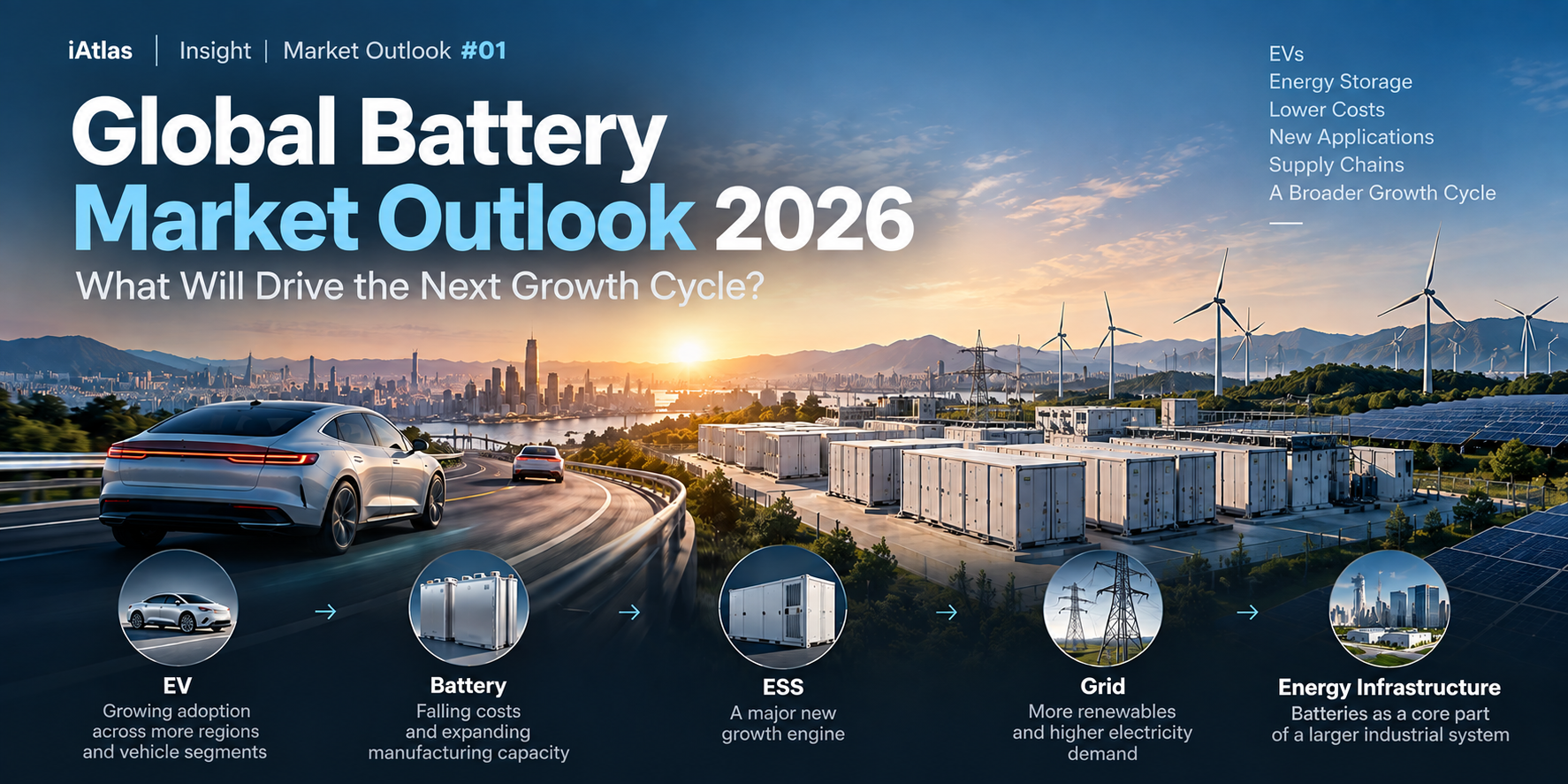
Global Battery Market Outlook 2026
What Will Drive the Next Growth Cycle?
iAtlas | Insight | Market Outlook #01
The global battery market outlook for 2026 points to a new phase of growth.
Over the past decade, battery-market growth was driven primarily by one powerful force: the rapid expansion of electric vehicles.
That growth story is far from over. Global EV battery deployment reached approximately 1.2 TWh in 2025, almost 30% higher than a year earlier, and the International Energy Agency expects EV battery deployment to approach 3 TWh by 2030 under current and stated-policy scenarios.
But the market is changing.
Energy storage systems are emerging as a second major source of battery demand. LFP is reshaping battery economics. Manufacturing capacity has expanded faster than demand in some regions. China remains dominant across cells and materials, while governments and manufacturers are trying to build more regionalized supply chains.
The next battery growth cycle will therefore be broader — and more competitive — than the one that came before it.
Key Takeaways
- EVs will remain the largest source of battery demand, with deployment expected to continue rising toward 2030.
- ESS is becoming a major second growth engine, supported by renewable energy, grid requirements and rising electricity demand.
- Battery costs continue to decline, expanding potential applications but increasing competitive pressure on manufacturers.
- LFP has become a mainstream chemistry, representing more than half of global EV battery deployment in 2025.
- Manufacturing capacity alone is no longer enough — utilization, cost, yield and supply-chain efficiency are becoming increasingly important.
- China remains at the center of the global battery supply chain, particularly in battery cells and active materials.
- The battery industry is increasingly becoming part of a much larger energy and industrial infrastructure ecosystem.
Global Battery Market Outlook: Demand Continues to Expand
The global battery market is still growing rapidly.
EVs accounted for more than 70% of total global battery deployment in 2025, with EV battery deployment reaching approximately 1.2 TWh.
That was more than seven times the level recorded in 2020.
Momentum has continued into 2026.
According to SNE Research, global battery usage in registered electric vehicles reached approximately 725.2 GWh from January through July 2026, an increase of 20.4% year over year.
This suggests an important point.
The battery market is no longer in the earliest phase of electrification, but demand is still expanding at a significant pace.
The difference is that future growth is likely to come from a wider range of applications and regions.
2. EVs Remain the Core Battery Market
Electric vehicles will continue to provide the foundation of global battery demand.
The IEA expects EV battery deployment to increase from around 1.2 TWh in 2025 to almost 3 TWh by 2030.
By 2035, deployment could rise to approximately 4–5 TWh under current and stated-policy scenarios.
Passenger vehicles will remain the largest segment, but other vehicle categories are beginning to matter.
Battery demand from electric trucks more than doubled in 2025, and trucks are expected to account for a growing share of total EV battery deployment over the coming decade.
Geographic diversification is also important.
China remains the world’s largest EV and battery market, but electrification is spreading across Europe, emerging Asian markets and other developing economies.
The next EV battery growth cycle will therefore be less dependent on one vehicle segment or one geographic market.
3. ESS Is Emerging as a Second Growth Engine
The most important structural change outside EVs is the rapid expansion of energy storage systems, or ESS.
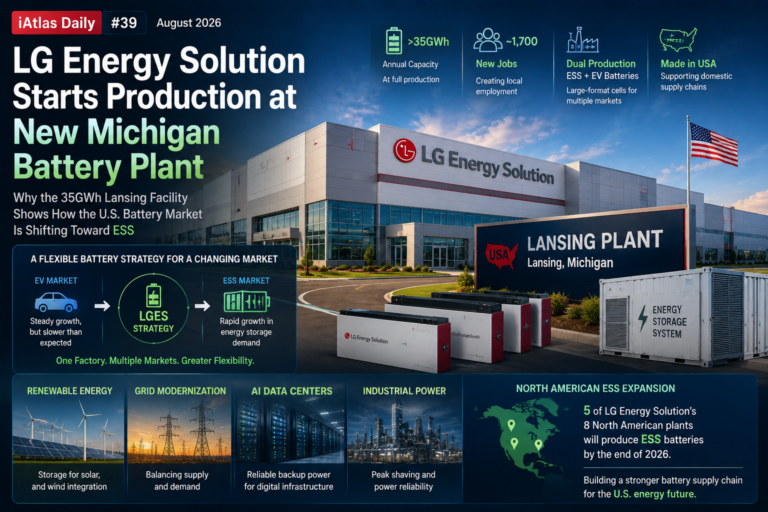
Global lithium-ion battery ESS shipments reached approximately 461.3 GWh in the first half of 2026, increasing 71% year over year, according to SNE Research.
For the first time, markets outside China represented more than half of global shipments.
This matters because ESS demand is driven by a different set of forces than EV demand.
Renewable energy deployment creates a greater need to balance electricity supply and demand.
Power grids require more flexible resources.
And growing electricity consumption is increasing interest in storage as part of future power infrastructure.
The IEA estimates that global energy storage capacity would need to reach around 1,500 GW by 2030 in its Net Zero Scenario, with batteries accounting for approximately 1,200 GW of that capacity.
ESS should therefore no longer be viewed as a niche extension of the battery market.
It is becoming a major battery market of its own.
4. Lower Battery Costs Are Expanding the Market
Battery economics continue to improve.
Average battery prices declined by approximately 8% in 2025, supported by manufacturing improvements, chemistry changes, competition and relatively favorable raw-material conditions.
Lower battery costs can create growth in several ways.
For EVs, lower costs can help narrow the price gap between electric and conventional vehicles.
For ESS, lower costs improve the economics of storing electricity.
And for emerging applications, lower battery prices can make technologies commercially viable that previously could not justify the cost.
This creates a powerful cycle:
Lower Costs
→ More Applications
→ Higher Demand
→ Greater Scale
→ Further Cost Improvement
But there is another side to this trend.
Extremely low battery prices can put pressure on battery and material producers.
In other words, what is positive for battery adoption may not always be positive for manufacturer profitability.
That distinction will become increasingly important during the next phase of the market.
5. LFP Is Changing Battery Economics
One of the clearest examples of this change is the rapid rise of lithium iron phosphate, or LFP.
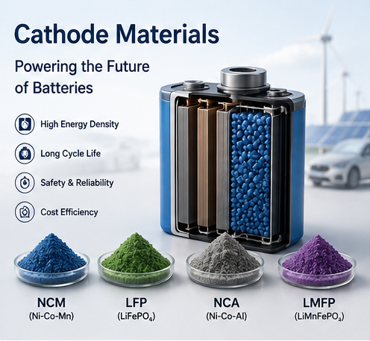
In 2025, LFP represented more than 55% of global EV battery deployment, up from nearly half in 2024.
The cost difference is significant.
Average LFP battery-pack prices in 2025 were more than 40% lower per kWh than NMC alternatives, although differences in application and energy-density requirements explain part of that gap.
LFP has become especially important where manufacturers prioritize:
- Cost
- Safety
- Cycle life
- Supply-chain simplicity
- Long operating life
rather than maximum energy density.
This is particularly relevant for stationary storage.
The IEA estimates that LFP accounted for more than 90% of global stationary battery storage installations in 2025.
The battery market is therefore evolving away from the idea that one chemistry must dominate every application.
Instead, the industry is becoming more application-specific.
EVs, ESS, premium vehicles, commercial vehicles and future technologies may each favor different combinations of chemistry, cost and performance.
6. The Gigafactory Race Is Entering a New Stage
For several years, one of the biggest themes in the battery industry was the global race to build gigafactories.
That expansion has created enormous manufacturing capacity.
Global lithium-ion battery nameplate production capacity exceeded 4 TWh by the end of 2025, approximately 30% higher than in 2024.
But capacity is no longer the whole story.
Building a factory does not guarantee that it will operate efficiently or close to its nominal capacity.
New battery plants can require years of production ramp-up before reaching high utilization and stable yields.
As the market matures, competitive advantage is likely to shift from:
Who can build the most capacity?
to:
Who can operate that capacity most efficiently?
That means future competition will increasingly focus on:
- Factory utilization
- Production yield
- Manufacturing cost
- Quality consistency
- Automation
- Chemistry flexibility
- Customer mix
- Supply-chain efficiency
The next stage of battery manufacturing is therefore likely to be as much about operational excellence as physical expansion.
7. China Remains the Center of the Battery Supply Chain
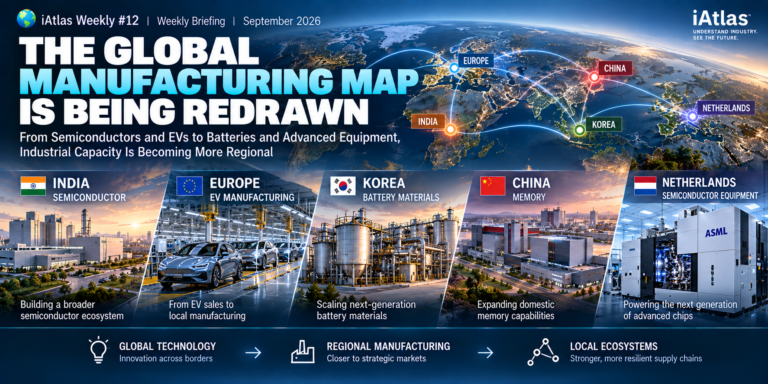
Despite large investments in the United States, Europe, Korea and other regions, global battery production remains highly concentrated.
China accounted for more than 80% of global battery-cell production in 2025.
Its position is even stronger in several critical material segments, accounting for around 85% of cathode active material production and more than 90% of anode active material production used in EV batteries.
Chinese battery companies are also increasing their share of the global EV battery market.
Among the ten largest EV battery suppliers, seven Chinese companies together represented approximately 72.8% of global EV battery usage during January–July 2026.
This concentration has made battery supply chains a strategic issue.
The United States and Europe are trying to localize manufacturing.
Korean and Japanese companies remain important global alternatives.
Emerging manufacturing bases are also developing in regions such as Southeast Asia.
But supply-chain diversification requires much more than building battery-cell factories.
A complete ecosystem includes:
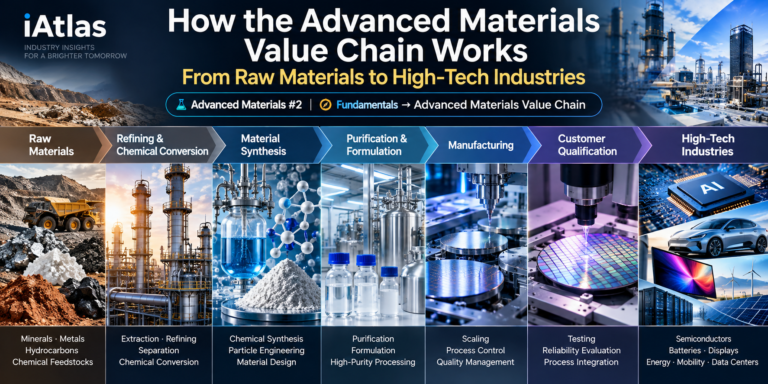
Raw Materials
→ Precursors
→ Cathode & Anode Materials
→ Battery Cells
→ Packs
→ Manufacturing Equipment
→ Recycling
Building that ecosystem takes time, capital and technical expertise.
8. Batteries Are Becoming Energy Infrastructure
Perhaps the most important long-term change is that the battery market can no longer be understood only through EV sales.
Batteries are becoming part of a much larger industrial system.
Consider one possible chain:
More Renewable Energy
↓
Greater Grid Variability
↓
More Need for Energy Storage
↓
Higher ESS Demand
↓
Higher Battery Demand
Another chain is emerging around electricity-intensive infrastructure:
AI & Data Centers
↓
Higher Electricity Demand
↓
More Power Infrastructure
↓
Grid & Storage Investment
↓
Battery Demand
And EV growth creates another industrial chain:
More EVs
↓
More Batteries
↓
More Battery Materials
↓
More Manufacturing Capacity
↓
More Equipment, Automation & Controlled Environments
This is why the battery market increasingly connects with industries far beyond battery manufacturing itself.
9. The Next Growth Cycle Will Also Bring New Risks
The long-term battery outlook remains positive, but growth will not necessarily be smooth.
Several risks could reshape the market.
Overcapacity
Manufacturing capacity has expanded rapidly, creating pressure on utilization and profitability in some regions.
Price Competition
Falling battery prices support adoption but can create difficult economics for battery and material manufacturers.
Supply-Chain Concentration
China’s dominant position in cells, LFP materials, cathode materials and anode materials remains difficult to replicate quickly.
Technology Shifts
LFP, high-nickel chemistries, sodium-ion, silicon-rich anodes and eventually solid-state batteries could redistribute value across the supply chain.
Policy & Trade
Localization policies, tariffs and industrial incentives are increasingly influencing where batteries and materials are produced.
The key question is therefore changing.
The question is no longer simply:
“Will the battery market grow?”
It is increasingly:
“Where in the battery value chain will future growth and value creation occur?”
iAtlas Outlook
The next battery growth cycle is likely to be broader than the previous one.
The first major phase of the battery industry was largely defined by:
EV Adoption
→ Gigafactory Expansion
→ Rapid Capacity Growth
The emerging phase looks different.
Battery Market 2.0
EV + ESS
↓
Growing Electricity Demand
↓
Energy & Grid Infrastructure
↓
Chemistry Diversification
↓
Manufacturing Efficiency
↓
Regional Supply Chains
EVs will remain the largest source of battery demand.
But ESS is becoming a second major growth engine.
LFP is reshaping battery economics.
Manufacturing competition is moving from capacity expansion toward cost and operational efficiency.
And battery supply chains are becoming increasingly connected to energy security and industrial policy.
The battery industry is still a growth industry.
But the next winners may not simply be the companies that manufacture the most batteries.
They may be the companies — and supply chains — that can deliver the right battery, at the right cost, for the right application.
That is what will define the next phase of the global battery market.
Continue Reading
Next Market Outlook
ESS Market Outlook
Why Energy Storage Is Entering a New Growth Phase
References
- International Energy Agency (IEA) — Global EV Outlook 2026
- International Energy Agency (IEA) — Batteries and Secure Energy Transitions
- SNE Research — Global EV Battery Usage, January–July 2026
- SNE Research — Global ESS Shipments, First Half 2026
ℹ️ About iAtlas
iAtlas is an independent publication covering batteries, semiconductors, OLED, advanced materials, AI, and global industrial trends.
We transform complex industrial developments into clear, reliable, and easy-to-understand insights.
Whether you’re following today’s industry news or building long-term expertise, iAtlas helps you understand not only what happened, but why it matters.
Technology creates change.
Insight creates opportunity.
— iAtlas