OLED Manufacturing Is Moving Beyond the Fine Metal Mask
LG Display’s FLiPP Technology Replaces the FMM with Photolithography — Potentially Changing How Large RGB OLED Panels Are Manufactured
🖥️ iAtlas Daily #66 | OLED Manufacturing & Display Equipment | September 2026
For more than a decade, one piece of manufacturing equipment has played a critical role in RGB OLED production:
The Fine Metal Mask
The concept is relatively simple.
A thin metal sheet contains microscopic openings.
Red, green and blue organic materials are deposited through those openings.
The mask determines where each OLED subpixel is formed.
This manufacturing method has enabled some of the world’s most advanced OLED displays.
But it also creates a fundamental constraint.
As displays become:
Larger
Higher Resolution
and:
More Complex
the metal mask becomes increasingly difficult to manage.
Now LG Display is developing another approach.
It is called:
FLiPP
FMM-Less innovative Pixel Patterning
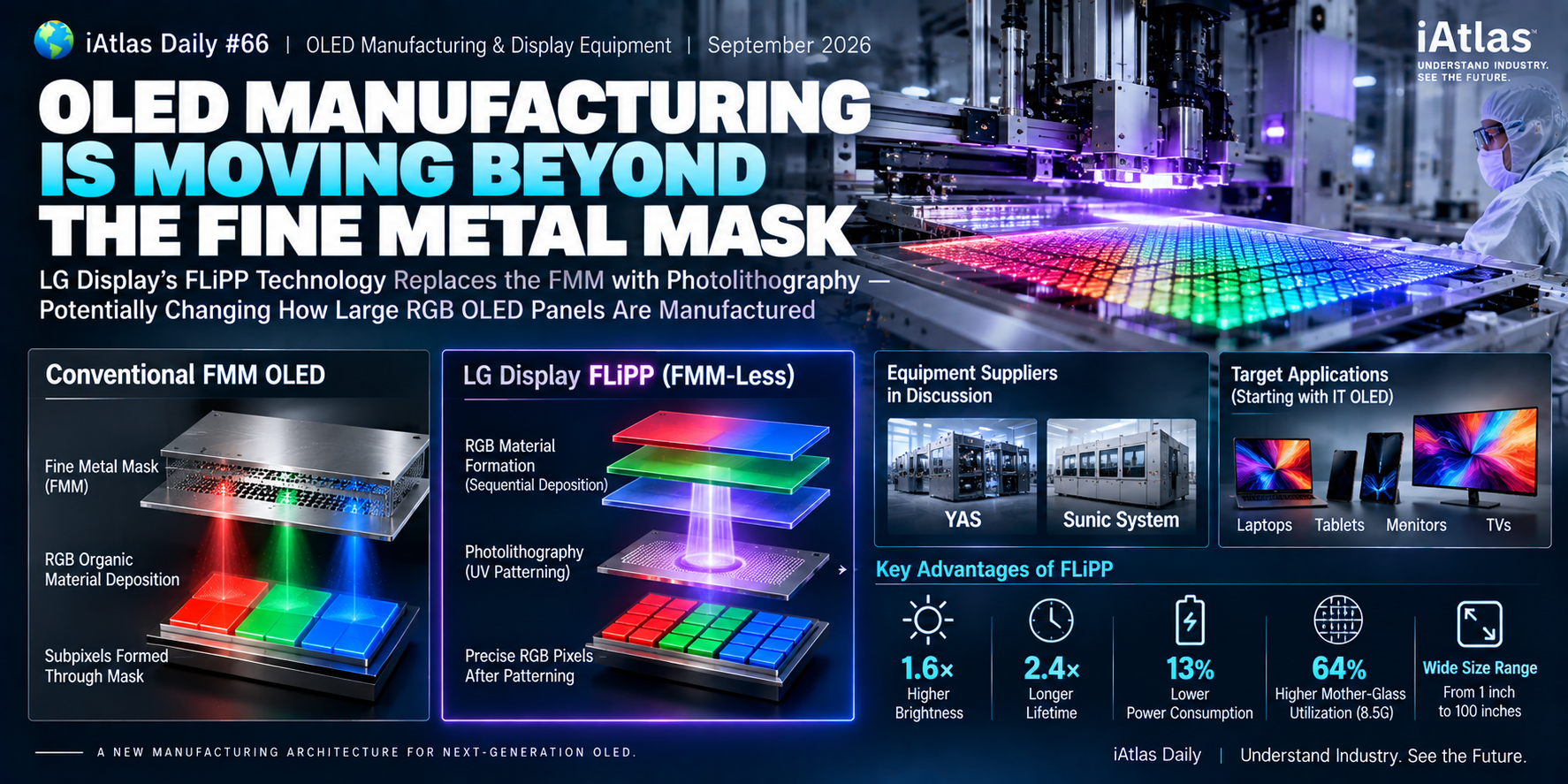
Instead of using a Fine Metal Mask to define RGB pixels during deposition, FLiPP combines sequential RGB material coating with:
Photolithography
to precisely pattern the pixels afterward. LG Display unveiled the technology publicly at IMID 2026 in August. LG Display
And the development is now moving beyond a technology demonstration.
Recent industry reporting says LG Display is discussing FLiPP deposition equipment with Korean equipment makers YAS and Sunic System, suggesting that the technology is beginning to move toward the next stage of manufacturing preparation. ETNEWS : Korea IT News
The transition could be significant:
Fine Metal Mask
↓
FMM-Less Patterning
↓
Photolithography
↓
A New OLED Manufacturing Architecture
OLED manufacturing may be beginning to borrow one of the semiconductor industry’s most important ideas: pattern the material with light instead of defining it with a physical mask.
🌈 The Big Story
OLED displays create light directly from organic emitting materials.
For RGB OLED, the display needs separate:
Red
Green
and:
Blue
subpixels.
The manufacturing challenge is therefore straightforward to describe:
How do you put each material exactly where it belongs?
For years, the answer has largely been:
Fine Metal Mask
LG Display’s FLiPP technology changes that basic assumption.
Instead of depositing RGB organic materials only through openings in a metal mask, FLiPP sequentially forms the materials across the substrate and then uses UV-based photolithography to remove unnecessary areas and create precise pixels. LG Display
That difference sounds technical.
But it could change several important aspects of OLED manufacturing:
Panel Size
Resolution
Aperture Ratio
Material Utilization
Production Flexibility
and:
Equipment Architecture
1. What Does the Fine Metal Mask Actually Do?
Think of an FMM as an extremely sophisticated stencil.
The simplified process looks like:
Glass Substrate
↓
Fine Metal Mask
↓
RGB Organic Material Deposition
↓
Material Passes Through Tiny Openings
↓
Subpixels Formed
LG Display compares the concept to stencil art. LG Display
For each color:
Red
then:
Green
then:
Blue
the material must be deposited accurately onto the intended pixel locations.
This requires extremely precise alignment between:
Mask
and:
Substrate
At small display sizes, this approach has proven highly effective.
Scaling it to much larger substrates is harder.
2. The Problem Is That the Mask Is Physical
A Fine Metal Mask is made of metal.
That sounds obvious.
But it creates one of the technology’s fundamental limitations.
As the mask becomes larger:
Weight increases
↓
Gravity acts on the mask
↓
The center can sag
↓
Alignment becomes harder
↓
Pixel accuracy can deteriorate
LG Display specifically identifies mask sagging and resulting misalignment or color-mixing defects as limitations of conventional FMM manufacturing. LG Display
This becomes increasingly important as manufacturers attempt to produce larger RGB OLED panels.
3. Larger Mother Glass Makes the Problem Harder
Display manufacturing economics depend heavily on:
Mother Glass
A large glass substrate enters the manufacturing line.
Multiple panels are produced from that substrate.
The larger the mother glass that can be processed efficiently, the more panels manufacturers can potentially produce per substrate.
But FMM dimensions create constraints.
LG Display says conventional FMM processes using large 8th-generation-class mother glass may require the substrate to be divided and processed as half-cut glass because of FMM size limitations. LG Display
That reduces one of the economic advantages of moving to larger-generation fabs.
4. FLiPP Removes the Fine Metal Mask
LG Display’s solution is radical in concept:
Remove the mask.
FLiPP changes the patterning method.
Instead of:
Mask
↓
Selective Deposition
the process becomes more like:
Material Formation
↓
Photolithography
↓
Selective Removal
The RGB emitting materials are formed sequentially and fixed in precise positions.
UV-based patterning then removes material that is not required.
The result is still:
R
G
B
pixels.
But the manufacturing route is fundamentally different. LG Display
5. This Is Where OLED Starts to Look More Like Semiconductor Manufacturing
Photolithography is one of the foundational technologies of semiconductor manufacturing.
In a semiconductor fab, the simplified concept is:
Coat Material
↓
Expose Pattern
↓
Develop / Remove Selected Area
↓
Create Structure
FLiPP applies a related patterning philosophy to OLED pixels.
This does not mean OLED manufacturing suddenly becomes the same as semiconductor wafer fabrication.
The materials, process conditions and engineering challenges are very different.
But conceptually the transition is important:
Physical Mask Patterning
↓
Lithographic Patterning
This is another example of display and semiconductor manufacturing technologies beginning to converge.
6. Why Not Use Photolithography Earlier?
There is an important reason.
OLED organic materials are sensitive.
They can be affected by:
Moisture
Oxygen
Heat
Chemicals
and:
Process Damage
Traditional semiconductor photolithography uses process conditions that cannot simply be transferred directly to sensitive OLED materials.
So the challenge was never merely:
Can UV light create small patterns?
The semiconductor industry answered that decades ago.
The real challenge is:
Can OLED materials survive a lithographic process while maintaining their optical and electrical performance?
That is a materials and process-integration problem.
7. FLiPP Is Therefore More Than a Patterning Trick
To make FMM-less RGB OLED practical, LG Display needed to control the interaction between:
Organic Emitting Material
Deposition
Patterning
UV Exposure
Removal Process
and:
Device Performance
This is why the technology matters.
The innovation is not simply replacing one machine with another.
It changes the:
Process Flow
And when a process flow changes, the surrounding equipment ecosystem can change with it.
8. The Aperture Ratio Can Increase Significantly
One of FLiPP’s most interesting advantages is:
Aperture Ratio
The aperture ratio is the proportion of display area actually used by the light-emitting pixel area.
Higher aperture ratio means more of the panel surface can generate useful light.
LG Display says FLiPP increases aperture ratio by approximately:
55%
compared with its conventional FMM method. LG Display
That improvement can then be used in several ways.
9. More Aperture Creates Several Engineering Options
LG Display reports that, under equivalent conditions, FLiPP can enable:
1.6× Higher Brightness
or:
2.4× Longer Lifetime
while also allowing:
13% Lower Power Consumption
depending on how the design is optimized. LG Display
These should not be interpreted as all being maximized simultaneously in every commercial product.
Rather, higher aperture ratio gives panel designers more room to optimize among:
Brightness
Lifetime
and:
Power
That flexibility can be valuable across different display applications.
10. A Laptop and a TV Do Not Need the Same Optimization
Consider two products.
Laptop OLED
May prioritize:
Lower Power Consumption
↓
Longer Battery Life
Premium Monitor
May prioritize:
Higher Brightness
↓
Better Visual Performance
Large TV
May prioritize:
Lifetime + Brightness
The same underlying manufacturing improvement can therefore create different product-level benefits.
This is why manufacturing technology can influence display design itself.
11. The Mother-Glass Advantage May Be Even More Important
LG Display says FLiPP enabled it to produce FMM-less OLED on a full:
8.5-Generation Mother Glass
approximately 2,200 × 2,500 mm.
Instead of cutting the large glass before processing, the company can use the substrate as a single piece. LG Display
LG Display says this can improve mother-glass utilization efficiency by as much as:
64%
for OLED laptop-panel production compared with approaches requiring divided substrates. LG Display
This moves the discussion beyond display performance.
It becomes a manufacturing-economics story.
12. Display Economics Are Heavily Influenced by Substrate Utilization
Imagine one large sheet of glass.
The goal is to produce as many saleable panels from that sheet as possible.
Better utilization means:
More Panels
↓
Less Waste
↓
Higher Productivity
↓
Potentially Lower Cost per Panel
This is why mother-glass size and cutting efficiency matter so much in display manufacturing.
FLiPP’s ability to work without a large physical FMM could therefore create an important manufacturing advantage if the process reaches stable mass production.
13. It Also Changes Product Flexibility
Another FMM limitation is product changeover.
Different:
Panel Sizes
and:
Resolutions
can require different mask designs.
Those masks are expensive and technically demanding.
LG Display says eliminating FMM reduces this constraint and gives FLiPP much greater flexibility across display sizes and resolutions. LG Display
The company says the technology could theoretically support displays ranging from:
1 inch to 100 inches
and potentially extend across:
Wearables
VR / AR
Tablets
Monitors
and:
TVs. LG Display
That is a very broad target.
Commercialization will determine how much of that theoretical range becomes practical.
14. The First Target Is IT OLED
LG Display says it plans to begin with:
IT Applications
including:
Tablets
and:
Monitors
before expanding the technology toward other panel categories. LG Display
That makes strategic sense.
IT OLED sits between:
Small Smartphone OLED
and:
Large TV OLED
in both size and manufacturing requirements.
It can therefore provide an important commercialization bridge for new RGB OLED manufacturing technology.
15. But FLiPP Is Still at an Early Stage
This distinction is important for iAtlas.
FLiPP is:
Developed
and:
Demonstrated
But that is not the same as:
Full Mass Production
LG Display’s CTO described the technology in August as still being at an early stage, with further technical improvements under development.
So we should not describe FMM as obsolete.
The correct industrial transition is:
Established FMM Manufacturing
versus:
Emerging FMM-Less Manufacturing
The competition is only beginning.
16. September Brought the Next Important Signal
The technology story became more interesting this month.
Electronic Times reported that LG Display is discussing FLiPP OLED deposition equipment with:
YAS
and:
Sunic System
YAS had been viewed as a likely supplier because of its previous relationship with LG Display’s large OLED production lines.
But Sunic System has emerged as another serious candidate.
That means the discussion is moving beyond:
Does the technology work?
toward:
What equipment will manufacture it?
That is an important industrial transition.
17. New Processes Create New Equipment Competition
Whenever a manufacturing process changes, the equipment landscape can change with it.
FLiPP could affect requirements around:
Organic Material Deposition
Substrate Handling
UV Patterning
Cleaning
Inspection
Alignment
and:
Process Control
Existing equipment suppliers may need to adapt.
New suppliers may gain opportunities.
The value chain can shift.
This is why process innovation matters far beyond the panel manufacturer.
18. Deposition Equipment Remains Critical
Removing FMM does not remove OLED deposition.
The organic emitting materials still need to be formed accurately and consistently.
What changes is the relationship between:
Deposition
and:
Patterning
In conventional FMM OLED:
Deposition itself helps define the pixel location.
In FLiPP:
Deposition + subsequent lithographic patterning define the pixel.
This changes what the deposition tool needs to accomplish and how it interacts with downstream processes.
That helps explain why equipment selection is strategically important.
19. YAS vs. Sunic Is More Than a Supplier Contest
From an industrial perspective, the interesting question is not simply:
Which company wins the order?
The more important question is:
What equipment architecture will FLiPP require at production scale?
That will determine opportunities across:
Deposition
Lithography
Inspection
Material Handling
and:
Automation
If FLiPP eventually reaches large-scale manufacturing, a new equipment ecosystem could form around it.
20. FMM Suppliers Also Face a Strategic Question
A successful FMM-less process would affect another part of the value chain:
Fine Metal Mask Suppliers
Today FMM represents a critical component in RGB OLED manufacturing.
If some panel production eventually transitions away from FMM, demand patterns could change.
But this is unlikely to happen overnight.
FMM already has:
Established Supply Chains
Proven Yield
Existing Equipment
Mass-Production Experience
FLiPP must compete against all of those advantages.
The relevant question is therefore not:
Will FMM disappear?
It is:
In which applications can FMM-less manufacturing become economically superior?
21. Yield Will Ultimately Decide the Technology
This is perhaps the most important commercialization issue.
A manufacturing technology can deliver impressive laboratory performance.
But a factory needs:
High Yield
Repeatability
High Throughput
Low Defectivity
Equipment Uptime
and:
Competitive Cost
The transition therefore looks like:
Technical Demonstration
↓
Pilot Equipment
↓
Process Optimization
↓
Yield Improvement
↓
Customer Qualification
↓
Mass Production
FLiPP is moving along this path, but it has not completed it.
22. Throughput Will Matter Too
Photolithography adds process complexity.
If the new patterning sequence takes substantially longer than FMM deposition, manufacturing economics could suffer.
The process therefore needs to balance:
Better Aperture Ratio
Better Glass Utilization
Product Flexibility
against:
Additional Process Steps
Equipment Cost
Process Time
Yield Risk
This is why the final commercial comparison cannot be made from panel performance alone.
Manufacturing cost will matter just as much.
23. OLED Materials May Need to Evolve with the Process
Photolithographic OLED patterning also places new requirements on organic materials.
Materials may need improved resistance to:
UV Exposure
Processing Chemicals
Environmental Interaction
and:
Patterning Damage
while preserving:
Emission Efficiency
Color
Lifetime
and:
Electrical Performance
This means FLiPP could create innovation opportunities not only for equipment makers but also for:
OLED Material Suppliers
Again, one process change can propagate through an entire industrial ecosystem.
24. OLED and Semiconductor Manufacturing Are Converging
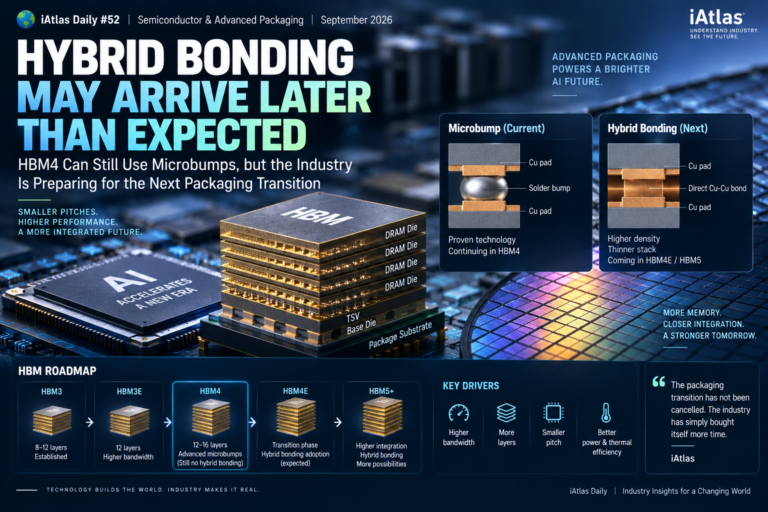
Daily #64 looked at advanced semiconductor packaging.
That story showed how front-end-like processes are increasingly moving into what was historically considered semiconductor back-end manufacturing.
FLiPP shows another form of convergence.
Display manufacturing increasingly uses concepts associated with semiconductor fabrication:
Photolithography
Precision Patterning
Process Integration
Inspection
Advanced Materials
The boundaries between:
Display Manufacturing
and:
Semiconductor Manufacturing
are becoming less rigid.
25. The Bigger Competition Is Manufacturing Architecture
OLED competition is often described through products:
Brightness
Resolution
Refresh Rate
Power Consumption
But underneath those product specifications lies another competition:
How is the panel manufactured?
Different manufacturing architectures can determine:
Cost
Yield
Panel Size
Performance
and:
Investment Requirements
That is why FLiPP matters.
It does not merely improve an OLED specification.
It challenges one of the fundamental assumptions behind RGB OLED manufacturing.
🧩 Why This Matters
FLiPP highlights several structural changes in the display industry.
FMM is no longer the only possible path to RGB OLED.
LG Display has demonstrated an 8.5-generation FMM-less process using photolithographic patterning.
Manufacturing innovation can directly improve panel performance.
Higher aperture ratio creates opportunities for higher brightness, longer lifetime or lower power consumption.
Large-substrate economics could change.
Processing full 8.5-generation mother glass could improve substrate utilization significantly.
OLED manufacturing is borrowing semiconductor techniques.
Photolithography is becoming part of next-generation RGB OLED patterning.
Equipment competition is beginning.
YAS and Sunic System are reportedly discussing deposition equipment for the potential FLiPP production line.
Commercialization remains the key test.
Yield, throughput, equipment cost and process stability will determine whether FLiPP can move from demonstration to mass production.
🔭 What to Watch
Production Investment
Watch whether LG Display formally approves investment in a FLiPP production line.
YAS vs. Sunic System
The eventual deposition-equipment decision could reveal more about the production architecture.
Yield
FMM-less manufacturing must prove stable high-volume yield.
IT OLED
Tablets and monitors are the first application area identified by LG Display.
8.5-Generation Manufacturing
The ability to process full mother glass could become one of FLiPP’s strongest economic advantages.
OLED Materials
Watch for new materials optimized for photolithographic RGB OLED processes.
Competitor Response
Other panel makers’ FMM-less strategies will show whether photolithographic OLED patterning becomes a broader industry direction.
🧭 iAtlas Insight
The most important thing about FLiPP is not that it eliminates a piece of metal.
It is that removing the Fine Metal Mask changes the logic of the manufacturing process.
The old approach is:
Put the material only where the pixel should exist.
The new approach is closer to:
Form the material, then precisely pattern where the pixel should remain.
That sounds like a subtle difference.
Industrially, it is not.
It shifts OLED manufacturing toward:
Lithography
Process Integration
New Equipment
New Materials
and potentially:
Larger-Scale RGB OLED Manufacturing
But there is an important distinction.
FLiPP has demonstrated what is:
Technically Possible
The next stage must prove what is:
Industrially Practical
That means:
Yield
Throughput
Cost
and:
Reliability
The recent YAS–Sunic equipment discussions make this particularly interesting because they suggest the conversation is beginning to move from the laboratory toward the factory.
The next OLED breakthrough may not come from a new display format. It may come from changing the way the pixels themselves are manufactured.
📚 Related Articles
📰 iAtlas Daily #64: Taiwan Is Building an Advanced Packaging Ecosystem Around TSMC
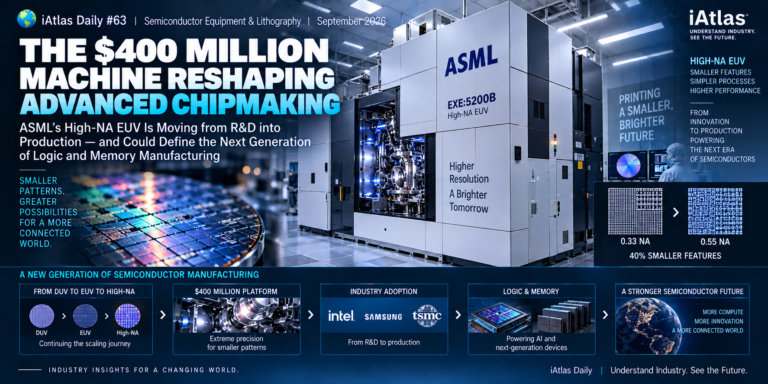
📰 iAtlas Daily #63: The $400 Million Machine Reshaping Advanced Chipmaking
🔗 References
- LG Display — LG Display Unveils FLiPP
- Electronic Times — LG Display Weighs YAS and Sunic for FLiPP OLED Tools
- Electronic Times — LG Display’s FLiPP Manufacturing Paradigm
ℹ️ About iAtlas
iAtlas is an independent publication covering batteries, semiconductors, OLED, advanced materials, AI, and global industrial trends.
We transform complex industrial developments into clear, reliable, and easy-to-understand insights.
Whether you’re following today’s industry news or building long-term expertise, iAtlas helps you understand not only what happened, but why it matters.
Technology creates change.
Insight creates opportunity.
— iAtlas