Battery Electrode Winding Explained: How Electrodes Form a Jelly Roll
Understanding Electrode Alignment, Separator Placement, Web Tension, Winding Accuracy, and Jelly Roll Formation in Lithium-ion Battery Manufacturing
Category: Battery Technology
Content Type: Manufacturing
Learning Path: Battery Manufacturing
Related Industries: Electric Vehicles · Energy Storage Systems · Consumer Electronics
Last Updated: September 2026
Industry Snapshot
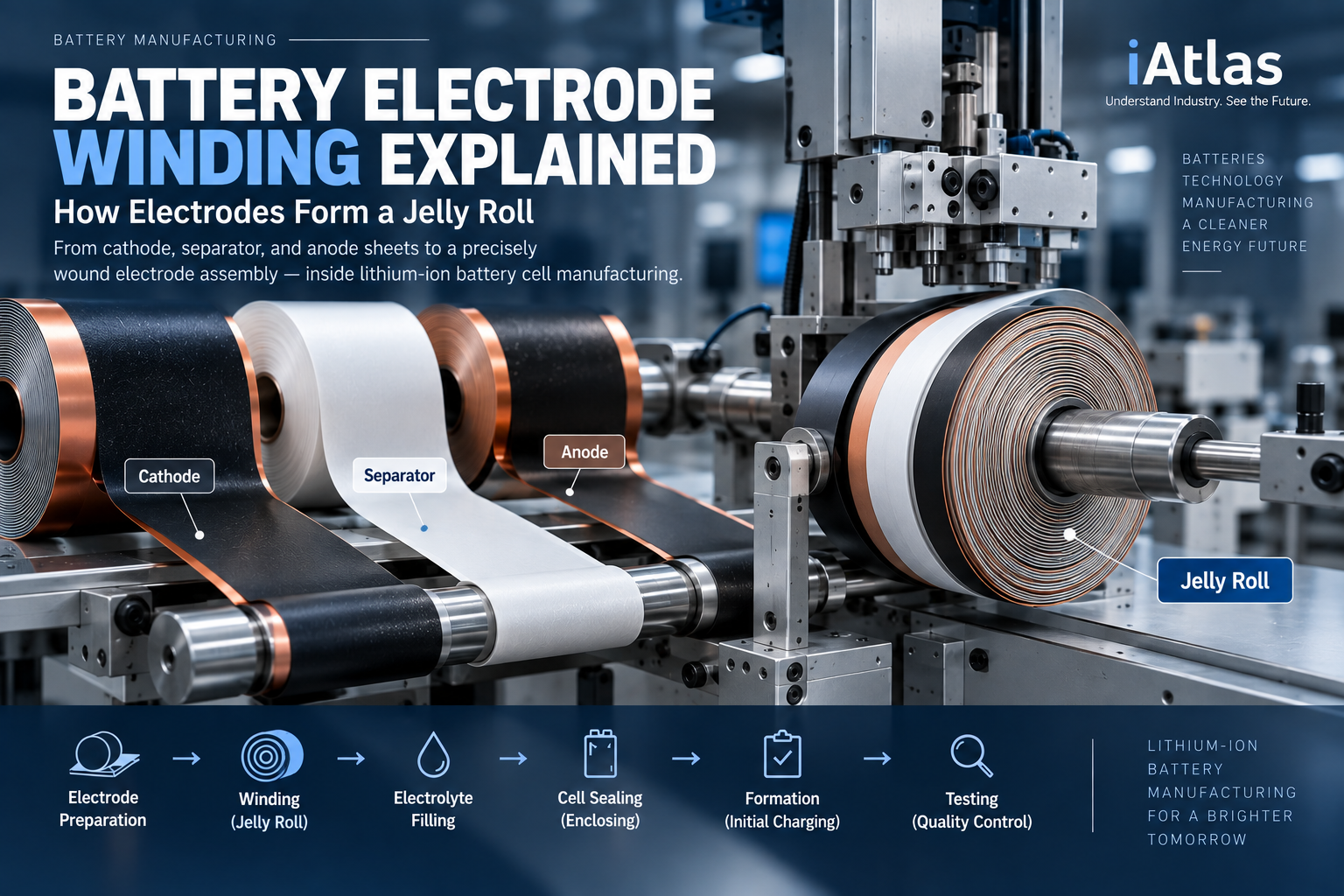
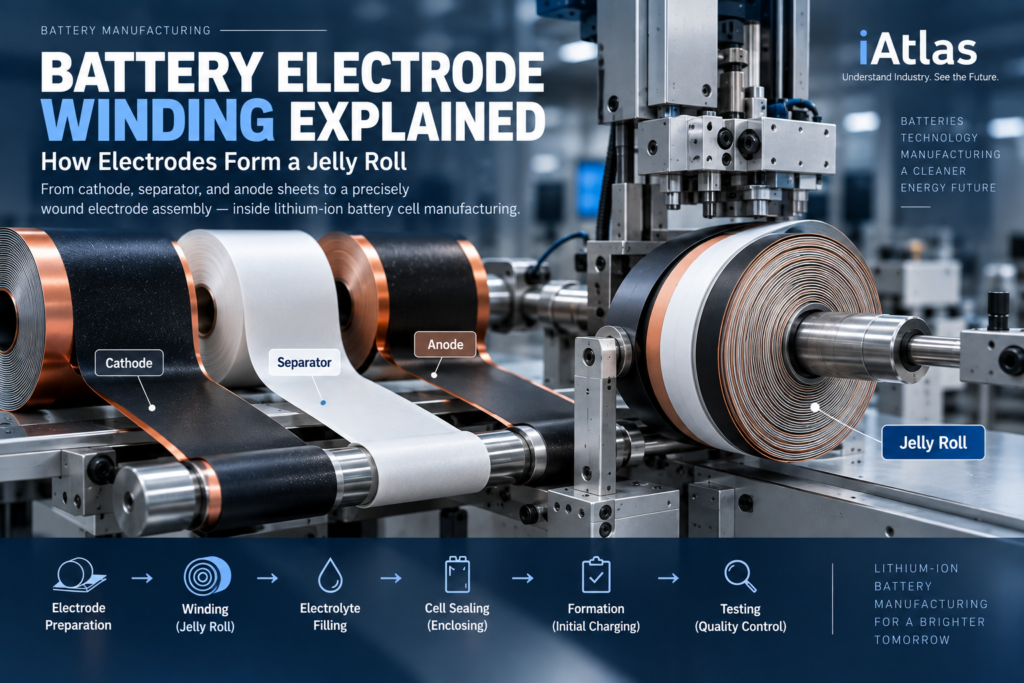
Battery electrode winding is a cell assembly process that combines cathode, anode, and separator webs into a compact wound electrode structure commonly called a jelly roll.
After electrode manufacturing and converting processes such as slitting and notching, the prepared electrode materials enter the cell assembly stage.
A simplified sequence is:
Cathode + Separator + Anode
↓
Alignment & Tension Control
↓
Winding
↓
Jelly Roll Formation
↓
Cell Housing
↓
Electrolyte Filling
Winding enables long electrode sheets to be packaged into a compact cell structure while maintaining electrical separation between the positive and negative electrodes.
The process appears mechanically simple.
In practice, however, small errors in alignment, tension, separator position, or winding geometry can propagate through many layers of the wound structure.
For this reason, winding is a precision manufacturing process rather than simply a material-rolling operation.
At a Glance
| Category | Description |
|---|---|
| Process | Electrode Winding |
| Stage | Battery Cell Assembly |
| Input | Cathode · Anode · Separator |
| Main Function | Form a wound electrode assembly |
| Output | Jelly Roll |
| Key Controls | Alignment · Tension · Position · Winding Accuracy |
| Typical Applications | Cylindrical Cells · Some Prismatic Cells |
| Previous Process | Notching / Electrode Preparation |
| Next Process | Housing · Tab Connection · Electrolyte Filling |
What Is Battery Electrode Winding?
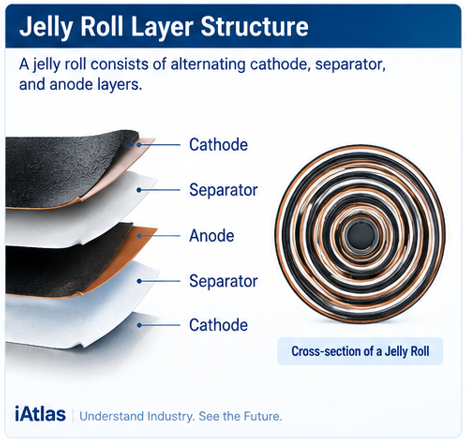
Battery electrode winding is the process of combining long sheets of cathode, separator, and anode material into a tightly controlled multilayer structure.
The basic arrangement is:
Separator
Cathode
Separator
Anode
These continuous layers are fed into a winding machine and wrapped around a central winding axis or mandrel according to the cell design.
The resulting structure is commonly called a:
Jelly Roll
The jelly roll contains the electrochemically active layers of the battery cell in a compact geometry.
What Is a Jelly Roll?
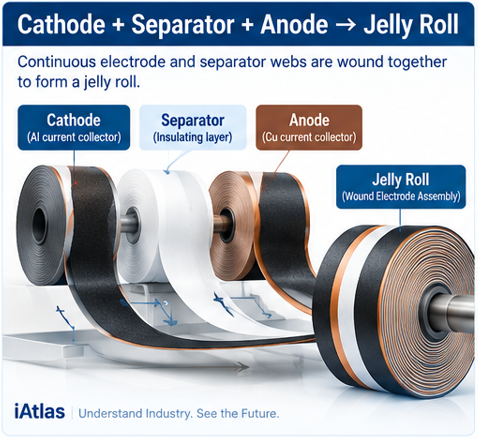
A jelly roll is the wound electrode assembly found in many lithium-ion battery cells.
Viewed conceptually from the side:
Cathode
↻
Separator
↻
Anode
↻
Separator
↻
The actual structure contains many repeated overlapping layers.
The separator remains between the positive and negative electrodes to prevent direct electrical contact while allowing lithium-ion transport after electrolyte is introduced.
This means winding must simultaneously achieve:
Compact Packaging
Electrical Isolation
Electrode Overlap
Mechanical Stability
Where Winding Fits in Battery Manufacturing
The process connects electrode preparation with final cell assembly.
Electrode Manufacturing
Mixing
→ Slurry
→ Coating
→ Drying
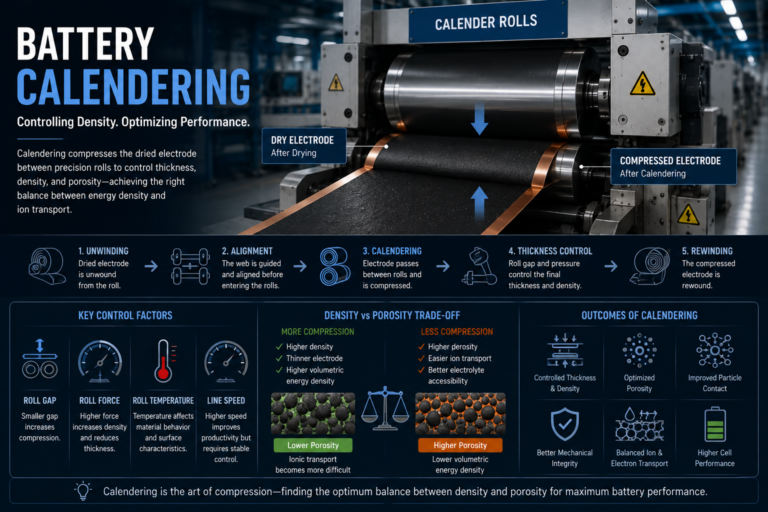
→ Calendering
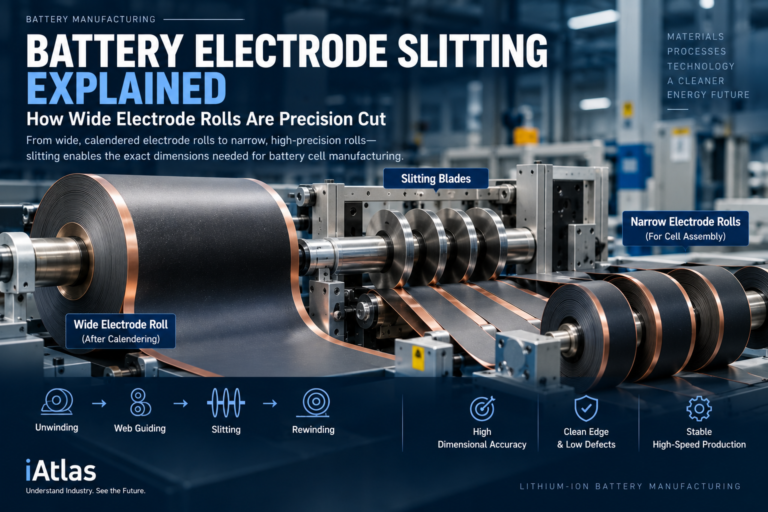
→ Slitting
Electrode Converting
Notching / Cutting
↓
Cell Assembly
Winding
↓
Jelly Roll
↓
Housing / Tab Connection
↓
Electrolyte Filling
↓
Sealing
↓
Formation
A defect created during winding can therefore remain inside the cell through all subsequent manufacturing stages.
Main Materials Entering the Winding Process
Three major sheet materials must be controlled simultaneously.
Cathode
The positive electrode typically consists of an active-material coating deposited on an aluminum current collector.
Examples of cathode active materials include:
- NMC
- NCA
- LFP
Anode
The negative electrode commonly consists of graphite or other anode materials coated on a copper current collector.
Separator
A porous polymer membrane electrically isolates the cathode from the anode while later allowing ionic transport through the electrolyte.
The winding machine must handle all three materials without damaging their surfaces or edges.
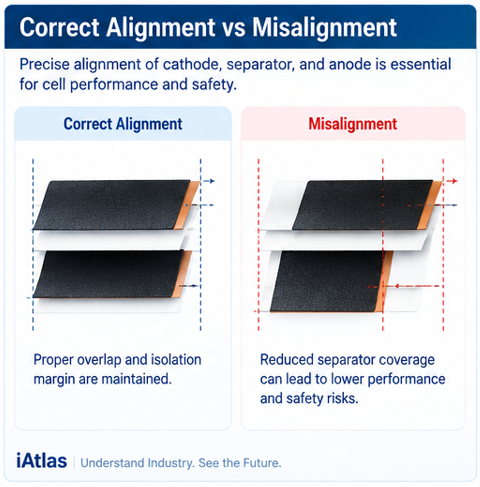
Why Separator Placement Matters
The separator is one of the most safety-critical components in the wound structure.
It must maintain sufficient coverage between opposing electrode surfaces.
Conceptually:
Correct
Cathode
────────
Separator
────────────
Anode
────────
The separator extends appropriately around the active electrode regions.
Incorrect positioning can reduce the intended isolation margin.
Because the electrode structure is wound repeatedly, a small alignment error can influence multiple layers of the jelly roll.
How Battery Electrode Winding Works
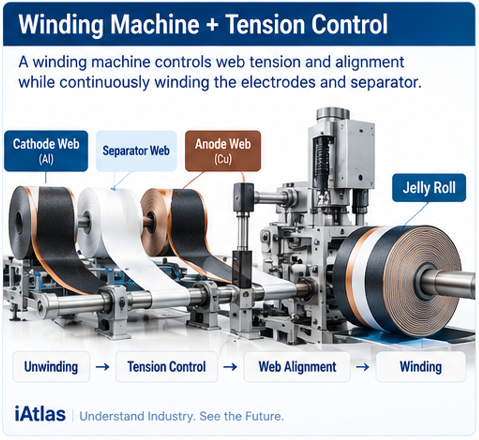
A simplified winding machine contains:
Electrode Unwind Units
↓
Separator Unwind Units
↓
Tension Control
↓
Web Alignment
↓
Winding Section
↓
Jelly Roll Removal
The cathode, anode, and separator materials are supplied from individual rolls or prepared feeds.
Each web must enter the winding zone at the correct:
- Position
- Angle
- Speed
- Tension
The materials are then wound according to a predefined geometry.
Web Tension Control
One of the most important winding parameters is web tension.
Each material experiences pulling force as it moves through the winding machine.
If tension is too low:
Low Tension
↓
Loose Material
↓
Wrinkles / Poor Layer Control
If tension is too high:
High Tension
↓
Excessive Mechanical Stress
↓
Stretching / Deformation / Damage Risk
The optimum tension depends on the mechanical properties of the electrode and separator materials.
Why Tension Changes During Winding
The winding geometry does not remain constant.
As additional layers are wound:
Jelly Roll Diameter ↑
This changes the relationship between:
- Rotational speed
- Linear web speed
- Winding torque
- Material tension
The control system therefore needs to compensate dynamically as the jelly roll grows.
Modern winding equipment can use closed-loop tension control to maintain stable web behavior.
Electrode Alignment
The cathode, anode, and separator must remain correctly aligned throughout winding.
A typical control concept is:
Edge Sensor / Vision System
↓
Web Position Measurement
↓
Alignment Correction
↓
Winding
Misalignment can affect electrode overlap and separator coverage.
This makes lateral web positioning another critical quality parameter.
Electrode Overhang
Battery designs often intentionally create dimensional differences between the cathode and anode.
For example, the anode may extend beyond the cathode active area according to the cell design.
This controlled dimensional relationship is often referred to as electrode overhang.
The exact design varies by manufacturer and chemistry, but maintaining the intended overlap relationship is important.
Winding errors can change this geometry locally within the jelly roll.
Winding Speed
Battery manufacturers want high production throughput.
Increasing winding speed can improve equipment productivity.
However:
Winding Speed ↑
can increase the difficulty of controlling:
- Web tension
- Alignment
- Material vibration
- Separator position
- Cut timing
- Final geometry
The production objective is therefore not simply maximum rotational speed.
It is:
Maximum stable throughput within the required quality window.
Winding Accuracy
A high-quality jelly roll requires consistent geometry.
Important dimensional characteristics can include:
- Outer diameter
- Layer alignment
- Electrode overlap
- Separator coverage
- Tab position
- Winding tightness
- Overall shape
These characteristics must remain repeatable across large production volumes.
Cylindrical Cell Winding
Cylindrical lithium-ion cells are strongly associated with wound electrode structures.
The electrode layers are wound into a cylindrical jelly roll.
Conceptually:
Flat Electrode Webs
↓
Winding
↓
Cylindrical Jelly Roll
↓
Metal Can
Examples of cylindrical cell formats include:
- 18650
- 21700
- 4680-type large cylindrical formats
The exact internal electrode and current-collection architecture can vary significantly between cell designs.
Prismatic Cell Winding
Some prismatic cells also use wound electrode assemblies.
Instead of producing a purely cylindrical geometry, the winding system can create a flatter or more elongated wound structure suited to a rectangular housing.
Conceptually:
Electrode Webs
↓
Winding
↓
Flattened / Prismatic Wound Structure
↓
Prismatic Housing
Other prismatic designs may instead use stacked electrode structures.
Therefore:
Prismatic cell does not automatically mean winding or stacking.
The manufacturing architecture depends on the cell design.
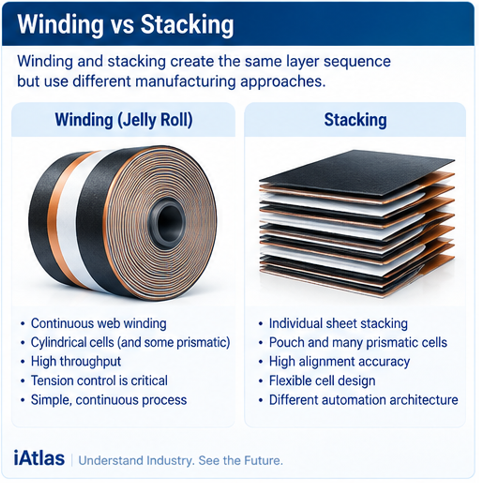
Winding vs Stacking
Winding and stacking are two major methods for building electrode assemblies.
| Winding | Stacking | |
|---|---|---|
| Structure | Continuous wound layers | Repeated individual layers |
| Typical Output | Jelly Roll | Electrode Stack |
| Material Motion | Continuous web handling | Sheet/layer handling |
| Common Application | Cylindrical + some prismatic | Pouch + many prismatic designs |
| Key Challenge | Tension & winding geometry | Layer placement & alignment |
| Throughput Consideration | High-speed continuous operation possible | High-speed stacking requires rapid precise handling |
Neither approach is universally superior.
Cell geometry, electrode design, production strategy, and equipment architecture determine which process is appropriate.
The next iAtlas Library article will examine Battery Electrode Stacking separately.
Tab Position During Winding
Electrode current collectors require electrical connection to the cell terminals.
Depending on cell architecture, current-collection features can include:
- Conventional tabs
- Multiple tabs
- Distributed current-collection regions
- Tabless-style architectures
The winding process must preserve the intended position and geometry of these features.
Incorrect positioning can complicate downstream electrical joining and assembly.
Winding Core and Mandrel
The initial winding geometry can be established using a winding core or mandrel.
The electrode and separator materials begin wrapping around this central structure.
The design of the winding mechanism influences:
- Initial curvature
- Core geometry
- Layer positioning
- Final jelly-roll shape
After winding, the assembly must also be removed or transferred without disturbing the wound layers.
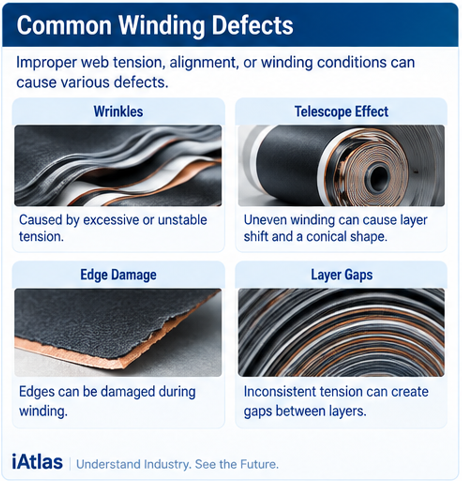
Common Winding Defects
Several defects can occur during electrode winding.
Electrode Misalignment
Cathode and anode positions deviate from the intended geometry.
Separator Misalignment
Separator coverage becomes insufficient or inconsistent.
Wrinkles
Electrode or separator material folds or wrinkles during feeding.
Uneven Tension
Different layers experience inconsistent mechanical loading.
Loose Winding
The jelly roll lacks sufficient structural consistency.
Excessive Compression
High tension or winding conditions create unwanted stress.
Edge Damage
Electrode or separator edges are damaged during handling.
Telescoping
Layers shift axially so that the wound structure develops an uneven, stepped profile.
These defects can affect both downstream assembly and finished-cell quality.
What Is Jelly Roll Telescoping?
Telescoping occurs when wound layers shift progressively sideways relative to one another.
Instead of forming a uniform structure:
Correct Jelly Roll
│████████│
the layers can become offset:
Telescoped Jelly Roll
│████████
│████████
│████████
This can result from problems involving:
- Web alignment
- Tension
- Material tracking
- Winding dynamics
- Handling
Controlling lateral position is therefore important throughout the entire winding cycle.
Separator Wrinkles
Separators are thin, flexible polymer membranes.
Their mechanical behavior differs from coated metal electrodes.
Improper tension or web handling can produce wrinkles.
A wrinkle can locally change:
- Layer spacing
- Separator coverage
- Mechanical pressure
- Electrode contact geometry
High-speed winding therefore requires careful separator handling.
Why Upstream Electrode Quality Matters
Winding performance is influenced by processes that occurred much earlier.
For example:
Calendering
affects electrode thickness and mechanical properties.
Slitting
affects edge quality and electrode width.
Notching
affects geometry and current-collection features.
Therefore:
Upstream Electrode Quality
↓
Winding Stability
↓
Jelly Roll Quality
↓
Cell Quality
Battery manufacturing processes cannot be optimized completely independently.
Contamination Control During Winding
Winding occurs after electrodes have undergone several mechanical converting operations.
Particles can originate from:
- Electrode edges
- Coating damage
- Cutting processes
- Equipment wear
- Handling
Foreign particles trapped between wound layers are undesirable.
Winding areas therefore require careful contamination management through equipment design, cleaning, extraction, and inspection.
Quality Control During Winding
Modern winding equipment can monitor multiple parameters in real time.
Possible measurements include:
Web Position
Tracks electrode and separator alignment.
Tension
Monitors mechanical loading on each web.
Electrode Dimensions
Confirms incoming material geometry.
Tab Position
Verifies electrical connection features.
Separator Coverage
Checks isolation margins.
Jelly Roll Dimensions
Confirms final wound geometry.
Combining these measurements enables more automated process control.
Machine Vision
High-speed cameras can inspect material before and during winding.
A simplified control architecture is:
Electrode / Separator
↓
Vision Sensor
↓
Position & Defect Analysis
↓
Machine Controller
↓
Alignment Correction
This allows equipment to detect deviations before they propagate through the entire wound structure.
From Jelly Roll to Cell Housing
Once winding is complete, the jelly roll proceeds to downstream assembly.
For a cylindrical cell:
Jelly Roll
↓
Insertion into Metal Can
↓
Electrical Connection
↓
Electrolyte Filling
↓
Sealing
For other wound cell architectures, the exact sequence can differ.
Careful handling is required because deformation during transfer can alter the carefully controlled winding geometry.
Electrolyte Wetting of the Jelly Roll
After the wound electrode assembly enters the cell housing, electrolyte is introduced during a later manufacturing step.
The electrolyte must penetrate:
- Separator pores
- Cathode pores
- Anode pores
- Spaces throughout the wound structure
This creates an important connection between upstream processes.
Calendering
determines part of the electrode pore structure.
Winding
determines physical layer arrangement.
Electrolyte Filling
introduces the liquid electrolyte.
Wetting
must then distribute electrolyte throughout the porous jelly roll.
Battery manufacturing is therefore a highly interconnected system.
Why Winding Matters to Battery Performance
Winding determines the physical arrangement of the cell’s active components.
Poor winding can influence:
- Electrode alignment
- Separator protection
- Mechanical uniformity
- Current distribution
- Electrolyte wetting
- Cell dimensions
- Reliability
The winding machine therefore helps define the internal architecture that the battery will retain throughout its operating life.
Emerging Electrode Winding Technologies
Battery winding equipment is becoming increasingly automated.
High-Speed Winding
Manufacturers continue increasing throughput while attempting to maintain dimensional control.
Advanced Servo Control
Precision motors allow tighter synchronization between material feeds and winding motion.
Closed-Loop Tension Control
Sensor feedback continuously adjusts web tension.
Machine Vision
High-speed imaging can monitor alignment and material position.
Automated Defect Detection
Vision algorithms can identify abnormal electrode or separator conditions.
Digital Traceability
Process parameters can be recorded for individual cells or production lots.
Predictive Maintenance
Machine data can help identify deteriorating rollers, bearings, drives, or other components before quality is affected.
The direction is toward increasingly self-monitoring and adaptive winding equipment.
iAtlas Insight
Electrode winding demonstrates why battery manufacturing is fundamentally a precision web-handling industry as much as it is an electrochemical industry.
Cathode, anode, and separator materials may extend for long distances, yet their relative position inside the finished cell must be controlled very precisely.
This creates an engineering challenge:
High-Speed Continuous Material Handling
must coexist with
Precision Layer Alignment
and
Battery Safety Requirements
As cell dimensions increase and manufacturing throughput rises, winding equipment must control more than rotational motion.
Modern systems increasingly integrate:
Servo Motion
Web Tension Control
Machine Vision
Inline Inspection
Process Data
The future winding machine is therefore not simply a machine that creates jelly rolls.
It is becoming an integrated precision assembly and quality-control platform.
Did You Know?
- A wound battery electrode assembly is commonly called a jelly roll.
- Cylindrical lithium-ion cells commonly use wound electrode structures.
- Some prismatic cells also use winding, while others use stacking.
- Separator position must remain controlled throughout winding.
- Web tension changes as the jelly-roll diameter increases.
- Winding defects can originate from problems created during slitting or notching.
- Telescoping describes lateral displacement of layers in a wound structure.
- Machine vision and closed-loop tension control are increasingly important in high-speed winding equipment.
FAQ
What is battery electrode winding?
Battery electrode winding combines cathode, separator, and anode materials into a multilayer wound structure used inside a lithium-ion battery cell.
What is a jelly roll?
A jelly roll is the wound electrode assembly created by wrapping cathode, separator, and anode layers into a compact structure.
Which battery cells use winding?
Cylindrical cells commonly use winding, and some prismatic cells also use wound electrode structures.
Do pouch cells use winding?
Some battery architectures can vary, but pouch cells are strongly associated with stacked or other layered electrode configurations. The specific manufacturing method depends on cell design.
Why is web tension important?
Incorrect tension can cause wrinkles, deformation, poor alignment, or unstable winding geometry.
What is telescoping?
Telescoping occurs when wound layers shift laterally, producing an uneven or stepped jelly-roll profile.
Why is separator alignment important?
The separator must maintain the designed isolation between positive and negative electrodes. Misalignment can reduce the intended safety margin.
What comes after winding?
The jelly roll proceeds through additional assembly operations such as housing insertion, electrical connection, electrolyte filling, and sealing, depending on the cell architecture.
Battery Manufacturing Learning Path
Overview
Electrode Manufacturing
Cell Assembly
- Battery Cell Assembly
- Battery Electrode Notching
- Battery Electrode Winding (Current)
- Battery Electrode Stacking
- Electrolyte Filling
- Cell Sealing
Cell Finishing
- Formation
- Aging
- Degassing
- Battery Cell Testing & Grading
System Assembly
- Battery Module Assembly
- Battery Pack Assembly
Explore More
Cell Assembly
- Battery Cell Assembly
- Battery Electrode Notching
- Battery Electrode Winding (Current)
- Battery Electrode Stacking
- Electrolyte Filling
- Cell Sealing
Electrode Manufacturing
- Calendering
- Slitting
Battery Components
- Cathode
- Anode
- Separator
- Battery Cell
References
Recommended primary-source areas:
- Batteries — Design, Properties, and Manufacturing of Cylindrical Li-Ion Battery Cells—A Generic Overview
- VDMA / PEM RWTH Aachen — Production Process of a Lithium-Ion Battery Cell, 5th Edition 2026
- iScience — Advanced Lithium-Ion Battery Process Manufacturing Equipment for Gigafactories: Past, Present, and Future Perspectives
- Energy Technology — Analyzing Bending Stresses on Lithium-Ion Battery Cathodes Induced by the Assembly Process
About iAtlas
iAtlas is an independent publication covering batteries, semiconductors, OLED, advanced materials, AI, and global industrial trends.
We transform complex industrial developments into clear, reliable, and easy-to-understand insights.
Whether you’re following today’s industry news or building long-term expertise, iAtlas helps you understand not only what happened, but why it matters.
Technology creates change.
Insight creates opportunity.
— iAtlas