Google’s 3.6 GW Power Deal Shows How AI Is Reshaping Energy Infrastructure
Why a Landmark Agreement with Constellation Energy Signals a New Era of Nuclear Investment, Grid Expansion, and AI Data Center Power Procurement
iAtlas Daily #79 | AI & Data Infrastructure | October 16, 2026
The Big Story
The Google Constellation Energy deal represents a major shift in how technology companies secure electricity, as artificial intelligence transforms power availability into a strategic requirement for digital infrastructure.
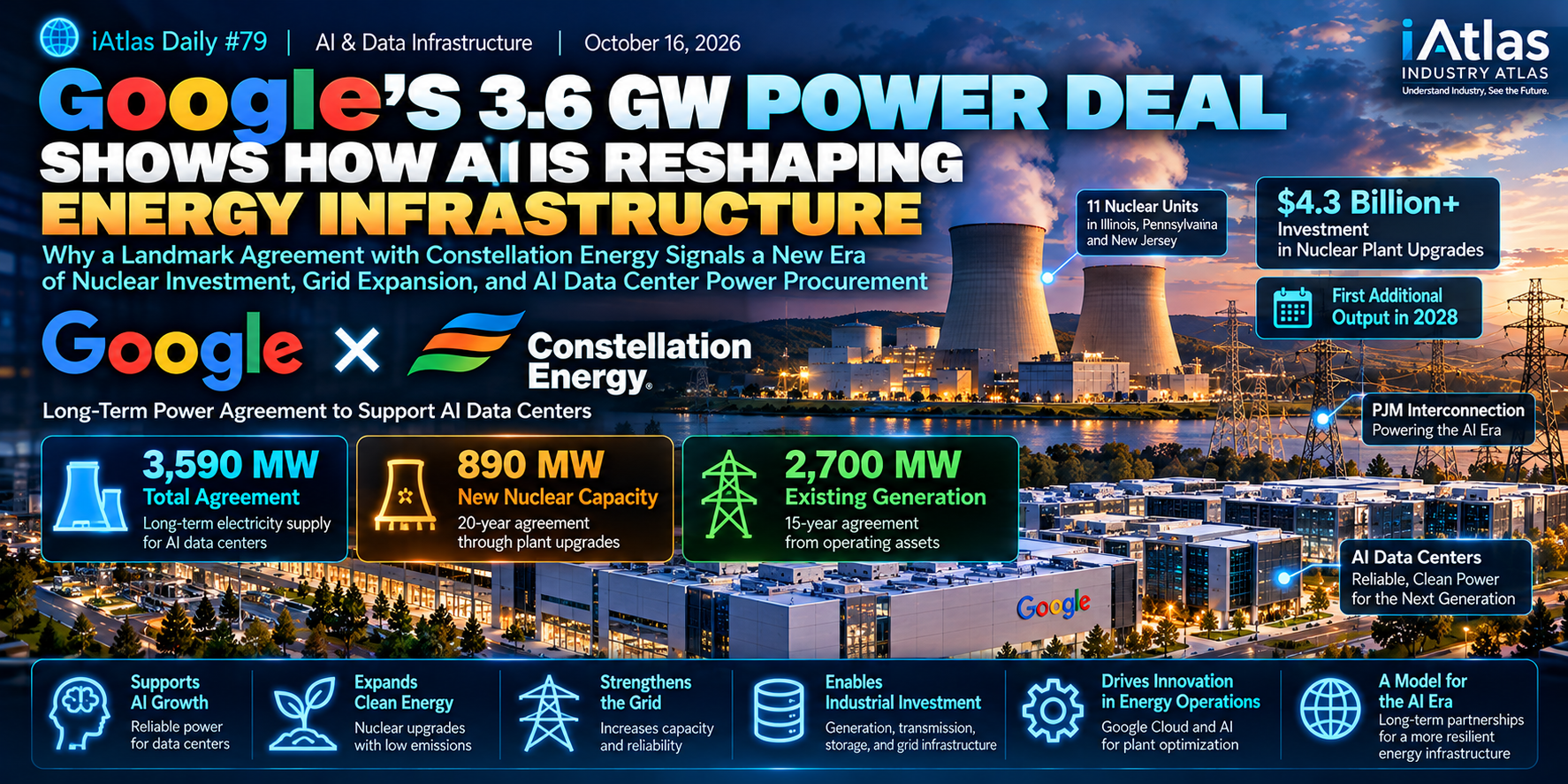
On October 6, 2026, Google and Constellation Energy announced long-term electricity agreements covering a combined 3,590 megawatts (MW) of power in the PJM Interconnection region of the United States.
The agreements include a 20-year power purchase agreement supporting 890 MW of additional nuclear generating capacity, alongside a separate 15-year agreement covering 2,700 MW from Constellation’s existing generation portfolio.
Constellation plans to invest more than $4.3 billion in nuclear plant upgrades associated with the partnership.
The agreement highlights a growing challenge for the AI industry.
Building data centers requires advanced processors, high-bandwidth memory, networking equipment, and cooling infrastructure.
But none of those systems can operate without a reliable electricity supply.
As AI computing expands, technology companies are increasingly entering long-term energy agreements and supporting investments in power infrastructure.
Electricity is becoming a strategic input in AI competition, not merely an operating expense.
1. Understanding Google’s 3.6 GW Power Agreement
The headline figure of 3.6 GW combines two different arrangements.
| Agreement | Capacity | Duration | Purpose |
|---|---|---|---|
| Nuclear uprate agreement | 890 MW | 20 years | Support additional generation from existing nuclear plants |
| Existing generation agreement | 2,700 MW | 15 years | Secure long-term supply from Constellation’s operating portfolio |
| Total | 3,590 MW | Different terms | Long-term electricity procurement |
The distinction is important.
The agreement does not create 3.59 GW of entirely new generating capacity.
Only the 890 MW nuclear uprate component is identified as incremental generation.
The remaining 2,700 MW is associated with existing generating assets and provides long-term commercial support for continued electricity supply.
Furthermore, 3,590 MW represents contracted power capacity, not the amount of electricity consumed every hour throughout the year.
Electricity capacity is measured in watts, while actual energy production or consumption over time is measured in watt-hours.
This distinction matters when assessing the agreement’s implications for the power grid.
2. Why Google Is Investing in Nuclear Power
AI data centers require large quantities of electricity.
Unlike many industrial facilities, major data centers can operate continuously, creating substantial demand for reliable power.
Nuclear energy offers several characteristics that make it attractive for this type of infrastructure.
High availability
Nuclear plants can provide substantial electricity output over long operating periods, subject to maintenance and refueling schedules.
Low operational carbon emissions
Nuclear generation can support corporate decarbonization objectives.
Long operating life
Existing nuclear facilities may continue operating for decades when they meet regulatory and technical requirements.
Potential capacity expansion
Upgrades to existing plants can increase output without requiring an entirely new nuclear power station.
However, nuclear power also involves substantial capital requirements, regulatory oversight, and lengthy equipment qualification processes.
The Google agreement focuses on increasing output from existing facilities rather than constructing new reactors.
This is an important part of its investment logic.
3. What Is a Nuclear Uprate?
A nuclear uprate is a project designed to increase the electricity output of an existing nuclear generating unit.
Depending on the plant, an uprate may involve improvements to turbines, steam generators, electrical systems, control technologies, and other equipment.
These changes can improve the efficiency or generating capability of the facility.
Under the Google–Constellation agreement, upgrades are planned across 11 nuclear units at six sites in Illinois, Pennsylvania, and New Jersey.
The companies expect the first uprate to deliver additional power in 2028.
The planned investments are intended to add approximately 890 MW of generating capacity across the participating units.
That is comparable in output to a large conventional nuclear reactor, although the capacity will be distributed across multiple existing units.
The strategy offers a potential alternative to developing entirely new generating facilities.
Instead of waiting for a new plant to complete construction and commissioning, operators can seek additional output from existing infrastructure.
Nevertheless, uprates still require engineering work, equipment upgrades, regulatory approvals, and execution over several years.
4. Why the PJM Power Grid Matters
The agreement is centered on PJM Interconnection, one of the largest electricity markets in the United States.
PJM coordinates electricity transmission and wholesale power markets across parts of the Mid-Atlantic and Midwest.
The region includes major population centers, industrial facilities, and rapidly expanding data center clusters.
As AI infrastructure grows, the power system faces several interconnected challenges.
Increasing electricity demand
Large data centers can require hundreds of megawatts of electrical capacity.
Grid connection constraints
Even when generating capacity is available, transmission and distribution infrastructure may limit how quickly new facilities can connect.
Generation investment requirements
Power producers need sufficient commercial certainty to justify major capital projects.
Reliability concerns
The system must maintain adequate resources during periods of high electricity demand.
These issues are changing the relationship between technology companies and electricity providers.
Instead of relying entirely on the existing market to supply additional power, large customers are increasingly participating in arrangements designed to support new generation investment.
Google and Constellation describe their agreement as a model for expanding power supply while supporting grid reliability.
The extent of its benefits will depend on the timing of capacity additions, grid conditions, and implementation.
5. Why Long-Term Contracts Are Becoming More Important
Electricity infrastructure is capital intensive.
Power plants, substations, transmission lines, and other facilities require substantial upfront investment.
Their development timelines can also extend over many years.
For energy companies, long-term contracts can reduce uncertainty about future revenue.
For technology companies, they can improve visibility into electricity availability and procurement costs.
The Google–Constellation agreement illustrates this relationship.
Google is securing long-term access to power.
Constellation is obtaining commercial support for investment in nuclear plant upgrades and continued operation of existing generating assets.
This creates a framework for coordinating electricity demand with infrastructure investment.
However, a long-term power agreement does not eliminate electricity price risk, grid congestion, regulatory uncertainty, or project execution risk.
Its effectiveness depends on the specific contractual arrangements and the broader electricity market.
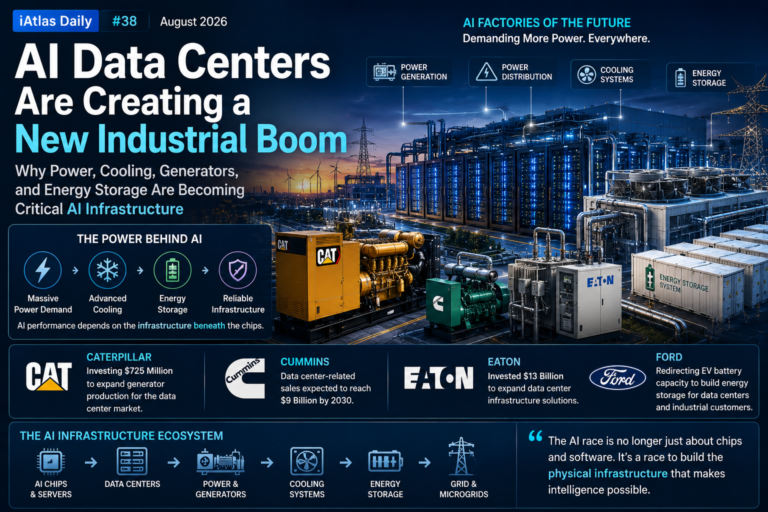
6. AI Is Creating a New Investment Cycle in Power Infrastructure
The AI infrastructure boom is often discussed in terms of semiconductor demand.
Companies invest in GPUs, memory, networking equipment, and data center construction.
But the electricity required to operate those facilities creates additional investment needs.
These extend across the energy value chain.
| Infrastructure Segment | Potential Investment Requirement |
|---|---|
| Electricity generation | Nuclear upgrades, gas generation, renewables, and other resources |
| Transmission | High-voltage lines and grid interconnections |
| Substations | Transformers, switchgear, and protection equipment |
| Data center electrical systems | Power distribution, UPS, and backup systems |
| Cooling infrastructure | Liquid cooling, chillers, pumps, and heat rejection |
| Energy storage | Grid balancing, peak management, and flexibility |
| Digital grid systems | Monitoring, forecasting, and control software |
The Google agreement directly supports nuclear generating capacity and long-term electricity procurement.
Other infrastructure opportunities are broader implications of AI-related electricity demand, not confirmed investments under this particular agreement.
Nevertheless, the relationship is becoming increasingly important.
The expansion of AI computing is creating demand for an industrial ecosystem that extends far beyond semiconductor manufacturing.
7. Where Battery Energy Storage Fits
Battery energy storage systems (BESS) are becoming an important part of electricity infrastructure.
They can store electricity when it is available and discharge it when needed.
Potential applications include peak-load management, renewable energy integration, frequency regulation, and grid flexibility.
For data centers, storage may also support specific power-management strategies, depending on system design and operational requirements.
However, battery storage is not a direct substitute for continuous electricity generation.
Its ability to support a load depends on both power capacity, measured in MW, and energy capacity, measured in MWh.
For example, a 100 MW battery with 400 MWh of usable energy could theoretically discharge at 100 MW for approximately four hours, before accounting for operating constraints and losses.
That is fundamentally different from a generating facility capable of producing electricity over extended periods.
The Google–Constellation partnership includes a strategic framework to explore future opportunities involving clean generation, energy storage, and demand response.
It does not establish a specific battery storage project or confirmed storage investment.
Still, the framework indicates that future AI power procurement may combine multiple technologies.
Nuclear power can provide firm generation.
Renewable energy can contribute low-carbon electricity.
Battery storage and demand response can add flexibility.
Grid infrastructure connects these resources to electricity consumers.
The result is a more integrated approach to energy planning.
8. AI Is Also Entering Power Plant Operations
An additional part of the announcement involves Google Cloud.
Constellation selected Google Cloud and Gemini Enterprise as part of an expanded five-year technology collaboration.
The companies intend to explore AI applications in energy operations.
These include planning, asset monitoring, outage management, and critical infrastructure protection.
Potential applications involve:
Infrastructure planning
Using digital tools to improve site selection, engineering analysis, and interconnection planning.
Asset monitoring
Analyzing equipment condition and operating data to support maintenance decisions.
Operational optimization
Improving planning and coordination across generation assets.
Cybersecurity
Strengthening protection of critical operational technology systems.
These initiatives remain implementation plans rather than independently demonstrated operational improvements.
Nevertheless, they reveal another dimension of the relationship.
AI companies are not only purchasing electricity from energy providers.
They are also supplying technologies that could help those providers operate more efficiently.
9. What the Agreement Means for Industrial Competitiveness
Electricity availability increasingly influences where large computing facilities can be developed.
A region may offer attractive land, tax incentives, and telecommunications infrastructure.
But if it cannot provide sufficient electrical capacity within the required timeframe, data center development may be delayed.
This makes power infrastructure a factor in industrial location decisions.
The implications extend beyond technology companies.
Electrical equipment manufacturers may benefit from grid investment.
Engineering and construction companies may participate in infrastructure projects.
Energy storage providers may find opportunities in grid flexibility.
Nuclear equipment suppliers may support plant modernization.
And utilities may face greater pressure to coordinate investment with large industrial customers.
The agreement therefore represents more than a major electricity purchase.
It reflects the growing connection between digital infrastructure investment and traditional industrial infrastructure.
Industry Impact
Technology companies: Long-term electricity procurement is becoming a strategic part of AI infrastructure planning.
Nuclear operators: Existing nuclear plants may gain new investment opportunities through capacity upgrades and long-term commercial agreements.
Utilities and grid operators: Rapidly growing data center demand increases the importance of generation adequacy, transmission capacity, and connection planning.
Electrical equipment suppliers: Grid expansion and plant modernization could support demand for transformers, switchgear, controls, and other equipment.
Battery manufacturers: Energy storage may play a larger role in managing grid flexibility, although specific project economics and operating requirements will determine deployment.
Data center developers: Access to reliable power may become an increasingly important factor in project timing and site selection.
Industrial investors: AI-related capital expenditure is extending into energy generation, grid infrastructure, and industrial equipment.
What to Watch
First nuclear uprate in 2028
Monitor whether the initial additional capacity becomes available on schedule.
Progress toward 890 MW
The timing, cost, and regulatory approval of individual nuclear plant upgrades will be important.
PJM electricity demand
Data center load growth and grid reliability assessments will help determine the scale of future investment requirements.
New technology-company power agreements
Additional long-term contracts could indicate how rapidly AI infrastructure is reshaping energy markets.
Energy storage projects
Watch whether the Google–Constellation framework produces specific battery storage or demand-response investments.
Electricity affordability
The effect of major data center expansion on broader electricity markets will remain an important policy and regulatory issue.
iAtlas Insight
The Google–Constellation agreement illustrates a fundamental shift in the economics of AI infrastructure.
For years, the competitive advantage of technology companies was closely associated with software, computing performance, and access to semiconductor technology.
Those capabilities remain essential.
But as AI systems become more computationally intensive, electricity availability is becoming another important constraint.
A data center cannot generate economic value if it cannot secure the power required to operate.
That changes how technology companies approach infrastructure investment.
Instead of treating electricity solely as a service purchased from utilities, large AI operators are increasingly helping support the development of generating capacity.
The Google agreement demonstrates this approach through long-term contracts and investment in existing nuclear facilities.
It also shows why the next industrial investment cycle may extend across multiple sectors.
Semiconductors provide computing capability.
Data centers provide physical infrastructure.
Power plants generate electricity.
Transmission networks deliver it.
Energy storage and demand-response systems provide flexibility.
The future of AI will depend not only on how much computing capacity companies can build, but also on how effectively they can secure and manage the energy required to operate it.
That is why energy infrastructure is becoming a central part of AI competition.
Related Articles
AI Data Center Infrastructure: The Next Industrial Investment Cycle
Explore how expanding AI computing demand is driving investment in semiconductor manufacturing, data centers, electricity infrastructure, and industrial equipment.
TSMC Expands Advanced Packaging Capacity as AI Demand Grows
Understand how AI demand is reshaping semiconductor production capacity and creating new manufacturing requirements.
References
1. Constellation Energy — Official Press Release (October 6, 2026)
Google and Constellation Announce Landmark Agreement to Bring 890 MW of New Nuclear Capacity to PJM Grid as Part of Long-Term Power Deal.
2. Constellation Energy — Investor Relations (October 6, 2026)
Official Investor Relations Release on the Google–Constellation Energy Agreement.
3. Reuters — October 6, 2026
Google Enters Massive 3.6-GW Power Deal with Constellation Energy.
4. Reuters — October 12, 2026
U.S. Panel Approves PJM’s Registry of Data Centers, Rejects Plan to Curtail Power to Them.
ℹ️ About iAtlas
iAtlas is an independent publication covering batteries, semiconductors, OLED, advanced materials, AI, and global industrial trends.
We transform complex industrial developments into clear, reliable, and easy-to-understand insights.
Whether you’re following today’s industry news or building long-term expertise, iAtlas helps you understand not only what happened, but why it matters.
Technology creates change.
Insight creates opportunity.
— iAtlas