Battery Electrolyte Filling Equipment Explained: How Precision Filling Determines Battery Performance
🔋 iAtlas Battery #25 | ⚙️ Equipment → 💧 Electrolyte Filling Equipment
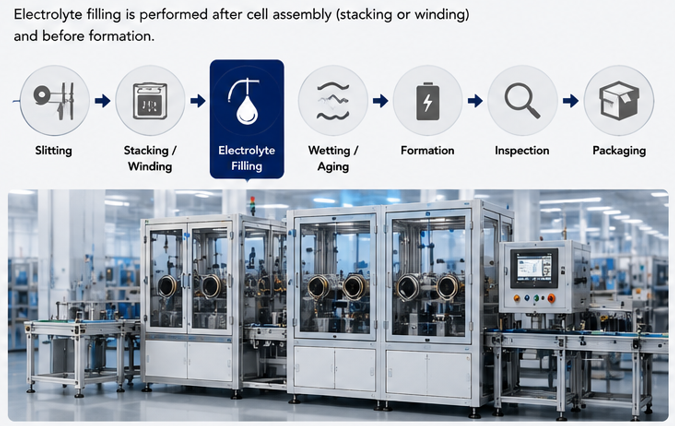
After battery electrodes have been assembled into a complete cell structure through stacking or winding, one critical process remains before the battery can become electrochemically active: electrolyte filling.
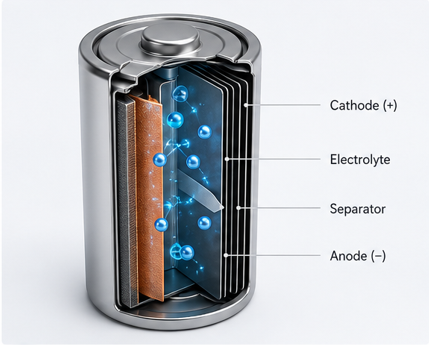
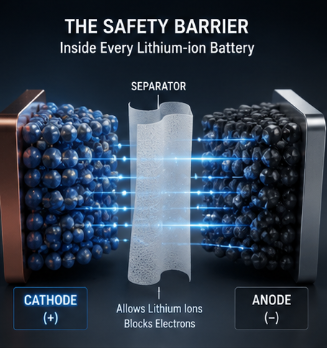
The electrolyte serves as the medium that transports lithium ions between the cathode and anode during charging and discharging. Without it, a lithium-ion battery cannot function.
Although electrolyte filling may appear to be a simple liquid injection process, it is actually one of the most sensitive manufacturing steps. The amount of electrolyte, filling speed, vacuum conditions, wetting time, and contamination control all directly influence battery performance, cycle life, and safety.
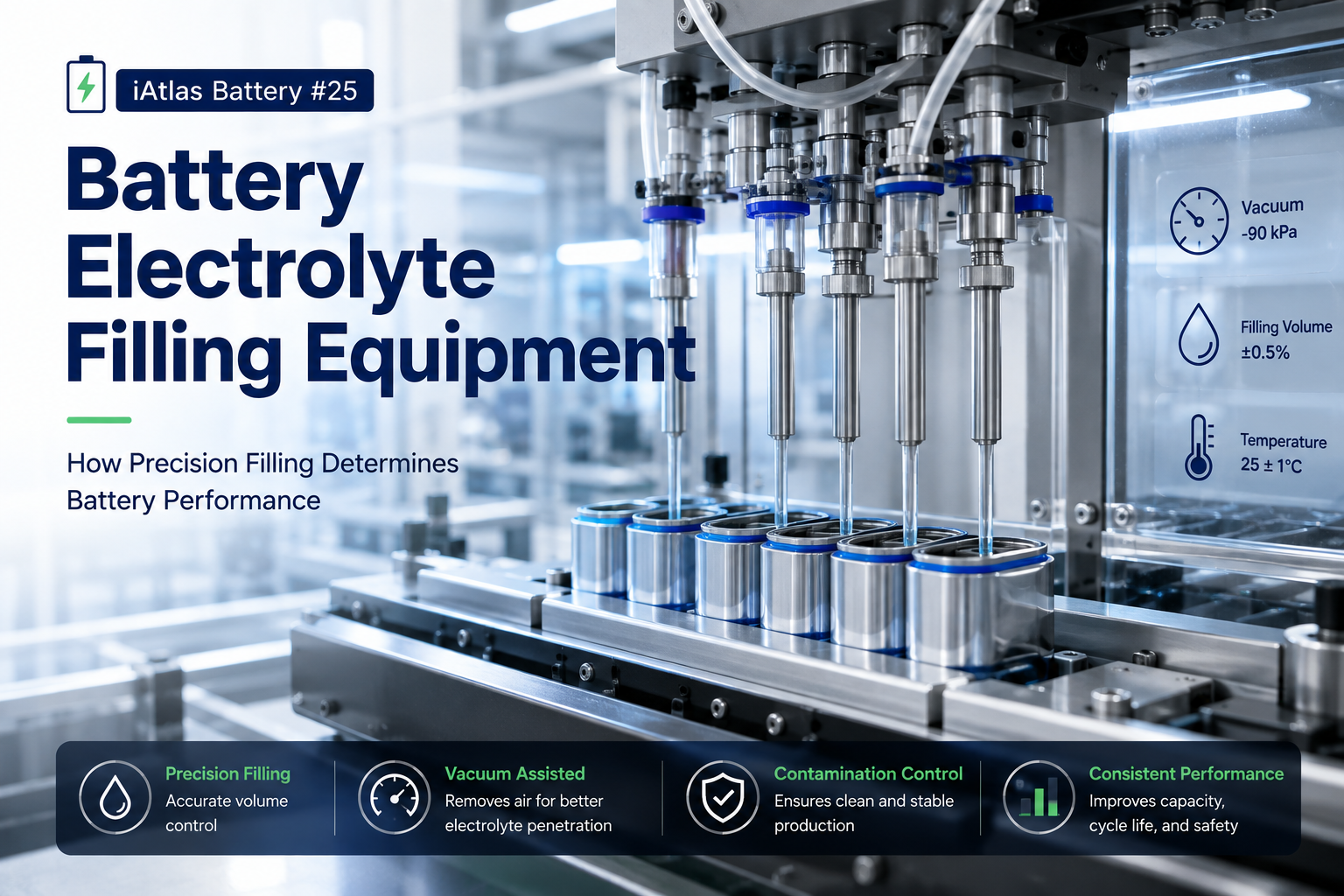
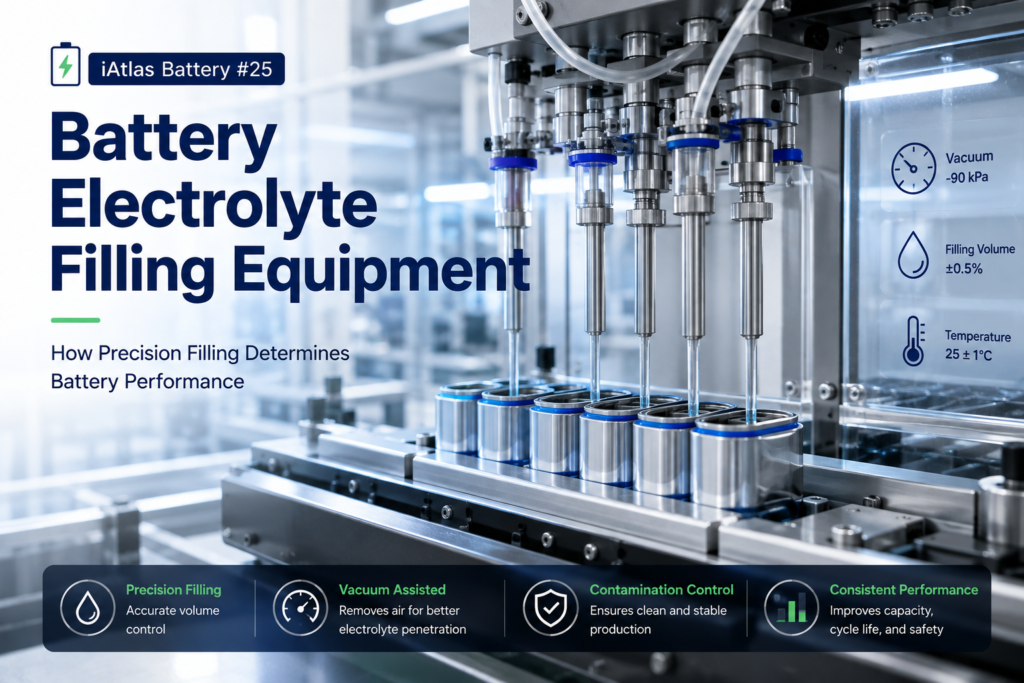
Modern battery electrolyte filling equipment combines precision metering pumps, vacuum chambers, automated dispensing systems, and intelligent process monitoring to ensure that every cell receives exactly the right amount of electrolyte.
In this article, we’ll explore how battery electrolyte filling equipment works, why precision filling is essential, and the technologies shaping next-generation battery manufacturing.
Table of Contents
- What Is Battery Electrolyte Filling Equipment?
- Why Electrolyte Filling Matters
- Main Components of an Electrolyte Filling Line
- How Electrolyte Filling Works
- Critical Filling Parameters
- Common Filling Defects
- Future Trends in Electrolyte Filling Equipment
- Frequently Asked Questions
- Key Takeaways
1. What Is Battery Electrolyte Filling Equipment?
Battery electrolyte filling equipment injects a precisely controlled amount of electrolyte into assembled battery cells before formation.
The filling process must ensure that the electrolyte completely wets the electrodes and separator without introducing contamination or trapped gas.
Battery electrolyte filling equipment is used in the production of:
- Cylindrical cells
- Prismatic cells
- Pouch cells
Its primary objectives are to:
- Deliver an accurate electrolyte volume
- Promote complete electrolyte wetting
- Remove trapped air
- Prevent contamination
- Support high-speed automated production
Because electrolyte distribution directly affects electrochemical performance, filling quality has a major influence on battery consistency and long-term reliability.
2. Why Electrolyte Filling Matters
Electrolyte filling is far more than simply injecting liquid into a battery cell.
Enabling Ion Transport
The electrolyte provides the pathway through which lithium ions move between the cathode and anode during charging and discharging.
Without sufficient electrolyte wetting, ion transport becomes uneven and battery performance decreases.
Achieving Uniform Wetting
Every portion of the separator and electrode must absorb electrolyte uniformly.
Incomplete wetting may lead to:
- Increased internal resistance
- Lower usable capacity
- Poor cycle life
- Reduced fast-charging performance
Supporting Stable SEI Formation
During the first charging cycle, the electrolyte reacts with the anode surface to form the Solid Electrolyte Interphase (SEI).
Proper electrolyte filling promotes uniform SEI formation, which is essential for long battery life.
3. Main Components of an Electrolyte Filling Line
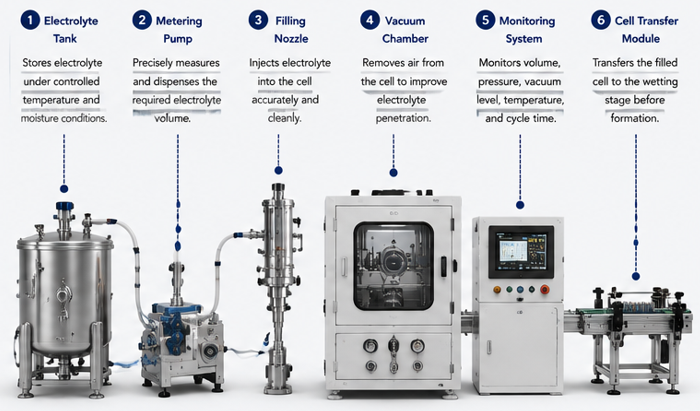
Electrolyte Storage Tank
Stores electrolyte under controlled temperature and moisture conditions.
Precision Metering Pump
Measures and dispenses the required electrolyte volume with high accuracy.
Filling Nozzle
Injects electrolyte into the battery cell while minimizing splashing and contamination.
Vacuum Chamber
Many filling systems use vacuum to remove air from inside the cell before electrolyte injection.
Vacuum-assisted filling improves electrolyte penetration into porous electrodes.
Process Monitoring System
Sensors continuously monitor:
- Filling volume
- Pressure
- Vacuum level
- Temperature
- Cycle time
Cell Transfer System
Automatically transfers filled cells to the wetting or aging stage before formation.
4. How Electrolyte Filling Works
A typical filling process consists of the following steps:
- The assembled battery cell enters the filling station.
- Air inside the cell is removed using vacuum.
- A metered amount of electrolyte is injected.
- Vacuum is gradually released.
- The electrolyte penetrates the separator and electrodes.
- The filled cell is transferred to a wetting period before formation.
This controlled sequence ensures complete electrolyte distribution while minimizing trapped gas.
5. Critical Filling Parameters
Several process variables determine filling quality.
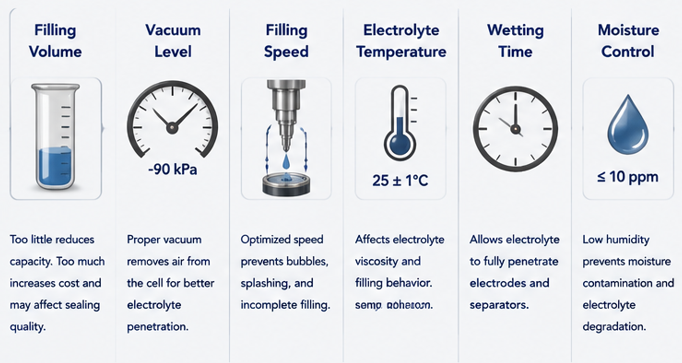
Filling Volume
Too little electrolyte reduces battery capacity, while excessive filling increases manufacturing cost and may affect sealing quality.
Vacuum Level
Proper vacuum improves electrolyte penetration and reduces trapped air.
Filling Speed
Injection speed must be optimized to prevent bubbles and splashing.
Electrolyte Temperature
Temperature influences electrolyte viscosity and filling behavior.
Wetting Time
Cells typically remain in storage for a defined period after filling to allow the electrolyte to fully penetrate the porous electrode structure.
Moisture Control
Electrolytes are highly sensitive to moisture.
Manufacturing therefore takes place in dry rooms with extremely low humidity.
6. Common Filling Defects
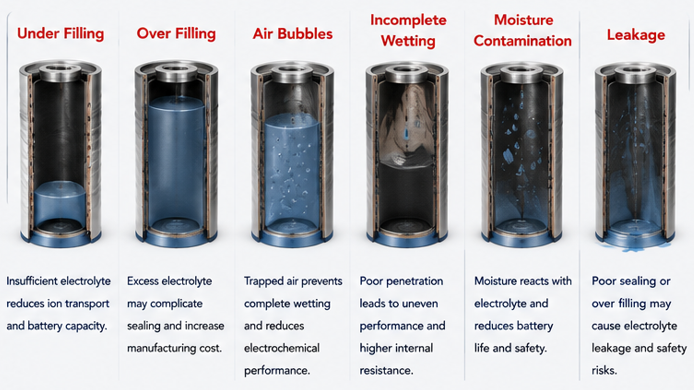
Under Filling
Insufficient electrolyte reduces ion transport and battery capacity.
Over Filling
Excess electrolyte may complicate sealing and increase manufacturing cost.
Air Bubbles
Trapped gas prevents complete electrolyte wetting.
Incomplete Wetting
Poor electrolyte penetration leads to uneven electrochemical performance.
Moisture Contamination
Exposure to moisture can degrade electrolyte quality and reduce battery life.
Leakage
Poor sealing after filling may result in electrolyte leakage and safety concerns.
7. Future Trends in Electrolyte Filling Equipment
Electrolyte filling technology continues to advance through:
- AI-assisted dispensing optimization
- High-speed precision metering
- Smart vacuum control
- Fully automated filling lines
- Real-time quality monitoring
- Digital twin process optimization
- Filling systems designed for solid-state battery production
These technologies improve manufacturing efficiency while ensuring consistent battery quality.
8. Frequently Asked Questions
Why is electrolyte filling performed under vacuum?
Vacuum removes trapped air inside the battery cell, allowing the electrolyte to penetrate porous electrodes and separators more effectively.
What happens if too much electrolyte is added?
Overfilling may increase manufacturing cost, complicate sealing, and potentially affect long-term reliability.
Why is a wetting period required?
The wetting period allows the electrolyte to fully soak into the porous electrode structure before formation begins.
Can moisture affect electrolyte quality?
Yes. Moisture reacts with common lithium-ion electrolytes, reducing performance and potentially generating harmful by-products.
What process follows electrolyte filling?
After wetting, the battery proceeds to the formation process, where the first charge-discharge cycles create the protective SEI layer.
9. Key Takeaways
- Battery electrolyte filling equipment precisely injects electrolyte into assembled battery cells.
- Filling volume, vacuum level, and wetting time strongly influence battery performance.
- Vacuum-assisted filling improves electrolyte penetration and reduces trapped air.
- Common defects include under filling, over filling, incomplete wetting, moisture contamination, and leakage.
- Future systems will emphasize automation, AI-based process optimization, and higher precision for next-generation batteries.
📚 Key Terms
Battery Electrolyte Filling Equipment
Automated manufacturing equipment that injects a precise amount of electrolyte into battery cells under controlled conditions before the formation process.
Electrolyte
A lithium-ion conductive medium that transports lithium ions between the cathode and anode during charging and discharging.
Vacuum Filling
A filling method that removes air from the battery cell before electrolyte injection, allowing the electrolyte to penetrate porous electrodes and separators more effectively.
Metering Pump
A precision pump that accurately measures and dispenses the required electrolyte volume into each battery cell.
Electrolyte Wetting
The process in which electrolyte gradually penetrates the porous structure of electrodes and separators after filling.
SEI (Solid Electrolyte Interphase)
A protective layer formed on the anode surface during the first charging cycle. A stable SEI improves battery life, efficiency, and safety.
Dry Room
A humidity-controlled manufacturing environment designed to prevent moisture contamination during electrolyte handling and battery assembly.
🎓 Battery Learning Path
⚙️ Equipment
✅ iAtlas Battery #18 — Mixing Equipment
✅ iAtlas Battery #19 — Coating Equipment
✅ iAtlas Battery #20 — Drying Equipment
✅ iAtlas Battery #21 — Calendaring Equipment
✅ iAtlas Battery #22 — Slitting Equipment
✅ iAtlas Battery #23 — Stacking Equipment
✅ iAtlas Battery #24 — Winding Equipment
📍 iAtlas Battery #25 — Electrolyte Filling Equipment (Current)
▶ iAtlas Battery #26 — Formation Equipment
▶ iAtlas Battery #27 — Inspection Equipment
Welcome to the Equipment Learning Path, where you’ll explore the machines that transform battery materials into complete lithium-ion battery cells.
📖 Continue Reading
⬅ Previous Article
🔋 iAtlas Battery #24
Battery Winding Equipment Explained: How Jelly Rolls Are Built for Lithium-Ion Batteries
Learn how battery winding equipment forms precise jelly rolls for cylindrical and prismatic lithium-ion batteries.
➡ Next Article
🔋 iAtlas Battery #26
Battery Formation Equipment Explained: Why the First Charge Determines Battery Life
Discover how formation equipment creates the protective SEI layer through carefully controlled charge and discharge cycles.
📚 Related Articles
Continue exploring battery manufacturing with these related topics:
- 🔋 iAtlas Battery #22 — Battery Slitting Equipment Explained
- 🔋 iAtlas Battery #23 — Battery Stacking Equipment Explained
- 🔋 iAtlas Battery #24 — Battery Winding Equipment Explained
- 🔋 iAtlas Battery #26 — Battery Formation Equipment Explained
- 📘 Electrolyte
- 📘 SEI (Solid Electrolyte Interphase)
- 📘 Dry Room
- 📘 Battery Cell
- 📘 Separator
Additional Library articles will be linked as they are published.
📚 References
Industry & Research
- International Energy Agency (IEA) – Global EV Outlook
- U.S. Department of Energy – Vehicle Technologies Office
- Journal of Power Sources
- Nature Energy
Equipment & Technology
🔷 About iAtlas
iAtlas is an independent publication dedicated to making industrial knowledge more accessible.
From batteries and semiconductors to advanced materials, AI, and global manufacturing, iAtlas transforms complex technologies into practical, easy-to-understand insights.
Whether you’re following today’s industry news or building long-term expertise, iAtlas helps you understand not only what happened, but why it matters.
Technology creates change.
Insight creates opportunity.
— iAtlas