Battery Stacking Equipment Explained: 7 Technologies Behind High-Precision Battery Cell Assembly
🔋 iAtlas Battery #23 | ⚙️ Equipment → 📑 Stacking Equipment
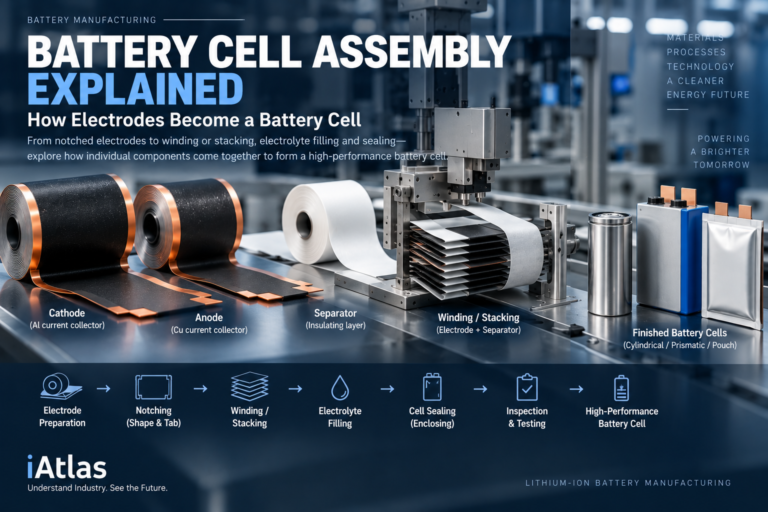
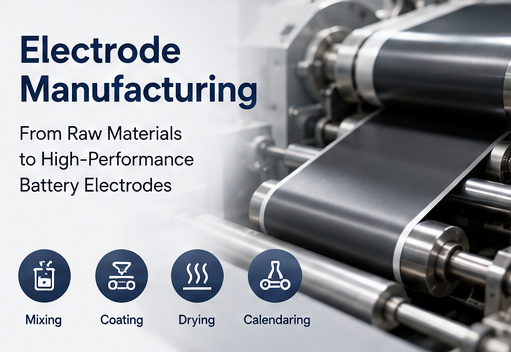
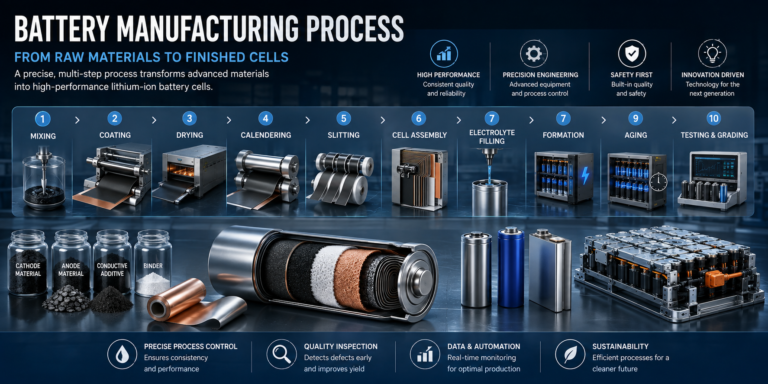
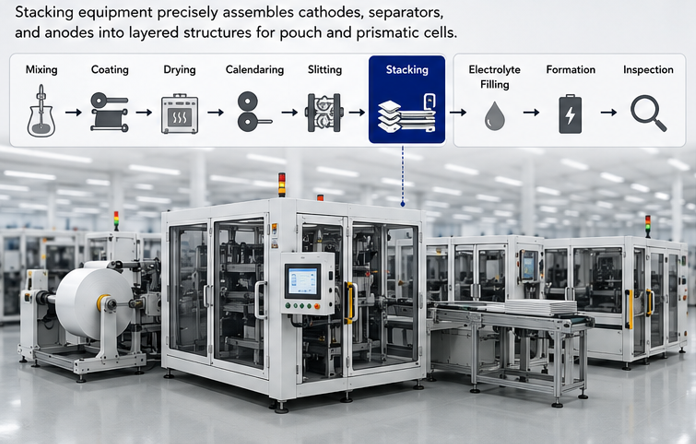
After electrodes have been coated, dried, calendared, and slit into precise dimensions, they are ready to be assembled into battery cells. For pouch cells and many next-generation prismatic batteries, this assembly process is performed using battery stacking equipment.
Instead of winding electrodes into a cylindrical “jelly roll,” stacking equipment precisely places alternating layers of cathodes, separators, and anodes to create a flat electrode stack. The accuracy of this process directly influences battery capacity, internal resistance, safety, and manufacturing yield.
Modern battery stacking equipment combines servo motion control, machine vision, robotic handling, and high-speed automation to position every layer within extremely tight tolerances.
In this article, we’ll explore how battery stacking equipment works, why precision stacking matters, and the technologies driving the next generation of lithium-ion battery manufacturing.
Table of Contents
- What Is Battery Stacking Equipment?
- Why Electrode Stacking Matters
- Main Components of a Stacking Line
- How Battery Stacking Works
- Critical Stacking Parameters
- Common Stacking Defects
- Future Trends in Battery Stacking Equipment
- Frequently Asked Questions
- Key Takeaways
1. What Is Battery Stacking Equipment?
Battery stacking equipment assembles cathodes, separators, and anodes into a precisely layered structure before electrolyte filling and cell sealing.
Unlike winding equipment, which rolls electrodes into a cylindrical structure, stacking equipment places individual sheets or continuous Z-fold separator layers one by one.
Battery stacking is widely used in:
- Pouch cells
- Many large-format prismatic cells
- High-energy-density EV batteries
- Solid-state battery prototypes
The primary objectives of stacking equipment are to:
- Achieve precise layer alignment
- Protect delicate separators
- Prevent contamination
- Maintain high production speed
- Produce consistent battery cells
Even a small alignment error may reduce the effective electrode area or increase the risk of internal short circuits.
2. Why Electrode Stacking Matters
The stacking process determines the internal geometry of the battery cell.
Because each cathode, separator, and anode layer must overlap precisely, stacking quality has a direct influence on battery performance.
Precise Layer Alignment
Each electrode layer must be positioned within very tight tolerances.
Poor alignment may result in:
- Reduced active material overlap
- Lower cell capacity
- Increased internal resistance
- Uneven current distribution
Modern battery stacking equipment uses machine vision and servo positioning systems to achieve micron-level accuracy.
Separator Protection
The separator is extremely thin and must remain free from wrinkles, tears, or contamination.
Improper handling during stacking may lead to:
- Separator damage
- Internal short circuits
- Lower manufacturing yield
High Production Efficiency
Modern EV battery factories require stacking systems capable of assembling hundreds of layers at high speed while maintaining consistent quality.
Automation plays a key role in achieving this balance.
3. Main Components of a Stacking Line
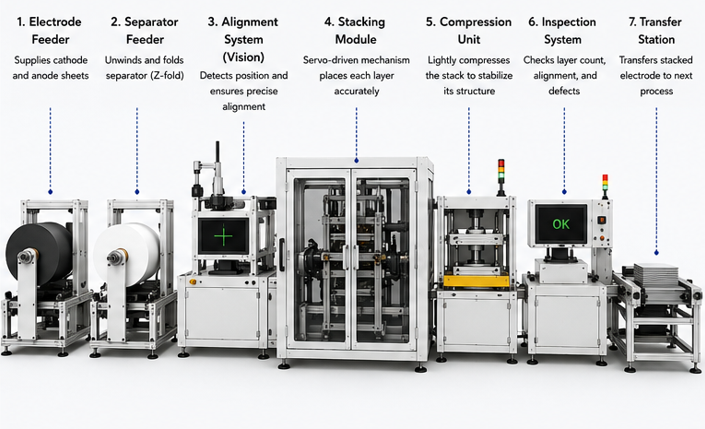
A battery stacking system consists of several integrated modules.
Electrode Feeding System
Prepared cathode and anode sheets are automatically supplied to the stacking station.
Separator Feeding System
The separator is continuously unwound and positioned between electrode layers.
Many systems use a Z-fold separator to reduce handling complexity and improve alignment.
Vision Alignment System
High-resolution cameras detect electrode position before each stacking cycle.
The control system automatically corrects positioning errors in real time.
Servo Stacking Module
Servo-driven mechanisms place each layer accurately while maintaining stable production speed.
This module determines overall stacking precision.
Compression Unit
After stacking is complete, the electrode stack is lightly compressed to stabilize the structure before transfer.
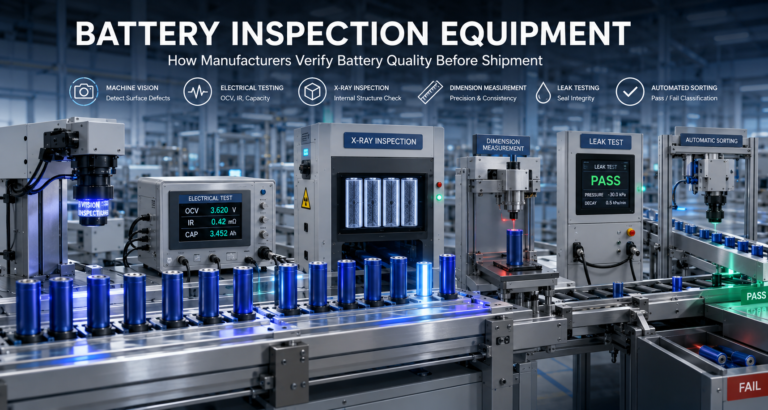
Inspection System
Inline inspection verifies:
- Layer count
- Alignment accuracy
- Missing sheets
- Surface contamination
4. How Battery Stacking Works
The stacking process follows a repeating sequence.
- A cathode sheet is positioned.
- The separator is placed.
- An anode sheet is added.
- The separator folds again.
- The cycle repeats until the required number of layers is reached.
- The completed stack is compressed and transferred to the next process.
Modern stacking equipment performs these steps automatically while continuously monitoring alignment and layer count.
The finished electrode stack is then transferred to the electrolyte filling process.
5. Critical Stacking Parameters
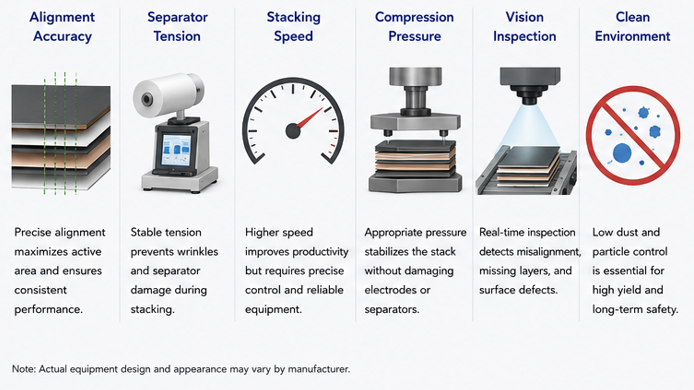
Several process variables determine stacking quality.
Alignment Accuracy
Proper electrode overlap is essential for consistent electrochemical performance.
Separator Tension
Stable separator tension prevents wrinkles and folding defects.
Stacking Speed
Higher speed improves productivity but increases positioning challenges.
Compression Pressure
Light compression stabilizes the completed stack before handling.
Vision Inspection
Camera systems continuously verify layer position and detect missing electrodes.
Clean Environment
Dust control is critical because foreign particles may reduce battery safety and yield.
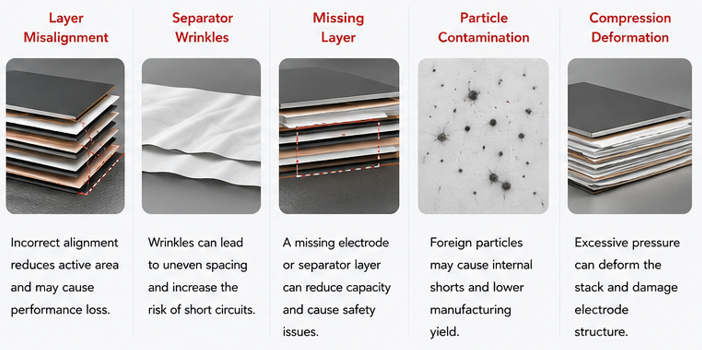
6. Common Stacking Defects
Improper stacking conditions may create several defects.
Layer Misalignment
Incorrect positioning reduces the active overlap area between electrodes.
Separator Wrinkles
Wrinkles may cause uneven spacing or increase the risk of internal short circuits.
Missing Layers
Equipment errors may occasionally fail to place an electrode or separator.
Inline inspection systems help prevent this defect.
Particle Contamination
Dust or foreign particles introduced during stacking reduce battery reliability.
Compression Deformation
Excessive compression may damage delicate electrode layers before electrolyte filling.
7. Future Trends in Battery Stacking Equipment
Battery stacking technology continues to evolve as manufacturers pursue higher energy density and faster production.
Key trends include:
- High-speed Z-fold stacking
- AI-based vision inspection
- Robotic sheet handling
- Servo-controlled positioning
- Digital twin optimization
- Equipment for solid-state batteries
- Fully automated cell assembly lines
These innovations improve both manufacturing efficiency and battery consistency.
8. Frequently Asked Questions
Why do pouch cells typically use stacking?
Stacking maximizes electrode utilization and provides excellent dimensional flexibility for flat battery designs.
What is Z-fold stacking?
Z-fold stacking uses a continuously folded separator while alternating cathode and anode sheets, improving both speed and alignment.
Why is alignment so important?
Poor alignment reduces the active electrode area and can negatively affect battery capacity and cycle life.
Does stacking require machine vision?
Most modern systems use vision inspection to achieve high positioning accuracy and detect missing or misaligned layers.
What process follows stacking?
After stacking, the assembled electrode stack moves to electrolyte filling and subsequent cell sealing processes.
9. Key Takeaways
- Battery stacking equipment assembles electrodes into precisely aligned layered structures for pouch and many prismatic cells.
- Alignment accuracy and separator handling are critical to battery quality.
- Servo positioning, machine vision, and Z-fold separator technology improve manufacturing consistency.
- Common defects include layer misalignment, separator wrinkles, missing layers, and contamination.
- Future stacking systems will continue to evolve through AI, robotics, and advanced automation
📚 Key Terms
Battery Stacking Equipment
Automated manufacturing equipment that assembles cathodes, separators, and anodes into precisely aligned layered structures before electrolyte filling.
Z-Fold Stacking
A stacking method that continuously folds the separator in a zigzag (Z-shaped) pattern while alternating cathode and anode sheets. It improves alignment accuracy and production efficiency.
Layer Alignment
The positional accuracy between electrode sheets and separators during stacking. Proper alignment maximizes the active electrode area and helps ensure consistent battery performance.
Separator
A thin porous membrane placed between the cathode and anode to prevent electrical contact while allowing lithium ions to move freely.
Servo Motion Control
A high-precision motor control system used to position electrodes and separators accurately during automated stacking.
Vision Inspection
A camera-based inspection system that verifies electrode position, detects missing layers, and identifies assembly defects in real time.
Compression Unit
A mechanism that lightly compresses the completed electrode stack to stabilize its shape before transferring it to the next manufacturing process.
🎓 Battery Learning Path
⚙️ Equipment
✅ iAtlas Battery #18 — Mixing Equipment
✅ iAtlas Battery #19 — Coating Equipment
✅ iAtlas Battery #20 — Drying Equipment
✅ iAtlas Battery #21 — Calendaring Equipment
✅ iAtlas Battery #22 — Slitting Equipment
📍 iAtlas Battery #23 — Stacking Equipment (Current)
▶ iAtlas Battery #24 — Winding Equipment
▶ iAtlas Battery #25 — Electrolyte Filling Equipment
▶ iAtlas Battery #26 — Formation Equipment
▶ iAtlas Battery #27 — Inspection Equipment
Welcome to the Equipment Learning Path, where you’ll explore the machines that transform battery materials into high-performance lithium-ion cells.
📖 Continue Reading
⬅ Previous Article
🔋 iAtlas Battery #22
Battery Slitting Equipment Explained: 7 Ways Precision Cutting Improves Battery Quality
Learn how precision slitting prepares battery electrodes with accurate dimensions and clean edges before cell assembly.
➡ Next Article
🔋 iAtlas Battery #24
Battery Winding Equipment Explained: How Jelly Rolls Are Built for Cylindrical Batteries
Discover how winding equipment forms electrodes into tightly controlled jelly rolls for cylindrical and some prismatic lithium-ion battery cells.
📚 Related Articles
Continue building your knowledge with these related topics:
- 📘 Battery Cell
- 📘 Separator
- 📘 Pouch Cell
- 📘 Prismatic Cell
- 📘 Z-Fold Stacking
Related Library articles will be linked as they are published.
📚 References
Industry & Research
- International Energy Agency (IEA) – Global EV Outlook
- U.S. Department of Energy – Vehicle Technologies Office
- Journal of Power Sources
- Nature Energy
Equipment Manufacturers
🔷 About iAtlas
iAtlas is an independent publication covering batteries, semiconductors, OLED, advanced materials, AI, and global industrial trends.
We transform complex industrial developments into clear, reliable, and easy-to-understand insights.
Whether you’re following today’s industry news or building long-term expertise, iAtlas helps you understand not only what happened, but why it matters.
Technology creates change.
Insight creates opportunity.
— iAtlas