Cell-to-Pack (CTP) Explained: How It Compares with Cell-to-Chassis | iAtlas
🔋 iAtlas Battery #12 | 🔋 Cell Design → 🏗️ Cell-to-Pack (CTP) & Cell-to-Chassis (CTC)
Introduction
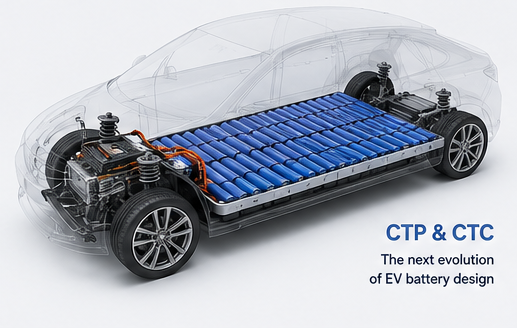
Cell-to-Pack (CTP) and Cell-to-Chassis (CTC) are two of the most significant innovations in modern EV battery design.
Understanding cell-to-pack vs. cell-to-chassis architecture helps explain how battery manufacturers are improving energy density, reducing vehicle weight, and simplifying battery manufacturing.
Instead of relying on traditional battery modules, these next-generation battery structures integrate cells more directly into the battery pack—or even into the vehicle chassis itself.
As electric vehicles continue to evolve, CTP and CTC are becoming key technologies that define the future of battery performance, manufacturing efficiency, and vehicle design.
Table of Contents
- Why Battery Architecture Is Changing
- What Is Cell-to-Pack (CTP)?
- What Is Cell-to-Chassis (CTC)?
- Cell-to-Pack vs. Cell-to-Chassis: Key Differences
- Advantages and Challenges
- Future Outlook
- Frequently Asked Questions
Why Battery Architecture Is Changing
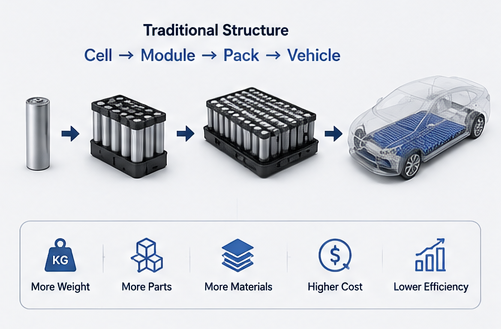
Traditional EV battery systems follow this structure:
Cell → Module → Pack → Vehicle
Each additional structural layer increases:
- Vehicle weight
- Manufacturing complexity
- Material consumption
- Production cost
To improve efficiency, battery manufacturers are reducing unnecessary structural components while maintaining safety and durability.
What Is Cell-to-Pack (CTP)?
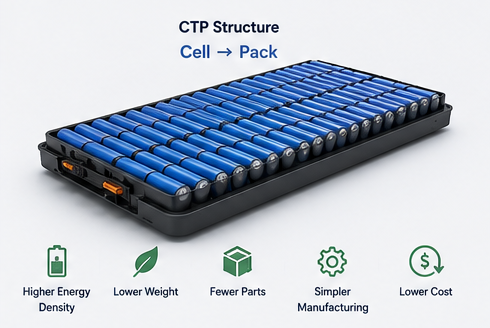
Cell-to-Pack (CTP) removes traditional battery modules.
Instead of:
Cell → Module → Pack
the battery becomes:
Cell → Pack
This architecture provides several advantages:
- Higher energy density
- Lower vehicle weight
- Fewer components
- Simplified manufacturing
- Lower production costs
CATL pioneered the commercial adoption of CTP technology, and many global manufacturers now use similar designs.
What Is Cell-to-Chassis (CTC)?
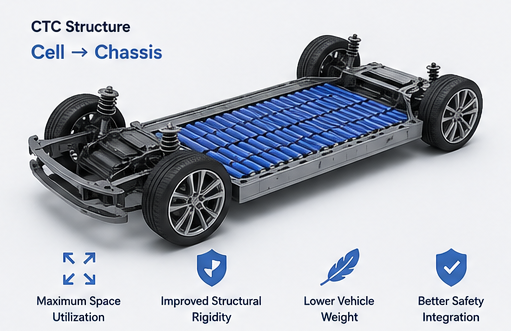
Cell-to-Chassis (CTC) represents the next stage of battery integration.
Instead of installing a completed battery pack into the vehicle chassis, the battery itself becomes part of the vehicle’s structural platform.
The structure becomes:
Cell → Chassis
This significantly improves structural efficiency while reducing redundant components.
Tesla, BYD, and several leading automakers are actively developing CTC-based vehicle platforms.
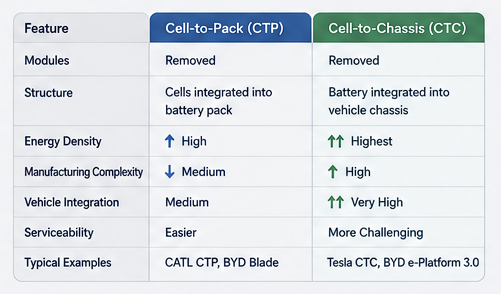
Cell-to-Pack vs. Cell-to-Chassis: Key Differences
| Feature | Cell-to-Pack (CTP) | Cell-to-Chassis (CTC) |
|---|---|---|
| Modules | Removed | Removed |
| Pack Structure | Maintained | Integrated into chassis |
| Energy Density | Higher | Highest |
| Manufacturing Complexity | Lower | Higher |
| Vehicle Integration | Medium | Very High |
While CTP optimizes battery pack design, CTC fundamentally redesigns how the battery and vehicle are integrated.
Advantages and Challenges
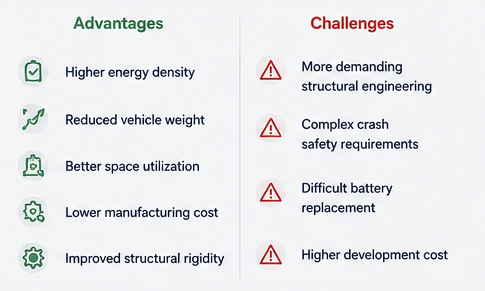
Advantages
- Higher energy density
- Lower vehicle weight
- Better space utilization
- Lower manufacturing cost
- Improved structural rigidity
Challenges
- More demanding structural engineering
- Complex crash safety requirements
- Difficult battery replacement
- Higher development costs
Future battery architecture must balance performance, safety, repairability, and manufacturing efficiency.
Future Outlook
Battery architecture continues to evolve beyond today’s CTP and CTC designs.

Emerging technologies include:
- Structural battery packs
- Integrated thermal management
- Gigacasting integration
- AI-assisted structural optimization
- Solid-state battery platforms
As batteries become more integrated with vehicle structures, the distinction between the battery and the vehicle itself will continue to disappear.
Frequently Asked Questions
What is the difference between Cell-to-Pack and Cell-to-Chassis?
Cell-to-Pack removes battery modules while retaining the battery pack.
Cell-to-Chassis goes one step further by integrating the battery directly into the vehicle chassis.
What are the advantages of Cell-to-Pack?
CTP improves energy density, reduces weight, lowers manufacturing costs, and simplifies battery pack assembly.
Why is Cell-to-Chassis considered the future?
CTC maximizes structural efficiency, reduces redundant components, and enables lighter, more rigid electric vehicles.
Which companies are developing CTP and CTC?
CATL, BYD, Tesla, and several major global automakers are actively developing or commercializing these battery architectures.
Key Takeaways
- Cell-to-Pack removes traditional battery modules.
- Cell-to-Chassis integrates the battery into the vehicle structure.
- Both technologies improve energy density and reduce vehicle weight.
- CTP is already widely commercialized.
- CTC represents the next generation of EV battery architecture.
🎓 Battery Learning Path
🔋 Cell Design
✅ 🔋 iAtlas Battery #8 — Cell Formats
✅ 🔋 iAtlas Battery #9 — Battery Pack Architecture
✅ 🔋 iAtlas Battery #10 — Battery Management System (BMS)
✅ 🔋 iAtlas Battery #11 — Thermal Management
📍 🔋 iAtlas Battery #12 — Cell-to-Pack (CTP) & Cell-to-Chassis (CTC) (Current)
🎉 Congratulations! You’ve completed the Cell Design learning path.
Next Learning Path: 🏭 Manufacturing
📖 Continue Reading
⬅ Previous Article
🔋 iAtlas Battery #11
Battery Thermal Management Explained: Keeping EV Batteries Safe and Efficient
Learn how battery thermal management regulates temperature, improves charging performance, extends battery life, and helps prevent thermal runaway in electric vehicles.
➡ Next Learning Path
🏭 Manufacturing
🔋 iAtlas Battery #13
Electrode Manufacturing Explained: Mixing, Coating, Drying, and Calendaring
Discover how lithium-ion battery electrodes are manufactured through mixing, coating, drying, and calendaring, and why each process directly affects battery quality and performance.
References
- International Energy Agency (IEA)
- U.S. Department of Energy – Vehicle Technologies Office
- Battery University
- Nature Energy (Battery Manufacturing Research)
About iAtlas
iAtlas is an independent publication covering batteries, semiconductors, OLED, advanced materials, AI, and global industrial trends.
We transform complex industrial developments into clear, reliable, and easy-to-understand insights.
Whether you’re following today’s industry news or building long-term expertise, iAtlas helps you understand not only what happened, but why it matters.
Technology creates change.
Insight creates opportunity.
— iAtlas