
Battery Cell Testing & Grading Explained: How Lithium-Ion Cells Are Evaluated and Classified
Understanding Capacity Testing, Internal Resistance, OCV, Cell Matching, Quality Classification, and End-of-Line Testing in Lithium-Ion Battery Manufacturing
Topic: Processes
Process Stage: Cell Finishing
Content Type: Manufacturing
Learning Path: Battery Manufacturing
Related Industries: Electric Vehicles · Energy Storage Systems · Consumer Electronics
Last Updated: November 2026

Industry Snapshot
Manufacturing a lithium-ion battery cell does not end when the electrodes are assembled, electrolyte is filled, and the cell completes formation and aging.
Before cells can be used in battery modules, packs, or other applications, manufacturers must verify that they meet defined electrical, mechanical, and safety-related quality requirements.
This is where Battery Cell Testing & Grading becomes essential.
Even cells manufactured using the same materials, equipment, and production conditions may exhibit small differences in capacity, internal resistance, voltage, and self-discharge behavior.
These differences can result from normal manufacturing variation or, in some cases, process-related defects.
Cell testing identifies whether each battery meets the required specifications.
Grading then groups acceptable cells according to selected performance characteristics.
A simplified process sequence is:
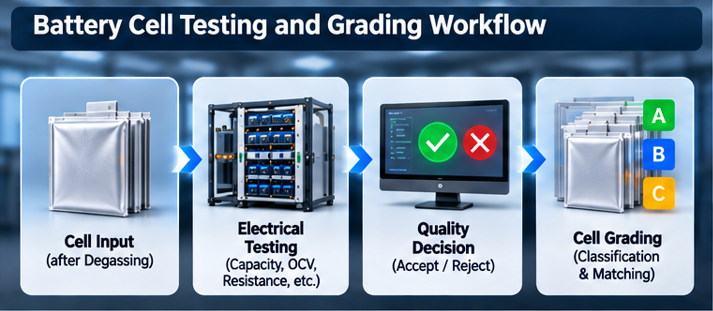
Formation → Aging → Degassing → Cell Testing → Grading → Module / Pack Assembly
The exact order of finishing operations varies by cell format and manufacturing process.
Battery cell testing determines whether a cell meets quality requirements. Grading determines how acceptable cells should be classified and matched for their intended applications.
At a Glance
| Category | Description |
|---|---|
| Process | Battery Cell Testing & Grading |
| Manufacturing Stage | Cell Finishing |
| Main Purpose | Electrical performance verification and quality classification |
| Key Measurements | Capacity, OCV, DC resistance, AC impedance, self-discharge |
| Common Equipment | Battery cyclers, OCV testers, resistance meters, inspection systems |
| Quality Objectives | Consistency, reliability, traceability, defect screening |
| Grading Criteria | Capacity, resistance, voltage and other validated parameters |
| Major Risks | Low capacity, high resistance, abnormal voltage decay, defects |
| Downstream Application | Cell matching, module assembly, battery pack manufacturing |
| Related Processes | Formation, Aging, Degassing, End-of-Line Inspection |
1. What Is Battery Cell Testing & Grading?
Battery cell testing is the process of measuring and evaluating a finished battery cell against defined specifications.
Grading is the subsequent classification of cells according to selected characteristics.
Although the two operations are closely connected, they serve different purposes.
Battery Cell Testing
Testing answers questions such as:
- Does the cell meet its minimum capacity requirement?
- Is its internal resistance within the permitted range?
- Is the open-circuit voltage acceptable?
- Does the cell exhibit abnormal self-discharge?
- Are there visible or measurable manufacturing defects?
Battery Cell Grading
Grading answers a different question:
Which acceptable cells have sufficiently similar characteristics to be grouped together?
For example, cells may be classified by capacity and internal resistance to support more consistent module or pack assembly.
Simplified Workflow
Grading should not be confused with using classification to make defective cells acceptable.
Cells that fail mandatory safety or quality requirements must be handled according to the manufacturer’s rejection or disposition procedures.
2. Why Is Cell Testing Necessary?
Battery manufacturing involves numerous tightly controlled processes.
These include electrode mixing, coating, drying, calendering, cutting, assembly, electrolyte filling, formation, and finishing.
Each stage can introduce small variations.
For example:
Electrode Coating Variation
↓
Different Active Material Loading
↓
Capacity Variation
Or:
Electrode Alignment / Contact Variation
↓
Different Electrical Resistance
↓
Different Heat Generation During Operation
The final testing stage evaluates the combined result of these upstream processes.
This makes cell testing both a quality-control activity and an important source of manufacturing feedback.
Manufacturing Consistency
Testing verifies whether cells remain within the required specification limits.
Defect Screening
Testing can identify cells with abnormal electrical behavior.
Product Reliability
Testing helps prevent cells with unacceptable characteristics from entering downstream products.
Production Traceability
Measurement results can be associated with individual cells and their manufacturing histories.
Cell Matching
Grading supports the selection of cells with sufficiently similar characteristics for multi-cell systems.
3. Battery Capacity Testing
Capacity is one of the most important battery performance characteristics.
It represents the amount of electric charge a cell can deliver under defined conditions.
Capacity is commonly expressed in ampere-hours (Ah).
For a constant discharge current:
\[ Q=I\times t \]
Where:
- \(Q\) = capacity (Ah)
- \(I\) = discharge current (A)
- \(t\) = discharge time (hours)
For a varying current:
\[ Q=\int I(t)\,dt \]
with consistent units.
Example
A cell discharged at a constant current of 5 A for 10 hours delivers:
\[ Q=5\times10=50\text{ Ah} \]
This is a simplified example.
Actual capacity testing follows a defined procedure specifying temperature, current, voltage limits, rest periods, and other conditions.
Why Capacity Testing Matters
Two cells may have the same nominal rated capacity but deliver slightly different measured capacities.
For example:
| Cell | Measured Capacity |
|---|---|
| Cell A | 50.2 Ah |
| Cell B | 50.0 Ah |
| Cell C | 49.8 Ah |
| Cell D | 47.1 Ah |
These are illustrative values, not universal acceptance criteria.
The manufacturer must determine whether each result meets the product specification.

4. Open-Circuit Voltage (OCV) Testing
Open-circuit voltage is measured when the battery is not supplying an external current.
OCV depends on:
- State of charge
- Electrode chemistry
- Temperature
- Electrochemical relaxation
- Cell condition
OCV measurements are commonly used during formation, aging, and final inspection.
Why Is OCV Important?
OCV can help identify abnormal voltage conditions and provide information for quality screening.
However, a single OCV measurement cannot determine every aspect of cell quality.
A cell may exhibit an acceptable voltage while still having abnormal capacity, resistance, or self-discharge behavior.
Therefore, OCV is typically evaluated together with other measurements.
5. Internal Resistance Testing
Internal resistance influences the voltage drop and heat generation that occur when current flows through a battery.
A simplified relationship is:
\[ \Delta V\approx I\times R \]
Where:
- \(\Delta V\) = voltage drop (V)
- \(I\) = current (A)
- \(R\) = effective internal resistance (Ω)
A simplified estimate of resistive heating is:
\[ P\approx I^2R \]
These expressions are useful approximations, but real battery behavior is more complex.
Battery resistance depends on temperature, SOC, measurement timescale, and electrochemical processes.
Why High Resistance Matters
Higher resistance can contribute to:
- Greater voltage drop under load
- Increased heat generation
- Reduced power capability
- Greater performance differences between cells
Resistance testing helps manufacturers identify cells that fall outside their required performance limits.
6. AC Resistance vs DC Resistance
Battery manufacturers may use different methods to characterize internal resistance.
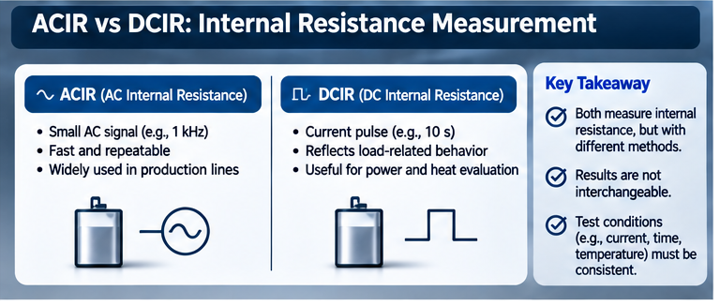
| Measurement | Principle | Typical Use |
|---|---|---|
| AC Internal Resistance (ACIR) | Measures impedance response to a small AC excitation, often at a specified frequency | Rapid production screening |
| DC Internal Resistance (DCIR) | Estimates resistance from voltage response to a defined current pulse | Load-related performance evaluation |
| Electrochemical Impedance Spectroscopy (EIS) | Measures impedance over a range of frequencies | Detailed electrochemical characterization |
These measurements are related but not interchangeable.
A resistance value should always be interpreted together with its measurement method and test conditions.
DCIR Example
Suppose a cell experiences a 0.10 V voltage change under a 20 A current step.
\[ R=\frac{0.10}{20}=0.005\ \Omega \]
Therefore:
\[ R=5\text{ m}\Omega \]
This result applies to the specified test method and observation interval.
7. Self-Discharge Testing
Self-discharge refers to the gradual loss of stored charge while a battery is not connected to an external load.
Some self-discharge is normal. However, excessive self-discharge may indicate undesirable internal reactions, contamination, or leakage pathways.
A common manufacturing screening approach involves measuring cell voltage at defined intervals.
Initial OCV Measurement → Controlled Storage → Second OCV Measurement → Voltage-Change Evaluation
The voltage change can be expressed as:
\[ \Delta V=V_{\mathrm{initial}}-V_{\mathrm{final}} \]
A simplified voltage-change rate is:
\[ k_V=\frac{\Delta V}{\Delta t} \]
This parameter is sometimes described as a voltage-drop rate or K-value in manufacturing contexts.
However, terminology and calculation methods vary among manufacturers.
Importantly, voltage decline is not identical to lost battery capacity. Voltage relaxation, SOC, temperature, and the chemistry-dependent OCV–SOC relationship must be considered.
Why Self-Discharge Screening Matters
Abnormal self-discharge can indicate:
- Internal electrical leakage
- Metallic contamination
- Undesirable electrochemical side reactions
- Manufacturing defects
- Unstable cell behavior
Self-discharge screening is particularly valuable because certain defects may become measurable only after a storage period.
This connects final cell testing directly to the previous Battery Aging process.
8. How Battery Cell Grading Works
Battery grading classifies acceptable cells according to defined performance criteria.
The purpose is to reduce undesirable differences between cells that will operate together.
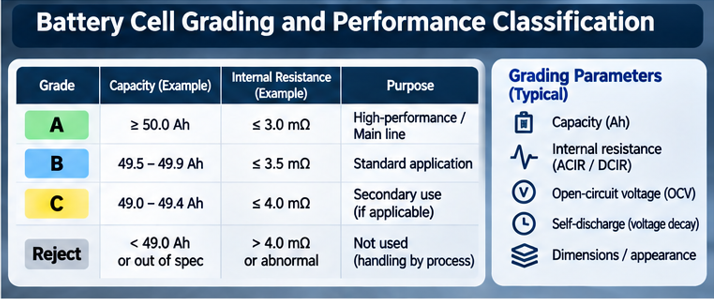
Common grading parameters include:
- Measured capacity
- Internal resistance
- Open-circuit voltage
- Self-discharge characteristics
- Cell dimensions and other product-specific requirements
Example: Capacity-Based Grading
Consider a hypothetical production batch of 50 Ah lithium-ion cells.
| Grade | Illustrative capacity range | Classification |
|---|---|---|
| A | 50.0–50.5 Ah | High-capacity group |
| B | 49.5–49.9 Ah | Standard-capacity group |
| C | 49.0–49.4 Ah | Lower-capacity group |
| Reject | Below 49.0 Ah | Outside illustrative capacity limit |
These are fictional ranges for explaining classification. They are not industry-wide grading standards, and actual rejection decisions require all mandatory quality criteria to be satisfied.
A manufacturer may use different grading ranges, or may avoid letter-based grades entirely.
Multi-Parameter Grading
Capacity alone is not sufficient for many applications.
Two cells can have similar capacities but different internal resistances.
For this reason, manufacturers may classify cells using multiple parameters simultaneously.
For example:
Capacity Range + Resistance Range + Voltage Requirements
↓
Matched Cell Group
The objective is to produce groups of cells with characteristics suitable for the intended module or pack design.
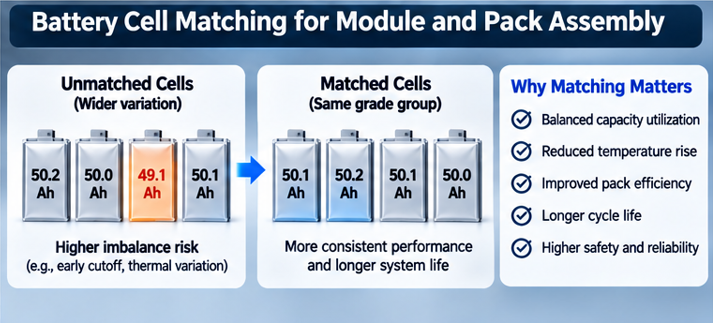
9. Why Cell Matching Matters in Battery Packs
A battery pack may contain dozens, hundreds, or thousands of individual cells.
Cells connected in series carry the same current, while parallel-connected cells share current according to their electrical characteristics and operating conditions.
If cells differ significantly in capacity, resistance, or state of charge, the pack may experience performance limitations.
Capacity Mismatch
In a series-connected group, a lower-capacity cell may reach its operating voltage limit earlier than the others.
This can constrain usable pack capacity.
Resistance Mismatch
Different internal resistances can produce different voltage drops and heat generation.
SOC Imbalance
Cells with different states of charge may require balancing by the battery management system.
Thermal Differences
Variations in resistance, cooling, and operating conditions can contribute to temperature differences between cells.
Example: Series-Connected Cells
Consider four cells with the following capacities:
| Cell | Capacity |
|---|---|
| Cell A | 50 Ah |
| Cell B | 50 Ah |
| Cell C | 49 Ah |
| Cell D | 50 Ah |
Under simplified conditions with equal initial SOC and comparable operating limits, Cell C may reach its discharge limit first.
The series group therefore cannot automatically deliver the sum of the individual capacities as if they were independent batteries.
This illustrates why cell consistency matters as much as individual cell performance.
10. Battery Testing Equipment
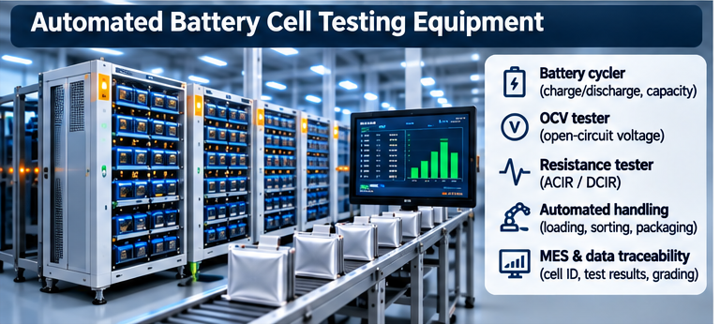
Industrial battery cell testing requires high measurement accuracy, repeatability, and traceability.
Battery Cyclers
Battery cyclers charge and discharge cells according to defined current, voltage, and time profiles.
They are used for:
- Capacity measurement
- Charge/discharge performance evaluation
- Energy measurement
- Selected resistance and pulse tests
OCV Testing Systems
OCV systems measure cell voltage under defined resting conditions.
They are commonly integrated into automated cell-handling lines.
Resistance Measurement Systems
Resistance testers measure ACIR, DCIR, or other electrical characteristics depending on the system.
Temperature Monitoring
Temperature sensors help ensure that electrical measurements are performed under appropriate conditions.
Automated Cell Handling
Robotic and conveyor systems can transport cells between measurement, inspection, sorting, and packaging stations.
Manufacturing Execution System (MES)
The MES or related production-data infrastructure links test results with individual cell identities.
A typical integrated line can be represented as:
Cell Identification → Electrical Testing → Data Evaluation → Quality Decision → Sorting → Traceability
11. Testing Accuracy and Measurement Conditions
Reliable testing depends on more than the nominal accuracy of the instrument.
Important factors include:
| Factor | Potential impact |
|---|---|
| Cell Temperature | Changes measured capacity and resistance |
| State of Charge | Influences voltage and resistance |
| Rest Time | Affects voltage relaxation |
| Contact Resistance | Can distort resistance measurements |
| Measurement Current | Influences test response |
| Voltage Cutoffs | Affect measured discharge capacity |
| Instrument Calibration | Influences measurement accuracy |
| Test Repeatability | Determines consistency between measurements |
Four-Wire Resistance Measurement
For low-resistance measurements, four-wire or Kelvin sensing can reduce errors caused by voltage drops across current-carrying test leads.
This is particularly important when measuring milliohm-level cell resistance.
Temperature Standardization
Comparing cells tested at different temperatures can produce misleading results.
For meaningful grading, manufacturers must establish consistent test conditions.
12. Quality Classification vs Performance Grading
It is important to distinguish quality acceptance from performance classification.
Quality Acceptance
Determines whether a cell meets mandatory requirements.
Examples include:
- No unacceptable leakage
- Acceptable insulation and electrical behavior
- Required capacity and resistance limits
- Acceptable dimensions
- No identified critical safety defect
Performance Grading
Groups cells that have already passed the relevant acceptance requirements.
For example, two acceptable cells may belong to different capacity groups while both remain suitable for approved applications.
A cell with a critical defect must not be treated as acceptable simply because its measured capacity is high.
This distinction prevents a common misunderstanding of battery grading.
Grade A, Grade B, and Grade C are not universally standardized battery quality classifications.
Their meaning depends on the manufacturer and the applicable product specification.
13. Cell Testing and Manufacturing Defect Detection
Final testing can reveal problems originating from earlier manufacturing stages.
| Upstream process | Potential issue | Possible testing indication |
|---|---|---|
| Electrode Mixing | Nonuniform material distribution | Capacity or resistance variation |
| Electrode Coating | Uneven active material loading | Capacity variation |
| Calendering | Inconsistent porosity or compression | Resistance or performance variation |
| Slitting / Notching | Burrs or particle contamination | Potential leakage or self-discharge abnormalities |
| Cell Assembly | Misalignment or contact defects | Abnormal electrical characteristics |
| Electrolyte Filling | Inadequate wetting | Capacity or resistance abnormalities |
| Formation | Inconsistent interfacial development | Capacity, resistance, or self-discharge variation |
| Degassing / Sealing | Gas retention or sealing defects | Dimensional or integrity-test abnormalities |
These relationships are not always unique.
For example, high internal resistance can arise from several different causes.
Testing identifies an abnormality; additional investigation may be necessary to determine its origin.
14. End-of-Line Testing and Quality Assurance
End-of-line testing is the final verification stage before cells are released to downstream production or distribution.
Depending on the manufacturer and application, it may include:
Electrical Verification
Capacity, OCV, resistance, and selected electrical checks.
Mechanical Inspection
Dimensions, appearance, terminal condition, and packaging integrity.
Safety-Related Checks
Applicable insulation, leakage, and other validated checks.
Data Verification
Confirmation that the cell’s identification and manufacturing records are complete.
Final Sorting
Routing accepted cells into appropriate performance groups.
Reject Handling
Separating cells that fail mandatory acceptance criteria.
The exact scope varies by cell design, product requirements, and manufacturing quality plan.
15. Cell Testing, Automation, and Data Analytics
As battery factories increase production capacity, testing generates large amounts of cell-level data.
These datasets can support more than final pass/fail decisions.
Statistical Process Control
Manufacturers can monitor whether production measurements remain stable over time.
Manufacturing Feedback
Unusual changes in capacity or resistance distributions can prompt investigation of upstream processes.
Predictive Quality Models
Formation, aging, and testing measurements can be combined to investigate potential quality risks.
Cell Traceability
Each cell’s performance can be associated with its manufacturing history.
Automated Matching
Software can identify compatible cell groups according to defined matching criteria.
These applications can improve consistency, but predictive models require validation and ongoing monitoring.
A statistical prediction should not replace mandatory safety testing without an approved and validated alternative.
16. Manufacturing Throughput and Testing Bottlenecks
Battery testing can require substantial production time and equipment capacity.
Capacity testing is particularly time-consuming because it may require a full or partial discharge under controlled conditions.
The theoretical testing capacity depends on the number of parallel channels and the duration of each test.
\[ Q=\frac{N}{t} \]
Where:
- \(Q\) = theoretical cell throughput per hour
- \(N\) = number of parallel testing channels
- \(t\) = test duration in hours
For example, consider 1,000 parallel channels and a four-hour test.
\[ Q=\frac{1000}{4}=250 \]
The theoretical throughput is 250 cells per hour.
Cell testing throughput calculatorParallel testing channels
1,000Test duration
4 hours
Theoretical testing throughput
250 cells/hour
Illustrative calculation assuming all channels operate continuously. Excludes loading, unloading, rest periods outside the defined cycle, downtime, and rejected tests.
The challenge is to achieve reliable quality screening without creating excessive production delays.
Potential improvements include higher channel density, automated handling, optimized testing sequences, and validated data-driven screening methods.
However, shortening a test must not compromise its ability to detect unacceptable cells.
iAtlas Insight
Battery Cell Testing & Grading represents the point where manufacturing precision becomes measurable product quality.
Every upstream process influences the final characteristics of a cell.
The relationships extend across the manufacturing chain:
Materials & Electrode Manufacturing
↓
Cell Assembly & Electrolyte Filling
↓
Formation, Aging & Degassing
↓
Electrical & Mechanical Testing
↓
Quality Acceptance & Grading
↓
Module and Pack Assembly
For battery manufacturers, the objective is not simply to produce cells with high capacity.
It is to produce large numbers of cells with consistent, predictable, and reliable performance.
This becomes particularly important in EV and ESS applications, where many cells operate together over extended periods.
Cell testing also creates a feedback loop.
If final testing reveals increasing resistance variation or abnormal self-discharge, the manufacturer can investigate the relevant upstream processes.
This means the testing stage is not merely the end of battery manufacturing.
It is also a source of information for improving the entire factory.
The value of battery testing lies not only in identifying defective cells, but also in understanding why manufacturing variation occurs and how it can be reduced.
Did You Know?
- Cells manufactured on the same production line can have different measured capacities.
- ACIR and DCIR are not interchangeable resistance measurements.
- A cell can have acceptable OCV but still fail capacity or resistance requirements.
- Cell grading is distinct from mandatory quality acceptance.
- There is no universal industry-wide definition of Grade A, B, and C cells.
- Cell matching can help reduce undesirable variation within modules and packs.
- Measurement temperature and SOC significantly influence resistance results.
- End-of-line testing data can help identify problems originating from upstream manufacturing.
- Testing throughput depends heavily on the number of parallel channels and test duration.
FAQ
What is battery cell testing?
Battery cell testing measures electrical, mechanical, and other specified characteristics to determine whether a manufactured cell meets defined quality requirements.
What is battery cell grading?
Battery cell grading classifies acceptable cells into groups based on selected characteristics such as capacity, resistance, and voltage.
Why do battery cells need to be matched?
Matching helps reduce differences between cells operating together in a battery module or pack.
What is the difference between ACIR and DCIR?
ACIR uses an alternating-current excitation, typically at a specified frequency. DCIR estimates resistance from the voltage response to a defined current pulse.
Is a higher-capacity cell always better?
Not necessarily. Resistance, safety, self-discharge, consistency, and application requirements also matter.
Are Grade A and Grade B battery cells standardized?
No. These labels do not have a universal meaning across all manufacturers.
Can OCV testing detect every battery defect?
No. OCV testing is useful, but it must be combined with other relevant measurements and inspections.
Why is capacity testing time-consuming?
Capacity testing requires controlled charging or discharging over a defined period, often with specified rest conditions.
What happens after battery cell testing and grading?
Accepted and appropriately classified cells can proceed to downstream operations such as module assembly, pack assembly, or other application-specific integration.
Battery Manufacturing Learning Path
Overview
– Battery Manufacturing Process
Electrode Manufacturing
Cell Assembly
- Battery Cell Assembly
- Battery Electrode Notching
- Battery Electrode Winding
- Battery Electrode Stacking
- Battery Electrolyte Filling
- Battery Cell Sealing
Cell Finishing
- Battery Formation
- Battery Aging
- Battery Degassing
- Battery Cell Testing & Grading (Current)
System Assembly
- Battery Module Assembly — Next
- Battery Pack Assembly
Explore More
Cell Finishing
- Battery Formation
- Battery Aging
- Battery Degassing
- Battery Cell Testing & Grading (Current)
Battery Systems
- Battery Cell
- Battery Module
- Battery Pack
- Battery Management System (BMS)
Related Technical Concepts
- Battery Capacity
- Open-Circuit Voltage (OCV)
- Internal Resistance
- State of Charge (SOC)
- Battery Self-Discharge
- Battery Cell Matching
References
1. VDMA / PEM RWTH Aachen — Production Process of a Lithium-Ion Battery Cell (2026)
Industry manufacturing reference covering cell finishing, electrical testing, quality inspection, and production equipment.
2. U.S. Department of Energy — Battery Manufacturing and Research
Research and technical information related to lithium-ion battery performance, manufacturing, and quality.
3. IEC 62660 Series — Secondary Lithium-Ion Cells for the Propulsion of Electric Road Vehicles
International standards addressing performance, reliability, and safety testing of lithium-ion cells for vehicle propulsion.
4. IEC 61960 Series — Secondary Lithium Cells and Batteries for Portable Applications
Standards covering performance-related testing and specifications for applicable lithium cells and batteries.
ℹ️ About iAtlas
iAtlas is an independent publication covering batteries, semiconductors, OLED, advanced materials, AI, and global industrial trends.
We transform complex industrial developments into clear, reliable, and easy-to-understand insights.
Whether you’re following today’s industry news or building long-term expertise, iAtlas helps you understand not only what happened, but why it matters.
Technology creates change.
Insight creates opportunity.
— iAtlas