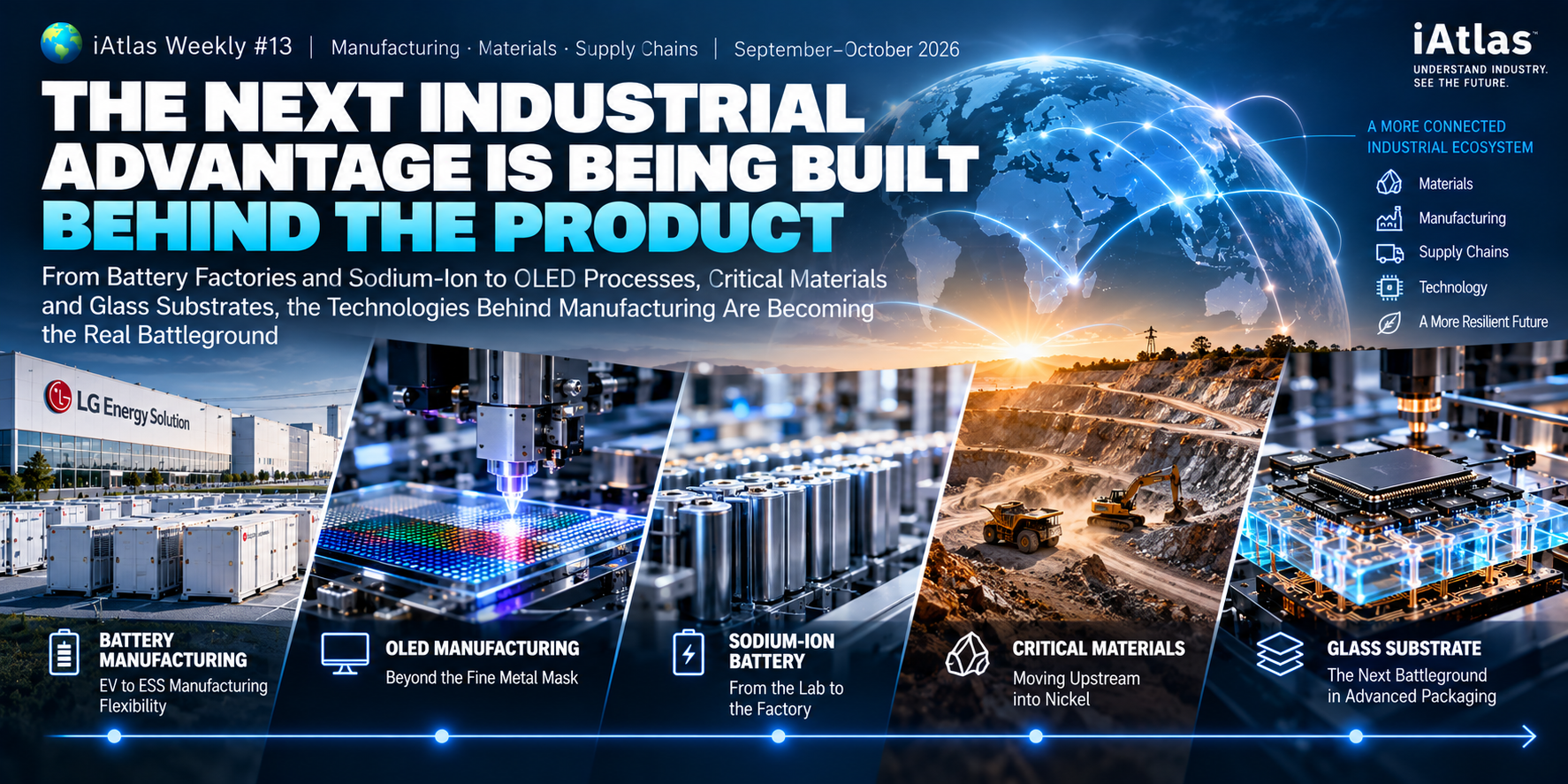
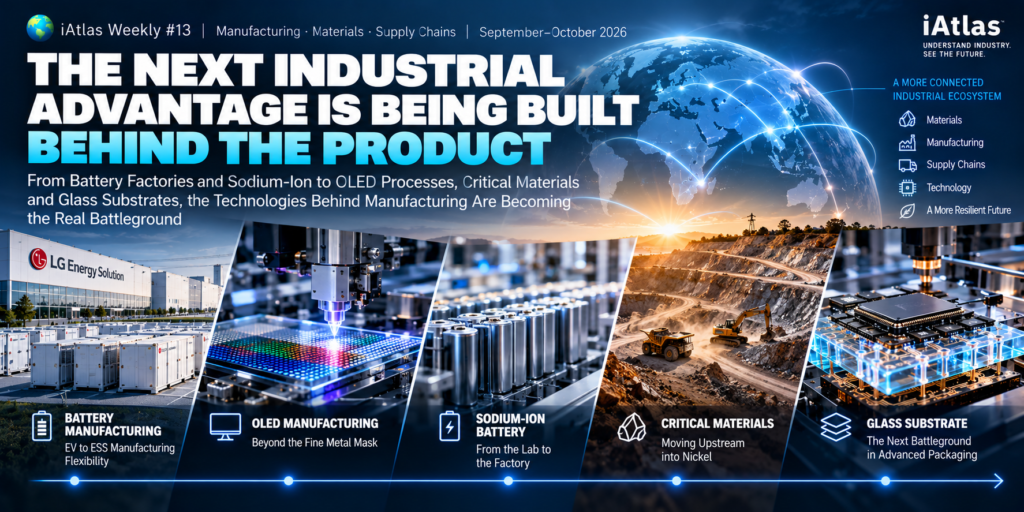
The Next Industrial Advantage Is Being Built Behind the Product
From Battery Factories and Sodium-Ion to OLED Processes, Critical Materials and Glass Substrates, the Technologies Behind Manufacturing Are Becoming the Real Battleground
🌐 iAtlas Weekly #13 | Manufacturing · Materials · Supply Chains | September–October 2026
The products that define modern industry are easy to see.
Electric vehicles.
Batteries.
Semiconductors.
OLED displays.
Energy storage systems.
But the technologies increasingly determining who wins these markets are much harder to see.
They sit behind the product.
Inside the factory.
Inside the manufacturing process.
Inside the package.
And sometimes deep inside the supply chain.
This week’s iAtlas Daily stories repeatedly pointed toward the same structural change.
Battery manufacturers are adapting EV factories for energy storage.
OLED companies are trying to change how pixels are patterned.
Sodium-ion batteries are moving from laboratory development toward industrial production.
Critical-material companies are moving upstream toward nickel resources.
And semiconductor companies are developing glass substrates for increasingly complex advanced packages.
Different industries.
Different technologies.
But one common direction:
Final Product
↓
Manufacturing
↓
Process
↓
Materials
↓
Supply Chain
↓
Industrial Infrastructure
Competition is moving deeper.
The next industrial advantage may be built in the technologies consumers never see.
🌍 The Big Picture
For much of the past decade, industrial competition could be summarized by one word:
Scale
Build more factories.
Produce more batteries.
Fabricate more chips.
Expand more capacity.
Scale remains important.
But something is changing.
Companies increasingly need to answer a second question:
What capabilities underneath that scale do we need to control?
A 50 GWh battery factory is valuable.
But its value changes if it cannot secure materials.
A semiconductor fab is valuable.
But the processor eventually depends on memory, packaging and substrates.
An OLED factory can produce millions of panels.
But its competitiveness may change if a new patterning process removes one of the fundamental constraints of existing production.
Industrial strength is therefore becoming less about one factory or one product.
It is increasingly about:
The system behind them.
1. Manufacturing Capacity Is Becoming More Flexible
One of this week’s battery stories illustrated the change at the factory level.
LG Energy Solution is expanding its energy-storage manufacturing footprint in North America.
The important point is not simply:
More ESS Capacity
It is the changing role of battery manufacturing infrastructure.
Factories originally developed around rapid EV growth increasingly need to respond to another rapidly expanding market:
Energy Storage
That creates a different manufacturing question.
Instead of asking only:
How much EV battery capacity do we have?
companies increasingly need to ask:
How flexibly can that capacity respond to different markets?
2. EV and ESS Demand Do Not Move in Exactly the Same Cycle
Electric vehicles and stationary energy storage both use batteries.
But their demand drivers are different.
EV batteries depend heavily on:
Vehicle Sales
Automaker Strategies
Consumer Demand
and:
EV Policy
ESS demand is influenced by:
Renewable Energy
Grid Modernization
Data Centers
Electricity Demand
and:
Energy Security
That difference creates strategic value.
A manufacturing system capable of serving multiple applications has more options when one market slows.
3. Flexibility Can Be as Important as Capacity
Imagine two battery manufacturers.
Company A:
100 GWh
but optimized around one application.
Company B:
80 GWh
with greater ability to shift among:
EV
and:
ESS
markets.
Company A has more nominal capacity.
But Company B may have more:
Optionality
when market conditions change.
This is an increasingly important industrial concept.
The value of a factory is not determined only by how much it can produce.
It is also determined by:
How easily it can adapt.
4. OLED Competition Is Moving into the Process
Another Daily story moved one level deeper.
For years, RGB OLED manufacturing has relied heavily on:
Fine Metal Masks
The mask determines where organic emitting materials are deposited.
But LG Display’s FLiPP development challenges this architecture.
Instead of using a conventional FMM to define the RGB pattern, the technology moves toward:
Photolithographic Patterning
That is much more than a materials substitution.
It changes the manufacturing process itself.
5. Process Innovation Can Reshape an Industry
Removing the Fine Metal Mask potentially changes several variables simultaneously.
Substrate Size
Pixel Patterning
Aperture Ratio
Equipment Architecture
Panel Flexibility
and:
Manufacturing Economics
That is why process technology can create a deeper competitive advantage than a single product feature.
A product feature can sometimes be copied.
A mature manufacturing process requires:
Equipment
Materials
Recipes
Yield Learning
Inspection
and:
Engineering Experience
That takes time.
6. Manufacturing Knowledge Is Often Invisible
Consumers rarely know how an OLED panel was patterned.
They care about:
Brightness
Resolution
Power Consumption
Lifetime
and:
Price
But those visible characteristics ultimately emerge from invisible manufacturing decisions.
This leads to one of the central themes of this week’s stories:
Manufacturing know-how is technology.
It may not appear on the product label.
But it can determine whether the product can be produced competitively.
7. Sodium-Ion Is Crossing the Same Boundary
The same distinction appears in batteries.
Sodium-ion chemistry has existed in research for years.
The important development now is not simply:
Sodium-ion batteries work.
The important development is:
Industrialization
CATL is pushing sodium-ion technology toward larger-scale manufacturing and commercial deployment.
That moves the discussion from:
Science
to:
Manufacturing
8. The Laboratory and the Factory Are Different Worlds
A laboratory asks:
Can the chemistry achieve the desired performance?
A factory asks many additional questions.
Can it be manufactured:
Thousands of times?
Millions of times?
Can the process maintain:
Consistency?
Can defects be controlled?
Can raw materials be supplied?
Can equipment maintain throughput?
Can the cell meet cost targets?
The path therefore becomes:
Research
↓
Prototype
↓
Pilot Line
↓
Qualification
↓
Mass Production
↓
Commercial Scale
Many promising technologies never complete this journey.
9. Industrialization Creates Its Own Moat
Once a company solves those manufacturing problems, it develops something competitors cannot obtain simply by reading a patent.
It accumulates:
Process Data
Yield Knowledge
Equipment Experience
Supplier Relationships
and:
Quality-Control Know-How
This creates:
Manufacturing Learning
And manufacturing learning compounds with scale.
That is one reason being early to industrialization can matter so much.
10. Sodium-Ion Also Changes the Materials Equation
Battery chemistry determines material demand.
High-nickel NCM requires one materials structure.
LFP requires another.
Sodium-ion introduces another.
This means battery competition is not simply:
Battery vs. Battery
It is increasingly:
Materials System vs. Materials System
A chemistry decision propagates upstream through:
Cathode Materials
Anode Materials
Electrolytes
Current Collectors
and:
Supply Chains
That brings us to another major story from this week.
11. The Battery Race Is Moving Upstream
Lohum built much of its business around:
Battery Recycling
But the company is now looking toward nickel resources in Southeast Asia.
That direction is notable.
Most companies are described as moving:
Upstream → Downstream
Lohum is moving in the opposite direction:
Recycling
↓
Recovered Materials
↓
Cathode Materials
↓
Primary Resources
Why?
Because manufacturing ultimately depends on physical materials.
12. Recycling Cannot Create the First Tonne of Material
A circular battery economy is an important long-term objective.
But recycling has a fundamental limitation.
It can only recover material that has already entered the economy.
During rapid market expansion:
Battery Demand
can grow faster than:
End-of-Life Battery Supply
An EV battery produced today may remain in service for many years.
That means primary materials remain necessary.
The future system is therefore unlikely to be:
Mining OR Recycling
It is more likely to be:
Mining + Recycling
13. Nickel Shows Why Supply Security Matters
Nickel is used in several battery cathode chemistries where high energy density is important.
But the strategic issue goes beyond nickel itself.
The larger question is:
How secure is the material system supporting manufacturing?
A battery factory can have enormous nameplate capacity.
But without reliable access to:
Lithium
Nickel
Graphite
Electrolytes
or other essential inputs, that capacity cannot be fully utilized.
This changes how companies think about supply chains.
Materials become part of manufacturing strategy.
14. Mining Alone Is Not Enough
Owning a mineral resource does not automatically create battery-grade material.
The chain still requires:
Mining
↓
Processing
↓
Refining
↓
Battery Materials
↓
Cell Manufacturing
The difficult part often lies in the middle.
This is why countries increasingly focus on:
Midstream Processing
rather than simply securing mines.
Indonesia’s nickel strategy illustrates this clearly.
Its ambition extends beyond extracting ore toward processing and downstream industrial development.
15. The Supply Chain Is Becoming Part of Industrial Policy
Critical minerals were once discussed primarily as commodities.
Increasingly, they are discussed alongside:
Energy Security
Manufacturing Security
Technology Leadership
and:
National Competitiveness
Lithium.
Nickel.
Graphite.
Rare earths.
These materials sit underneath several strategic industries simultaneously.
They are therefore becoming:
Industrial Infrastructure
16. Semiconductors Are Experiencing the Same Movement
The semiconductor industry appears very different from mining.
But structurally, the same pattern is visible.
For decades, semiconductor progress focused heavily on:
Transistor Scaling
Smaller transistors enabled more performance.
That remains important.
But modern AI and high-performance computing systems increasingly combine:
Logic
HBM
Chiplets
and:
Advanced Packaging
The competitive frontier expands beyond the transistor.
17. Advanced Packaging Makes the Substrate Strategic
As semiconductor packages become larger and more complex, the package substrate faces greater demands.
It must support:
More Connections
Higher Data Rates
More Power
Larger Areas
and:
Greater Precision
Conventional organic substrates already perform this role extremely well.
But increasingly large packages create challenges around:
Warpage
and:
Dimensional Stability
That is why glass substrates are attracting attention.
18. Glass Moves the Competition Underneath the Chip
Glass offers potentially attractive characteristics including:
High Rigidity
Excellent Flatness
Dimensional Stability
and:
Fine Interconnect Potential
But glass itself does not solve the problem.
It creates an entirely new manufacturing challenge.
The industry needs technologies for:
Through-Glass Vias
Metallization
Fine Wiring
Handling
Inspection
and:
Reliability
The material and the process must evolve together.
19. This Is Where the Real Competition Begins
Samsung Electro-Mechanics is developing glass-substrate technology and securing glass-core capabilities.
SKC is investing heavily in Absolics as the company works through customer qualification.
Intel is collaborating with precision-glass specialists.
These developments show that the industry is no longer asking only:
Can glass work?
It is increasingly asking:
Can glass become a manufacturable platform?
That is the same transition sodium-ion is experiencing.
And the same transition FMM-less OLED must eventually complete.
20. Three Industries, the Same Industrial Problem
Look at the pattern.
OLED
New Process
↓
Can it achieve mass-production yield?
Sodium-Ion
New Chemistry
↓
Can it achieve mass-production economics?
Glass Substrate
New Material Platform
↓
Can it achieve mass-production reliability?
Different technologies.
Same question:
Can innovation survive the factory?
That is one of the most important filters in industrial technology.
21. The Factory Is Where Technology Meets Economics
A technology may be technically superior.
But if it requires:
Too Much Capital
Too Many Process Steps
Too Low a Yield
or:
Too Expensive Materials
it may still lose.
Industrial technology therefore sits at the intersection of:
Performance
×
Manufacturability
×
Cost
×
Reliability
A successful industrial technology needs all four.
22. This Is Why Equipment Matters So Much
Every manufacturing transition creates new equipment requirements.
Glass substrates may require new:
Laser Processing
TGV Formation
Metallization
Inspection
and:
Handling
FMM-less OLED can change requirements around:
Patterning
Deposition
and:
Inspection
New battery chemistries can require optimization of:
Mixing
Coating
Drying
Formation
and:
Environmental Control
Equipment sits between scientific possibility and industrial reality.
23. Materials Matter for the Same Reason
The same is true of materials.
Advanced manufacturing increasingly depends on materials engineered for specific process conditions.
Examples include:
Glass Core Materials
Hard Carbon
Battery Electrolytes
OLED Organic Materials
Photo-Patterning Materials
and:
Advanced Packaging Materials
The material may represent only a small fraction of the final product’s physical size.
But it can determine whether the process works.
24. The Competitive Moat Is Getting Deeper
Imagine copying a product.
That may be difficult.
Now imagine copying:
Its Material Supply
Its Equipment
Its Process Recipes
Its Yield Knowledge
Its Qualified Suppliers
Its Engineering Talent
That is much harder.
This is why deeper industrial capabilities can create durable competitive advantages.
The moat is no longer only around:
The Product
It increasingly surrounds:
The Production System
25. Geography Matters at Every Layer
Industrial localization is often described through factory announcements.
But a factory is only one point on the map.
A complete industrial map includes:
Raw Materials
Processing
Equipment
Component Suppliers
Manufacturing
Customers
and:
Recycling
One product may therefore depend on several countries.
A battery manufactured in North America may still depend on materials processed elsewhere.
A semiconductor packaged in one country may rely on substrates, equipment and chemicals from several others.
Localization does not eliminate global supply chains.
It changes their structure.
26. The New Goal Is Resilience, Not Isolation
Companies and governments increasingly want:
Local Capacity
Diversified Suppliers
Strategic Partners
Critical Technology
This is not necessarily complete self-sufficiency.
Few advanced industries can realistically operate that way.
Instead, the objective is to avoid:
Single Points of Failure
That is a more practical definition of industrial resilience.
27. Vertical Integration Is Becoming More Selective
Companies do not need to own every stage.
Instead, they identify the layers that matter most.
Control can come through:
Ownership
Joint Ventures
Long-Term Supply Agreements
Technology Partnerships
or:
Strategic Investment
The goal is not:
Own everything.
The goal is:
Secure what cannot easily be replaced.
This is a more selective form of vertical integration.
28. The Six Stories Point in the Same Direction
This week’s six Daily briefings span multiple industries.
But each one shows a company, technology or ecosystem moving deeper into its production system.
One story focuses on:
Manufacturing Flexibility
Another on:
Process Architecture
Another on:
Battery Chemistry
Another on:
Critical Materials
Another on:
Package Substrates
And the additional Daily reinforces the broader shift toward the infrastructure surrounding advanced manufacturing.
The common denominator is not AI.
It is not batteries.
It is not semiconductors.
It is:
Industrial Depth
29. Scale Is Still Essential
This does not mean the era of scale is over.
Quite the opposite.
Scale remains one of the strongest industrial advantages.
But scale alone is becoming less sufficient.
The stronger equation may be:
Scale × Depth × Flexibility
Scale creates cost advantages.
Depth creates technological and supply-chain advantages.
Flexibility allows the system to respond when markets change.
Together they create:
Resilience
30. Industrial Competition Is Becoming System vs. System
This may be the larger lesson.
Modern industries cannot be understood only as individual companies.
A battery ecosystem includes:
Mining
Refining
Materials
Equipment
Cells
EV / ESS
and:
Recycling
A semiconductor ecosystem includes:
Design
Foundry
Memory
Packaging
Substrates
Equipment
and:
Materials
The competitive unit increasingly becomes:
The Ecosystem
That is much harder to build.
And much harder to copy.
🧩 This Week in Six Stories
🔋 Battery Manufacturing
LG Energy Solution Is Building an ESS Manufacturing Network Across North America
Underlying shift:Capacity → Manufacturing Flexibility
🖥️ OLED Manufacturing
OLED Manufacturing Is Moving Beyond the Fine Metal Mask
Underlying shift:Physical Mask → Process Innovation
🔋 Sodium-Ion Battery
Sodium-Ion Batteries Are Moving from the Lab to the Factory
Underlying shift:Research → Industrialization
⛏️ Critical Minerals
The Battery Supply Chain Is Moving Upstream into Nickel
Underlying shift:Material Procurement → Resource Security
🔲 Semiconductor Packaging
Glass Substrates Are Emerging as the Next Battleground in Advanced Packaging
Underlying shift:Package Component → Strategic Material Platform
🔭 What to Watch
Battery Manufacturing Flexibility
Watch how effectively battery manufacturers can shift production between EV and ESS applications. Manufacturing flexibility could become increasingly important to the economics of North American battery investments.
FMM-Less OLED
The next challenge is no longer simply demonstrating the technology. Watch yield, throughput and material compatibility as FMM-less OLED processes move closer to potential mass production.
Sodium-Ion
Watch whether announced GWh-scale sodium-ion capacity translates into sustained commercial shipments and real-world ESS deployment.
Critical Minerals
Watch whether battery-material and recycling companies continue moving upstream through mining investments, joint ventures and long-term supply agreements.
Glass Substrates
Customer qualification and mass-production readiness will be critical. The key question is whether glass substrates can achieve the yield, reliability and cost required for commercial advanced packaging.
Manufacturing Equipment
New materials and manufacturing processes could create opportunities across processing, inspection, automation and environmental-control equipment as production architectures evolve.
🧭 iAtlas Insight
Industrial competition is becoming less visible.
The consumer sees:
The Battery
not the nickel supply chain.
The OLED Panel
not the patterning process.
The AI Processor
not the package substrate.
But increasingly, those hidden layers determine what the visible product can become.
This week’s stories show the competitive frontier moving:
Behind the Product
↓
Into the Factory
↓
Into the Process
↓
Into the Material
↓
Into the Supply Chain
That movement changes how we should understand industrial leadership.
The company with the best product today does not automatically own the strongest industrial position tomorrow.
The stronger position may belong to the company or ecosystem that can:
Secure Critical Materials
Industrialize New Technologies
Adapt Manufacturing Capacity
Develop Difficult Processes
and:
Build Supplier Networks Around Them
The next industrial race is therefore not simply about building more.
It is about building deeper.
The technologies consumers never see may increasingly determine the industries they eventually do.
📚 Related Daily Briefings
📰 iAtlas Daily #65: LG Energy Solution Is Building an ESS Manufacturing Network Across North America
📰 iAtlas Daily #66: OLED Manufacturing Is Moving Beyond the Fine Metal Mask
📰 iAtlas Daily #67: Sodium-Ion Batteries Are Moving from the Lab to the Factory
📰 iAtlas Daily #68: The Battery Supply Chain Is Moving Upstream into Nickel
📰 iAtlas Daily #69: Glass Substrates Are Emerging as the Next Battleground in Advanced Packaging
🔗 References
- LG Energy Solution — ESS Battery Manufacturing / North America
- LG Display — Next-Generation OLED Manufacturing Technology
- CATL — Naxtra Sodium-Ion Battery
- Reuters — Lohum / Nickel & Critical Minerals
- Samsung Electro-Mechanics — Glass Substrates and Advanced Packaging
- SKC — Absolics Glass Substrate Commercialization
- Intel — Advanced Packaging / Glass Substrate Development
ℹ️ About iAtlas
iAtlas is an independent publication covering batteries, semiconductors, OLED, advanced materials, AI, and global industrial trends.
We transform complex industrial developments into clear, reliable, and easy-to-understand insights.
Whether you’re following today’s industry news or building long-term expertise, iAtlas helps you understand not only what happened, but why it matters.
Technology creates change.
Insight creates opportunity.
— iAtlas