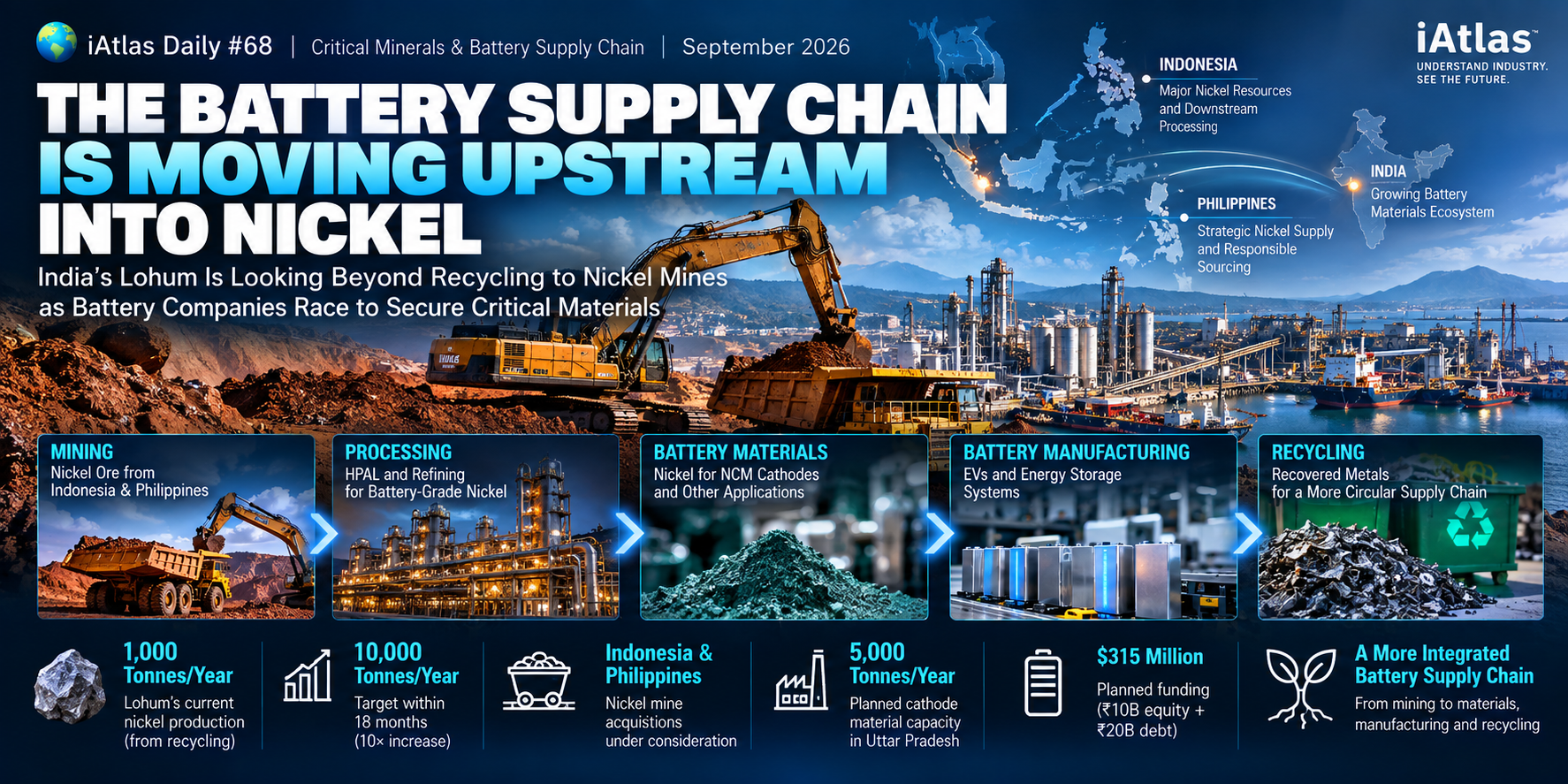
The Battery Supply Chain Is Moving Upstream into Nickel
India’s Lohum Is Looking Beyond Recycling to Nickel Mines as Battery Companies Race to Secure Critical Materials
⛏️ iAtlas Daily #68 | Critical Minerals & Battery Supply Chain | September 2026
Battery competition is usually visible at the factory.
Gigafactories are built.
New battery cells are launched.
EV platforms are announced.
Energy-storage projects expand.
But underneath all of them lies a much deeper industrial system.
Before a battery can be manufactured, companies need:
Lithium
Nickel
Cobalt
Graphite
Manganese
and other critical materials.
And securing those materials is becoming increasingly strategic.
This week, Indian critical-minerals company Lohum revealed that it is seeking to acquire nickel mines in:
Indonesia
and:
The Philippines
The company currently produces approximately:
1,000 tonnes of nickel per year
from recycled materials at its facility in Gujarat, India.
Its target?
10,000 tonnes per year within 18 months.
That would represent a tenfold increase.
But the most interesting part of the story is not the number.
Lohum began primarily as a battery recycling and materials company.
Now it is looking toward:
Mining
The direction of travel is therefore unusual.
Battery Recycling
↓
Material Recovery
↓
Cathode Materials
↓
Critical Minerals
↓
Mining
Instead of moving downstream toward batteries, Lohum is moving upstream toward the raw materials themselves.
And that tells us something important about the next phase of battery competition.
The battery supply chain is no longer only a race to build factories. It is increasingly a race to control what enters those factories.
🌍 The Big Story
Battery manufacturing requires enormous quantities of materials.
Consider a simplified battery supply chain:
Mine
↓
Ore Processing
↓
Refining
↓
Battery Materials
↓
Electrode Manufacturing
↓
Cell Manufacturing
↓
Battery Pack
↓
EV / ESS
For much of the battery industry’s recent expansion, attention concentrated near the bottom:
Cells
Gigafactories
EVs
But companies and governments are increasingly looking toward the top.
Why?
Because a battery factory without reliable materials is simply:
An expensive building waiting for supply.
This is why critical-mineral security is becoming part of industrial strategy.
1. Why Does Nickel Matter?
Nickel is used across many industries.
Its largest traditional market is stainless steel.
But it also plays an important role in certain lithium-ion battery cathodes.
For example:
NCM
Nickel-Cobalt-Manganese
and:
NCA
Nickel-Cobalt-Aluminum
Higher nickel content can help increase:
Energy Density
That makes nickel particularly important for batteries where:
Driving Range
Weight
and:
Pack Size
matter.
This is especially relevant to many long-range and higher-performance EV batteries.
2. But Not Every Battery Needs Nickel
This distinction is important.
LFP batteries use:
Lithium
Iron
and:
Phosphate
rather than nickel and cobalt in the cathode.
Sodium-ion batteries also follow a different material structure.
So the battery industry is not moving toward universal dependence on nickel.
Instead, different chemistries create different raw-material requirements.
The future supply chain may increasingly look like:
High-Nickel NCM
→ Performance-oriented EVs
LFP
→ Mainstream EV + ESS
Sodium-Ion
→ Selected ESS + mobility applications
This is why chemistry diversification also means:
Material Diversification
3. Nickel Still Matters at Enormous Scale
Even if LFP continues gaining market share, nickel-based batteries remain strategically important.
The reason is simple.
The global battery market itself is becoming much larger.
EV adoption continues.
Energy storage expands.
Battery factories continue being built.
A smaller percentage of a much larger market can still represent enormous material demand.
Companies therefore cannot simply assume:
LFP is growing, so nickel no longer matters.
The industrial reality is more complicated.
4. Lohum Started from the Other End of the Supply Chain
Lohum is interesting because its background is not traditional mining.
The company built its business around:
Battery Recycling
and:
Critical-Material Recovery
Its Gujarat operation currently produces around:
1,000 tonnes of nickel annually
from recycled material.
That means its original material flow looked roughly like:
Used Battery
↓
Recycling
↓
Recovered Metals
↓
Battery Materials
This is often described as a:
Circular Supply Chain
Materials from old batteries return to industrial production.
But recycling has an inherent limitation.
5. You Can Only Recycle Material That Already Exists
Imagine battery demand growing rapidly.
Recycling can recover materials from:
End-of-Life EV Batteries
Production Scrap
Damaged Cells
and:
Consumer Electronics
But there is a timing problem.
An EV battery may remain in use for many years before becoming available for recycling.
That means today’s rapidly growing battery industry cannot rely entirely on yesterday’s batteries.
The equation is:
New Battery Demand
Available Recycled Material
At least during periods of rapid market expansion.
Primary resources therefore remain necessary.
This is one reason a recycling company might eventually look toward:
Mining
6. Lohum Wants to Increase Nickel Production Tenfold
Lohum’s current nickel production is approximately:
1,000 tonnes/year
Its target over the next 18 months is:
10,000 tonnes/year
The company says that figure could become even larger if it gains access to high-quality mining assets.
To support its broader expansion, Lohum plans to raise roughly:
₹10 billion in equity
plus:
₹20 billion in debt
equivalent to about:
$315 million combined
The capital requirement illustrates something important.
Moving upstream is expensive.
Mining requires a very different capital structure from recycling alone.
7. Why Indonesia?
Indonesia has become one of the most important countries in the global nickel industry.
It possesses enormous nickel resources and has aggressively developed downstream processing capacity.
The country’s strategy has increasingly been:
Nickel Ore
↓
Processing
↓
Refining
↓
Battery Materials
↓
Battery Ecosystem
rather than simply exporting raw ore.
This is often described as:
Downstreaming
Indonesia wants to capture more value inside the country before materials leave its borders.
That has attracted substantial international investment.
8. Indonesia Is Becoming More Than a Mining Country
This distinction matters.
A resource-rich country can follow two very different models.
Model A
Mine
↓
Export Ore
Model B
Mine
↓
Process
↓
Refine
↓
Manufacture Materials
↓
Build Batteries
Indonesia increasingly prefers Model B.
In January 2026, the Indonesian government announced another framework for an integrated EV battery ecosystem involving mining, processing and battery production.
The strategic objective is clear:
Move Downstream
That creates an interesting contrast with Lohum.
Indonesia is moving:
Mine → Battery
while Lohum is moving:
Recycling → Mine
The two strategies meet in the middle.
9. The Philippines Matters Too
The Philippines is another major nickel-producing country.
Its role is increasingly important as companies seek diversified sources of battery and industrial materials.
But mining expansion also raises questions around:
Environmental Management
Worker Safety
Community Impact
Traceability
and:
Responsible Sourcing
Earlier this month, the International Labour Organization and partners launched a new initiative focused specifically on responsible and sustainable nickel supply chains in the Philippines.
That illustrates how critical-mineral competition is evolving.
Securing supply is not enough.
Companies increasingly need to demonstrate:
Where the material came from and how it was produced.
10. Traceability Is Becoming Part of the Product
This is an important shift.
Historically, industrial buyers often focused primarily on:
Price
Purity
Volume
and:
Delivery
Those remain essential.
But battery customers increasingly need information about:
Origin
Carbon Footprint
Labor Practices
Environmental Standards
and:
Processing Route
The OECD’s September 2026 study on lithium and nickel supply chains specifically highlights traceability as an important component of resilient and responsible critical-mineral supply chains.
This means a tonne of nickel is increasingly not just:
Nickel
It also carries information about:
How it was produced.
11. Mining Is Only the Beginning
Owning a mine does not mean you own battery-grade material.
Nickel must move through several stages.
A simplified route can look like:
Nickel Ore
↓
Concentration / Processing
↓
Intermediate Nickel Product
↓
Refining
↓
Battery-Grade Nickel
↓
Cathode Active Material
The exact pathway depends on:
Ore Type
Processing Technology
and:
Final Application
This distinction is critical.
Battery supply-chain security requires more than mineral deposits.
It requires:
Processing Capability
12. HPAL Has Become Important for Battery Nickel
Indonesia contains large quantities of laterite nickel ore.
One important route for processing certain lower-grade laterite resources is:
HPAL
High-Pressure Acid Leach
HPAL uses high temperature, high pressure and acid to extract nickel and cobalt.
The process can produce intermediates such as:
Mixed Hydroxide Precipitate — MHP
which can then move further through the battery-material supply chain.
Indonesia has invested heavily in this processing route.
This is part of why the country has become so important to the global battery-material industry.
13. Processing Economics Matter as Much as Ore
This month Indonesia changed its benchmark pricing formula for lower-grade nickel ore.
The adjustment is particularly relevant to limonite used by HPAL operations.
Indonesia’s nickel smelter association said the revised formula provides greater operational certainty for processors.
This highlights another important point.
Critical-mineral economics are determined by more than:
How much ore exists underground.
They also depend on:
Ore Grade
Energy
Acid
Processing Cost
Taxes
Royalties
Infrastructure
and:
Product Price
A resource is only strategically useful if it can be processed economically.
14. This Is Why Vertical Integration Is Attractive
Suppose a battery-material company depends entirely on external suppliers.
Its chain looks like:
Mine Supplier
↓
Refiner
↓
Material Supplier
↓
Battery Company
Each step introduces:
Price Risk
Supply Risk
Geopolitical Risk
and:
Margin
Vertical integration attempts to bring more of those layers under strategic control.
For Lohum, the emerging model could become:
Mining
↓
Material Processing
↓
Cathode Active Material
↓
Recycling
That creates a very different company from a pure recycler.
15. Lohum Is Also Building Cathode-Material Capacity
Nickel is not an isolated expansion.
Lohum is establishing a plant in Uttar Pradesh designed to produce approximately:
5,000 tonnes of cathode active material per year
The plant is expected to require both:
Nickel
and:
Lithium
This makes the mining strategy easier to understand.
If the company wants to produce cathode material, securing upstream feedstock becomes strategically valuable.
The chain starts connecting:
Nickel
↓
Cathode Material
↓
Battery Supply Chain
Instead of buying every input from the open market.
16. And Lohum Is Moving into Lithium Too
The same upstream strategy is appearing in lithium.
Lohum has secured rights to:
10 lithium mining blocks in Zimbabwe
with estimated deposits of roughly:
30–40 million tonnes of ore
and plans to invest around:
$100 million
The intended chain is particularly interesting.
Zimbabwe
→ Lithium ore
↓
Lithium Sulphate
↓
India
↓
Higher-Value Lithium Carbonate
This is not simply a mining investment.
It is an attempt to connect overseas resources with domestic processing.
17. The Geographic Supply Chain Is Becoming More Complex
Lohum’s emerging network could span:
Indonesia / Philippines
→ Nickel
Zimbabwe
→ Lithium
India
→ Refining + Cathode Materials + Recycling
UAE
→ Battery Recycling
This shows how modern critical-mineral supply chains work.
They are not necessarily:
One Country
↓
One Factory
They increasingly resemble:
International Industrial Networks
Countries contribute different layers based on:
Resources
Capital
Technology
Infrastructure
and:
Market Access
18. India Is Trying to Build Its Own Materials Ecosystem
There is a larger national strategy behind this.
India wants to expand:
EV Manufacturing
Renewable Energy
Battery Production
and:
Energy Storage
But industrial expansion creates dependence on raw materials.
If those materials come primarily through external supply chains, manufacturing autonomy remains limited.
The strategic sequence therefore becomes:
Build Manufacturing
↓
Identify Material Dependency
↓
Secure Overseas Resources
↓
Develop Domestic Processing
↓
Build a More Complete Ecosystem
Lohum’s strategy fits directly into this pattern.
19. China Remains the Benchmark
The reason this matters becomes clearer when looking at China.
China’s industrial strength in batteries does not come solely from cell factories.
Its position extends across:
Lithium Processing
Graphite Processing
Cathode Materials
Anode Materials
LFP
Battery Cells
Equipment
and:
Recycling
Reuters recently noted that China still controls extremely large shares of global refining capacity across several critical minerals and battery-material categories.
This is why other countries are focusing increasingly on:
The Middle of the Supply Chain
Mining alone is insufficient.
Factories alone are insufficient.
The difficult part is connecting them.
20. Critical Minerals Are Becoming Industrial Policy
Governments increasingly treat materials such as:
Lithium
Nickel
Graphite
Cobalt
and:
Rare Earths
not simply as commodities.
They are becoming:
Strategic Industrial Inputs
The logic is straightforward.
No graphite:
→ No conventional battery anode.
No lithium:
→ No lithium-ion cell.
No nickel:
→ No high-nickel cathode.
No rare earth magnets:
→ Problems for many electric motors.
Materials therefore sit underneath several strategic industries simultaneously.
21. Lohum Is Looking at Rare Earths Too
The company is also exploring rare-earth opportunities in Southeast Asia.
In India, it is developing a:
1,200-tonne-per-year rare-earth magnet plant
This broadens the strategy beyond batteries.
Rare-earth magnets are critical to applications including:
Electric Motors
Wind Turbines
Industrial Equipment
and:
Electronics
Lohum is therefore evolving from:
Battery Recycler
toward something much broader:
Critical-Materials Platform
That is an important corporate transformation.
22. Recycling Still Remains Essential
Moving into mining does not make recycling less important.
In fact, the strongest long-term model may combine:
Primary + Secondary Resources
Primary:
Mining
Secondary:
Recycling
Together:
Mine
↓
Battery
↓
Use
↓
Recycle
↓
Material
↓
Battery
Over time, more material can circulate through this loop.
But during rapid industry growth, primary supply remains necessary to expand the total material base.
23. The Future Could Be a Hybrid Materials System
Imagine the battery industry in 2040.
A growing percentage of material may come from recycled batteries.
But new material will still enter the system to support:
Market Growth
Material Losses
and:
New Applications
The ideal industrial structure may therefore be:
Responsible Mining
Efficient Refining
Battery Manufacturing
Large-Scale Recycling
↓
Circular Materials Ecosystem
Lohum’s upstream expansion potentially connects both ends of that loop.
24. But Owning More of the Chain Also Creates More Risk
Vertical integration is not automatically better.
Mining brings risks including:
Commodity Price Volatility
Environmental Liability
Political Risk
Large Capital Requirements
Project Delays
and:
Operational Complexity
A recycling company acquiring mining assets is entering a very different business.
The strategy works only if greater supply security outweighs the added complexity.
That is why the actual acquisitions—not simply the intention—will matter.
25. The Bigger Battery Race Is Moving Underground
The battery industry’s visible competition happens in:
Cells
Cars
and:
Gigafactories
But the deeper competition increasingly happens much earlier.
Who controls the lithium?
Who processes the graphite?
Who refines the nickel?
Who produces the cathode?
Who can recycle the material?
These questions determine what eventually reaches the battery factory.
The battery race is therefore moving:
Downstream
↓
Midstream
↓
Upstream
And Lohum is a small but revealing example of that shift.
🧩 Why This Matters
Battery companies are looking further upstream.
Securing raw materials is becoming part of manufacturing strategy.
Recycling alone cannot supply a rapidly expanding industry.
Primary mining remains necessary while the global battery material pool continues growing.
Nickel remains strategically important.
LFP growth changes nickel demand, but does not eliminate the role of nickel-rich batteries.
Indonesia and the Philippines are increasingly strategic.
Their nickel resources place Southeast Asia near the center of global battery-material competition.
Processing is as important as mining.
A mineral deposit does not automatically become battery-grade material.
India is building a broader critical-minerals strategy.
Lohum’s nickel, lithium, cathode-material and rare-earth projects illustrate an attempt to build a more integrated supply chain.
🔭 What to Watch
Nickel Mine Acquisition
Lohum has expressed interest in Indonesia and the Philippines, but no acquisition has yet been announced. This distinction is important.
10,000-Tonne Target
Watch whether Lohum can expand nickel output from approximately 1,000 to 10,000 tonnes per year within its 18-month target.
Cathode Active Material
The planned 5,000-tonne-per-year Uttar Pradesh facility will show whether upstream resources can be connected successfully to higher-value battery materials.
Zimbabwe Lithium
The $100 million project will test Lohum’s strategy of combining overseas resources with processing in India.
Indonesia
Watch nickel pricing, HPAL economics and government downstreaming policy.
Traceability
Responsible sourcing and traceability requirements could become increasingly important for both Indonesian and Philippine nickel.
🧭 iAtlas Insight
For years, the battery industry focused on one question:
Who can build the most battery capacity?
That question is changing.
A gigafactory needs materials.
A cathode plant needs metals.
A recycling plant needs feedstock.
And an energy transition needs all of them at enormous scale.
The new question is becoming:
Who can build the most resilient materials system behind the factory?
Lohum’s strategy is particularly interesting because it begins from the opposite direction of a traditional mining company.
It started near the end of the battery lifecycle:
Recycling
Now it is moving toward the beginning:
Mining
If that strategy succeeds, the company could connect:
Primary Resources
↓
Battery Materials
↓
Battery Use
↓
Recycling
↓
Recovered Resources
into a much larger industrial loop.
And that illustrates where battery competition may be heading.
The next advantage may not come simply from making a better cell.
It may come from controlling enough of the system to ensure that the materials required to make that cell are available in the first place.
The battery supply chain begins long before the battery factory. Increasingly, the competitive race begins underground.
📚 Related Articles
📰 iAtlas Daily #67: Sodium-Ion Batteries Are Moving from the Lab to the Factory
📰 iAtlas Daily #62: Korea Is Betting ₩1.2 Trillion on Silicon Anodes
📰 iAtlas Weekly #12: The Global Manufacturing Map Is Being Redrawn
🔗 References
- Reuters — India’s Lohum Seeks to Buy Nickel Mines in Indonesia and the Philippines
- OECD — Enhancing Resilience Through Traceability
- ILO — Responsible Philippine Nickel Supply Chains
- Indonesia Ministry of Energy and Mineral Resources — Integrated Battery Ecosystem
- Reuters — Indonesian Nickel Pricing and HPAL Economics
ℹ️ About iAtlas
iAtlas is an independent publication covering batteries, semiconductors, OLED, advanced materials, AI, and global industrial trends.
We transform complex industrial developments into clear, reliable, and easy-to-understand insights.
Whether you’re following today’s industry news or building long-term expertise, iAtlas helps you understand not only what happened, but why it matters.
Technology creates change.
Insight creates opportunity.
— iAtlas