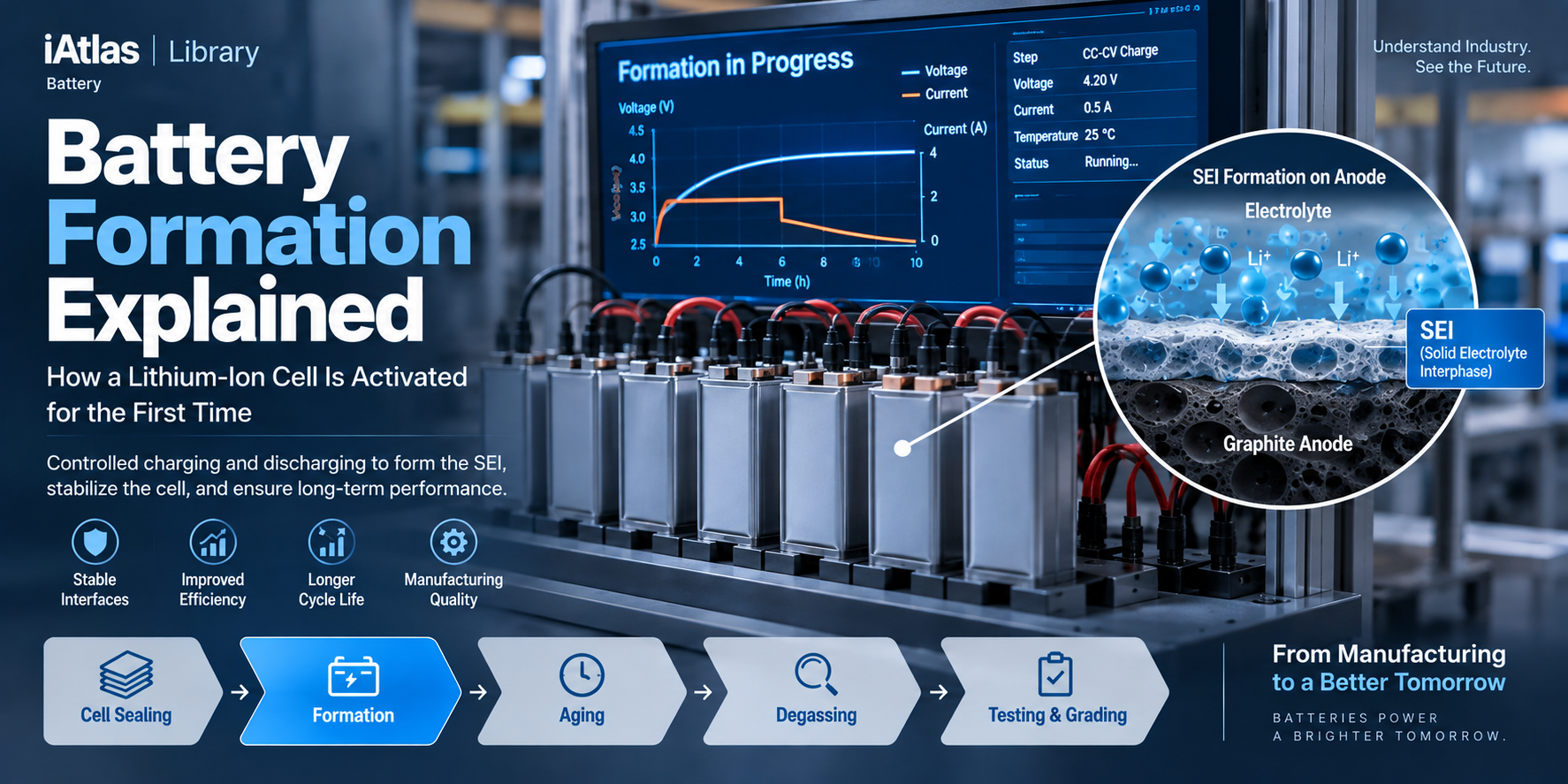
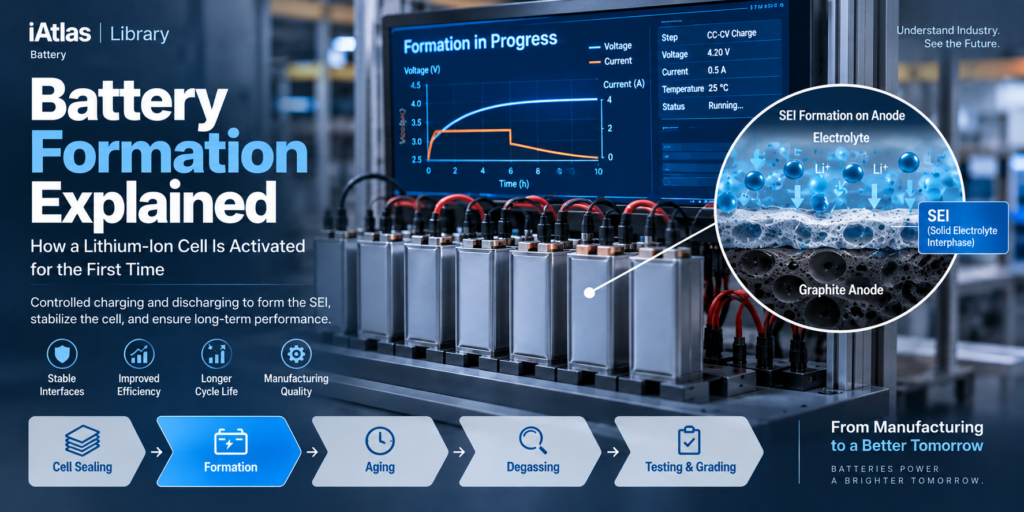
Battery Formation Explained: How a Lithium-Ion Cell Is Activated for the First Time
Understanding First Charge, SEI Formation, CEI Development, Formation Protocols, Gas Generation, Process Control, and Battery Quality
Category: Battery Technology
Content Type: Manufacturing
Learning Path: Battery Manufacturing
Related Industries: Electric Vehicles · Energy Storage Systems · Consumer Electronics
Last Updated: September 2026
Industry Snapshot
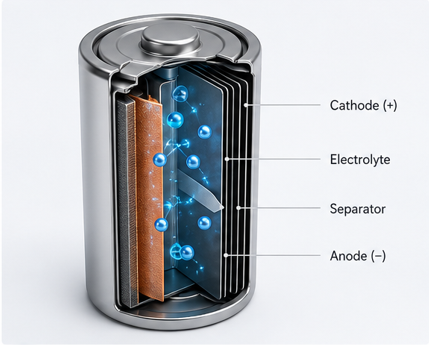
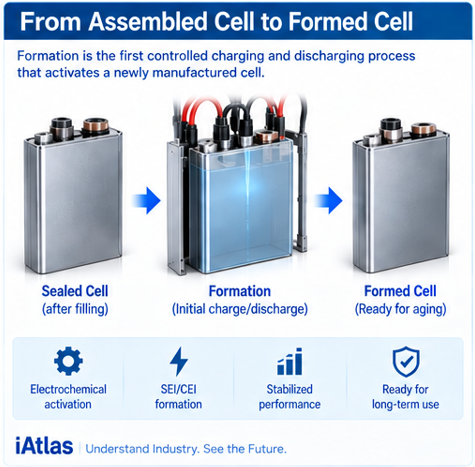
Battery formation is the controlled initial charging and discharging process performed after a lithium-ion battery cell has been assembled and filled with electrolyte.
Before formation, the cell already contains:
Cathode
Separator
Anode
Electrolyte
But simply assembling these components does not mean the cell is ready for normal use.
During the first controlled charging process, important electrochemical reactions occur at the interfaces between the electrodes and electrolyte.
Most notably, a protective interphase known as the Solid Electrolyte Interphase (SEI) develops on the anode surface.
Interfacial reactions also occur on the cathode side, commonly discussed in terms of the Cathode Electrolyte Interphase (CEI).
These interfaces influence battery properties including:
- Initial efficiency
- Internal resistance
- Capacity retention
- Cycle life
- Gas generation
- Safety
- Long-term stability
Formation is therefore not simply a factory test.
Formation is a manufacturing process that establishes the cell’s initial electrochemical state.
Research describes formation as one of the most critical—and costly—late-stage processes in lithium-ion battery manufacturing.
At a Glance
| Category | Description |
|---|---|
| Process | Battery Formation |
| Stage | Cell Finishing |
| Input | Assembled and Electrolyte-Filled Cell |
| Main Function | Initial controlled electrochemical activation |
| Key Phenomenon | SEI / CEI Development |
| Typical Operation | Controlled Charge / Discharge |
| Key Variables | Current · Voltage · Temperature · Time · Pressure |
| Major Risks | Excessive SEI Growth · Gas Generation · Lithium Plating · Non-uniform Formation |
| Previous Process | Cell Sealing |
| Next Process | Aging |
What Is Battery Formation?
Battery formation is the first controlled electrochemical cycling process applied to a newly manufactured battery cell.
A simplified sequence is:
Manufactured Cell
↓
Electrolyte Wetting
↓
Initial Charge
↓
Interfacial Reactions
↓
SEI / CEI Development
↓
Controlled Charge–Discharge
↓
Formed Cell
The formation protocol is deliberately controlled.
Rather than immediately charging the battery at the maximum rate it might experience in service, manufacturers define specific:
- Current profiles
- Voltage limits
- Charge steps
- Discharge steps
- Rest periods
- Temperature conditions
The objective is to establish favorable interfacial conditions while limiting unwanted side reactions. Formation protocols can vary substantially by chemistry, cell format, electrode design and manufacturer.
Where Formation Fits in Battery Manufacturing
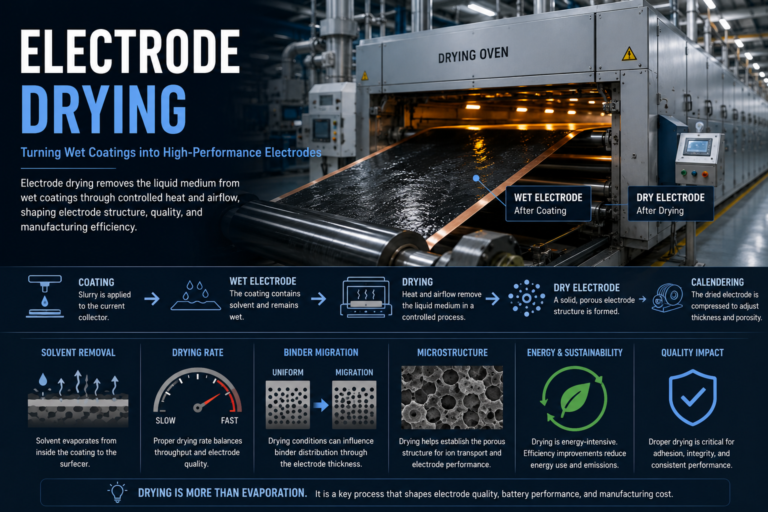
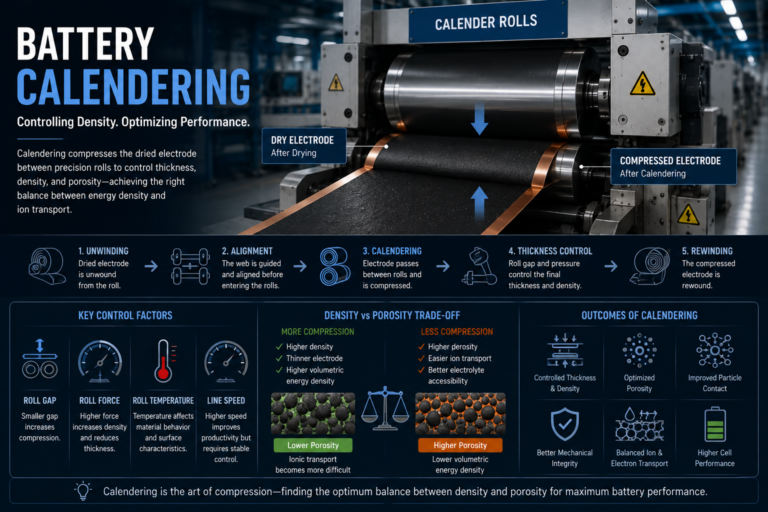
Electrode Manufacturing
Material Mixing
→ Battery Slurry
→ Electrode Coating
→ Electrode Drying
→ Calendering
→ Slitting
Cell Assembly
Battery Cell Assembly
→ Notching
→ Winding / Stacking
→ Electrolyte Filling
→ Cell Sealing
Cell Finishing
Formation
↓
Aging
↓
Degassing
↓
Testing & Grading
Formation therefore marks an important transition:
Physical Cell Manufacturing
↓
Electrochemical Cell Activation
↓
Quality Evaluation
Why a New Battery Needs Formation
When a freshly manufactured cell is charged for the first time, the electrode-electrolyte interfaces are not yet in their long-term operating state.
At the graphite anode, the electrolyte is thermodynamically unstable at sufficiently low electrode potentials.
Some electrolyte components therefore undergo reduction reactions.
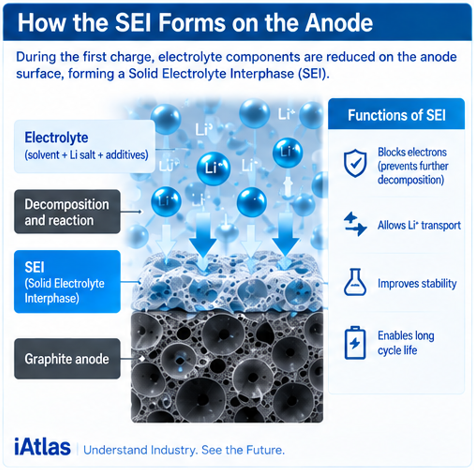
The reaction products accumulate on the anode surface and create the SEI.
Conceptually:
Electrolyte
Electrons
Lithium Ions
↓
Interfacial Reactions
↓
SEI
The SEI subsequently helps limit continued electrolyte decomposition while still allowing lithium-ion transport.
What Is the SEI?
SEI stands for:
Solid Electrolyte Interphase
It is a thin passivation layer that develops on the anode surface as electrolyte components decompose during early charging.
An effective SEI performs two apparently conflicting functions:
Blocks Electron Transfer
while allowing:
Lithium-Ion Transport
Conceptually:
Electrolyte
↓
Li⁺ ↓
━━━━━━━━━━━━
SEI
━━━━━━━━━━━━
↓
Graphite Anode
The SEI helps prevent continuous electrolyte decomposition while allowing lithium ions to move between electrolyte and active material.
This makes it one of the most important interfaces inside a lithium-ion battery.
Why the SEI Matters
An idealized SEI should be:
- Ionically conductive
- Electronically insulating
- Chemically stable
- Mechanically stable
- Thin enough to limit excessive resistance
- Uniform across the electrode surface
If the SEI is unstable, continued electrolyte decomposition can consume active lithium and electrolyte.
If it becomes excessively resistive, ion transport can become more difficult.
The challenge is therefore not simply:
Create an SEI
but:
Create a stable interphase with favorable electrochemical and transport properties.
Its composition and morphology depend on variables including electrode material, electrolyte composition, current, temperature and formation conditions.
What Is the CEI?
The cathode also develops an electrode-electrolyte interphase.
This is commonly called the:
Cathode Electrolyte Interphase (CEI)
Conceptually:
Cathode
↕
CEI
↕
Electrolyte
The chemistry differs from the anode SEI, but the broader principle is similar:
Electrode
Electrolyte
↓
Interfacial Reactions
↓
Protective / Reactive Interphase
Both SEI and CEI evolution are therefore relevant to formation protocol design.
The First Charge
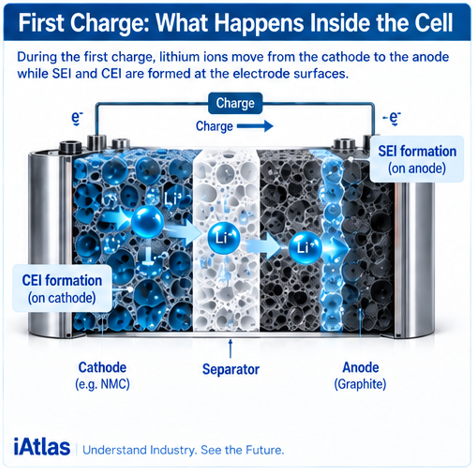
The first charge is especially important because substantial interfacial reactions occur during this period.
As the cell charges:
Lithium leaves the cathode
↓
Li⁺ moves through the electrolyte
↓
Li⁺ reaches the anode
↓
Lithium enters the anode structure
At the same time, some lithium and electrolyte participate in SEI-forming side reactions.
This means not all lithium involved in the first charging process is fully recovered during the first discharge.
First-Cycle Irreversible Capacity Loss
Formation consumes part of the available lithium inventory.
Conceptually:
Lithium Inventory
↓
Useful Reversible Lithium
Lithium Consumed by Side Reactions
The latter contributes to first-cycle irreversible capacity loss.
One important formation objective is therefore to create the required protective interphase without consuming unnecessarily large quantities of active lithium or electrolyte.
Formation Charge Rate
Formation has traditionally used relatively conservative charge rates.
Why?
Rapid charging under inappropriate conditions can increase risks such as:
- Non-uniform reactions
- Unfavorable interphase development
- Excessive heat
- Lithium plating
However, this does not mean slow formation is always intrinsically superior.
Recent research increasingly shows that carefully designed fast-formation protocols can substantially reduce process time while preserving cell performance.
The important variable is not simply:
Fast vs Slow
but:
How current, voltage, temperature and other conditions are controlled throughout formation.
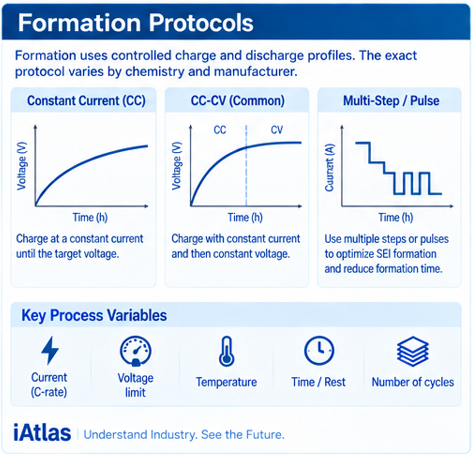
CC and CC-CV Formation
Formation protocols can use different charging strategies.
One familiar method is:
Constant Current — CC
The cell is charged using a defined current.
Another is:
Constant Current–Constant Voltage — CC-CV
Constant Current
↓
Voltage rises
↓
Voltage Limit Reached
↓
Constant Voltage
↓
Current decreases
CC-CV is widely used in lithium-ion charging, although the exact formation sequence can be more complex and manufacturer-specific.
Multi-Step Formation
Formation does not necessarily consist of one simple charge and discharge.
A protocol can include:
Low-Current Charge
↓
Rest
↓
Additional Charge
↓
Discharge
↓
Second Charge
↓
Additional Rest / Cycling
Other strategies can include:
- Multi-stage current profiles
- Pulse charging
- Intermittent protocols
- Chemistry-specific voltage windows
Industrial protocols are highly optimized and often proprietary.
Why Temperature Matters
Temperature affects electrochemical reaction kinetics.
During formation it can influence:
- SEI formation reactions
- Electrolyte transport
- Internal resistance
- Reaction rate
- Gas generation
- Lithium plating risk
Formation temperature therefore needs to remain controlled.
Conceptually:
Temperature
↓
Reaction Kinetics
↓
Interphase Development
↓
Cell Performance
Formation chambers or environmental control systems can therefore be part of the production infrastructure.
Why Electrolyte Wetting Still Matters
The previous iAtlas article discussed Electrolyte Filling and Wetting.
That process directly affects formation.
If electrolyte has not sufficiently penetrated the electrode and separator pores:
Poor Wetting
↓
Non-uniform Ionic Pathways
↓
Non-uniform Electrochemical Reaction
↓
Non-uniform Formation
This is why electrolyte wetting and formation cannot be treated as completely independent processes.
Research on manufacturing formation specifically identifies complete electrolyte wetting as important for effective SEI/CEI formation, particularly in larger cells.
Gas Generation During Formation
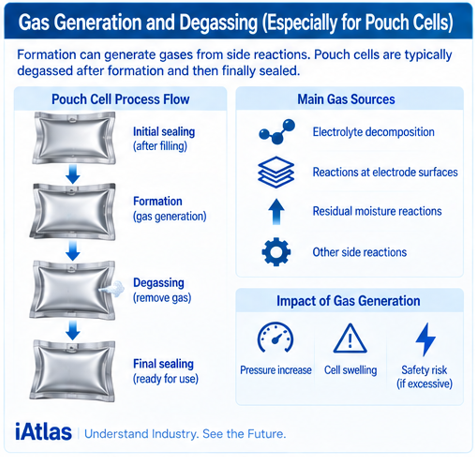
Electrochemical side reactions during early charging can generate gases.
Possible gas evolution depends on:
- Electrolyte composition
- Electrode chemistry
- Formation voltage
- Temperature
- Additives
- Cell design
This gas must be considered in the manufacturing architecture.
The implications differ by cell format.
Gas Management in Pouch Cells
Pouch cells provide the clearest example.
A simplified manufacturing sequence is:
Electrolyte Filling
↓
Initial Sealing
↓
Formation
↓
Gas Generation
↓
Degassing
↓
Final Sealing
A temporary pouch region can provide space for gases generated during early electrochemical reactions.
Those gases are subsequently removed during the Degassing process.
Formation in Cylindrical and Prismatic Cells
Rigid cells cannot expand and be opened in the same manner as conventional pouch-cell degassing architectures.
Their internal pressure and gas-management strategies therefore differ.
Cell architecture may include features designed for pressure management and safety.
Formation protocols must consequently be compatible with:
- Cell geometry
- Internal free volume
- Vent architecture
- Housing strength
- Electrolyte quantity
Again, formation cannot be optimized independently of cell design.
Mechanical Pressure During Formation
For some cell formats, controlled external pressure can influence electrode contact and cell geometry during formation.
This is particularly relevant to flat stacked cells.
Conceptually:
Cell
⇩ Controlled Pressure ⇩
Electrode Layers
Pressure can influence:
- Electrode contact
- Cell thickness
- Gas distribution
- Interfacial behavior
However, the appropriate pressure depends on cell design and chemistry.
Formation Equipment
Formation requires electrical equipment capable of independently controlling large numbers of cells.
A formation system can include:
Cell Racks
Charge / Discharge Channels
Voltage Measurement
Current Control
Temperature Monitoring
Data Acquisition
Potentially thousands of cells may need to undergo controlled formation simultaneously in high-volume manufacturing.
This creates significant equipment, energy and factory-space requirements. Formation and aging have historically represented substantial manufacturing bottlenecks and capital demands.
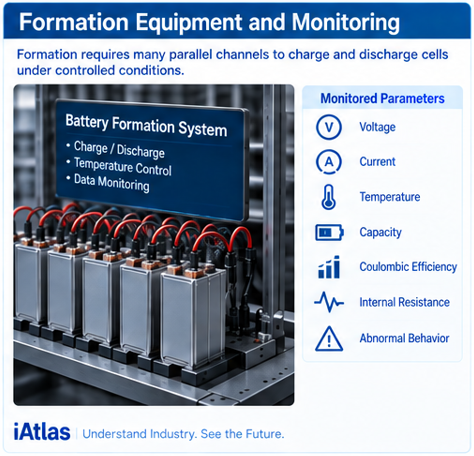
Formation Channels
Each cell or controlled group of cells requires an electrical connection to formation equipment.
The system measures variables such as:
- Voltage
- Current
- Time
- Capacity
- Temperature
This creates a valuable dataset.
Instead of formation being only a manufacturing operation, it can simultaneously become an early quality-screening process.
What Can Formation Data Reveal?
A cell that behaves abnormally during formation may show unusual:
- Voltage response
- Capacity
- Coulombic efficiency
- Temperature
- Resistance
- Self-discharge behavior
These signals can potentially indicate manufacturing abnormalities.
Formation therefore sits at the intersection of:
Manufacturing
Electrochemistry
Quality Control
Data Analytics
Coulombic Efficiency During Formation
Coulombic efficiency compares charge transferred during charging and discharging.
A simplified expression is:
Coulombic Efficiency
=
Discharge Capacity / Charge Capacity × 100%
During the first cycle, efficiency is typically lower than in later stable operation because some lithium is consumed in interfacial reactions.
Monitoring early-cycle efficiency provides information about the cell’s initial electrochemical behavior.
Internal Resistance
Formation also affects the cell’s internal resistance.
Interfacial layers introduce resistance to charge transfer and ion transport.
The objective is therefore not to maximize interphase thickness.
Instead:
Stable Interphase
Controlled Resistance
Efficient Li⁺ Transport
must be balanced.
This again highlights why formation protocol design matters.
Lithium Plating Risk
Under unfavorable charging conditions, metallic lithium can deposit on the anode surface instead of intercalating normally into the anode structure.
This phenomenon is known as:
Lithium Plating
Risk can increase under conditions such as:
- Excessively aggressive charging
- Low temperature
- High polarization
- Poor transport conditions
Formation protocols therefore need to avoid charging conditions that promote unwanted lithium deposition.
Modern fast-formation research explicitly considers plating-aware protocol design.
Formation Time
Formation is problematic for manufacturers because it can take much longer than many mechanical production processes.
A coating or assembly line continuously processes material.
Formation, however, requires cells to remain connected to electrical equipment while controlled electrochemical processes occur.
Conceptually:
Production Volume ↑
↓
Number of Cells Requiring Formation ↑
↓
Formation Channels ↑
↓
Equipment + Space + Energy ↑
This explains why reducing formation time can have a large impact on factory economics.
Why Formation Is a Manufacturing Bottleneck
Suppose a production line continuously produces cells.
Every cell eventually needs formation.
If formation takes many hours or days, manufacturers require large numbers of parallel channels and storage positions.
Historically, wetting, formation and aging have consumed substantial production time and factory floor space.
The manufacturing objective therefore becomes:
Reduce Formation Time
without sacrificing:
Cell Quality or Lifetime
Fast Formation
Fast formation aims to shorten this process through optimized charging protocols.
Potential strategies include:
- Multi-stage current profiles
- Higher initial currents under controlled conditions
- Pulse or intermittent charging
- Optimized voltage windows
- Temperature optimization
- Chemistry-specific protocols
- Plating-aware control
A recent review concludes that fast formation is not inherently detrimental; success depends on coordinated control of protocol variables and the specific chemistry/cell architecture.
Quality Control During Formation
Formation equipment can monitor several parameters.
Voltage
Does the cell follow the expected voltage profile?
Current
Is the programmed current delivered correctly?
Capacity
Does the cell store and release the expected charge?
Temperature
Is abnormal heating occurring?
Coulombic Efficiency
How much of the initial charge is recovered?
Resistance
Is internal resistance within the expected range?
Gas / Pressure Behavior
Where applicable, is gas generation or dimensional change abnormal?
These measurements create an early electrochemical fingerprint of each cell.
From Formation to Aging
After formation, the cell does not necessarily proceed directly to final grading.
The next stage in our Learning Path is:
Aging
During aging, cells are stored under controlled conditions and monitored for changes such as:
- Voltage relaxation
- Self-discharge
- Leakage current
- Stability
- Abnormal behavior
This gives manufacturers time to identify defects that may not be immediately apparent at the end of formation.
The sequence becomes:
Formation
↓
Aging
↓
Degassing
↓
Testing & Grading
The exact industrial sequence can vary by cell format and manufacturer.
Emerging Formation Technologies
Formation is becoming an important target for smart manufacturing.
Fast Formation Protocols
Reducing processing time without sacrificing lifetime.
Adaptive Formation
Formation conditions can potentially respond to measured cell behavior.
Advanced Diagnostics
Voltage, impedance, thermal, acoustic and other signals can provide information about internal cell state.
Data-Driven Optimization
Large formation datasets can be analyzed to identify relationships between early behavior and later performance.
Closed-Loop Formation
Future systems may increasingly adjust protocol parameters based on real-time measurements rather than relying solely on fixed recipes.
Recent research is moving toward exactly this combination of diagnostics, modeling and adaptive control.
iAtlas Insight
Formation reveals something important about battery manufacturing:
A battery is not finished when its physical components have been assembled.
Before formation, manufacturers have created:
Electrodes
→ Electrode Assembly
→ Cell Housing
→ Electrolyte-Filled Cell
But formation creates something different:
A controlled electrochemical system
The first charge establishes interfaces that can influence the cell for the rest of its life.
This means an upstream manufacturing defect can also reveal itself during formation:
Poor Coating
↓
Non-uniform Electrode
↓
Poor Wetting
↓
Non-uniform Formation
↓
Performance Variation
Formation therefore connects almost the entire manufacturing chain.
At the same time, it creates one of the industry’s biggest productivity challenges:
Better-Controlled Formation
often requires
Time + Equipment + Energy
while battery manufacturers need:
Higher Throughput + Lower Cost
The future of formation is therefore likely to focus less on simply asking:
“How slowly should we charge a new battery?”
and increasingly on:
“What is the fastest formation protocol that creates the required interphase and reliably predicts a high-quality cell?”
That makes formation one of the strongest intersections between electrochemistry, manufacturing engineering, quality control and industrial AI in battery production.
Did You Know?
- Formation is the first controlled electrochemical cycling process of a newly manufactured cell.
- The SEI forms primarily during early charging on the anode surface.
- Some lithium is irreversibly consumed during initial interphase formation.
- Formation protocols differ by chemistry and cell design.
- Formation can generate gases.
- Pouch cells can be degassed after formation.
- Formation requires large numbers of electrical channels in mass production.
- Faster formation can significantly reduce manufacturing equipment and factory-space requirements.
- Modern research is exploring adaptive and data-driven formation protocols.
FAQ
What is battery formation?
Battery formation is the controlled initial charging and discharging process used to establish important electrode-electrolyte interfaces and activate a newly manufactured lithium-ion cell.
Why is battery formation necessary?
It helps establish protective interphases such as the SEI and brings the cell into a controlled electrochemical state.
What is SEI formation?
SEI formation is the creation of a passivating layer on the anode surface from electrolyte decomposition products during early charging.
Does formation reduce battery capacity?
Some active lithium is consumed during initial interphase formation, contributing to first-cycle irreversible capacity loss.
Why is formation performed slowly?
Conservative conditions have traditionally been used to control interfacial reactions and avoid undesirable effects. However, newer research shows appropriately designed faster protocols can also work effectively.
What causes gas during formation?
Electrochemical side reactions involving electrode and electrolyte materials can generate gaseous products during early cycling.
Why is formation expensive?
Every manufactured cell requires controlled electrical cycling, which demands formation channels, factory space, energy and time.
What comes after formation?
In the iAtlas Battery Manufacturing Learning Path, the next process is Battery Aging.
Battery Manufacturing Learning Path
Overview
Electrode Manufacturing
Cell Assembly
- Battery Cell Assembly
- Battery Electrode Notching
- Battery Electrode Winding
- Battery Electrode Stacking
- Battery Electrolyte Filling
- Battery Cell Sealing
Cell Finishing
- Battery Formation (Current)
- Aging
- Degassing
- Battery Cell Testing & Grading
System Assembly
- Battery Module Assembly
- Battery Pack Assembly
Explore More
Cell Finishing
- Battery Formation (Current)
- Battery Aging
- Battery Degassing
- Battery Cell Testing & Grading
Cell Assembly
- Battery Electrolyte Filling
- Battery Cell Sealing
- Battery Electrode Stacking
Related Concepts
- Solid Electrolyte Interphase (SEI)
- Cathode Electrolyte Interphase (CEI)
- Electrolyte
- Lithium Plating
- Coulombic Efficiency
- Internal Resistance
References
Wood et al. — Formation Challenges of Lithium-Ion Battery Manufacturing
A particularly useful manufacturing reference connecting electrolyte wetting, SEI/CEI formation, aging, production time, equipment and factory cost.
Article — Joule / ScienceDirect
Formation Protocol Design in Lithium-Ion Batteries: Pathways Toward Manufacturable Fast Formation
A recent review focused specifically on formation protocol design, including CC/CC-CV, multistage, pulse/intermittent protocols, lithium plating, temperature, pressure and fast formation.
Full Article — Next Energy / ScienceDirect
Peled & Menkin — Review—SEI: Past, Present and Future
For the underlying science, SEI literature provides the foundation for understanding why the initial charge has such long-term consequences. A detailed graphite-SEI review also directly connects SEI chemistry with formation cycling and cell lifetime.
Graphite SEI & Formation Cycling Review — ScienceDirect
Structure and Evolution of Solid Electrolyte Interphase (SEI) at the Electrode-Electrolyte Interface
A newer review covering SEI structure, formation mechanisms and evolution under different operating conditions.
SEI Structure and Evolution — ScienceDirect
About iAtlas
iAtlas is an independent publication covering batteries, semiconductors, OLED, advanced materials, AI, and global industrial trends.
We transform complex industrial developments into clear, reliable, and easy-to-understand insights.
Whether you’re following today’s industry news or building long-term expertise, iAtlas helps you understand not only what happened, but why it matters.
Technology creates change.
Insight creates opportunity.
— iAtlas