Battery Electrode Notching Explained: Precision Cutting Before Cell Assembly
Understanding Electrode Geometry, Tab Formation, Cutting Accuracy, Burrs, Particles, and Laser Notching in Lithium-ion Battery Manufacturing
Category: Battery Technology
Content Type: Manufacturing
Learning Path: Battery Manufacturing
Related Industries: Electric Vehicles · Energy Storage Systems · Consumer Electronics
Last Updated: September 2026
Industry Snapshot
Battery electrode notching is a precision cutting process that prepares cathode and anode electrodes for battery cell assembly.
After electrodes have been coated, dried, calendered, and slit, they still need the correct geometry for the intended cell design.
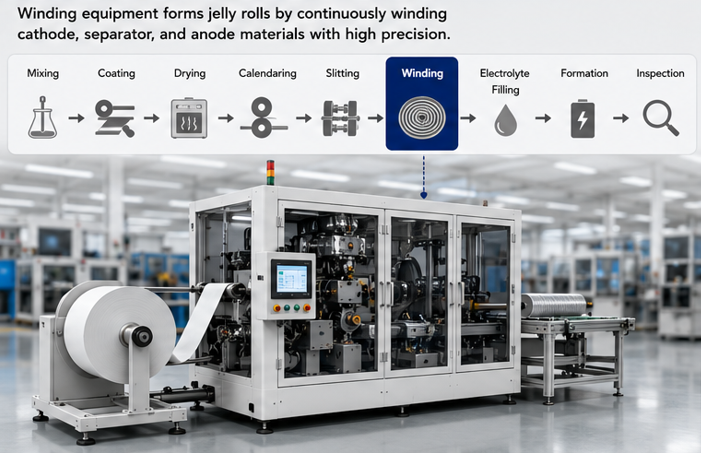
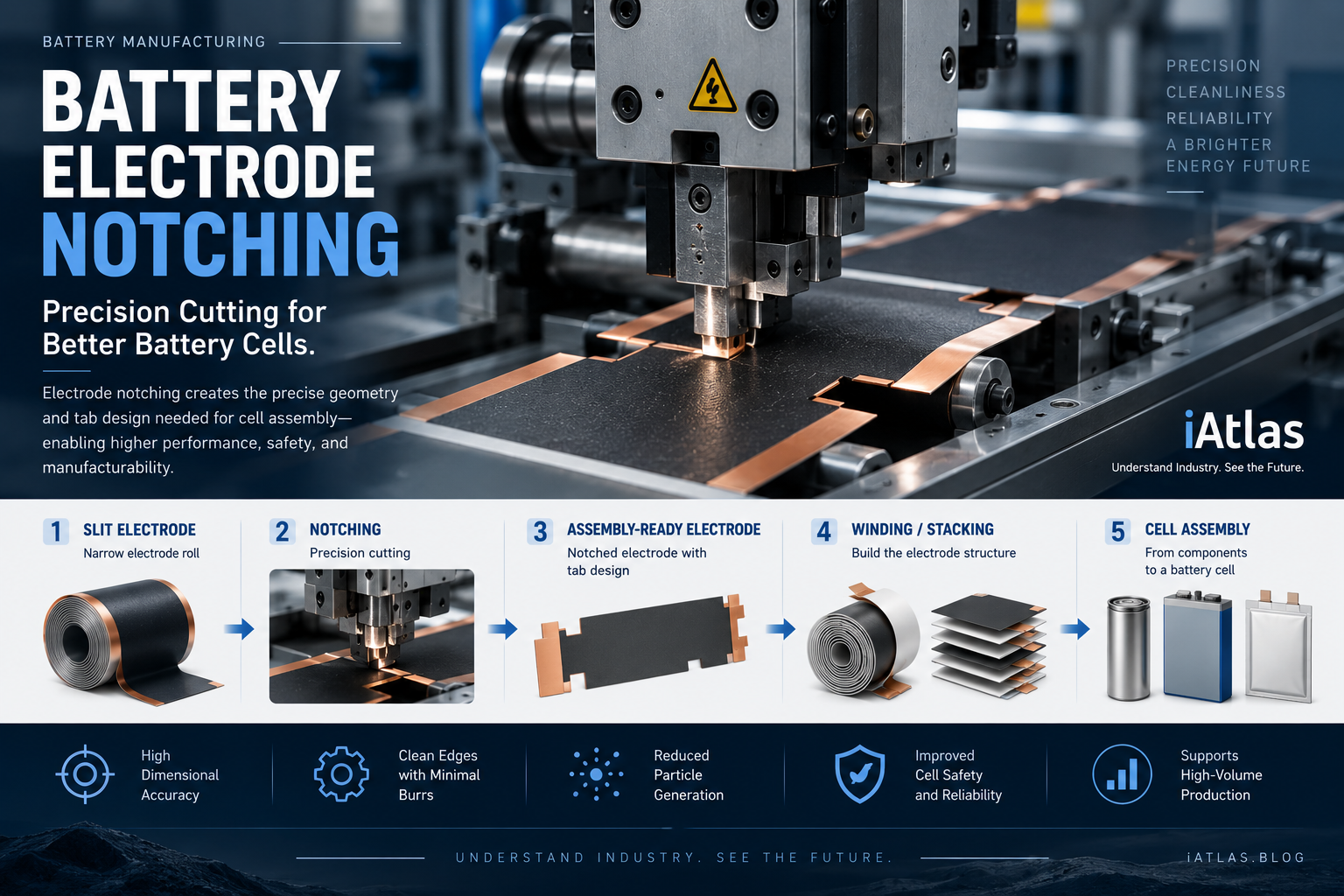
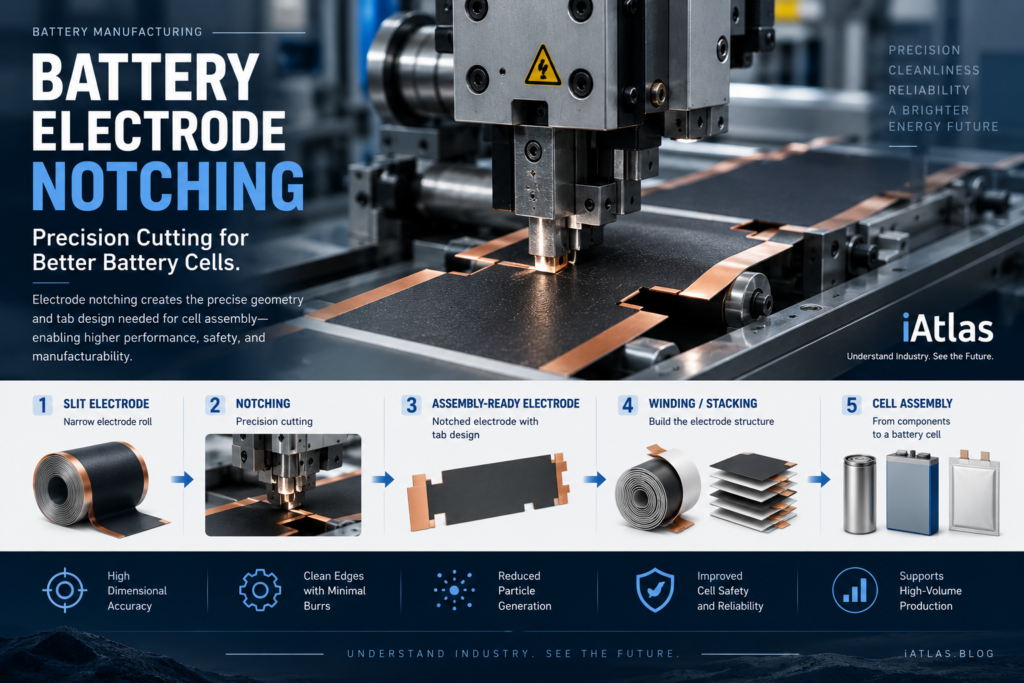
A simplified manufacturing sequence is:
Slitting
→ Notching
→ Winding / Stacking
→ Cell Assembly
During notching, electrode material is cut into predetermined shapes and dimensions. Depending on the cell design and manufacturing architecture, the process can also create or define current-collector tab regions used for electrical connection.
The challenge is not simply cutting the electrode quickly.
The process must achieve:
High Dimensional Accuracy
Clean Electrode Edges
Minimal Burrs
Low Particle Generation
High Production Speed
Poor cutting quality can introduce defects that remain inside the battery after assembly.
At a Glance
| Category | Description |
|---|---|
| Process | Electrode Notching |
| Stage | Cell Assembly / Electrode Converting |
| Input | Slit Electrode Roll |
| Main Function | Precision Electrode Shaping |
| Output | Assembly-Ready Electrode Geometry |
| Key Technologies | Mechanical Die Cutting · Laser Cutting |
| Key Controls | Dimensions · Edge Quality · Burrs · Particles |
| Previous Process | Slitting |
| Next Process | Winding / Stacking |
What Is Battery Electrode Notching?
Battery electrode notching is the process of cutting prepared electrode material into the geometry required for cell assembly.
A simplified flow is:
Slit Electrode
↓
Positioning
↓
Precision Cutting
↓
Electrode Shape / Tab Geometry
↓
Inspection
↓
Winding or Stacking
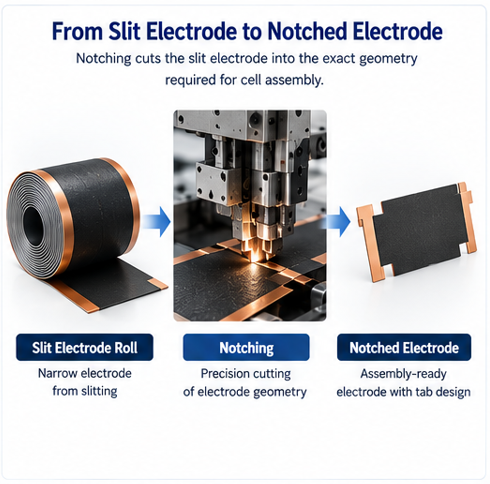
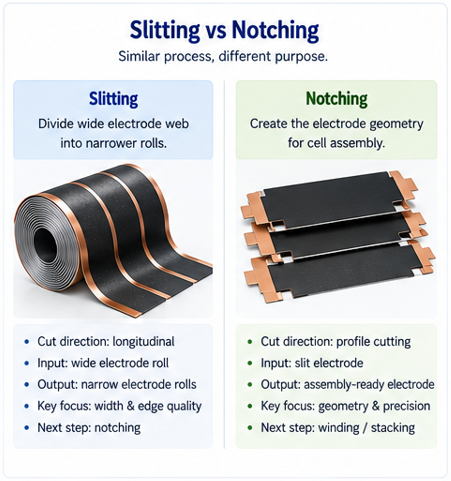
Unlike slitting, which primarily divides a wide continuous web into narrower strips, notching creates more detailed electrode geometry.
This distinction is important.
Slitting vs Notching
The two processes are closely related but perform different functions.
| Slitting | Notching | |
|---|---|---|
| Main Purpose | Divide wide electrode web | Create required electrode geometry |
| Cut Direction | Mainly longitudinal | Detailed/profile cutting |
| Input | Wide electrode roll | Slit electrode |
| Output | Narrow electrode rolls | Assembly-ready electrode |
| Key Concern | Width & edge quality | Geometry & cutting precision |
| Typical Next Step | Notching | Winding / Stacking |
A simple way to remember the difference is:
Slitting controls electrode width. Notching creates the geometry needed for assembly.
Why Electrode Geometry Matters
Battery cells are tightly packed electrochemical structures.
The cathode, anode, and separator must maintain their intended relative positions.
Electrode geometry therefore influences:
- Layer alignment
- Separator coverage
- Electrode overlap
- Tab position
- Cell dimensions
- Assembly accuracy
A dimensional error introduced during notching can propagate into winding or stacking.
For example:
Incorrect Electrode Geometry
↓
Poor Layer Alignment
↓
Assembly Variation
↓
Potential Performance or Safety Issues
Precision cutting is therefore part of cell design—not merely a material-handling operation.
Anatomy of a Notched Electrode
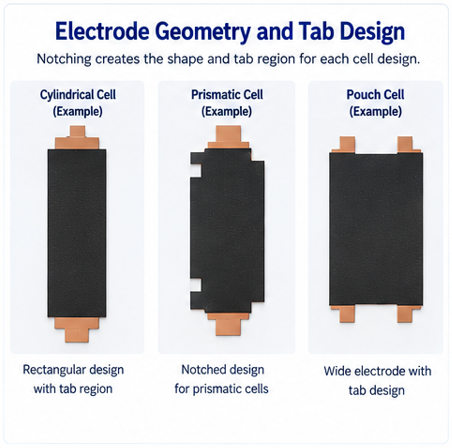
A prepared electrode generally contains two functional regions.
Coated Area
This region contains the active electrode material responsible for electrochemical energy storage.
Current Collector / Tab Region
A portion of the metallic current collector remains available for electrical connection.
Depending on the manufacturing design, notching can define the geometry around these regions.
For example:
Coated Electrode
───────────────
Uncoated Foil / Tab Region
──────┐
The exact geometry varies considerably between cell manufacturers and cell formats.
Why Battery Electrodes Are Difficult to Notch
Battery electrodes are composite structures.
A cathode may contain:
NMC / LFP / NCA
Conductive Additive
Binder
on
Aluminum Foil
An anode may contain:
Graphite / Silicon-Graphite
Binder
Conductive Additive
on
Copper Foil
The cutting system therefore needs to process two mechanically different materials simultaneously:
Composite Electrode Coating
Thin Metallic Current Collector
The coating can fracture or generate particles, while the metal foil can deform and form burrs.
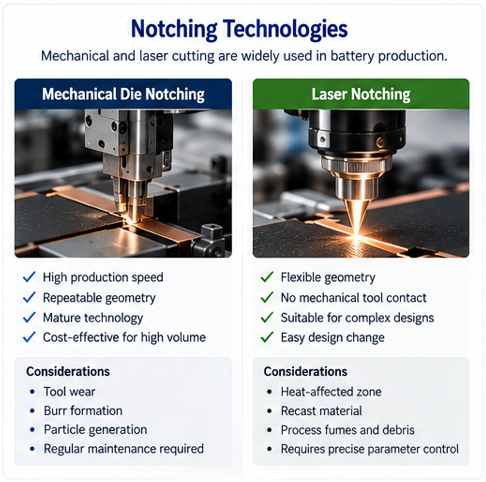
Mechanical Die Notching
One established method uses mechanical cutting tools.
A shaped die physically cuts the electrode into the required geometry.
Conceptually:
Electrode Web
↓
Punch / Die
↓
Mechanical Shearing
↓
Finished Electrode Geometry
Mechanical notching can offer:
- High production speed
- Repeatable geometry
- Mature industrial implementation
- Relatively straightforward process control
However, physical tool contact introduces several considerations.
Challenges of Mechanical Notching
Mechanical cutting tools experience wear.
As the cutting edge deteriorates:
Tool Wear ↑
↓
Cutting Quality ↓
↓
Burr / Particle Risk ↑
Potential issues include:
- Blade or die wear
- Burr formation
- Coating fracture
- Particle generation
- Tool replacement
- Mechanical maintenance
Cutting quality must therefore be monitored throughout production.
Laser Notching
Laser processing provides an alternative approach.
Instead of physically shearing the electrode, a focused laser removes material along a programmed cutting path.
Conceptually:
Laser Beam
↓
Localized Energy
↓
Material Removal
↓
Electrode Geometry
Because the cutting profile is digitally controlled, laser systems can provide significant flexibility for complex electrode geometries.
Why Laser Notching Is Attractive
Laser processing can offer several potential advantages.
No Mechanical Cutting Edge
There is no conventional blade or die contacting the electrode.
Flexible Geometry
Cutting paths can be controlled digitally.
Reduced Tool Wear
There is no mechanical cutting tool requiring sharpening in the traditional sense.
High Automation Potential
Laser processing can integrate with automated web handling and inspection.
Fast Design Changes
Changing the programmed cutting path may be easier than replacing physical tooling for some applications.
However, laser processing introduces its own challenges.
Challenges of Laser Notching
Laser cutting applies concentrated energy to battery materials.
Process conditions therefore need careful optimization.
Potential concerns include:
- Heat-affected zones
- Material melting
- Recast material
- Edge morphology changes
- Particle or debris generation
- Process fumes
- Optical contamination
- Cutting-speed limitations
Different electrode materials can respond differently to laser energy.
Cathode coating, anode coating, aluminum foil, and copper foil do not necessarily require the same laser conditions.
Mechanical vs Laser Notching
| Characteristic | Mechanical | Laser |
|---|---|---|
| Cutting Mechanism | Physical shearing | Localized laser ablation/cutting |
| Tool Contact | Yes | No conventional cutting contact |
| Tool Wear | Important | Reduced mechanical tool wear |
| Geometry Flexibility | Tool dependent | High |
| Burr Risk | Mechanical burr possible | Different edge defects possible |
| Thermal Effect | Minimal | Must be controlled |
| Maintenance | Die/blade maintenance | Optical/process maintenance |
| Automation | High | High |
Neither method is universally superior.
The appropriate solution depends on:
- Electrode material
- Cell design
- Production speed
- Required geometry
- Quality specifications
- Equipment economics
What Is an Electrode Burr?
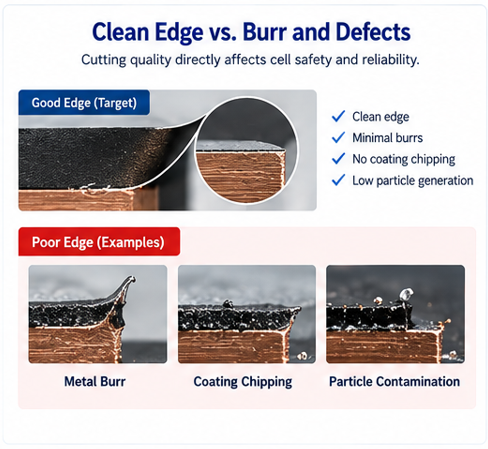
A burr is a small protrusion or deformation left at a cut metal edge.
Because battery electrodes use thin aluminum or copper current collectors, poor cutting conditions can leave microscopic metallic projections.
Clean Edge
────────────
versus
Burred Edge
───────────╱
The burr may be extremely small relative to the overall electrode.
But battery cells contain thin separators positioned very close to electrode edges.
This makes edge quality particularly important.
Why Burrs Matter
Inside a lithium-ion cell:
Cathode
│
Separator
│
Anode
The separator prevents direct electrical contact between the electrodes.
A sharp metallic protrusion near the separator can create unwanted mechanical stress.
Conceptually:
Large / Sharp Burr
↓
Separator Stress
↓
Potential Separator Damage
↓
Risk of Unwanted Electrical Contact
For this reason, electrode-edge inspection is an important quality-control task.
Particle Generation
Notching can also produce small particles.
Possible sources include:
- Fractured active-material coating
- Metallic cutting debris
- Current-collector fragments
- Mechanical tool wear
- Laser-generated debris
Particles can remain near the cut edge or contaminate equipment and nearby electrode surfaces.
This creates another manufacturing priority:
Cut the electrode without contaminating the electrode.
Why Metallic Particles Are Particularly Important
Not all contamination has the same risk profile.
Metallic foreign particles can be particularly problematic because they may be electrically conductive.
If an unwanted conductive particle becomes trapped within the cell structure, it can potentially interact with electrodes or separators.
Battery factories therefore place strong emphasis on:
- Particle prevention
- Extraction
- Cleaning
- Inspection
- Contamination monitoring
Notching equipment must be considered part of this broader contamination-control system.
Edge Quality
A high-quality notched electrode should exhibit:
- Accurate geometry
- Clean cut edges
- Low burr height
- Minimal coating chipping
- Minimal delamination
- Low particle generation
- Consistent dimensions
Edge quality is influenced by both the electrode itself and the cutting process.
For example, upstream processes can affect:
Coating Adhesion
Electrode Density
Mechanical Strength
which can change how the electrode behaves during cutting.
Dimensional Accuracy
Modern battery manufacturing requires highly repeatable electrode dimensions.
Notching systems must control parameters such as:
- Electrode length
- Electrode width
- Tab geometry
- Tab position
- Cut location
- Edge position
Small variations repeated across hundreds or thousands of electrode layers can influence the final cell geometry.
Electrode Alignment
Before cutting, the electrode must be positioned accurately.
Web-guiding systems can detect electrode position and compensate for lateral movement.
Conceptually:
Position Sensor
↓
Web Position Measurement
↓
Alignment Correction
↓
Precision Notching
Without accurate web positioning, even a perfectly calibrated cutting tool can produce incorrectly located features.
Registration Control
Notching may also need to remain synchronized with existing electrode features.
For example, the system may need to recognize:
- Coated areas
- Uncoated regions
- Previous cutting features
- Electrode boundaries
Sensors or machine-vision systems can identify these references.
The cutting system then performs the notch at the correct location.
This synchronization is known as registration control.
Notching Speed and Productivity
Battery factories operate at increasingly high production volumes.
Notching equipment must therefore combine:
High Cutting Speed
with
High Precision
and
Low Defect Generation
Increasing speed without maintaining process stability can increase:
- Dimensional variation
- Cutting defects
- Particle generation
- Handling errors
The goal is not simply the fastest possible cut.
It is the highest sustainable throughput within the required quality window.
Common Electrode Notching Defects
Several defects can occur during electrode notching.
Burr Formation
Metal protrudes from the cut edge.
Coating Chipping
Small pieces of active-material coating break away.
Delamination
The coating separates locally from the current collector.
Particle Generation
Cutting produces loose material.
Dimensional Error
The electrode geometry deviates from specification.
Tab Position Error
Electrical connection regions are incorrectly positioned.
Edge Deformation
The metal foil or coating becomes distorted.
Thermal Damage
In laser processing, excessive energy can alter material near the cut.
These defects can affect subsequent winding or stacking.
Quality Control After Notching
Electrode inspection can evaluate several characteristics.
Geometry
Does the electrode match the required dimensions?
Burr Height
Are metallic edge protrusions within specification?
Edge Condition
Is there cracking, chipping, or delamination?
Tab Position
Is the electrical connection geometry correctly located?
Particle Contamination
Has cutting generated unacceptable debris?
Surface Condition
Was the electrode damaged during handling?
Modern production increasingly relies on automated optical inspection.
Machine Vision and Inline Inspection
Machine vision systems can inspect electrodes immediately after cutting.
A simplified control loop is:
Notching
↓
High-Speed Camera
↓
Image Analysis
↓
Defect Detection
↓
Process Feedback
Potentially detectable characteristics include:
- Electrode outline
- Tab geometry
- Edge defects
- Dimensional variation
- Surface contamination
Automated inspection becomes increasingly valuable as production speeds rise.
Particle Extraction
Mechanical and laser cutting can both produce debris.
Notching equipment can therefore incorporate extraction systems near the cutting zone.
A simplified concept is:
Cutting Zone
↓
Particle Generation
↓
Local Extraction
↓
Filtration / Collection
The objective is to capture debris before it deposits on the electrode or spreads into surrounding equipment.
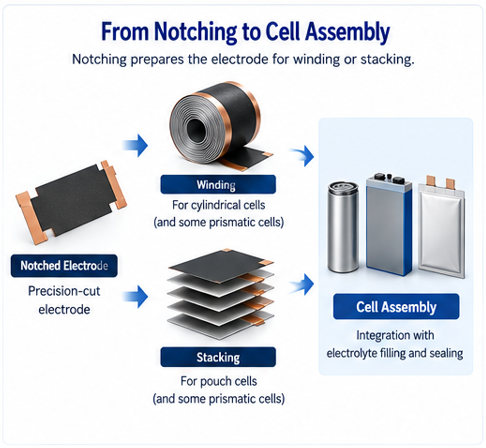
From Notching to Winding
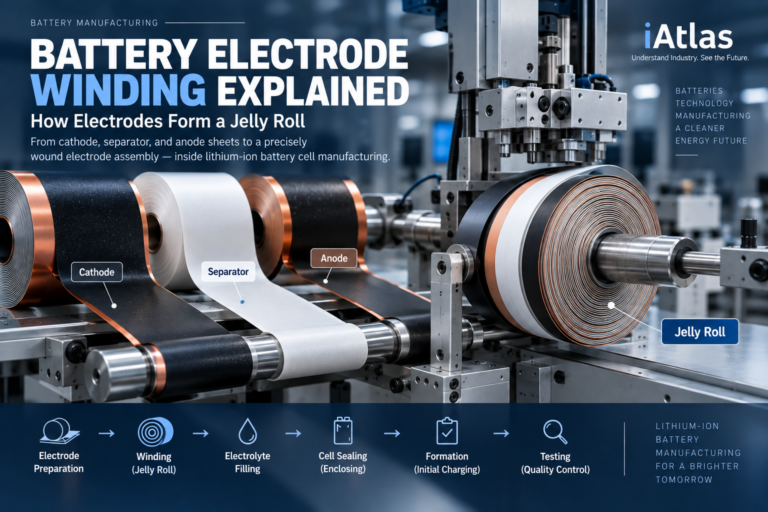
For cells using wound electrode structures, prepared electrodes proceed toward winding.
The sequence becomes:
Slitting
↓
Notching
↓
Electrode Alignment
↓
Cathode + Separator + Anode
↓
Winding
↓
Jelly Roll
At this stage, notching accuracy influences where electrode edges and current-collector connection regions appear within the wound structure.
From Notching to Stacking
For stacked cells, electrodes are prepared for sequential layer assembly.
Conceptually:
Notched Cathode
Separator
Notched Anode
↓
Layer Alignment
↓
Repeated Stacking
↓
Electrode Stack
Dimensional consistency becomes particularly important because many individual layers must align within the finished stack.
Why Notching Matters to Battery Safety
Notching is a relatively small part of the overall factory.
But it occurs at a critical location in the process.
The connection can be summarized as:
Cutting Process
↓
Edge Quality
↓
Burrs / Particles
↓
Interaction with Separator
↓
Cell Reliability
This is why precision electrode cutting should not be viewed simply as a productivity step.
It is also part of battery quality and safety engineering.
Emerging Electrode Notching Technologies
Battery manufacturing is pushing electrode cutting toward greater precision and automation.
High-Speed Laser Processing
Higher-power and more advanced laser systems aim to increase cutting speed while maintaining edge quality.
Ultrafast Lasers
Shorter laser pulses can reduce unwanted thermal effects in certain processing applications.
AI-Based Vision Inspection
Machine-learning systems can help classify cutting defects automatically.
Closed-Loop Process Control
Inspection data can be fed back to equipment settings.
Predictive Maintenance
Equipment data can help identify deteriorating cutting performance before defects exceed limits.
Digital Traceability
Cutting parameters and inspection results can be associated with individual production lots or electrode rolls.
The long-term direction is toward self-monitoring electrode converting systems.
iAtlas Insight
Battery electrode notching illustrates an important principle of advanced manufacturing:
As products become more energy-dense, small manufacturing defects become increasingly important.
A battery electrode can be hundreds of millimeters wide.
A cell may contain many meters of electrode material or numerous stacked sheets.
Yet a defect at the cut edge can exist on a scale measured in micrometers.
This creates a manufacturing challenge:
Gigafactory-Scale Production
must coexist with
Micrometer-Scale Quality Control
Future notching equipment will therefore be judged not only by cutting speed.
The more meaningful performance equation is:
Throughput
Precision
Low Particle Generation
Edge Quality
Automated Inspection
As battery manufacturing becomes increasingly automated, notching is evolving from a simple cutting station into an integrated precision processing and quality-control system.
Did You Know?
- Slitting and notching are different electrode-cutting processes.
- Slitting mainly divides wide electrode webs into narrower rolls.
- Notching creates more detailed electrode geometry for cell assembly.
- Battery electrodes combine brittle composite coatings with thin metallic foils, making precision cutting challenging.
- Mechanical cutting can create metallic burrs.
- Laser cutting eliminates conventional blade contact but introduces thermal-processing considerations.
- Particle contamination can originate directly from electrode cutting.
- Machine vision can inspect electrode geometry immediately after notching.
FAQ
What is battery electrode notching?
Battery electrode notching is a precision cutting process that creates the electrode geometry required for subsequent battery cell assembly.
What is the difference between slitting and notching?
Slitting divides wide electrode rolls into narrower strips. Notching performs more detailed cutting to create assembly-ready electrode geometry.
What methods are used for electrode notching?
Mechanical die cutting and laser-based cutting are two important approaches.
Why are electrode burrs dangerous?
Sharp metallic burrs can create mechanical stress near the separator and may increase the risk of unwanted electrical contact if defects become severe.
Does laser notching eliminate all cutting defects?
No. Laser processing avoids conventional mechanical blade wear but requires control of thermal effects, debris, edge morphology, and other laser-material interactions.
Why is particle control important?
Particles generated during cutting can contaminate electrodes and may become trapped inside the battery during assembly.
What is registration control?
Registration control synchronizes the cutting position with existing electrode features so that notches and other geometries are produced in the correct location.
What comes after notching?
Depending on the cell design, electrodes typically proceed toward winding or stacking.
Battery Manufacturing Learning Path
Overview
Electrode Manufacturing
Cell Assembly
- Battery Cell Assembly
- Battery Electrode Notching (Current)
- Battery Electrode Winding
- Battery Electrode Stacking
- Electrolyte Filling
- Cell Sealing
Cell Finishing
- Formation
- Aging
- Degassing
- Battery Cell Testing & Grading
System Assembly
- Battery Module Assembly
- Battery Pack Assembly
Explore More
Cell Assembly
- Battery Cell Assembly
- Battery Electrode Notching (Current)
- Battery Electrode Winding
- Battery Electrode Stacking
- Electrolyte Filling
- Cell Sealing
Electrode Manufacturing
- Calendering
- Slitting
Battery Components
- Cathode
- Anode
- Separator
- Battery Cell
References
Recommended primary research areas for this article:
- Journal of Power Sources
Computational and Experimental Studies of Laser Cutting of the Current Collectors for Lithium-ion Batteries - Journal of Power Sources
High Speed Remote Laser Cutting of Electrodes for Lithium-ion Batteries: Anode - Journal of Materials Processing Technology
Characterization and Process Optimization of Remote Laser Cutting of Current Collectors for Battery Electrode Production - Advanced Intelligent Systems
Autonomous Visual Detection of Defects from Battery Electrode Manufacturing
About iAtlas
iAtlas is an independent publication covering batteries, semiconductors, OLED, advanced materials, AI, and global industrial trends.
We transform complex industrial developments into clear, reliable, and easy-to-understand insights.
Whether you’re following today’s industry news or building long-term expertise, iAtlas helps you understand not only what happened, but why it matters.
Technology creates change.
Insight creates opportunity.
— iAtlas