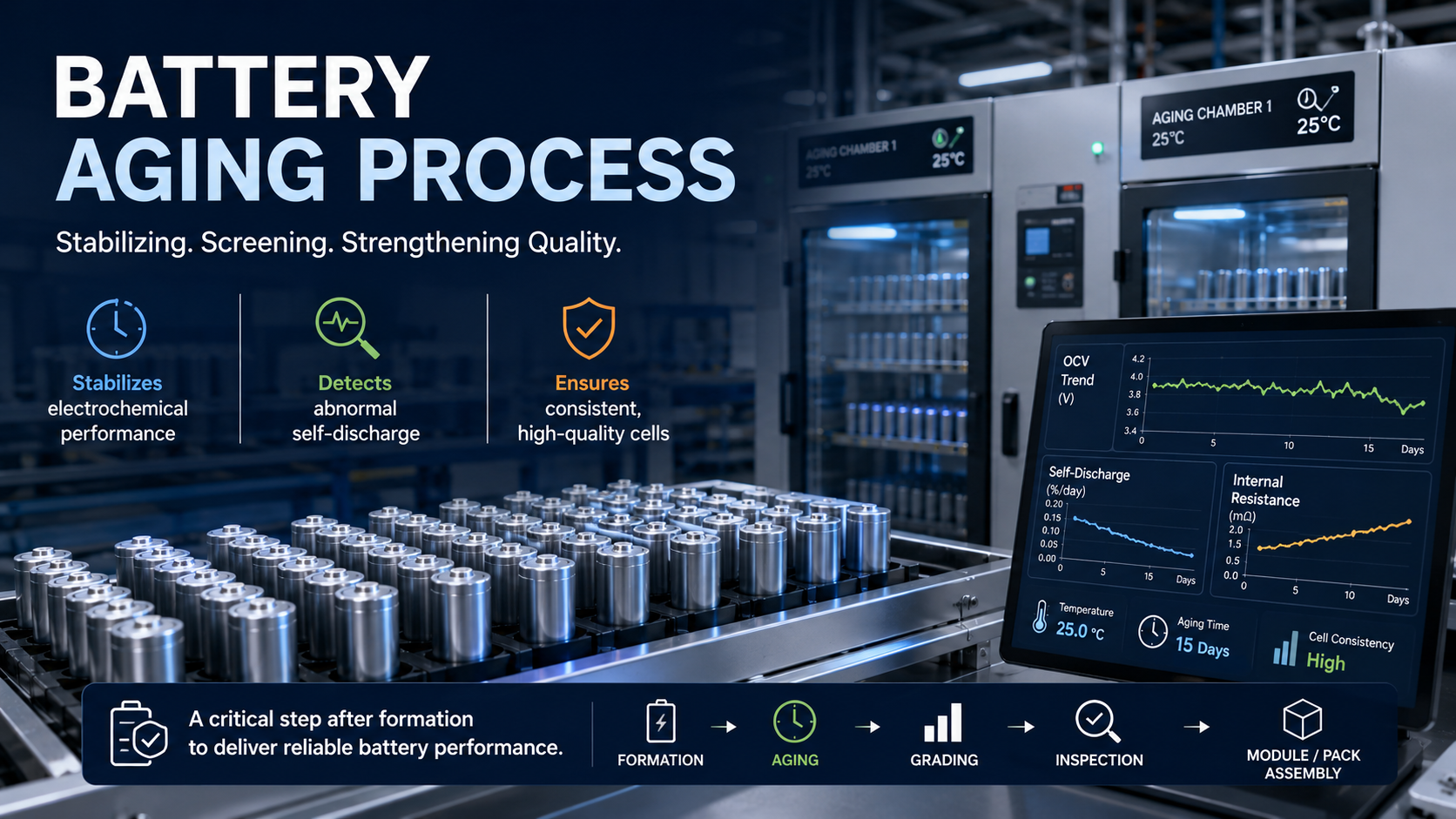
Battery Aging Process Explained: Why Lithium-Ion Cells Must Rest Before Final Grading
🔋 iAtlas Battery #29 | 🏭 Manufacturing → ⏳ Battery Aging Process
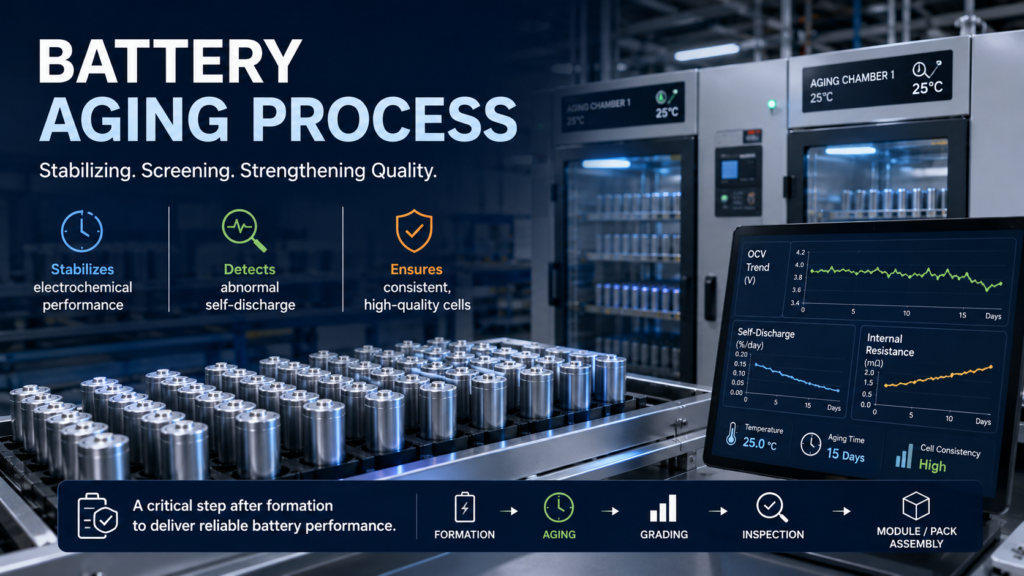
A lithium-ion battery does not move directly from formation to final shipment.
After the first controlled charge and discharge cycles, newly formed cells typically enter another important manufacturing stage known as battery aging.
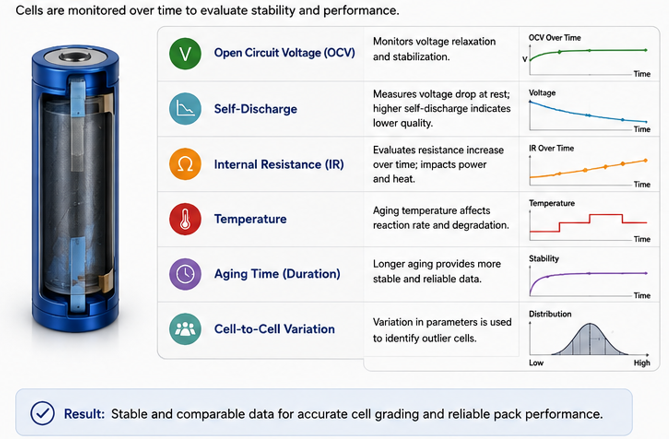
During aging, battery cells are stored under controlled conditions while manufacturers monitor changes in voltage, internal resistance, temperature, and other characteristics. The objective is not simply to let the battery “rest.” Aging gives the cell time to stabilize and helps manufacturers identify cells with abnormal self-discharge, internal defects, or inconsistent electrochemical behavior.
This makes the battery aging process an important bridge between formation and final grading or quality control.
In this article, we’ll explore how battery aging works, why manufacturers need it, which parameters are monitored, and how aging helps ensure consistent lithium-ion battery quality.
Table of Contents
- What Is the Battery Aging Process?
- Why Do Batteries Need Aging?
- Where Aging Fits in Battery Manufacturing
- How the Battery Aging Process Works
- Key Parameters During Battery Aging
- Room-Temperature vs High-Temperature Aging
- What Defects Can Aging Detect?
- Aging vs Formation: What’s the Difference?
- Future Trends in Battery Aging
- Frequently Asked Questions
- Key Takeaways
1. What Is the Battery Aging Process?
The battery aging process is a controlled storage and monitoring stage performed during the finishing of newly manufactured battery cells.
After formation, cells require time for their electrochemical condition to stabilize.
During this period, manufacturers can monitor whether each cell behaves normally or shows signs of abnormal performance.
Typical parameters include:
- Open Circuit Voltage (OCV)
- Voltage change over time
- Internal resistance
- Temperature
- Self-discharge behavior
- Cell consistency
Cells that remain stable can proceed toward grading and final quality control, while abnormal cells can be separated for further evaluation.
2. Why Do Batteries Need Aging?
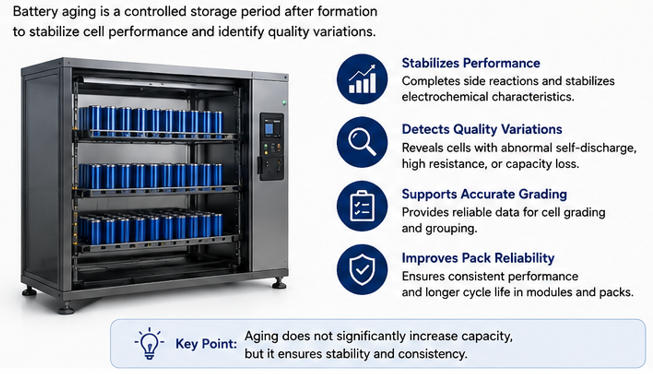
A newly formed battery may initially appear normal even when an internal defect exists.
Some abnormalities become easier to identify only after the cell has remained at rest for a certain period.
Electrochemical Stabilization
Formation initiates important electrochemical reactions inside the cell.
After formation, additional stabilization can continue as the cell reaches a more stable condition.
Aging provides controlled time for this stabilization before final evaluation.
Detecting Abnormal Self-Discharge
One of the most important purposes of aging is detecting cells whose voltage decreases abnormally during storage.
A cell with excessive self-discharge may indicate:
- Internal leakage pathways
- Contamination
- Micro-short circuits
- Manufacturing abnormalities
By comparing voltage measurements over time, manufacturers can identify cells that would otherwise appear acceptable during a single inspection.
Improving Cell Consistency
Large battery packs contain many individual cells.
Significant differences between cells can affect pack performance and reliability.
Aging data helps manufacturers identify cells with unusual behavior before they enter module or pack assembly.
3. Where Aging Fits in Battery Manufacturing
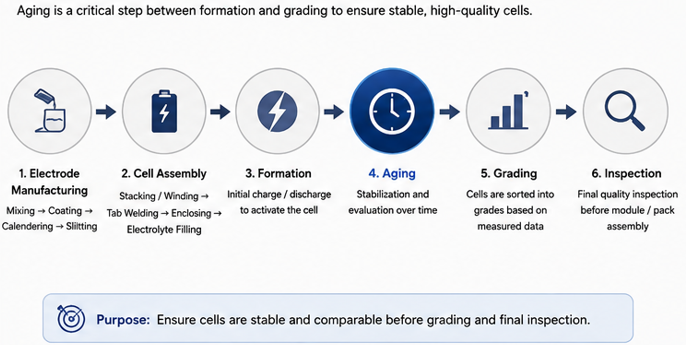
A simplified cell-finishing sequence can be represented as:
Electrolyte Filling
↓
Wetting
↓
Formation
↓
Aging
↓
Electrical Testing / Grading
↓
Final Inspection
Aging therefore sits between electrochemical activation and final quality classification.
Each stage serves a different purpose.
Electrolyte filling and wetting prepare the internal electrode structure for electrochemical operation.
Formation performs the initial controlled charge and discharge process.
Aging allows the formed cell to stabilize while manufacturers monitor changes over time.
Grading and inspection determine whether the finished cell meets required specifications.
4. How the Battery Aging Process Works
The exact aging procedure varies depending on battery chemistry, cell format, manufacturer, and production strategy.
A simplified process generally follows several stages.
Step 1 — Formation Completion
Cells complete their specified formation charge and discharge profile.
Step 2 — Initial Measurement
Electrical characteristics such as OCV and internal resistance are measured and recorded.
Step 3 — Controlled Storage
Cells are stored for a defined period under controlled environmental conditions.
Step 4 — Intermediate or Final Measurement
OCV and other parameters are measured again.
Step 5 — Data Comparison
Manufacturing systems compare measurements to determine how each cell changed during the aging period.
Step 6 — Cell Classification
Cells showing abnormal behavior can be separated, while qualified cells continue toward grading and final inspection.
The key point is that aging introduces time as an additional quality-control variable.
A single measurement tells manufacturers how a battery behaves at one moment.
Aging helps reveal how that battery changes over time.
5. Key Parameters During Battery Aging
Open Circuit Voltage (OCV)
OCV is one of the most important measurements during aging.
Manufacturers can compare voltage before and after the aging period to identify abnormal voltage decay.
Self-Discharge
All batteries exhibit some degree of self-discharge.
However, unusually rapid self-discharge can indicate an internal problem.
Internal Resistance
Changes in internal resistance may provide additional information about cell consistency and electrochemical condition.
Temperature
Storage temperature influences electrochemical reaction rates and therefore must be carefully controlled and recorded.
Aging Time
The required aging duration depends on the cell chemistry, manufacturing process, and quality-control strategy.
Cell-to-Cell Variation
Manufacturers analyze large populations of cells to identify units that behave differently from the expected production distribution.
6. Room-Temperature vs High-Temperature Aging
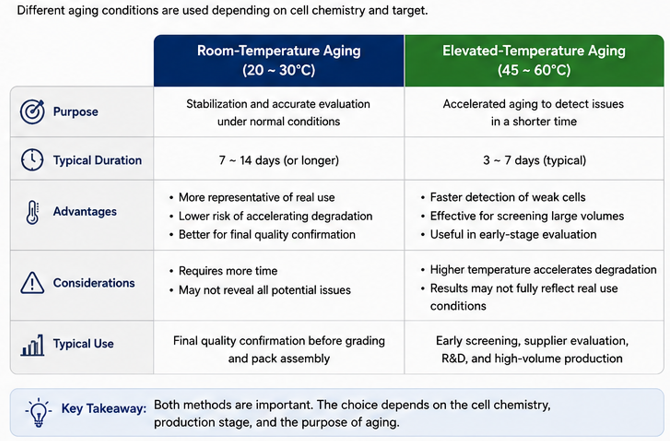
Battery aging does not necessarily occur under only one environmental condition.
Two broad approaches are commonly discussed.
Room-Temperature Aging
Cells are stored under controlled ambient conditions.
This allows manufacturers to observe natural stabilization and voltage behavior without intentionally accelerating electrochemical reactions.
Elevated-Temperature Aging
Some manufacturing or qualification strategies may use higher controlled temperatures to accelerate certain reactions or reveal abnormalities more quickly.
Higher temperature can increase reaction rates, which may help expose defects that would otherwise take longer to become visible.
However, temperature, duration, and acceptance criteria must be carefully defined for the specific cell chemistry and manufacturing process.
7. What Defects Can Aging Detect?
Aging is particularly useful for identifying defects that develop or become measurable over time.
Abnormal Self-Discharge
Unexpected voltage loss may indicate unwanted internal current paths.
Micro-Short Circuits
Very small internal shorts may not cause immediate cell failure but can contribute to abnormal voltage decay.
Internal Contamination
Foreign conductive particles can potentially create undesirable electrical pathways inside the cell.
Cell Inconsistency
Cells with significantly different voltage or resistance behavior can be identified before pack assembly.
Electrochemical Instability
Abnormal changes following formation may indicate that the cell has not stabilized as expected.
Aging therefore complements inspection technologies such as machine vision and X-ray.
Those technologies examine the battery’s physical condition, while aging helps reveal aspects of its electrochemical behavior over time.
8. Aging vs Formation: What’s the Difference?
Formation and aging are closely connected, but they are not the same process.
| Formation | Aging |
|---|---|
| Active electrochemical process | Primarily controlled storage and monitoring |
| Applies charge/discharge profiles | Observes cell behavior over time |
| Establishes initial electrochemical condition | Evaluates stabilization |
| Strongly associated with initial interphase formation | Useful for detecting abnormal self-discharge |
| Uses formation channels | Uses storage, monitoring, and measurement systems |
A simple way to understand the relationship is:
Formation activates the battery. Aging checks whether that newly formed battery remains stable.
This distinction is important because combining Formation and Aging into a single concept can hide the different manufacturing purposes of each stage.
9. Future Trends in Battery Aging
Battery manufacturers continuously seek ways to shorten production time while maintaining quality.
Aging is particularly important because long storage periods require significant:
- Factory space
- Inventory
- Capital
- Environmental control
- Production time
Future manufacturing strategies increasingly focus on using data to determine cell quality more efficiently.
Key directions include:
- Automated OCV monitoring
- High-density aging storage systems
- Manufacturing data integration
- Predictive quality analytics
- AI-assisted abnormal-cell detection
- Improved self-discharge prediction
- Automated cell handling
- Better integration between formation, aging, and grading
The long-term objective is not simply to eliminate aging time, but to obtain the same or better quality information with greater manufacturing efficiency.
10. Frequently Asked Questions
What is battery aging?
Battery aging is a controlled storage and monitoring process performed after formation to evaluate cell stabilization and identify abnormal behavior.
Is battery aging the same as battery degradation?
No. In battery manufacturing, aging refers to a deliberate production and quality-control stage. Battery degradation generally describes performance deterioration occurring throughout battery use and calendar life.
Why is OCV measured during aging?
Comparing OCV measurements over time helps manufacturers identify cells with abnormal voltage decay or self-discharge.
Why can’t manufacturers inspect cells immediately after formation?
Some abnormalities become more apparent only after the cell has remained at rest and its electrical behavior has been observed over time.
Does aging take place before or after formation?
Aging generally follows formation as part of cell finishing and quality-control processes.
What happens after battery aging?
Cells typically proceed to additional electrical testing, grading, inspection, and classification before module or pack assembly.
11. Key Takeaways
- The battery aging process is an important manufacturing stage performed after formation.
- Aging allows newly formed lithium-ion cells to stabilize before final classification.
- OCV changes and self-discharge behavior are important indicators monitored during aging.
- Aging can help identify micro-shorts, contamination, abnormal self-discharge, and inconsistent cells.
- Formation and aging serve different purposes: formation activates the cell, while aging evaluates its stability over time.
- Aging time contributes to manufacturing cost, inventory, and factory-space requirements.
- Advanced data analytics may help battery manufacturers detect abnormal cells faster and optimize future aging processes.
📚 Key Terms
Battery Aging
A controlled storage and monitoring stage performed after formation to allow newly manufactured battery cells to stabilize and to identify abnormal electrochemical behavior.
Self-Discharge
The gradual loss of stored charge while a battery is not connected to an external load. Abnormally high self-discharge can indicate internal defects or unwanted electrical pathways.
Open Circuit Voltage (OCV)
The voltage measured across a battery when no external current is flowing. Changes in OCV over time are commonly used to evaluate cell stability during aging.
OCV Drop
The decrease in open circuit voltage over a defined period. An unusually large voltage drop may indicate abnormal self-discharge or an internal defect.
Internal Resistance (IR)
The resistance to current flow within a battery cell. Internal resistance measurements can help manufacturers evaluate cell consistency and electrochemical condition.
Micro-Short Circuit
A small unintended electrical connection inside a battery cell that may cause abnormal self-discharge without immediately producing a complete cell failure.
Cell Grading
The process of measuring and classifying finished battery cells according to characteristics such as capacity, voltage, internal resistance, and other performance criteria.
Cell-to-Cell Variation
Differences in electrical or electrochemical characteristics among cells produced under nominally identical manufacturing conditions.
Traceability
The ability to connect battery measurement and quality data with individual cells, production batches, processes, and manufacturing history.
🎓 Battery Learning Path
🏭 Manufacturing
✅ iAtlas Battery #28 — Battery Manufacturing Process
📍 iAtlas Battery #29 — Battery Aging Process (Current)
▶ iAtlas Battery #30 — Battery Cell Grading
Welcome to the Battery Manufacturing Learning Path, where you’ll explore how individual manufacturing processes work together to transform battery materials into consistent, production-ready lithium-ion cells.
⚙️ Related Equipment Learning Path
For a deeper understanding of the equipment used before and after battery aging:
✅ iAtlas Battery #25 — Electrolyte Filling Equipment
✅ iAtlas Battery #26 — Formation Equipment
✅ iAtlas Battery #27 — Inspection Equipment
These equipment articles explain the machines and technologies behind the manufacturing processes discussed in this Learning Path.
📖 Continue Reading
⬅ Previous Article
🔋 iAtlas Battery #28
Battery Manufacturing Process Explained: From Raw Materials to Finished Lithium-Ion Cells
Follow the complete lithium-ion battery manufacturing process from electrode mixing and coating through cell assembly, electrolyte filling, formation, aging, and final inspection.
➡ Next Article
🔋 iAtlas Battery #30
Battery Cell Grading Explained: How Manufacturers Sort Lithium-Ion Cells by Quality and Performance
Learn how manufacturers measure capacity, voltage, internal resistance, and other cell characteristics to classify lithium-ion batteries before module and pack assembly.
📚 Related Articles
Continue exploring lithium-ion battery cell finishing and quality control:
- 🔋 iAtlas Battery #25 — Battery Electrolyte Filling Equipment Explained
- 🔋 iAtlas Battery #26 — Battery Formation Equipment Explained
- 🔋 iAtlas Battery #27 — Battery Inspection Equipment Explained
- 🔋 iAtlas Battery #28 — Battery Manufacturing Process Explained
- 📘 Open Circuit Voltage (OCV)
- 📘 Internal Resistance (IR)
- 📘 Self-Discharge
- 📘 SEI (Solid Electrolyte Interphase)
- 📘 Cell Grading
Additional Library articles will be linked as they are published.
📚 References
Battery Manufacturing & Research
- U.S. Department of Energy — Vehicle Technologies Office
- Argonne National Laboratory
- Journal of Power Sources
- Journal of Energy Storage
- Nature Energy
Battery Testing & Measurement
🔷 About iAtlas
iAtlas is an independent publication dedicated to making industrial knowledge more accessible.
From batteries and semiconductors to advanced materials, AI, and global manufacturing, iAtlas transforms complex technologies into practical, easy-to-understand insights.
Whether you’re following today’s industry news or building long-term expertise, iAtlas helps you understand not only what happened, but why it matters.
Technology creates change.
Insight creates opportunity.
— iAtlas