South Korea Launches ₩5 Trillion Fund to Strengthen Its Semiconductor Supply Chain
Why the Next Chip Race Is Moving Beyond Fabs to Materials, Equipment, and Infrastructure
📰 iAtlas Daily #34 | August 2026
📰 What Happened?
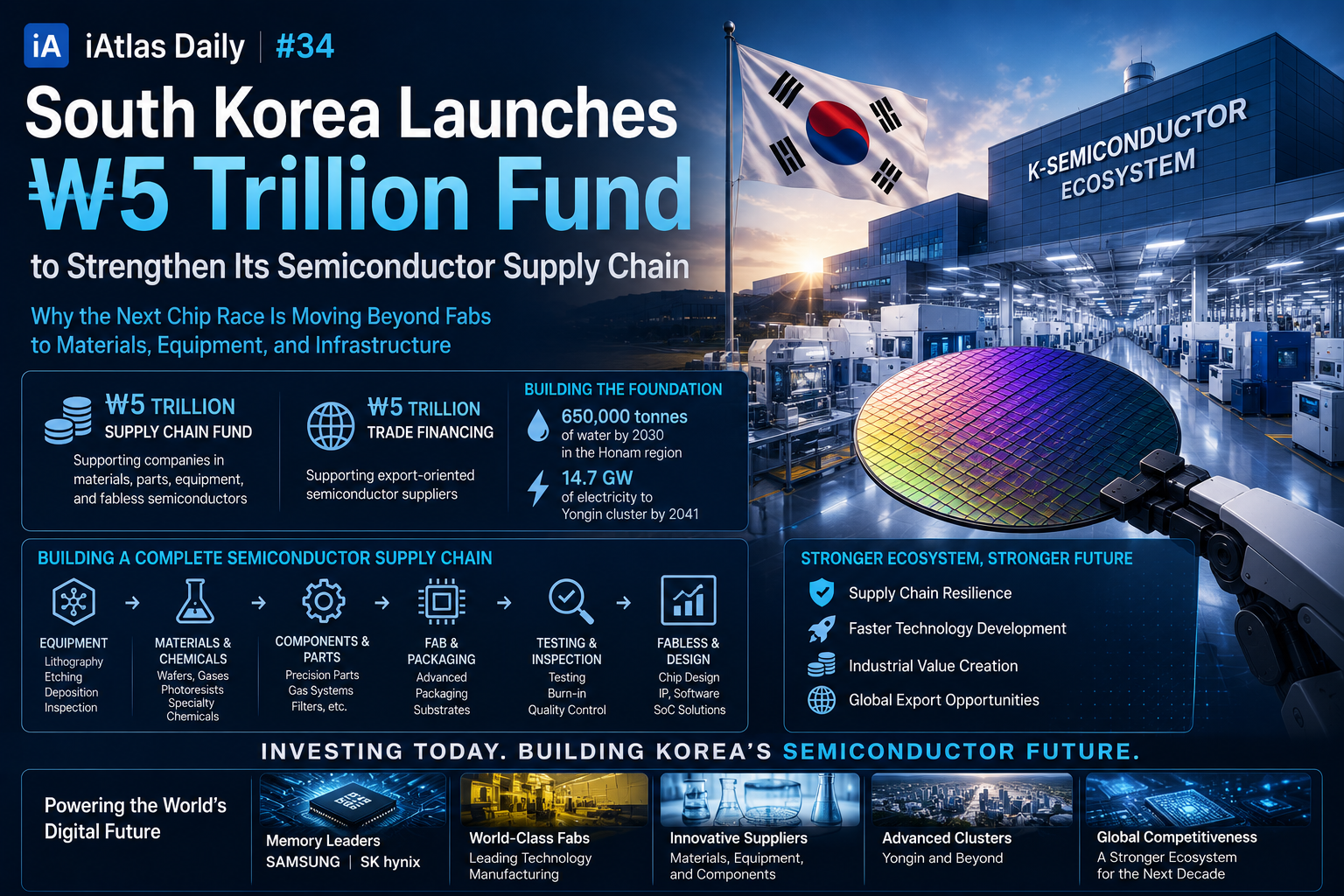
South Korea is preparing a new ₩5 trillion ($3.5 billion) fund to strengthen the country’s semiconductor ecosystem.
The initiative will support promising companies across areas including:
- Semiconductor materials
- Components and parts
- Equipment
- Fabless semiconductor companies
The government also plans another ₩5 trillion in trade financing for export-oriented semiconductor suppliers.
The announcement shows that Korea’s semiconductor strategy is expanding beyond simply building more fabs.
The focus is increasingly shifting toward something broader:
Building a complete semiconductor supply chain around those fabs.
💡 Why This Matters
A Semiconductor Fab Cannot Operate Alone
When semiconductor investment is discussed, attention usually goes to companies such as Samsung Electronics and SK hynix.
But a semiconductor fab depends on hundreds of suppliers.
Manufacturing advanced chips requires:
Equipment → Materials → Chemicals → Gases → Components → Utilities → Packaging → Testing
A weakness in any one of these areas can affect the entire manufacturing process.
This is why strengthening domestic semiconductor suppliers has become increasingly important to Korea’s industrial strategy.
🧪 Materials Are Becoming Strategic Assets
Advanced semiconductor manufacturing requires increasingly sophisticated materials.
Examples include:
- Silicon wafers
- Photoresists
- Specialty gases
- Wet chemicals
- CMP slurry
- Deposition precursors
- Packaging substrates
As semiconductor nodes become smaller and packaging becomes more complex, material performance becomes increasingly important.
Even small improvements in purity, uniformity, or process stability can influence manufacturing yield.
That makes semiconductor materials much more than simple consumables.
They are becoming strategic technologies.
⚙️ Semiconductor Equipment Matters Too
The same applies to manufacturing equipment.
Modern semiconductor fabs depend on equipment for:
- Lithography
- Deposition
- Etching
- Cleaning
- Ion implantation
- Metrology
- Inspection
- Packaging
Leading-edge fabs can require tens of billions of dollars in investment.
A significant portion of that spending ultimately flows to equipment suppliers.
Strengthening domestic equipment companies could therefore allow Korea to capture more value from its own semiconductor manufacturing expansion.
🏗️ Infrastructure Is Becoming Part of the Strategy
The announcement goes beyond financing.
South Korea is also planning infrastructure required to support future semiconductor clusters.
The government plans to secure approximately 650,000 tonnes of water by 2030 in the Honam region and provide 14.7 GW of electricity to the Yongin semiconductor cluster by 2041.
Those numbers illustrate an important reality:
Semiconductor manufacturing is becoming an infrastructure industry.
A fab needs much more than semiconductor equipment.
It requires enormous amounts of:
- Electricity
- Ultra-pure water
- Industrial gases
- Cooling
- Chemical infrastructure
- Waste treatment
- Logistics
As semiconductor clusters become larger, these supporting systems become strategic assets themselves.
🏭 From Chip Companies to Semiconductor Ecosystems
Korea already has two of the world’s largest memory semiconductor manufacturers:
Samsung Electronics and SK hynix.
But future competitiveness will increasingly depend on the companies surrounding them.
A stronger domestic ecosystem could provide several advantages:
🔗 Supply Chain Resilience
More local suppliers can reduce dependence on overseas supply chains.
🚀 Faster Technology Development
Close cooperation between fabs, equipment makers, and materials suppliers can accelerate process development.
💰 Industrial Value Creation
More semiconductor investment can remain within the domestic industrial ecosystem.
🌍 Export Opportunities
Suppliers that develop technology alongside Korean chipmakers may eventually expand into global semiconductor markets.
🌍 The Global Chip Race Is Changing
The semiconductor competition between countries is no longer simply about who produces the most chips.
Governments around the world are increasingly supporting entire semiconductor ecosystems.
The United States, Japan, Europe, Taiwan, China, and South Korea are all investing in different parts of the semiconductor value chain.
The competitive unit is gradually changing from:
Company vs. Company
to
Ecosystem vs. Ecosystem.
📈 Industry Impact
🧪 Materials Suppliers
New funding could accelerate technology development and capacity expansion among Korean semiconductor materials companies.
⚙️ Equipment Manufacturers
Domestic equipment suppliers may benefit from continued fab and semiconductor-cluster investment.
💻 Fabless Companies
The fund also targets promising chip designers, broadening Korea’s semiconductor strategy beyond memory manufacturing.
🏗️ Industrial Infrastructure
Electricity, water, gas, chemical, and environmental infrastructure will become increasingly important as semiconductor clusters expand.
🏭 Samsung & SK hynix Supply Chains
A stronger domestic supplier ecosystem could support future manufacturing expansion by Korea’s major chipmakers.
👀 What to Watch
Several developments will determine whether the strategy succeeds:
- Which companies receive investment
- Localization of semiconductor materials
- Domestic semiconductor equipment development
- Yongin cluster construction
- Electricity supply
- Water infrastructure
- Fabless ecosystem growth
- Export growth among Korean suppliers
The amount of funding matters.
But the more important question is whether that capital creates globally competitive suppliers.
🎯 Atlas Insight
The semiconductor race is becoming much larger than the chip itself.
A leading semiconductor industry requires:
Fabs
↓
Equipment
↓
Materials & Components
↓
Utilities & Infrastructure
↓
Packaging & Testing
↓
Engineering Talent
South Korea already has world-class semiconductor manufacturers.
The next challenge is building a world-class industrial ecosystem around them.
The new ₩5 trillion fund shows that Korea increasingly views materials, equipment, components, infrastructure, and fabless companies as part of the same semiconductor strategy.
And that may become one of the defining themes of the next semiconductor investment cycle.
📚 Related Articles
📰 iAtlas Daily #23 | TSMC Expands Advanced Packaging Capacity
📰 iAtlas Daily #26 | ASML Sees Strong EUV Demand
📰 iAtlas Daily #30 | SK hynix Invests ₩54 Trillion in New Memory Fabs
📊 iAtlas Weekly #5 | Building the AI Infrastructure Era
Sources
Reuters — South Korea to establish fund for semiconductor materials, parts and equipment
About iAtlas
iAtlas is an independent publication covering batteries, semiconductors, OLED, advanced materials, AI, and global industrial trends.
We transform complex industrial developments into clear, reliable, and easy-to-understand insights.
Whether you’re following today’s industry news or building long-term expertise, iAtlas helps you understand not only what happened, but why it matters.
Technology creates change.
Insight creates opportunity.
— iAtlas