Battery Winding Equipment Explained: How Jelly Rolls Are Built for Lithium-Ion Batteries
🔋 iAtlas Battery #24 | ⚙️ Equipment → 🌀 Winding Equipment
While pouch cells are commonly assembled using stacking technology, cylindrical cells—and many prismatic batteries—rely on a different method called winding.
In this process, the cathode, separator, and anode are continuously rolled together to form a compact spiral structure known as the jelly roll. Although winding appears straightforward, it requires extremely precise control of alignment, tension, and winding speed to ensure consistent battery performance.
Modern battery winding equipment combines servo motion control, machine vision, tension monitoring, and automated inspection to manufacture millions of high-quality lithium-ion cells every year.
This article explains how battery winding equipment works, why precision winding is essential, and the technologies shaping next-generation battery manufacturing.
Table of Contents
- What Is Battery Winding Equipment?
- Why Electrode Winding Matters
- Main Components of a Winding Line
- How Battery Winding Works
- Critical Winding Parameters
- Common Winding Defects
- Future Trends in Battery Winding Equipment
- Frequently Asked Questions
- Key Takeaways
1. What Is Battery Winding Equipment?
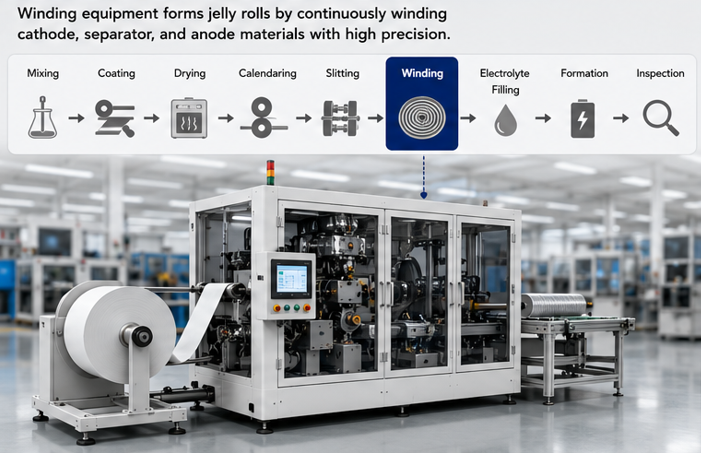
Battery winding equipment assembles cathodes, separators, and anodes into a tightly wound cylindrical structure called a jelly roll.
Unlike stacking equipment, which places electrode sheets layer by layer, winding equipment continuously rolls electrode materials around a central mandrel.
Battery winding is widely used for:
- Cylindrical cells (18650, 21700, 4680)
- Many prismatic lithium-ion batteries
- Consumer electronics batteries
- Electric vehicle battery production
The main objectives are to:
- Produce a stable jelly roll
- Maintain precise electrode alignment
- Control separator tension
- Prevent wrinkles and damage
- Support high-speed manufacturing
Because the jelly roll becomes the core of the battery cell, winding quality directly affects safety, capacity, and cycle life.
2. Why Electrode Winding Matters
The winding process determines the internal geometry of cylindrical battery cells.
A properly wound jelly roll ensures that the cathode, separator, and anode remain evenly aligned throughout the entire cell.
Maintaining Uniform Alignment
Accurate alignment prevents exposed electrode edges and ensures consistent overlap between active materials.
Proper alignment improves:
- Capacity consistency
- Current distribution
- Cell reliability
- Safety
Controlling Separator Tension
The separator must remain flat and undamaged during winding.
Excessive tension may stretch or tear the separator, while insufficient tension can create wrinkles or loose winding.
Improving Production Efficiency
Modern winding machines operate at extremely high speeds while maintaining micron-level positional accuracy.
This combination of speed and precision is essential for large-scale EV battery production.
3. Main Components of a Winding Line
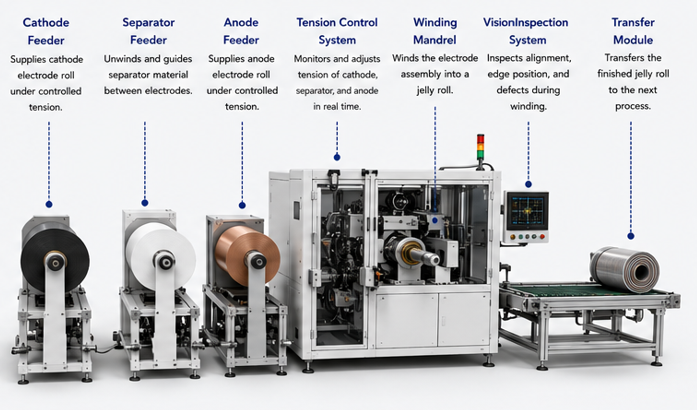
Electrode Feeding System
Prepared cathode and anode rolls are fed into the winding machine under controlled tension.
Separator Feeding System
The separator is continuously unwound and guided between the electrodes.
Tension Control System
Load cells and servo motors continuously monitor and adjust material tension throughout the winding process.
Winding Mandrel
The mandrel serves as the central core around which the electrode assembly is wound.
Its precision directly influences jelly-roll geometry.
Vision Inspection System
Machine vision verifies:
- Electrode alignment
- Separator position
- Edge quality
- Material tracking
Finished Cell Transfer
After winding, the completed jelly roll is transferred automatically to the next manufacturing process.
4. How Battery Winding Works
The winding process follows a continuous sequence.
- Cathode and anode materials are supplied.
- The separator is positioned between them.
- The electrode assembly begins winding around the mandrel.
- Tension and alignment are continuously adjusted.
- The jelly roll reaches its target diameter.
- The finished assembly is secured and transferred.
Throughout production, sensors monitor winding accuracy to ensure stable geometry and prevent defects.
5. Critical Winding Parameters
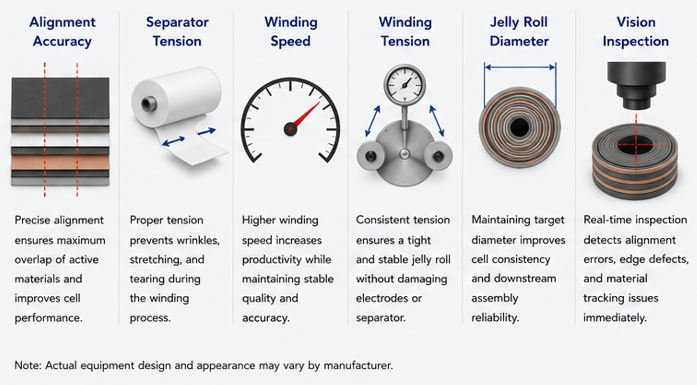
Several variables determine winding quality.
Alignment Accuracy
Proper electrode overlap ensures consistent battery performance.
Separator Tension
Maintains separator integrity and prevents wrinkles.
Winding Speed
Higher speeds increase productivity but require more precise control.
Winding Tension
Uniform tension prevents loose or over-tight winding.
Jelly Roll Diameter
The finished diameter must remain within tight tolerances.
Vision Inspection
Real-time cameras verify alignment and detect abnormalities before transfer.
6. Common Winding Defects
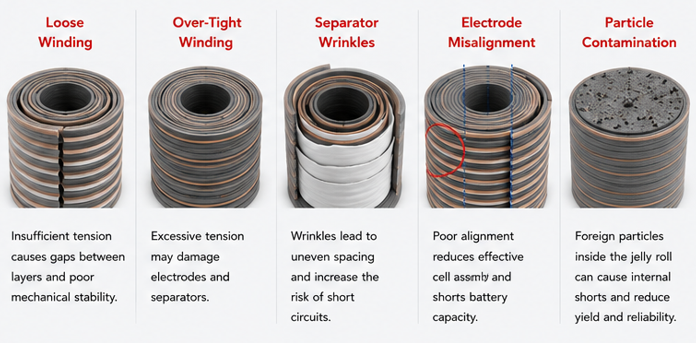
Loose Winding
Insufficient tension creates unstable jelly rolls that may deform during cell assembly.
Over-Tight Winding
Excessive tension can damage electrodes or separators.
Electrode Misalignment
Incorrect positioning reduces the effective active area.
Separator Wrinkles
Wrinkles may create uneven spacing and increase safety risks.
Diameter Variation
Inconsistent winding changes jelly-roll dimensions and affects downstream assembly.
Particle Contamination
Foreign particles introduced during winding reduce reliability and manufacturing yield.
7. Future Trends in Battery Winding Equipment
Battery winding systems continue evolving toward higher precision and productivity.
Key trends include:
- High-speed continuous winding
- AI-assisted vision inspection
- Servo-controlled adaptive tension
- Fully automated jelly-roll handling
- Digital twin process optimization
- Equipment designed for large-format cylindrical cells such as 4680 batteries
- Integration with smart manufacturing systems
8. Frequently Asked Questions
Why do cylindrical batteries use winding?
Winding efficiently creates a compact jelly roll that maximizes active material utilization while supporting high-speed production.
What is a jelly roll?
A jelly roll is the spiral-wound internal structure made from cathodes, separators, and anodes inside many lithium-ion batteries.
Why is separator tension important?
Correct separator tension prevents wrinkles, tearing, and misalignment during winding.
Can winding equipment produce pouch cells?
Generally, no. Pouch cells are usually manufactured using stacking equipment rather than winding.
What process follows winding?
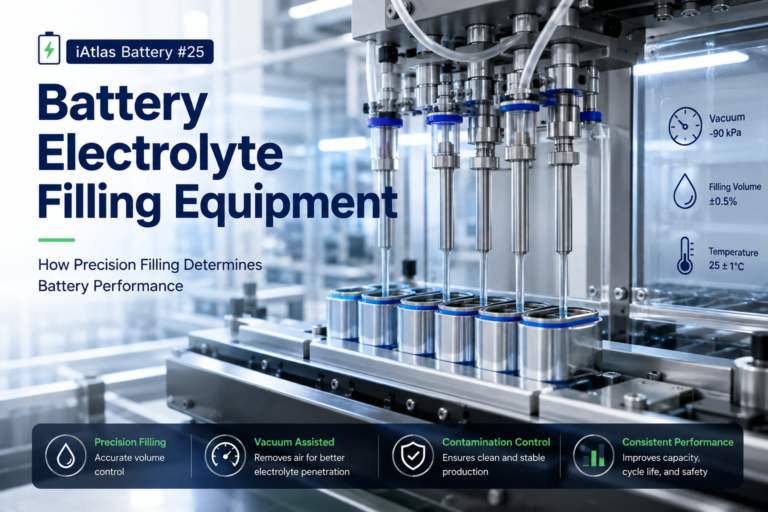
After winding, the jelly roll moves to electrolyte filling and subsequent sealing processes.
9. Key Takeaways
- Battery winding equipment produces jelly rolls for cylindrical and many prismatic lithium-ion batteries.
- Precise alignment and tension control are essential for battery quality.
- Modern winding machines combine servo control, machine vision, and automated inspection.
- Common defects include loose winding, over-tight winding, separator wrinkles, and diameter variation.
- Future equipment will emphasize AI, automation, and support for next-generation cylindrical batteries such as the 4680.
📚 Key Terms
Battery Winding Equipment
Automated equipment that winds cathodes, separators, and anodes into a compact jelly roll for cylindrical and some prismatic lithium-ion batteries.
Jelly Roll
The spiral-wound electrode assembly inside cylindrical and many prismatic battery cells. It consists of alternating layers of cathode, separator, and anode.
Winding Mandrel
A precision shaft around which the electrode assembly is wound to form the jelly roll.
Winding Tension
The controlled force applied during winding to ensure consistent layer spacing, alignment, and mechanical stability.
Separator Tension
The tension applied specifically to the separator during winding. Proper control prevents wrinkles, stretching, and tearing.
Electrode Alignment
The positional accuracy between the cathode, separator, and anode throughout the winding process. Accurate alignment improves battery capacity and safety.
4680 Cell
A large-format cylindrical lithium-ion battery cell (46 mm diameter × 80 mm height) widely used in next-generation electric vehicles. It requires highly precise winding technology due to its larger electrode dimensions.
🎓 Battery Learning Path
⚙️ Equipment
✅ iAtlas Battery #18 — Mixing Equipment
✅ iAtlas Battery #19 — Coating Equipment
✅ iAtlas Battery #20 — Drying Equipment
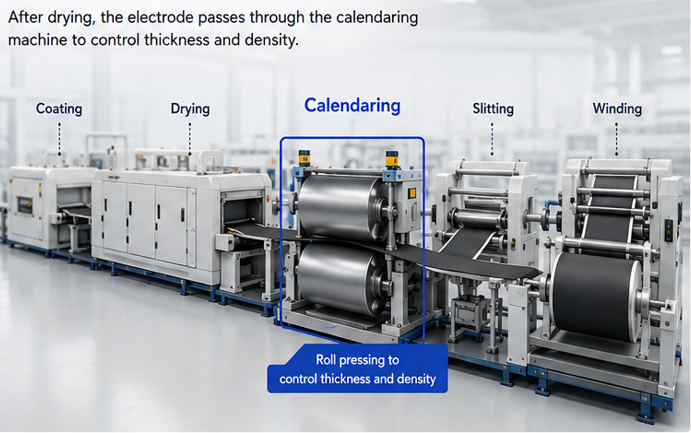
✅ iAtlas Battery #21 — Calendaring Equipment
✅ iAtlas Battery #22 — Slitting Equipment
✅ iAtlas Battery #23 — Stacking Equipment
📍 iAtlas Battery #24 — Winding Equipment (Current)
▶ iAtlas Battery #25 — Electrolyte Filling Equipment
▶ iAtlas Battery #26 — Formation Equipment
▶ iAtlas Battery #27 — Inspection Equipment
Welcome to the Equipment Learning Path, where you’ll explore the machines that transform battery materials into complete lithium-ion battery cells.
📖 Continue Reading
⬅ Previous Article
🔋 iAtlas Battery #23
Battery Stacking Equipment Explained: 7 Technologies Behind High-Precision Cell Assembly
Learn how stacking equipment precisely assembles cathodes, separators, and anodes into layered structures for pouch and prismatic battery cells.
➡ Next Article
🔋 iAtlas Battery #25
Battery Electrolyte Filling Equipment Explained: How Precision Filling Ensures Battery Performance
Discover how electrolyte filling equipment injects electrolyte into battery cells with high precision while minimizing contamination and improving manufacturing consistency.
📚 Related Articles
Expand your understanding of battery cell assembly and manufacturing:
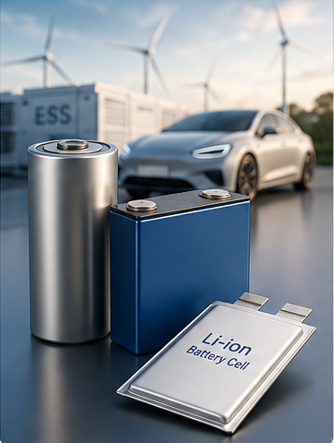
- 📘 Battery Cell
- 📘 Jelly Roll
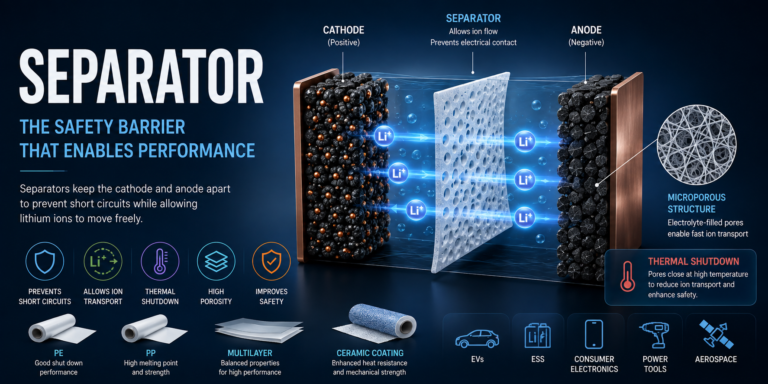
- 📘 Separator
- 📘 Cylindrical Cell
- 📘 Prismatic Cell
Additional Library articles will be linked as they are published.
📚 References
Industry & Research
- International Energy Agency (IEA) – Global EV Outlook
- U.S. Department of Energy – Vehicle Technologies Office
- Journal of Power Sources
- Nature Energy
Equipment Manufacturers
🔷 About iAtlas
iAtlas is an independent publication covering batteries, semiconductors, OLED, advanced materials, AI, and global industrial trends.
We transform complex industrial developments into clear, reliable, and easy-to-understand insights.
Whether you’re following today’s industry news or building long-term expertise, iAtlas helps you understand not only what happened, but why it matters.
Technology creates change.
Insight creates opportunity.
— iAtlas