Anode Materials Explained: Graphite, Silicon, and the Future of Lithium-ion Batteries
🔋 iAtlas Battery #5 | 🧪 Materials → ⚫ Anode
Anode Materials at a Glance
Anode materials are the negative electrode materials used in lithium-ion batteries. They store lithium ions during charging and release them during discharging, directly influencing battery capacity, charging speed, cycle life, and overall battery performance.
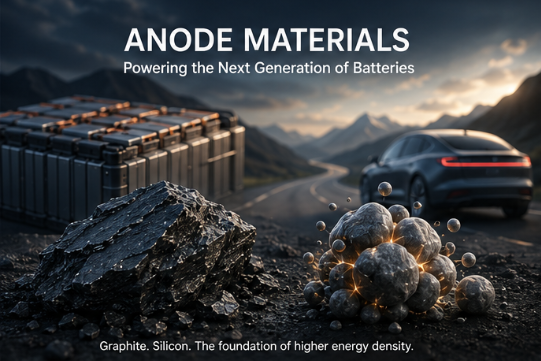
Table of Contents
- What Are Anode Materials?
- Graphite Anodes
- Silicon Anodes
- Graphite vs. Silicon
- Composite Anodes
- Future Trends
- Key Figures
- Frequently Asked Questions
Introduction
Anode materials play a critical role in determining the performance of lithium-ion batteries. While cathode materials often receive greater attention, the anode is responsible for storing lithium ions during charging and releasing them during discharge.
Today, graphite remains the dominant commercial anode material because of its excellent stability and long cycle life. However, silicon-based anodes are rapidly emerging as one of the industry’s most promising technologies due to their significantly higher theoretical capacity.
Understanding anode materials is essential for anyone interested in electric vehicles, battery manufacturing, and next-generation energy storage technologies.
What Are Anode Materials?
The anode is the negative electrode of a lithium-ion battery.
During charging:
- Lithium ions move from the cathode to the anode.
- Electrons travel through the external circuit.
- Energy is stored inside the battery.
During discharging:
- Lithium ions return to the cathode.
- Electrical energy powers external devices.
The efficiency of this process depends heavily on the properties of the anode material.
Graphite: The Industry Standard
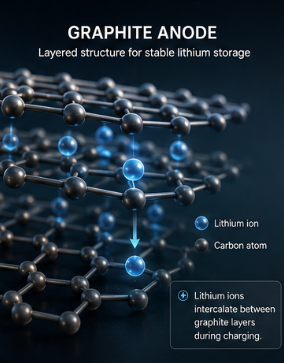
Graphite has served as the commercial standard for lithium-ion battery anodes for more than thirty years.
Its layered crystal structure allows lithium ions to be repeatedly inserted and extracted without causing significant structural damage.
Advantages
- Excellent cycle life
- Mature manufacturing technology
- Low production cost
- High reliability
- Stable charging characteristics
Limitations
- Limited theoretical capacity
- Energy density approaching its practical limit
Despite these limitations, graphite remains the preferred anode material for most commercial EV batteries.
Silicon: The Next Generation of Anode Materials
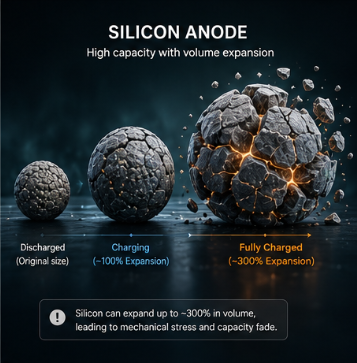
Silicon has attracted enormous interest because its theoretical lithium storage capacity is approximately ten times greater than graphite.
This higher capacity offers the potential for significantly longer driving ranges and increased battery energy density.
Advantages
- Extremely high capacity
- Higher energy density
- Potential for faster charging
- Longer driving range
Challenges
- Volume expansion during charging
- Mechanical cracking
- Capacity fading
- More complex manufacturing
To address these challenges, many battery manufacturers use graphite-silicon composite anodes rather than pure silicon.
Graphite vs. Silicon
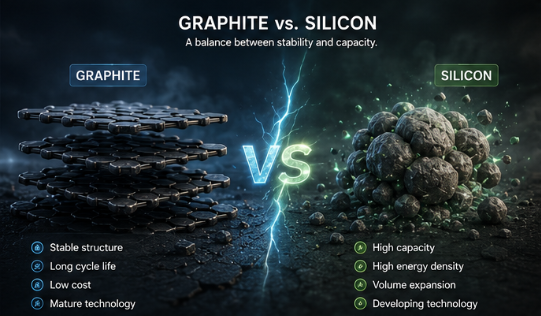
| Property | Graphite | Silicon |
|---|---|---|
| Theoretical Capacity | 372 mAh/g | ~3,500 mAh/g |
| Energy Density | Moderate | Very High |
| Cycle Life | Excellent | Improving |
| Stability | Excellent | Moderate |
| Commercialization | Mature | Growing |
| Manufacturing Cost | Low | Higher |
Graphite continues to dominate today’s market, while silicon represents the future direction of battery development.
Composite Anodes
Instead of replacing graphite entirely, many manufacturers combine graphite and silicon into composite anodes.
This approach delivers:
- Higher energy density
- Better stability
- Improved cycle life
- Practical manufacturability
Many premium EV batteries already incorporate silicon into their graphite anodes.
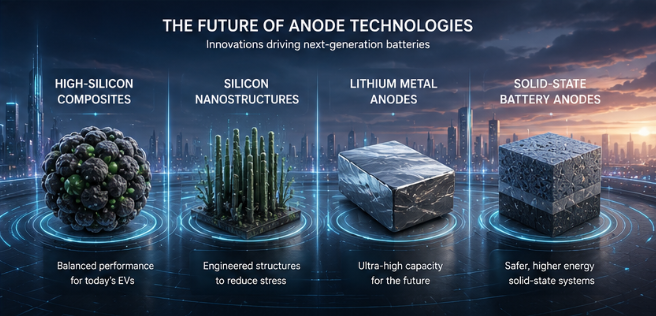
Future Trends
Researchers are actively developing several advanced anode technologies.
These include:
- High-silicon composite anodes
- Silicon nanowires
- Lithium metal anodes
- Solid-state battery anodes
These innovations aim to increase energy density while improving charging speed and battery lifespan.
Key Figures
| Metric | Graphite | Silicon |
|---|---|---|
| Capacity | 372 mAh/g | ~3,500 mAh/g |
| Volume Expansion | Minimal | Up to ~300% |
| Cycle Life | Excellent | Improving |
| Commercialization | High | Medium |
| Main Application | Most Commercial Batteries | Next-generation EV Batteries |
Frequently Asked Questions
Why is graphite still widely used?
Graphite offers an excellent balance of cost, stability, manufacturability, and long cycle life, making it the most commercially successful anode material today.
Why is silicon considered the future?
Silicon can store far more lithium ions than graphite, allowing batteries to achieve much higher energy density.
Will silicon completely replace graphite?
Probably not in the near future. Most manufacturers are expected to use graphite-silicon composite anodes because they provide a practical balance between performance and durability.
Which anode material is best for electric vehicles?
There is no universal answer. Graphite remains the commercial standard, while silicon-rich anodes are becoming increasingly attractive for premium EV applications.
Key Takeaways
- Anode materials store lithium ions during charging.
- Graphite remains the industry’s dominant commercial material.
- Silicon offers significantly higher theoretical capacity.
- Composite anodes combine the advantages of graphite and silicon.
- Future battery technologies will increasingly adopt silicon-rich anodes.
🎓 Battery Learning Path
🧪 Materials
✅🔋 iAtlas Battery #4 — Cathode
📍🔋 iAtlas Battery #5 — Anode (Current)
▶ 🔋 iAtlas Battery #6 — Electrolyte
▶ 🔋 iAtlas Battery #7 — Separator
Next Learning Path: 🔋 Cell Design
📖 Continue Reading
⬅ Previous Article
🔋 iAtlas Battery #4
Cathode Materials Explained: Types, Chemistry, and Applications
Explore how cathode materials determine battery energy density and operating voltage.
➡ Next Article
🔋 iAtlas Battery #6
Battery Electrolyte Explained: The Medium That Powers Lithium-ion Batteries
Discover how electrolytes transport lithium ions and why moisture control is critical for battery performance.
References
- International Energy Agency (IEA)
- U.S. Department of Energy – Vehicle Technologies Office
- Battery University
- Nature Energy (Battery Manufacturing Research)
About iAtlas
iAtlas is an independent publication covering batteries, semiconductors, OLED, advanced materials, AI, and global industrial trends.
We transform complex industrial developments into clear, reliable, and easy-to-understand insights.
Whether you’re following today’s industry news or building long-term expertise, iAtlas helps you understand not only what happened, but why it matters.
Technology creates change.
Insight creates opportunity.
— iAtlas