Could Small Nuclear Reactors Power the Next Generation of AI?
Why Google, Amazon, and Nuclear Technology Companies Are Betting on Small Modular Reactors—and What Must Happen Before They Can Power Data Centers
iAtlas Daily #82 | Nuclear Energy & AI Infrastructure | October 21, 2026
The Big Story: AI’s Growing Electricity Problem
Artificial intelligence is changing more than the semiconductor industry.
It is changing the way technology companies think about electricity.
Training and operating advanced AI systems requires enormous computing infrastructure. That infrastructure needs power—not only during peak demand, but continuously.
For companies building large data centers, access to reliable electricity is becoming a strategic concern.
This is one reason Small Modular Reactors (SMRs) are attracting attention.
Unlike conventional large nuclear power plants, SMRs are designed around smaller reactor units, with the potential for more standardized manufacturing and phased deployment.
Technology companies are exploring whether these reactors could provide reliable, low-carbon electricity for future AI infrastructure.
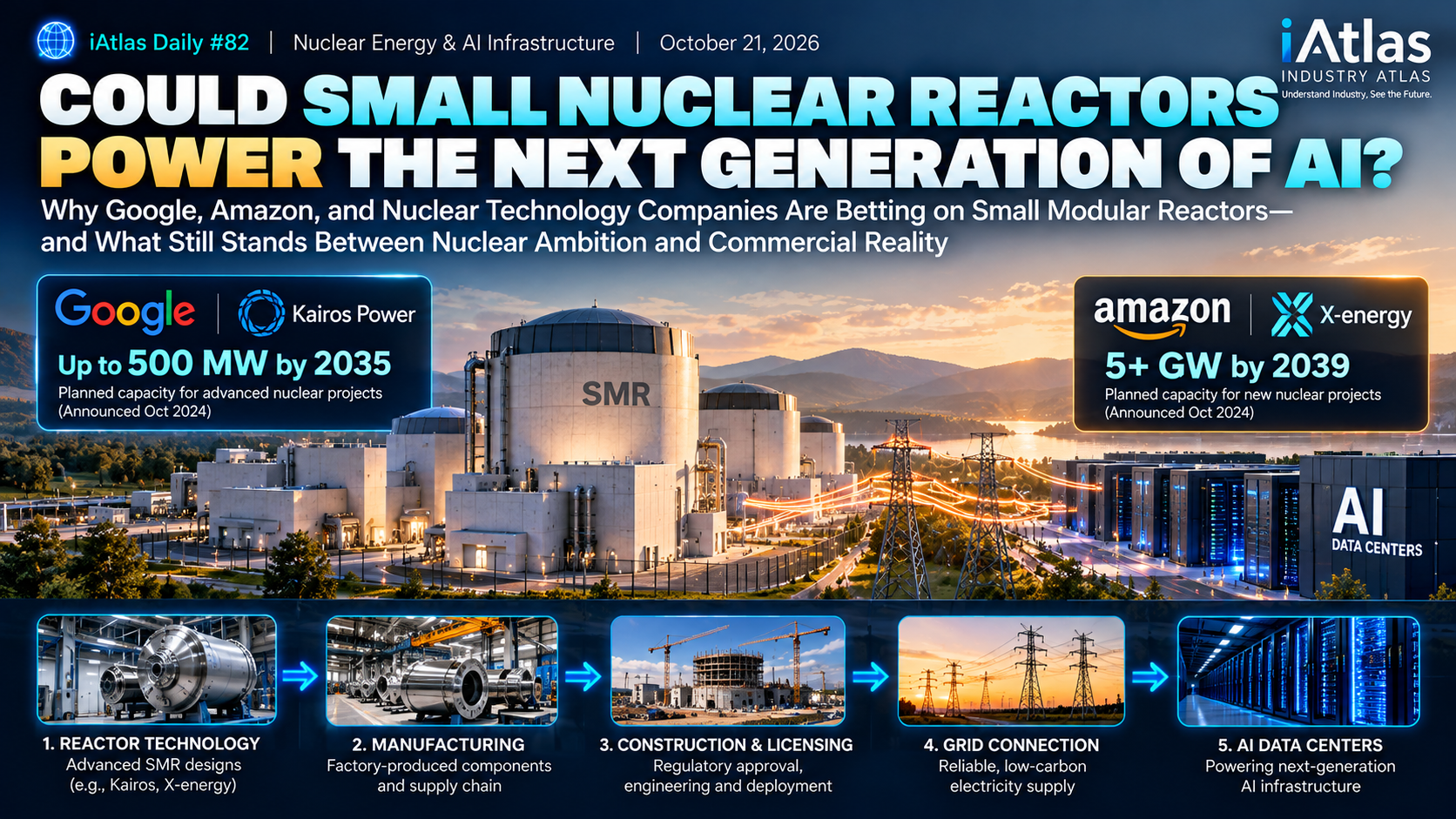
Google has partnered with Kairos Power on a plan for up to 500 megawatts of advanced nuclear capacity by 2035.
Amazon is supporting X-energy’s efforts to develop more than five gigawatts of new nuclear capacity in the United States by 2039.
These projects are ambitious.
But they are not yet evidence that commercial SMR fleets are already powering AI data centers.
The first deployments still face engineering, licensing, construction, financing, and fuel-supply challenges.
The important question is no longer simply whether AI needs more electricity. It is whether next-generation nuclear technology can deliver that electricity at the right cost and on the right schedule.
1. What Are Small Modular Reactors?
Small Modular Reactors are nuclear reactors designed to generate electricity at a smaller scale than most conventional large nuclear power plants.
The International Atomic Energy Agency generally describes SMRs as reactors with electrical output of up to 300 megawatts per unit.
The word small refers to their power output.
The word modular refers to the possibility of manufacturing components or systems in factories and assembling them at project sites.
In principle, modular construction could reduce some of the complexity associated with large, one-off nuclear construction projects.
It may also allow operators to add generating capacity in stages.
For example, instead of building one very large reactor, a developer might construct several smaller reactor units at the same site.
This approach could offer greater flexibility in matching generation capacity to electricity demand.
However, modular construction does not automatically guarantee lower costs.
SMRs still require extensive safety engineering, specialized components, regulatory approvals, and long-term operational support.
Their commercial competitiveness will depend on actual construction and operating performance.
2. Why AI Data Centers Are Interested in Nuclear Power
Data centers have different electricity requirements from many other industrial facilities.
A large AI data center may operate around the clock.
Its computing equipment, networking systems, cooling infrastructure, and electrical distribution systems all require reliable power.
Electricity interruptions can disrupt operations and create substantial economic consequences.
As a result, technology companies are looking beyond electricity prices alone.
They are also considering availability, reliability, emissions, and long-term supply security.
Nuclear power has several characteristics that make it relevant to this discussion.
Continuous Generation
Nuclear plants can provide electricity around the clock, subject to planned maintenance and unplanned outages.
Low Operational Carbon Emissions
Nuclear generation produces very low direct carbon emissions during operation.
Long Operating Life
Nuclear facilities are designed for decades of operation, making them potentially suitable for long-term electricity supply arrangements.
Potential Capacity Expansion
New reactor projects could add generation capacity in regions facing rising demand.
These characteristics make nuclear energy attractive to some large technology companies.
However, SMRs must compete with other electricity solutions, including renewable energy, energy storage, gas-fired generation, existing nuclear plants, and grid expansion.
The most suitable option will vary by location, cost, timing, and regulatory conditions.
3. Google and Kairos Power: A 500 MW Nuclear Roadmap
In October 2024, Google announced an agreement with Kairos Power to support the development of multiple advanced nuclear reactor projects.
The agreement targets up to 500 MW of new electricity generation capacity by 2035.
Google described the initiative as part of its strategy to secure reliable, carbon-free electricity for its growing infrastructure.
A more concrete step followed in August 2025.
Google, Kairos Power, and the Tennessee Valley Authority announced a collaboration involving the Hermes 2 project in Oak Ridge, Tennessee.
Under the arrangement, TVA will purchase electricity from the project, with Google obtaining associated clean-energy benefits for its regional data center operations.
Hermes 2 is planned to deliver up to 50 MW to the TVA grid.
Its targeted operational date is 2030.
This structure is important.
Google is not simply installing a private nuclear reactor inside a data center.
Instead, the arrangement involves a reactor developer, a regional utility, and a large electricity customer.
The project is intended to contribute electricity to the grid while supporting Google’s energy requirements.
It also provides a potential commercial pathway for advanced nuclear technology.
But the project still needs to complete the development and deployment process before it can deliver electricity.
The 50 MW project is a planned first deployment—not operating generation capacity today.
4. Amazon and X-energy: A Larger Deployment Ambition
Amazon is pursuing a different advanced nuclear strategy through its relationship with X-energy.
In October 2024, Amazon participated in a financing round of approximately $500 million for X-energy.
The companies also outlined plans to support the development of more than five gigawatts of new nuclear generating capacity in the United States by 2039.
One of the initial projects involves Energy Northwest in Washington state.
The first phase is designed around four Xe-100 reactor units with a combined capacity of 320 MW.
The project could potentially expand to 12 reactor units and 960 MW.
X-energy’s Xe-100 design uses high-temperature gas-cooled reactor technology.
Each reactor is designed to produce approximately 80 MW of electricity.
The company’s broader development plans include specialized fuel manufacturing and standardized reactor deployment.
The potential scale is substantial.
But the distinction between ambition and delivered capacity is essential.
The five-gigawatt figure represents a long-term development target, not completed generation.
The Energy Northwest project also remains subject to development milestones.
The commercial outcome will depend on whether the technology can be licensed, financed, constructed, and operated competitively.
5. South Korea’s Role in the Emerging SMR Supply Chain
The SMR opportunity is not limited to U.S. reactor developers.
In August 2025, X-energy, Amazon, Korea Hydro & Nuclear Power (KHNP), and Doosan Enerbility announced a strategic partnership to support advanced nuclear deployment.
The collaboration covers areas including project development, manufacturing, construction, operations, and supply-chain capabilities.
This is particularly relevant to South Korea.
Korean industrial companies have experience in nuclear plant construction, heavy manufacturing, power equipment, and large-scale project execution.
These capabilities could become valuable as advanced reactor developers move from engineering demonstrations toward commercial deployment.
Potential industrial opportunities include:
- Reactor components and specialized metal fabrication
- Heat exchangers and thermal-management equipment
- Valves, pumps, and electrical systems
- Construction and engineering services
- Quality assurance and nuclear-grade manufacturing
- Long-term maintenance and operational support
However, participation in a strategic partnership does not guarantee a specific volume of equipment orders.
Actual revenue opportunities will depend on project execution, procurement decisions, certification, and construction schedules.
For Korean manufacturers, the central question is whether advanced nuclear development can become a repeatable commercial supply chain.
6. Why Manufacturing Could Determine the Future of SMRs
One of the strongest arguments for SMRs is their potential to use standardized manufacturing.
Conventional nuclear projects often involve complex site-specific engineering and construction.
This can make schedules and costs difficult to control.
SMR developers aim to reduce some of that complexity through repeatable reactor designs and factory-produced components.
The concept is similar to other industrial sectors.
Semiconductor manufacturers improve productivity through process standardization.
Battery manufacturers rely on repeatable production systems.
Automotive companies reduce costs through platform sharing and high-volume component manufacturing.
SMR developers hope to apply comparable principles to nuclear technology.
But there is an important difference.
Nuclear equipment must meet exceptionally demanding safety, material, inspection, and regulatory requirements.
A factory-produced reactor component cannot be treated like an ordinary mass-market product.
Manufacturing quality and traceability are essential.
And because early SMR production volumes will be limited, developers may struggle to achieve the cost reductions associated with large-scale manufacturing.
The industrial challenge is therefore substantial.
SMRs must demonstrate that standardized manufacturing can improve construction performance without compromising nuclear safety.
7. The Five Challenges Standing Between SMRs and Commercial Scale
Despite growing interest, several barriers remain.
| Challenge | Why It Matters |
|---|---|
| Regulatory approval | Each reactor design and project must meet applicable nuclear safety requirements |
| First-of-a-kind construction | Initial projects may face higher costs and schedule uncertainty |
| Fuel availability | Some advanced reactors require specialized nuclear fuel supply chains |
| Manufacturing capacity | Nuclear-grade components need qualified suppliers and quality systems |
| Financing and electricity pricing | Projects must offer commercially acceptable risk and power costs |
Regulatory Approval
Advanced reactor designs must satisfy demanding regulatory requirements.
Licensing can influence both development schedules and project economics.
Construction Costs
Early projects may not benefit from the economies of repetition.
Cost reductions are possible, but they must be demonstrated through actual deployment.
Fuel Supply
Different SMR technologies use different fuel designs.
Some advanced reactors require high-assay low-enriched uranium (HALEU) or specialized fuel fabrication.
Fuel availability can therefore become a critical constraint.
Industrial Supply Chains
Developers need manufacturers capable of producing qualified components consistently.
Supply-chain expansion may require substantial investment before large commercial orders materialize.
Commercial Financing
Utilities and electricity customers need confidence in construction schedules, operating performance, and long-term electricity costs.
Large technology companies can help support early projects through investments and purchase agreements.
But that support does not eliminate the underlying technical and financial risks.
8. SMRs vs. Existing Nuclear Power: An Important Distinction
Not every nuclear agreement involving a technology company is an SMR project.
This distinction is particularly relevant after Google’s October 2026 agreement with Constellation Energy.
That agreement covers approximately 3.59 GW of contracted electricity, including plans to add 890 MW through upgrades to existing nuclear plants.
It is fundamentally different from developing new advanced reactor designs.
Existing nuclear facilities already have operating infrastructure and established technologies.
SMR projects are generally earlier in their commercialization process.
| Category | Existing Nuclear Agreements | New SMR Projects |
|---|---|---|
| Technology maturity | Established operating technology | Varies by design; many are pre-commercial |
| Main investment focus | Existing generation, upgrades, life extension | New reactor design and deployment |
| Delivery timeline | May include near-term contracted supply | Often dependent on future construction |
| Principal risks | Operating performance, upgrades, market conditions | Licensing, construction, fuel, first-of-a-kind costs |
| AI relevance | Access to established generation | Potential source of future additional capacity |
Both approaches could support AI infrastructure.
But they represent different levels of technology and execution risk.
For investors and industrial suppliers, treating them as interchangeable would be misleading.
9. Could SMRs Be Built Directly Next to Data Centers?
The idea of placing small reactors near large data centers is attracting interest.
In theory, local generation could reduce dependence on distant power supplies and create opportunities for dedicated infrastructure.
But the practical situation is more complicated.
Nuclear projects must satisfy site-specific safety and regulatory requirements.
They also require appropriate cooling arrangements, emergency planning, security, and long-term waste-management systems.
Electrical integration is another consideration.
Even when a reactor is located near a data center, grid connections may remain important for backup, balancing, and system reliability.
A reactor cannot simply be installed beside a server building like a conventional industrial generator.
Some projects may use electricity supplied through regional grids.
Others may explore closer integration with industrial facilities.
The most practical configuration will depend on local conditions and regulatory requirements.
10. The Bigger Opportunity: A New Industrial Supply Chain
The growth of SMR development could create opportunities beyond reactor manufacturers.
Advanced nuclear projects require extensive supporting infrastructure.
This includes precision manufacturing, industrial materials, specialized equipment, electrical systems, construction services, and engineering capabilities.
The potential value chain can be summarized as:
Nuclear Fuel & Materials → Reactor Components → Plant Construction → Grid Connection → Electricity Supply → AI Data Centers
Companies participating in these activities may benefit if advanced nuclear deployment expands.
However, investment opportunities will not develop uniformly.
Some technologies may achieve commercial deployment earlier than others.
Certain reactor designs may face licensing or fuel-supply difficulties.
Others may struggle to deliver electricity at competitive prices.
The commercial winners will depend on engineering execution and economics—not simply the number of announced partnerships.
Industry Impact
AI & Data Infrastructure: SMRs could become one option for securing additional long-term electricity supply.
Nuclear Technology: Large technology companies are helping create potential demand for advanced reactor development.
Industrial Manufacturing: Repeatable reactor construction could increase demand for specialized components and qualified suppliers.
South Korean Industry: KHNP, Doosan Enerbility, and related suppliers may find opportunities in international advanced nuclear projects.
Energy Infrastructure: Grid connections, substations, and electrical equipment remain important even when new generation is added.
Capital Markets: Investors will need to distinguish long-term capacity targets from projects that have achieved financing, licensing, and construction milestones.
What to Watch Next
Kairos Power Hermes 2
Can the project meet the development milestones required for its targeted 2030 operation?
X-energy’s First Deployments
Will initial Xe-100 projects advance through licensing, financing, and construction?
Nuclear Fuel Supply
Can specialized fuel manufacturing expand quickly enough to support planned reactor deployments?
Korean Supply-Chain Participation
Will strategic partnerships translate into equipment orders, manufacturing investment, and long-term service contracts?
Commercial Electricity Costs
Can SMRs demonstrate competitive lifetime electricity costs after accounting for construction, financing, fuel, and operations?
AI Data Center Demand
Will future electricity demand materialize at the locations and times assumed in current infrastructure plans?
iAtlas Insight
The growing interest in Small Modular Reactors reflects an important shift in the AI industry.
For years, competition focused primarily on computing performance.
Faster processors, larger AI models, and more advanced data centers attracted the most attention.
Now electricity is becoming part of that competition.
A powerful AI system cannot operate without reliable energy infrastructure.
Technology companies are therefore becoming increasingly involved in long-term electricity development.
SMRs offer an intriguing possibility.
They could provide additional low-carbon electricity through smaller, potentially standardized nuclear plants.
But their commercial success remains uncertain.
Developers must prove that advanced reactor designs can be licensed, manufactured, constructed, and operated at acceptable costs.
This creates a broader industrial opportunity.
The future of SMRs may depend as much on materials, equipment, manufacturing, and project execution as on reactor technology itself.
For technology companies, the objective is reliable electricity.
For reactor developers, the objective is commercial deployment.
For industrial suppliers, the opportunity is to become part of a new generation of nuclear infrastructure.
AI may help create demand for Small Modular Reactors. But manufacturing performance, project economics, and regulatory execution will determine whether that demand becomes a scalable industry.
Related Articles
AI Data Center Infrastructure: The Next Industrial Investment Cycle
Explore how AI demand is transforming semiconductor production, electricity supply, and industrial infrastructure.
TSMC Expands Advanced Packaging Capacity as AI Demand Grows
Discover why AI computing growth requires investment across a broader semiconductor manufacturing ecosystem.
References
1. Google — October 14, 2024
New Nuclear Clean Energy Agreement with Kairos Power.
Read the official Google announcement
2. Google — August 18, 2025
Our First Advanced Nuclear Reactor Project with Kairos Power and Tennessee Valley Authority.
Read the official Google announcement
3. X-energy — October 16, 2024
Amazon Invests in X-energy to Support Advanced Small Modular Nuclear Reactors and Expand Carbon-Free Power.
Read the X-energy announcement
4. X-energy — August 25, 2025
X-energy, Amazon, Korea Hydro & Nuclear Power, and Doosan Enerbility Announce Partnership to Scale Advanced Nuclear Energy for AI Infrastructure.
Read the partnership announcement
5. Kairos Power — August 18, 2025
Google, Kairos Power, and TVA Collaborate to Meet America’s Growing Energy Needs.
Read the official Kairos Power announcement
ℹ️ About iAtlas
iAtlas is an independent publication covering batteries, semiconductors, OLED, advanced materials, AI, and global industrial trends.
We transform complex industrial developments into clear, reliable, and easy-to-understand insights.
Whether you’re following today’s industry news or building long-term expertise, iAtlas helps you understand not only what happened, but why it matters.
Technology creates change.
Insight creates opportunity.
— iAtlas