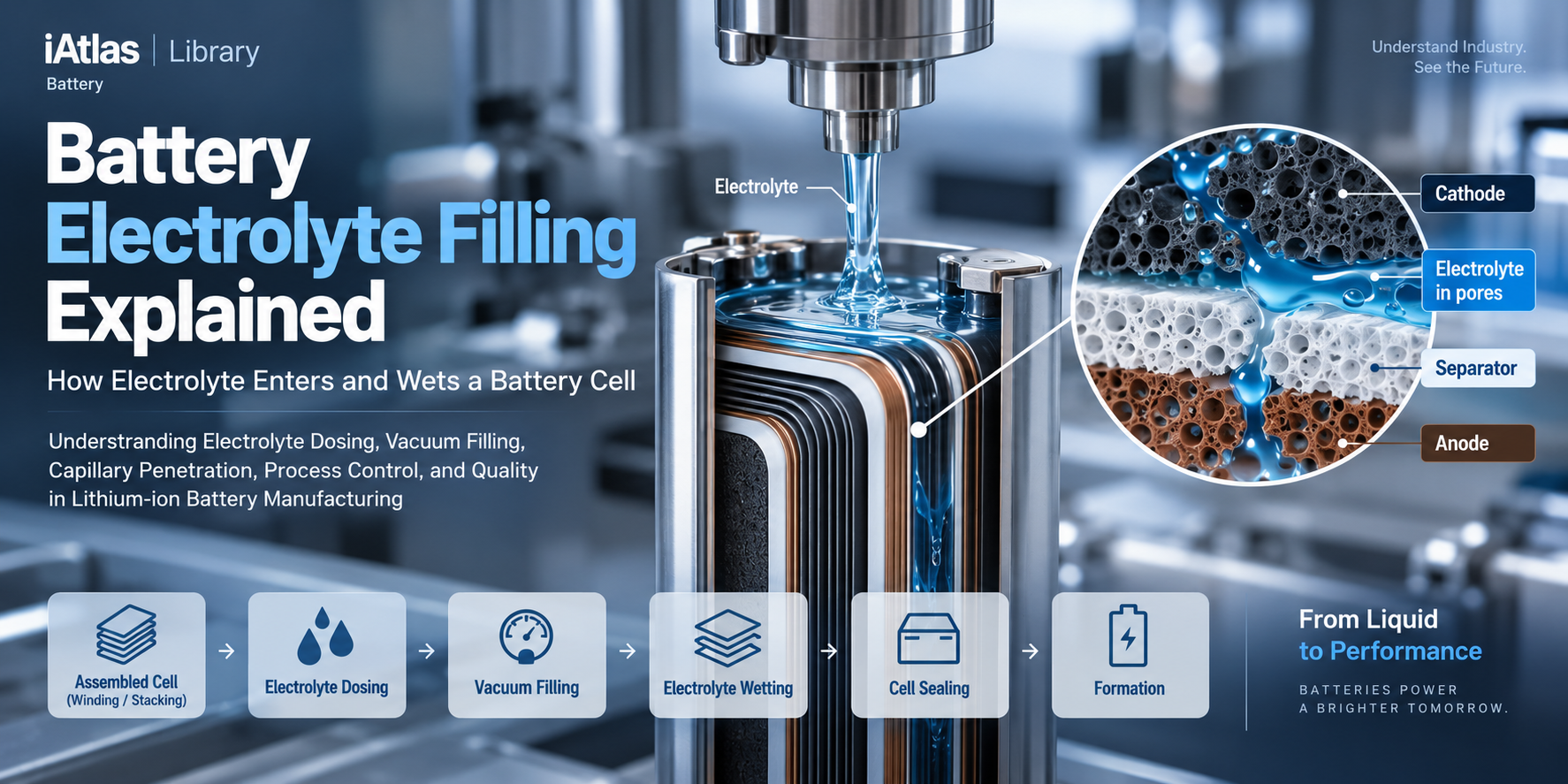
Battery Electrolyte Filling Explained: How Electrolyte Enters and Wets a Battery Cell
Understanding Electrolyte Dosing, Vacuum Filling, Capillary Wetting, Trapped Gas, Process Control, and Quality in Lithium-ion Battery Manufacturing
Category: Battery Technology
Content Type: Manufacturing
Learning Path: Battery Manufacturing
Related Industries: Electric Vehicles · Energy Storage Systems · Consumer Electronics
Last Updated: September 2026
Industry Snapshot
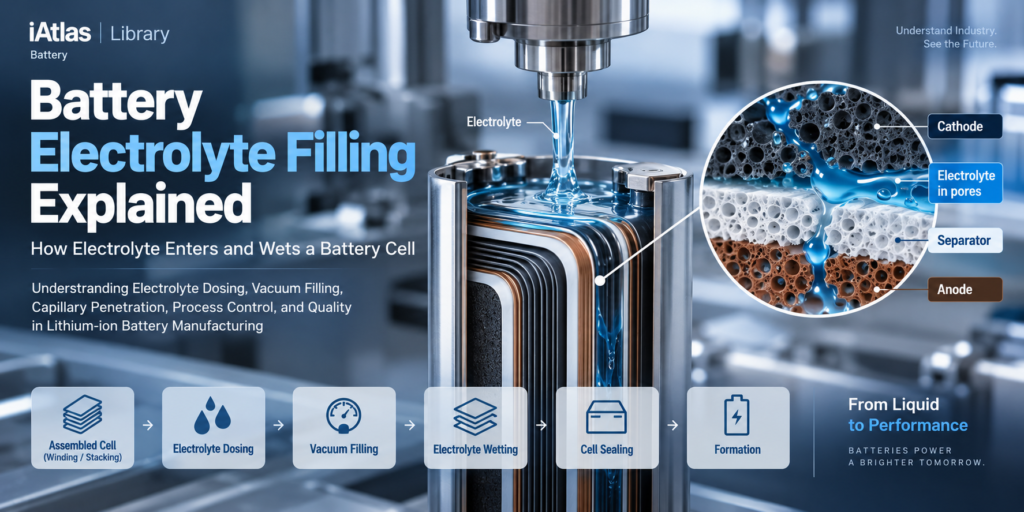
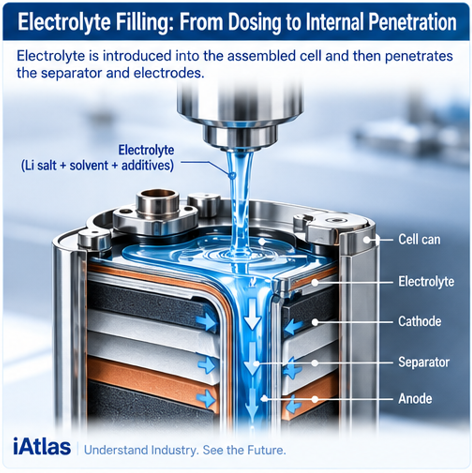
Battery electrolyte filling is the manufacturing process in which liquid electrolyte is introduced into an assembled lithium-ion battery cell and allowed to penetrate the porous electrodes and separator.
After cathode, anode, and separator materials have been wound or stacked, they form the internal electrode assembly.
However, the cell cannot yet operate electrochemically.
The pores inside the:
- Cathode
- Anode
- Separator
must become sufficiently filled with electrolyte so that lithium ions can move through the cell during charging and discharging.
A simplified sequence is:
Winding / Stacking
↓
Cell Packaging
↓
Electrolyte Dosing
↓
Vacuum-Assisted Filling
↓
Electrolyte Wetting
↓
Cell Sealing
↓
Formation
Electrolyte filling is therefore not simply a liquid-dispensing operation.
It is a quality-critical manufacturing process that determines how effectively electrolyte reaches the internal porous structure of the cell. Research literature describes electrolyte filling and wetting as both quality-critical and relatively time-intensive within cell production.
At a Glance
| Category | Description |
|---|---|
| Process | Electrolyte Filling |
| Stage | Battery Cell Assembly |
| Input | Assembled Cell + Electrolyte |
| Main Function | Introduce electrolyte and wet porous cell components |
| Main Sub-processes | Filling / Dispensing · Wetting |
| Key Mechanisms | Vacuum · Pressure · Capillary Forces |
| Key Controls | Fill Amount · Vacuum · Pressure · Time · Temperature |
| Major Risks | Poor Wetting · Trapped Gas · Moisture · Incorrect Dosing |
| Previous Process | Winding / Stacking |
| Next Process | Cell Sealing / Formation Preparation |
What Is Battery Electrolyte Filling?
Battery electrolyte filling introduces the required quantity of liquid electrolyte into an assembled battery cell.
The electrolyte generally contains:
Lithium Salt
Organic Solvents
Functional Additives
Once introduced into the cell, the liquid must spread through the internal electrode structure.
The overall objective can be represented as:
Electrolyte Dosing
↓
Cell Internal Volume
↓
Separator Wetting
↓
Electrode Pore Wetting
↓
Uniform Electrolyte Distribution
The process is complete only when the required electrolyte has been introduced and the relevant porous cell components have been sufficiently wetted.
This distinction leads to one of the most important concepts in this article:
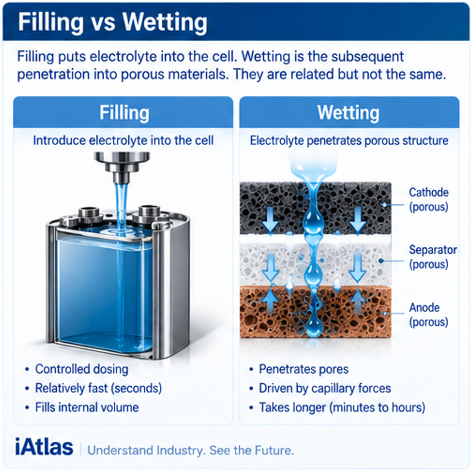
Filling and wetting are related, but they are not the same process.
The literature commonly divides electrolyte filling into these two subprocesses.
Where Electrolyte Filling Fits in Battery Manufacturing
Electrolyte filling occurs after the internal electrode structure has been assembled.
Electrode Manufacturing
Material Mixing
→ Battery Slurry
→ Electrode Coating
→ Electrode Drying
→ Calendering
→ Slitting
Cell Assembly
Notching
→ Winding / Stacking
→ Cell Packaging
→ Electrolyte Filling
→ Cell Sealing
Cell Finishing
Formation
→ Aging
→ Degassing
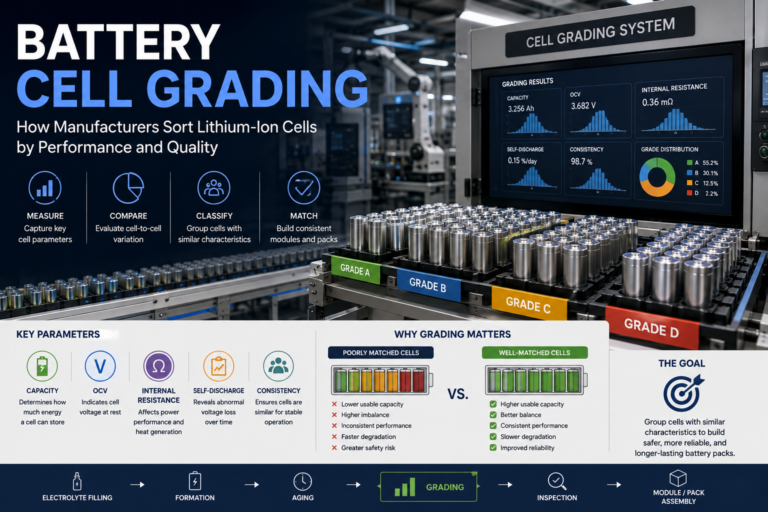
→ Testing & Grading
This means electrolyte filling is one of the final opportunities to influence the internal physical condition of the cell before it becomes increasingly closed to external intervention.
Filling vs Wetting
This distinction is essential.
Filling
Filling refers to introducing a controlled amount of electrolyte into the cell.
Conceptually:
Electrolyte Reservoir
↓
Dosing System
↓
Cell Internal Volume
This can occur relatively quickly.
Wetting
Wetting refers to the subsequent penetration and distribution of electrolyte through the porous internal materials.
Conceptually:
Electrolyte
↓
Separator Pores
Cathode Pores
Anode Pores
↓
Internal Electrolyte Distribution
This can take considerably longer.
Experimental work on hard-case prismatic cells has shown that liquid filling itself can occur in seconds while subsequent absorption into the electrode stack can require hours.
Therefore:
A cell can be filled without being fully wetted.
Why Electrolyte Wetting Matters
Lithium ions must move between the cathode and anode during battery operation.
The transport pathway involves the electrolyte inside the porous structure.
Conceptually:
Cathode Active Material
↕
Electrolyte-Filled Pores
↕
Separator
↕
Electrolyte-Filled Pores
↕
Anode Active Material
If some regions remain poorly wetted, ionic transport and local electrochemical conditions can become non-uniform.
Insufficient wetting has been associated with quality and safety concerns during later cell operation and formation.
What Happens Inside the Cell?
Electrodes are not solid blocks.
After coating, drying, and calendering, they retain a network of microscopic pores.
The separator is also porous.
Therefore, electrolyte must penetrate a complex structure containing:
Macroscopic Internal Space
↓
Electrode Stack / Jelly Roll Gaps
↓
Separator Pores
↓
Electrode Pore Network
The challenge becomes greater as cells become:
- Larger
- Thicker
- More densely packed
- Higher in energy density
This is one reason electrolyte filling remains an important manufacturing research area for next-generation high-energy cells.
Capillary Wetting
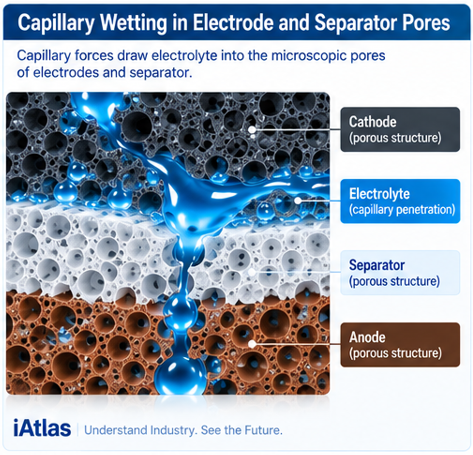
One mechanism driving electrolyte penetration is capillary action.
When liquid electrolyte contacts small pores within an electrode or separator, interactions among:
- Surface tension
- Pore geometry
- Liquid properties
- Material surface properties
can draw the electrolyte into the pore structure.
Conceptually:
Electrolyte
↓
│ pore │
↓
Capillary Penetration
As wetting progresses, electrolyte displaces gas originally occupying portions of the pore network.
Why Vacuum Is Used
One major obstacle to wetting is gas already present inside the cell and porous structure.
If gas remains trapped:
Trapped Gas
↓
Electrolyte Cannot Occupy the Same Volume Easily
↓
Local Wetting Becomes More Difficult
Vacuum-assisted processes can reduce the amount of gas and create more favorable conditions for electrolyte penetration.
A simplified sequence is:
Cell
↓
Vacuum
↓
Internal Gas Removal / Pressure Reduction
↓
Electrolyte Introduction
↓
Pressure Adjustment
↓
Enhanced Penetration
Experimental neutron-imaging work on hard-case prismatic cells found that vacuum assistance accelerated wetting substantially and increased electrolyte uptake under the tested conditions.
Vacuum-Assisted Electrolyte Filling
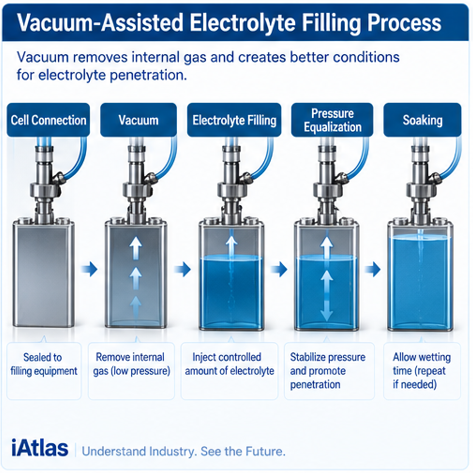
Industrial filling processes can use combinations of vacuum and pressure rather than relying on gravity alone.
A simplified process may be:
Cell Connection
↓
Vacuum
↓
Electrolyte Dosing
↓
Pressure Equalization / Pressure Control
↓
Soaking
↓
Additional Filling Cycle if Required
The exact process sequence varies by:
- Cell format
- Cell dimensions
- Electrode structure
- Electrolyte
- Production equipment
Large-format cells can require multiple filling and soaking steps.
Trapped Gas
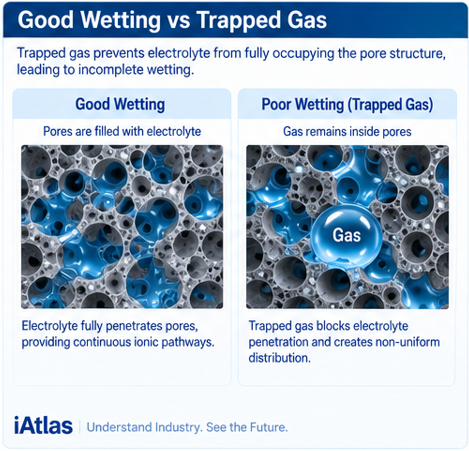
Even after electrolyte enters the cell, gas can remain within local regions of the porous structure.
Conceptually:
Good Wetting
Pore
[Electrolyte][Electrolyte][Electrolyte]
Incomplete Wetting
Pore
[Electrolyte][ GAS ][Electrolyte]
Gas pockets can interfere with uniform electrolyte distribution.
Research describes residual gas either remaining in locally confined regions or migrating toward pore-system boundaries and appearing as bubbles within the electrolyte.
Electrode Porosity and Wetting
Electrode porosity is one of the important links between earlier manufacturing steps and electrolyte filling.
Consider:
Higher Solid Density
↔
Lower Available Pore Volume
Electrode structure affects how easily electrolyte can penetrate the material.
This creates a direct process-chain relationship:
Electrode Manufacturing
↓
Pore Structure
↓
Electrolyte Wetting
↓
Cell Performance
Electrolyte filling therefore cannot be optimized completely independently from upstream electrode manufacturing.
How Calendering Affects Electrolyte Wetting
Calendering compresses the electrode to control:
- Thickness
- Density
- Porosity
- Mechanical properties
Increasing compression can improve volumetric energy density.
However, excessive reduction of porosity can make liquid transport through the electrode structure more difficult.
Conceptually:
Calendering Pressure ↑
↓
Electrode Density ↑
↓
Porosity ↓
↓
Electrolyte Penetration Can Become More Difficult
This illustrates a recurring battery-manufacturing trade-off:
A process optimized for energy density can create new challenges for downstream manufacturing.
The systematic literature on electrolyte wetting specifically identifies upstream electrode-production parameters, including calendering-related structure, as relevant to wetting behavior.
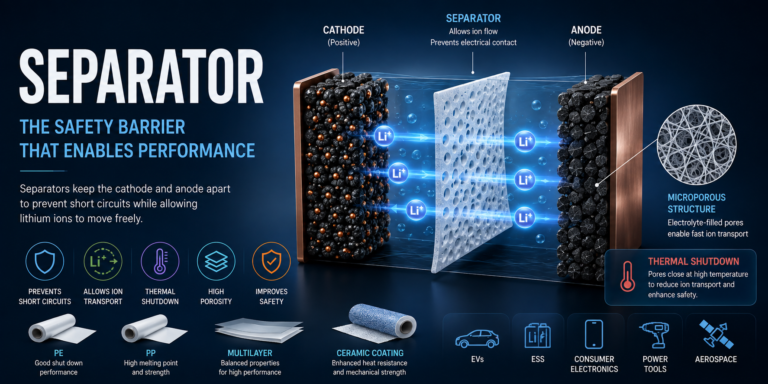
Separator Wetting
The separator must also become wetted by electrolyte.
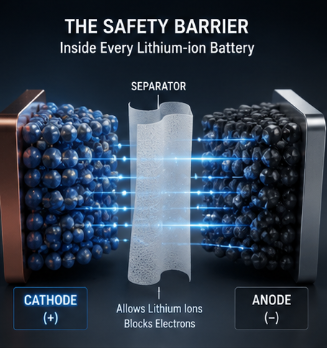
A separator is designed to:
Physically Separate Cathode and Anode
while allowing:
Lithium-Ion Transport
through electrolyte-filled pores.
Important factors can include:
- Separator material
- Porosity
- Pore size
- Surface properties
- Electrolyte compatibility
Poor separator wetting can interfere with the intended ionic pathway between the electrodes.
Electrolyte Viscosity
Electrolyte properties also influence filling behavior.
One important property is viscosity.
In simplified terms:
Lower Resistance to Flow
can facilitate liquid movement through small spaces.
However, electrolyte formulation cannot be optimized for filling speed alone.
It must simultaneously satisfy requirements related to:
- Ionic conductivity
- Electrochemical stability
- Temperature behavior
- Safety
- Interface formation
- Cell chemistry
Manufacturing performance and electrochemical performance therefore have to be considered together.
Temperature and Wetting
Temperature can influence electrolyte properties such as viscosity and therefore wetting behavior.
Changing temperature can affect:
- Flow characteristics
- Capillary penetration
- Wetting rate
- Process time
However, industrial filling temperatures must remain compatible with the electrolyte, materials, equipment, and safety requirements.
Temperature is therefore a controlled process variable rather than simply a way to make filling faster.
Electrolyte Dosing
The quantity of electrolyte introduced into the cell must be carefully controlled.
Too Little Electrolyte
can increase the risk of insufficient wetting or electrolyte starvation.
Excess Electrolyte
can add unnecessary mass and cost and may interfere with the intended cell design.
The target is therefore:
Sufficient Electrolyte
Controlled Quantity
Uniform Distribution
This makes dosing accuracy an important equipment and quality-control parameter.
Filling Time vs Wetting Time
A critical manufacturing distinction is:
Filling Time
≠
Wetting Time
Dispensing electrolyte into the available cell volume can be relatively fast.
But penetrating the full porous electrode structure can take significantly longer.
Therefore:
Fast Dosing
does not automatically mean
Fast Cell Processing
The wetting or soaking stage can become a production bottleneck.
A 2025 assessment of electrolyte-filling technologies specifically identifies the process as a bottleneck requiring substantial parallelization at gigafactory scale.
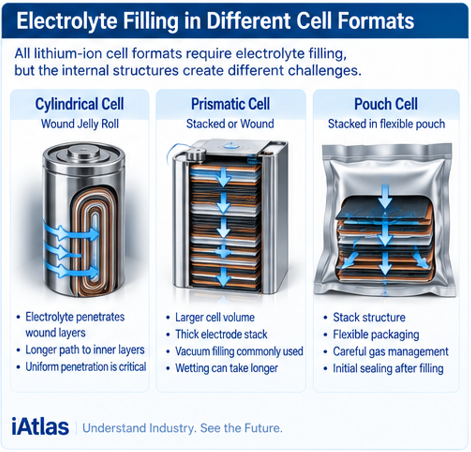
Cylindrical Cell Filling
In cylindrical cells, electrolyte must penetrate the wound jelly roll.
The pathway includes:
Outer Jelly Roll
↓
Separator / Electrode Interfaces
↓
Internal Wound Layers
↓
Electrode Pores
The tightly wound geometry can make uniform penetration throughout the internal structure a significant process consideration.
Prismatic Cell Filling
Large prismatic cells can contain thick or extensive electrode assemblies.
Electrolyte must travel through the internal stack or wound structure.
Research using neutron imaging on hard-case prismatic cells showed wetting progressing through the electrode stack from outer regions toward the interior.
As cell dimensions increase, the distance required for complete wetting can become increasingly important.
Pouch Cell Filling
Pouch cells use flexible multilayer packaging.
A simplified sequence is:
Electrode Stack
↓
Pouch Packaging
↓
Electrolyte Filling
↓
Wetting
↓
Initial Sealing
↓
Formation
↓
Degassing
↓
Final Sealing
Because pouch packaging is flexible, gas management and later degassing become particularly important parts of the manufacturing sequence.
Common Electrolyte Filling Defects
Several problems can arise during filling and wetting.
Underfilling
Insufficient electrolyte is introduced.
Overfilling
More electrolyte than required is introduced.
Incomplete Wetting
Some porous regions remain insufficiently penetrated.
Trapped Gas
Gas pockets interfere with electrolyte distribution.
Uneven Distribution
Electrolyte is not distributed uniformly through the cell.
Contamination
Foreign material enters during filling.
Moisture Exposure
Electrolyte or cell components are exposed to unwanted humidity.
Process Leakage
The filling interface or cell packaging does not maintain the required process condition.
Why Moisture Control Is Critical
Battery electrolytes and several cell materials are moisture-sensitive.
Common lithium-ion electrolytes using salts such as LiPF₆ require careful moisture control because unwanted water can promote undesirable chemical reactions.
Electrolyte filling is therefore typically performed under tightly controlled low-humidity conditions.
The process environment may require control of:
Humidity / Dew Point
Particles
Temperature
Contamination
The filling process is therefore closely connected to battery dry-room infrastructure.
Quality Control During Electrolyte Filling
Several process parameters can be monitored.
Electrolyte Mass
The cell can be weighed before and after filling.
Dosing Volume
Dispensing equipment controls the introduced amount.
Vacuum Level
The vacuum process can be monitored for consistency.
Pressure
Pressure profiles can be recorded during filling cycles.
Filling Time
Process duration can indicate abnormal behavior.
Cell Weight
Final weight provides another process-control indicator.
Leak Integrity
The cell and filling interface must maintain the required process conditions.
No single measurement necessarily proves complete internal wetting, which is one reason wetting measurement remains an active research field.
Measuring Electrolyte Wetting
Unlike external dimensions, internal wetting is difficult to observe directly.
Research methods include techniques such as:
- Neutron imaging
- X-ray-based methods
- Ultrasound
- Electrochemical measurements
- Mass-based methods
- Optical and material-level wetting measurements
Each technique has different advantages and limitations.
This creates an important manufacturing challenge:
The property manufacturers need to control occurs inside a largely closed battery cell.
From Electrolyte Filling to Cell Sealing
Once the required filling and wetting operations are complete, the cell progresses toward sealing.
The manufacturing sequence becomes:
Electrode Assembly
↓
Electrolyte Filling
↓
Wetting
↓
Cell Sealing
↓
Formation
The exact relationship between filling and sealing varies with cell format and manufacturing architecture.
The next iAtlas Library article will examine Battery Cell Sealing in detail.
From Wetting to Formation
Electrolyte distribution becomes especially important before the first controlled charging process.
During formation, electrochemical interfaces begin developing, including the solid electrolyte interphase on the anode.
Insufficient wetting before formation can create non-uniform electrochemical conditions.
Research on wetting quality therefore emphasizes completion of the wetting process before initial charging.
This creates another important process relationship:
Electrolyte Filling
↓
Wetting
↓
Formation
↓
Cell Performance
Emerging Electrolyte Filling Technologies
Electrolyte filling remains an active area of manufacturing development.
Optimized Vacuum-Pressure Cycles
Process sequences can be optimized to accelerate gas removal and liquid penetration.
Multi-Stage Filling
Electrolyte can be introduced in multiple controlled steps.
Faster Wetting Strategies
Researchers are investigating methods to reduce long soaking times.
Advanced Wetting Measurement
Non-destructive techniques can provide more information about internal electrolyte distribution.
Inline Process Monitoring
Vacuum, pressure, weight, dosing, and other process data can increasingly be integrated.
Alternative Wetting Technologies
Research is exploring approaches including electrocapillary effects and other methods intended to accelerate electrolyte penetration.
iAtlas Insight
Electrolyte filling illustrates a fundamental challenge in battery manufacturing:
Increasing energy density can make manufacturing more difficult.
Battery manufacturers want:
Thicker Electrodes
Higher Electrode Density
Larger Cells
because these approaches can contribute to higher energy density and reduced inactive-material fractions.
But those same changes can make electrolyte penetration more challenging. Research on high-energy electrodes specifically identifies thick and highly pressed electrode structures as creating additional wetting challenges.
The manufacturing relationship becomes:
Energy Density ↑
↓
Electrode Thickness / Density ↑
↓
Wetting Difficulty ↑
↓
Process Time & Control Requirements ↑
This means electrolyte filling can become increasingly important as battery technology advances.
The future challenge is therefore not simply:
“How quickly can electrolyte be injected?”
It is:
“How quickly can the entire internal electrode structure become uniformly and verifiably wetted?”
That distinction changes filling from a simple dosing operation into a critical process-engineering and quality-control problem.
Did You Know?
- Electrolyte filling consists of both filling/dispensing and wetting.
- Filling the open internal volume can be much faster than fully wetting the porous electrodes.
- Capillary forces help pull electrolyte into electrode and separator pores.
- Vacuum can accelerate electrolyte penetration by reducing trapped gas.
- Electrode porosity established during earlier manufacturing affects later wetting behavior.
- Large and highly compacted electrodes can be more challenging to wet.
- Internal electrolyte distribution is difficult to inspect directly.
- Wetting should be sufficiently completed before formation begins.
FAQ
What is battery electrolyte filling?
Battery electrolyte filling is the process of introducing liquid electrolyte into an assembled battery cell and enabling it to penetrate the porous electrodes and separator.
Are filling and wetting the same thing?
No. Filling introduces electrolyte into the cell, while wetting describes its penetration and distribution through porous cell materials.
Why is vacuum used during electrolyte filling?
Vacuum helps reduce internal gas and can facilitate electrolyte penetration into the electrode assembly.
Why does electrolyte wetting take time?
Electrolyte must travel through microscopic pores and complex internal electrode structures rather than simply filling an empty container.
How does calendering affect electrolyte filling?
Calendering changes electrode density and porosity, which can influence how easily electrolyte penetrates the electrode.
What happens if a battery is not fully wetted?
Insufficient wetting can create non-uniform electrochemical conditions and negatively affect subsequent formation, performance, and quality.
Which battery formats require electrolyte filling?
Cylindrical, prismatic, and pouch lithium-ion cells all require electrolyte introduction when using conventional liquid-electrolyte architectures.
What comes after electrolyte filling?
The downstream sequence depends on cell design, but cell sealing and formation are major subsequent manufacturing stages.
Battery Manufacturing Learning Path
Overview
Electrode Manufacturing
Cell Assembly
- Battery Cell Assembly
- Battery Electrode Notching
- Battery Electrode Winding
- Battery Electrode Stacking
- Electrolyte Filling (Current)
- Cell Sealing
Cell Finishing
- Formation
- Aging
- Degassing
- Battery Cell Testing & Grading
System Assembly
- Battery Module Assembly
- Battery Pack Assembly
Explore More
Cell Assembly
- Battery Cell Assembly
- Battery Electrode Notching
- Battery Electrode Winding
- Battery Electrode Stacking
- Electrolyte Filling (Current)
- Cell Sealing
Electrode Manufacturing
Battery Components
- Cathode
- Anode
- Separator
- Electrolyte
- Battery Cell
References
Kaden et al. — A Systematic Literature Analysis on Electrolyte Filling and Wetting in Lithium-Ion Battery Production
Batteries, 2023, 9(3), 164
The most useful overall reference for this article, covering filling, wetting, material/process parameters, measurement methods, and research gaps.
Full Article — Batteries / MDPI
DOI: 10.3390/batteries9030164
Weydanz et al. — Visualization of Electrolyte Filling Process and Influence of Vacuum During Filling for Hard Case Prismatic Lithium Ion Cells by Neutron Imaging to Optimize the Production Process
Journal of Power Sources, 2018, 380, 126–134
Experimental reference for vacuum-assisted filling, wetting progression, and neutron visualization in prismatic cells.
Article — Journal of Power Sources / ScienceDirect
DOI: 10.1016/j.jpowsour.2018.01.081
Grundmeier et al. — Simplified Electrochemical Approaches for Quality Determination of the Wetting Process in Lithium-Ion Cell Production
Energy Technology, 2023
Useful for understanding wetting-quality determination and the importance of sufficient wetting before formation.
Full Article — Wiley Online Library
DOI: 10.1002/ente.202201004
Comprehensive Assessment of Novel Technologies for Electrolyte Filling in Lithium-Ion Battery Production
Batteries, 2025, 11(2), 41
A more recent reference focused on production bottlenecks and emerging filling technologies.
Full Article — Batteries / MDPI
DOI: 10.3390/batteries11020041
Electrocapillary Boosting Electrode Wetting for High-Energy Lithium-Ion Batteries
Useful as an advanced reference for emerging methods aimed at accelerating electrode wetting in thick/high-density electrodes.
About iAtlas
iAtlas is an independent publication covering batteries, semiconductors, OLED, advanced materials, AI, and global industrial trends.
We transform complex industrial developments into clear, reliable, and easy-to-understand insights.
Whether you’re following today’s industry news or building long-term expertise, iAtlas helps you understand not only what happened, but why it matters.
Technology creates change.
Insight creates opportunity.
— iAtlas